

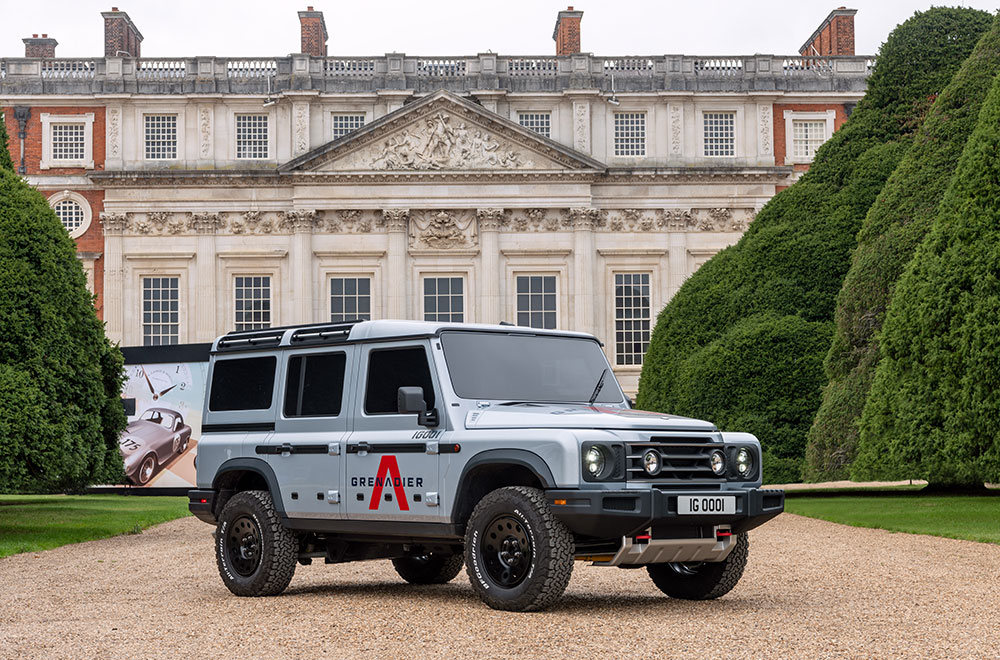

The first one is barely here and the second is already announced. INEOS Automotive is planning a small, purely electric off-roader. Is it meant to become what the Smart was for Mercedes? A means of meeting the CO2 fleet limit? Suzuki breached the limit and paused the extremely successful Jimny; Ineos is apparently taking a different path.
Today Ineos Automotive announced that it will develop and bring to market a purely electric, smaller e-off-roader on a second, smaller platform. They are probably wise to do so, otherwise the Grenadier could become a considerable burden for dealers when the fleet limit is reached and sales have to be stopped. Suzuki dealers know what I mean by that. They met this fate with the Jimny GJ, only they had other vehicles to carry on with.
The plan for the e-off-roader
One thing was clear: a manufacturer can’t survive on just one model, so further models have to follow. If the only model is based on 3-litre combustion engines, the other model should come along somewhat smaller. Or electric. Jim Ratcliffe therefore decided to give the Grenadier, which has just arrived, a small, fully electric brother. Endowed with the same attributes and built on a smaller platform, it is nonetheless meant to be fully off-road capable.
Only, the e-off-roader has to be sold and registered, otherwise the sums don’t add up. Large vehicle fleets with factory registrations and leasing may work for big volume manufacturers, but not with rather smaller numbers.
The fleet limit
In April 2019, regulation 2019/631 was adopted within the EU. It sets the so-called CO2 fleet limits in grams of CO2 per kilometre driven for cars and light commercial vehicles and applies from 1 January 2020. The limits set there apply from 2025 for cars and from 2030 for light commercial vehicles.
The fleet limit is nothing other than the permitted upper limit of the overall average CO2 emissions of all registered vehicles of a manufacturer within the EU. So it isn’t the individual car that has to meet the value, but the average of all a manufacturer’s vehicles. A large-capacity, powerful engine with high CO2 emissions can therefore be offset by a small, economical engine from the same maker. They just have to have been registered. Overall, this arrangement has applied in the EU since 2012.
But since the system wasn’t complicated enough, each manufacturer gets its own limit, depending on the average vehicle weight within the EU across all manufacturers. So if a manufacturer mainly produces vehicles above the average weight of all vehicles in the EU, it is also granted a higher fleet emission limit, and vice versa. This is meant to make the distribution of the burden fairer.
The values in detail
- 2015 – 2019: 130 g CO2/km under the old NEDC test procedure.
- 2020: 95 g CO2/km under the old NEDC test procedure for 95% of the fleet; the 5% of new cars with the highest emissions are not taken into account.
- 2021 – 2024: 95 g CO2/km for the whole fleet and a switch to the more realistic WLTP test procedure for a kerb weight of 1,392 kg.
Since the target values applying from 2021 were not yet precisely known at the time they were set, the new targets were formulated as percentage reductions compared with 2021:
- 2025-2029: CO2 reduction of 15%
- from 2030: CO2 reduction of 37.5%
The incentive to build an electric car now stems from the fact that vehicles below 50 g CO2/km receive so-called “super credits”. This means that ZLEVs (zero and low emission vehicles) are counted much more heavily in the statistics, thus considerably lowering the average CO2 emissions determined for a manufacturer. In 2020 a ZLEV counted with a factor of two, i.e. double. This year it still counts with a factor of 1.33. From next year, then 1. A maximum of 7.5 g CO2 can be credited as a saving. From 2025 the incentive, or pressure, depending on how you want to see it, to bring ZLEVs to market is increased further. Then it’s no longer the individual ZLEV that counts; instead, minimum quantities have to be reached for the saving to be credited. Initially 15%, and from 2030 30% of vehicles then have to be ZLEVs to be able to claim savings.
What happens if the limit isn’t met?
In that case the manufacturer has to pay a penalty of 95 euros per gram above the limit per registered vehicle. That can add up to a lot, and the value was set so that it becomes more expensive to ignore the limit than to invest in meeting it.