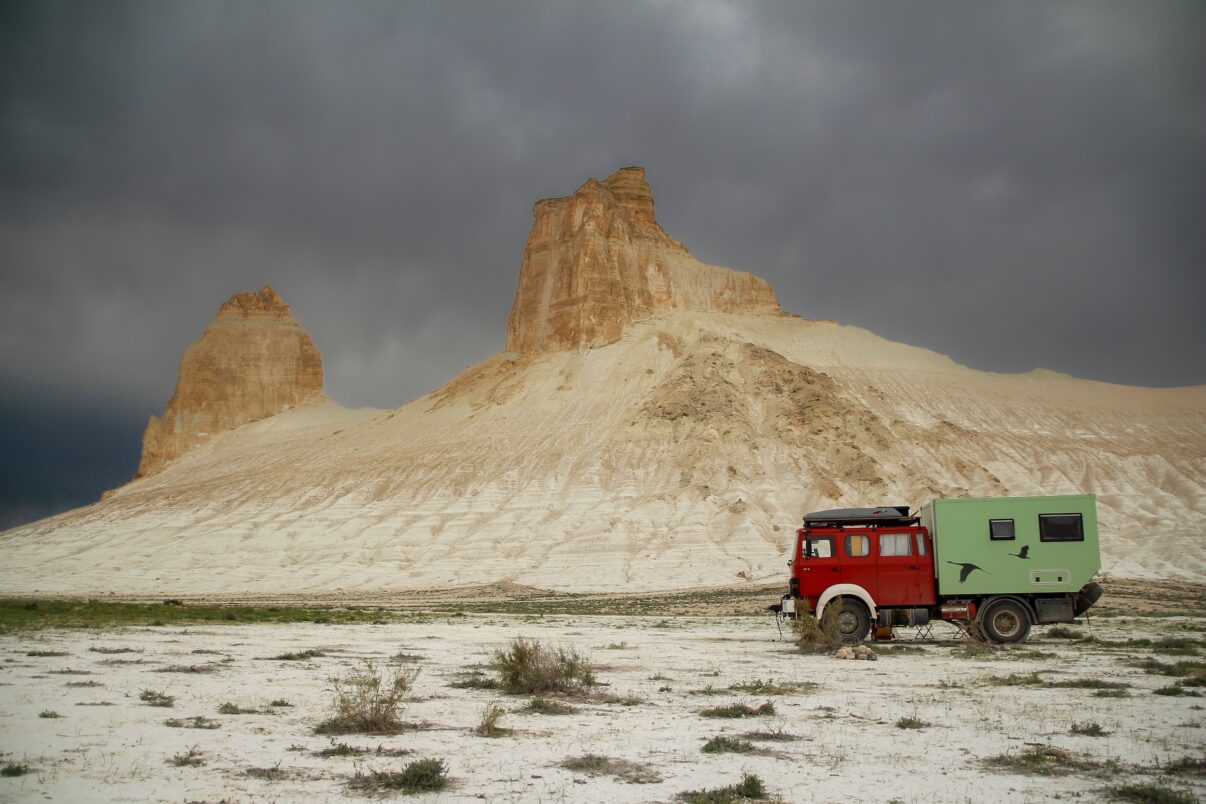

In an old IVECO 90-16 fire engine, with our two children Elva (6) and Hanno (3) and our two dogs Enna and Tilde, we’d already been travelling for half a year from central Germany through the Balkans to Turkey. Our dream: to reach Mongolia overland.
In the second part of the travel report we cross Russia, drive along an ancient seabed, cover several hundred kilometres off-road through the Kazakh steppe and take on the infamous Pamir Highway. On the truck the spare-wheel carrier breaks, and the tank mount nearly does too.
And it gets worse: we have to visit a hospital again. You’ll find out in this report whether we reach Mongolia, our dream destination, under these circumstances, and which encounters left the deepest mark on us.
Georgia: new arrivals and goodbyes
First we stay a little longer in Georgia. Near Kutaisi we find a hot spring, and the pleasantly warm water is pure bliss after the many hundred kilometres we’ve driven from Cappadocia to get here.
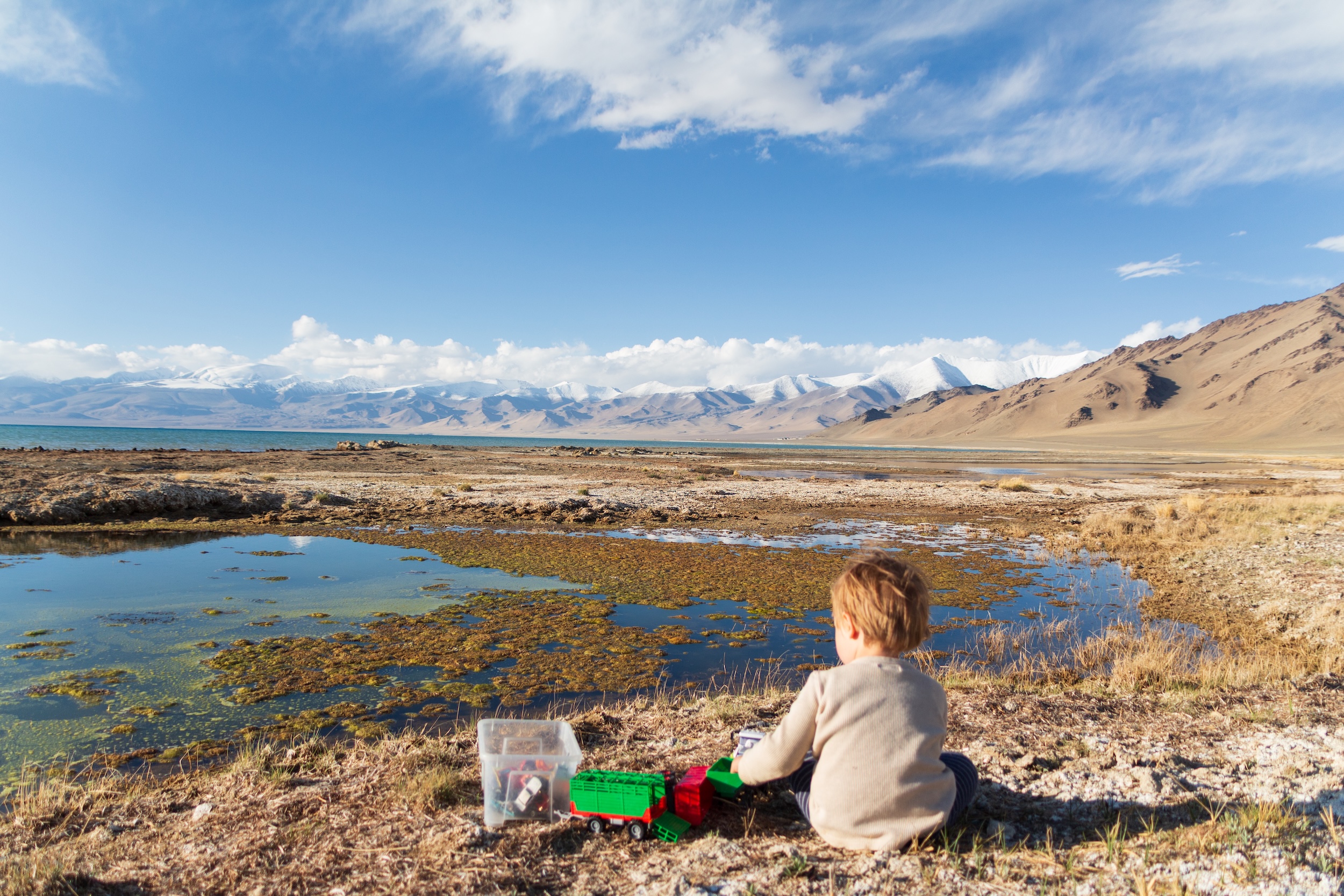
To our great luck we’d driven this stretch with Janine and Ingo and their two children Thea and Ole. We met the two doctors in Cappadocia and, because we hit it off straight away, we decided to drive together as far as Georgia. Sadly, here at this spring our time together was to end after three weeks. We want to carry on to Tbilisi, the others to Kutaisi. The parting is hard, for the children and for us too. We adults loved travelling as a group too. That we’d need their medical help in the not-too-distant future, we of course had no idea of at that point.
New acquaintances
On the way to Tbilisi we meet plenty of animals at the roadside, in the fields and on the motorway. The cows seem to know the highway code, they’re so relaxed, standing on the central reservation, swinging their heads left and right, looking every way, and when nothing’s coming, ambling calmly across the road. All the while cars often race past them at more than 100 km/h.
The streets of Tbilisi are no less exciting. Quite the opposite: they’re packed and chaotic. Drenched in sweat, we manage to park the fire engine in a small car park next to the beautiful Sameba Cathedral. Among travellers it’s a well-known meeting point to connect with like-minded people and swap notes. A shame the car park is fairly empty when we arrive. Other travellers? None. It’s 28 March, and the travel season probably hasn’t started yet, we reckon.
When we come back to the car park the next day after seeing the city, there really are several travel vehicles parked there. Among them a German family with an old motorhome, a Swiss family with a pick-up and an off-road caravan, a German couple with a 4×4 panel van, and a Dutch couple with a MAN Kat expedition truck.
As different as all the vehicles are, our planned route is the same. We all want to head into the “Stan countries”, drive the Pamir Highway, and some of us even to Mongolia. We’ll see each other again and share parts of the route with some of them.
Russia: burnt entry papers at the Russian border
On 2 April we drive up the Georgian Military Road right into the Greater Caucasus. Snow is piled metres high on both sides of the road. In places single lanes are closed, and the queues of lorries we pass are correspondingly long.
We finally reach Stepantsminda, the last village before the Georgian-Russian border, in the early evening. We spend the night at the beautifully set Gergeti Trinity Church, ringed by the mountain panorama, before driving up to Russia’s gates on 4 April. The night is a restless one, because we have to admit we’re pretty wary of the crossing and what awaits us afterwards.
Luckily, after hours in the queue, the processing on both the Georgian and the Russian side went very quickly in the end. The truck was briefly checked and our passports stamped. Janine, Hanno, Elva and I have officially entered. Only the fire engine is missing.
We fill in the vehicle-import forms we’ve been handed as best we can, and I take them to the relevant window. A few men are already waiting there in front of a closed white hatch. At some point it opens and I hold out my papers to the grim-faced man looking out. He takes them, looks at me and slams the hatch shut again. What feels like an eternity later he flings it open once more, looks even grimmer than before, holds my forms up in the air, and a lighter underneath them.
They start to smoulder at once. The problem? We’d unwittingly used an erasable pen, which of course isn’t permanent enough for documents. With new forms and a different pen we finally manage the official vehicle import, and after six hours in all we chug into the largest country in the world.
A machine gun and a glimmer of hope
SIM cards can’t be sold to foreigners, Starlink isn’t allowed, and in some places the GPS doesn’t work reliably. The last of these drops out especially in and around bigger cities. We weren’t ready for that, and because we can’t read Russian letters, in Vladikavkaz we first drove kilometres in the wrong direction, straight into our first police check. “Oh great, that’s it now and it’s bound to take forever,” I think to myself. But far from it. The officer is friendly, asks where we’re from, wishes us all the best and lets us drive on without any further check.
The next day we pass another road check and see a uniformed soldier from a distance. The big, frightening machine gun across his chest catches our eye at once. Our faces must have looked pretty alarmed, because the man takes one hand off the trigger, looks at us, lifts the corners of his mouth and waves at us with a friendly smile.
The many police checks and the presence of weapons feel strange and unsettling to us, yet we’re always treated kindly. Just before the Kazakh border we talk with a uniformed traffic officer through his translation app. The man, around 60, an authoritative air about him, at one point turns serious, almost moved, and on his phone the translation of what he’s just said lights up at me: “We Russians are friendly people. You’re safe here. That you travel through my country with your children gives me hope.”
Words that echo in me for a long time. For a moment I can’t reply and am deeply moved. After all, we ourselves entered the country not free of prejudice and even a little afraid, and in the few hours we spent here we got to experience so much warmth, interest and openness.
At the exit checks we adults only get our passports back after answering a written questionnaire on current world politics. A procedure every European has to go through at the moment. Of course we knew nothing about it beforehand, so the situation was very surprising and nerve-wracking for us, since we couldn’t judge the weight of the questioning in that moment.
Kazakhstan: to see mountains, we have to drive down
For five long days we drive through an endless, wide plain. Wherever we look, it all looks the same. By now we can barely remember what the previous night’s camp spot looked like. In the steppe they’re all pretty much alike.
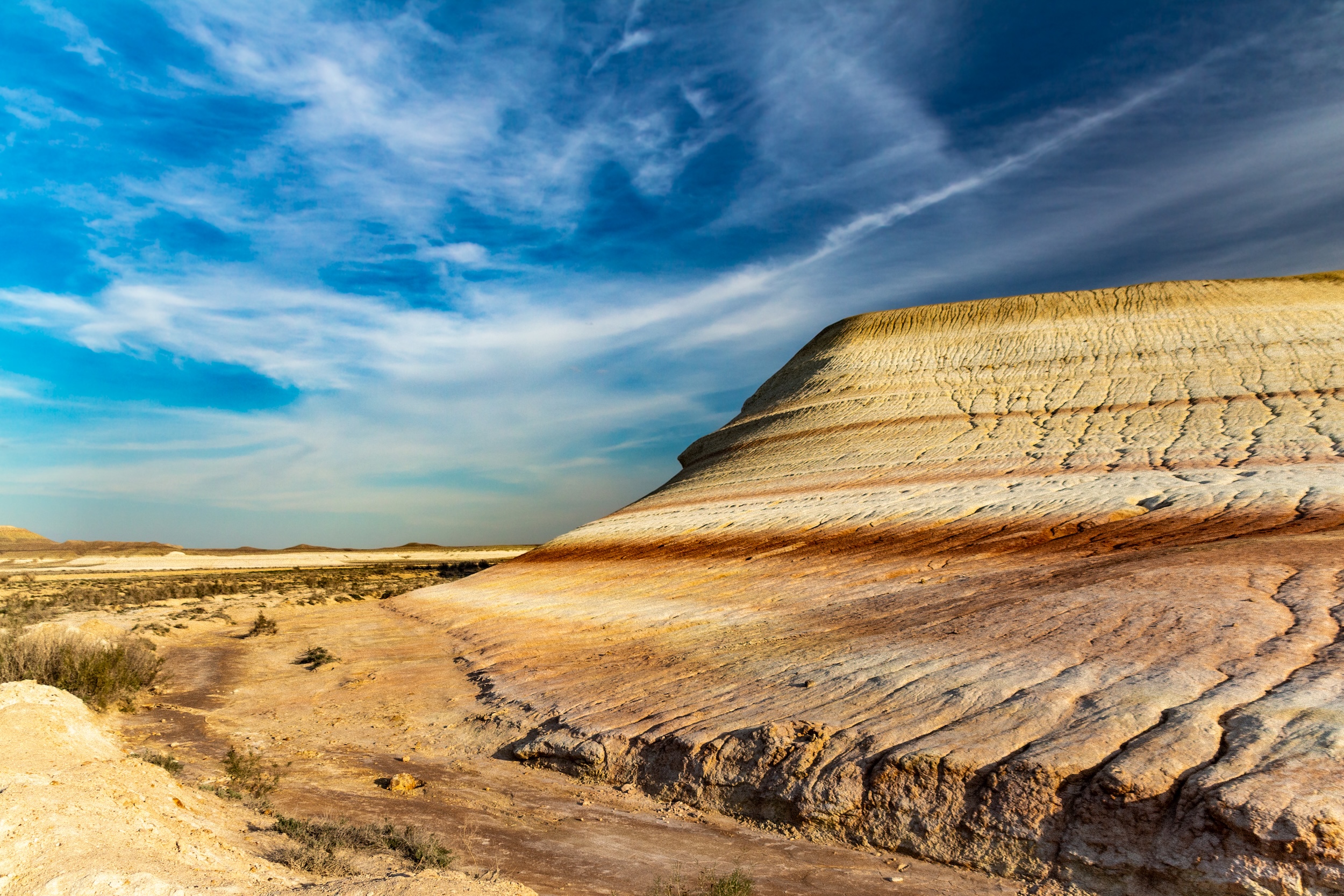
Eventually, out of nowhere, a road sign appears. 12% gradient. Right in front of us the ground suddenly drops away. It feels as if we’re driving down a whole storey until we can roll along on more or less flat ground again. The only difference is that the plain ahead is criss-crossed with hills small and large. Behind us the cliffs rise up steeply. We’re in Mangghystau. Dried out long ago, the former sea left behind a striking landscape of mountains and rock.
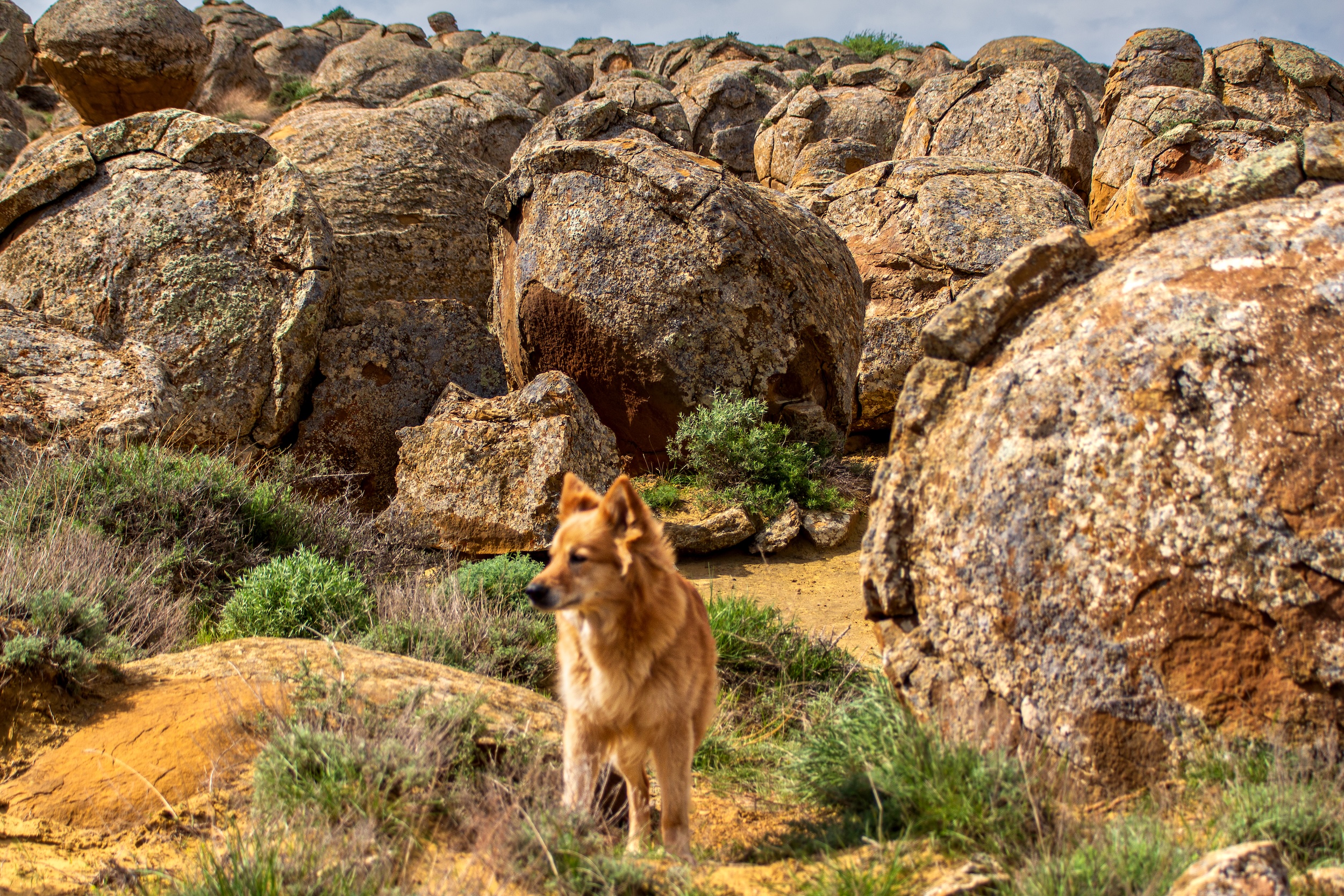
Mangghystau is an El Dorado for off-roaders, because on all kinds of tracks brave 4×4 drivers can venture up to the most beautiful mountains. We’re a bit more careful. And we turned back more than once, for example when the dry river crossing looked too dangerous and we worried about tipping over. We still reached the goal we’d set, even if by detours. In our case, though, that costs us a whole extra day. The reward is all the greater: we stand at the foot of the Bozzhira cliffs, or before the intensely coloured Tiramisu Mountains with their flanks striped in alternating white and pink and their striking brown caps. In the Valley of Balls we find thousands of stones up to three metres across, their shape almost like geometric spheres.
A shortcut across the steppe
Our plan to take the nearby border from Mangghystau into Uzbekistan doesn’t work out, because the border is closed for building work. We knew that, but it was meant to open now on 1 May. It doesn’t, though, and probably won’t until September after all. The annoying part is that our visa runs out soon and the next border crossing is more than 2,500 km away. That stretch would take us over a week. But there’s an alternative: straight across the steppe. We probably wouldn’t have driven it alone, but a travelling couple from Tbilisi, friends by now, is waiting for us. As a pair of trucks we feel safer taking on the challenge.
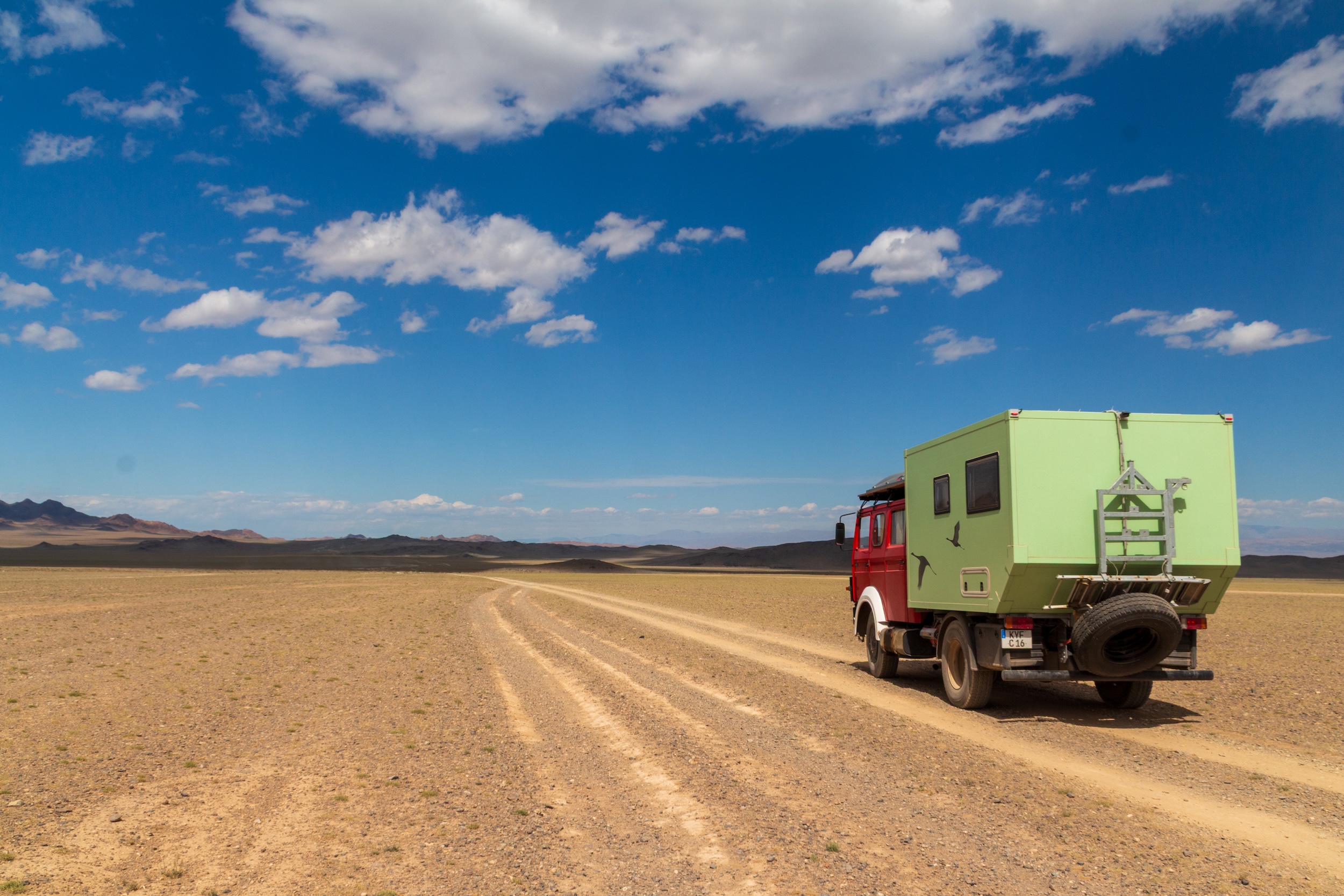
The route takes us through dry, dusty, unpaved terrain, a full 600 km of it. For several days we get shaken about hard, and the truck in particular suffers, the off-road tracks don’t pass over it without a trace. After we go by the Aral Sea and reach the town of the same name, the drain tap on the water tank and the washer-fluid mount have snapped off, the roof rack’s bolts have worked loose and, far worse, the mount for the diesel tank has cracked. With straps I can rig it up for now. Later I have it welded back together.
Tajikistan: the Pamir Highway, between worry, doubt and confidence
Of course we get a whiff of Silk Road air too. In early May, though, it’s already around 30 degrees, so we decide to leave Uzbekistan again quickly. We do still pay a visit to the old trading city of Samarkand. Here we meet up again with everyone we got to know in Tbilisi.
The Pamir Highway offers several alternative routes and sections. Some are less spectacular than others, but also easier to drive. From what we’ve found out, the detour through the Wakhan Corridor is one of the most beautiful, but also the most dangerous stretches. We decide to drive it. Partly because a local who speaks to me in the street goes out of his way to contact a ranger friend and ask about the current road conditions, but above all because Rita and Franz are driving this stretch together with us. We got to know the Austrian couple back in Turkey, stayed in touch over the months and shared our concerns about this section with them. It isn’t just their bigger, stronger truck that reassures us. Above all it’s Franz’s calm, confident manner. “One way or another it’ll work out, or we simply turn back.”
And it does. The horror scenarios and tilted passages other travellers had predicted, we look for in vain, and the narrow spots too. Still, this section isn’t entirely safe, because parts of the road keep slipping away and become impassable. We’re lucky: not three weeks after we come through, meltwater and rain make it impossible to get through afterwards, and that for months. (As we now know.)
Our travel friends who crossed the Kazakh steppe with us join the convoy too. With three vehicles we’re less alone, and that brings safety, especially when you travel with children. In the end we were rewarded with wonderful views of the surrounding mountains, the Panj river and Afghanistan.
High, higher, altitude sickness!?
Driving through the Wakhan Corridor we’re above 2,700 m for the first time, and that doesn’t pass me by, at least. A slight dizziness and tiredness set in, but still within the bearable. We only want to drive another 20 kilometres.
But up to an altitude of over 3,400 m, and that’s really too much climbing. The recommendation is a gain of no more than 500 m a day, so the body has enough time to adjust to the conditions and the lack of oxygen. On the Pamir that advice isn’t always easy to follow. We keep a special eye on the children. But they seem relaxed, playing happily, laughing and jumping about.
One night, though, the situation looks quite different. Retching sounds tear Janine and me from our sleep. We jump out of bed and find Elva being sick where she lies. She’s awake and responsive. Still, every alarm bell in us goes off. With altitude trouble, the only thing that helps is dropping to lower ground at once. But it’s just 2:30 in the morning. Four hours until it’s light again. Driving at night can be deadly. Even though the route was fine to drive by day, in the dark we could too easily miss a drop-off at the edge. Luckily our horror thoughts are interrupted by Elva: “There, my tummy’s empty now. Mummy, I have to sleep in your bed, I get better quickly there,” she says with a smile. A few more jokes from her follow, until, freshly changed and in good spirits, she climbs back into bed. Her mood lets us breathe out and, in the end, all sleep peacefully again.
4,655 m above sea level: a strain on man and machine
In Murghab we’re forced to take a break. It’s snowing, and that in early June. The snow itself isn’t the problem, the view is. More murky than anything, we decide to wait a few days. Since we’re here, we want to enjoy the view too. After three days the time comes. Under a blue sky we drive on and chug towards the highest point of the trip. On the Ak-Baital Pass we actually reach it and climb the second-highest through road in the world. We don’t grant ourselves much time, though. A few photos for the memory and we’re already rolling downhill again. Hanno doesn’t cope too well above 4,000 metres and seems worn out. After a few minutes and a few hundred metres lower he’s soon better. But bodies aren’t the only things struggling. Our travel friends’ MAN van has been running in limp mode for several days now. The thin air clearly doesn’t agree with it either. The van can’t make the last few metres to the pass under its own power and has to be towed by Rita and Franz. Our fire engine, the oldest vehicle in the group, doesn’t let anything show and does its job dutifully.
Kyrgyzstan: same highway, different scenery
After weeks in the high mountains we leave Tajikistan’s rugged, bare peaks behind and come into green slopes and lush meadows. Once again the border crossing brings a change in the landscape. But it doesn’t stop there. It’s the many animals, the horses above all, and the many white yurts, that cast their spell on us. Kyrgyzstan surprises us with new, exciting scenes around every bend.
Luck, earth, backs and horses: when joy and sorrow sit close together
By now we’re travelling alone again. From Osh we want to drive over the Kaldama Pass to Son-Köl, Kyrgyzstan’s second-largest lake. On the way we top up our water in a small village. Into this scene comes a middle-aged couple. They’re cleaning their grain by hand in big sieves. Then, just before we leave, the engine already running, a boy comes past with his horse, and Elva’s happiness seems complete. We’re allowed to stroke the animal, and more than that, because the woman cleaning the grain sees Elva’s great interest in horses and arranges a trial sit for her. But no sooner is she on its back than the horse takes fright, spins round at lightning speed and shoots off. The boy can no longer hold the animal, nor Elva herself on its back. She falls and hits the ground. She cries, she has a small graze on her head, her clothes are wet, and she complains of pain in her arm.
Another hospital visit
Internet signal? Of course not. The nearest hospital? Many hours’ drive away. Until nightfall we try to cover as many kilometres as we can. Maybe the arm is only bruised, that’s my hope at least, and Elva calms down a little over time too.
For the night we still look for a spot with enough internet signal. Ingo and Janine, our travel friends and the doctor couple we met in Cappadocia, luckily stand by us with advice and promise to stay reachable through the night too.
First thing next morning we set off for the nearest hospital. We reach it around 1 pm in the town of Naryn. Finding your way won’t be easy, you can see that at a glance, the site is far too big and the signs unreadable.
My strategy: speak to the first person who looks like a member of staff. I already have the case description translated into Kyrgyz on my phone, guessing that English won’t get me far. We don’t have to wander long before a young woman in white work clothes comes towards us. I quickly hold my phone up to her and she knows at once what to do. An hour later we leave the hospital again. With the arm in plaster. I’ve got the X-rays on my phone. With no printer, I had to photograph them and show them later to the doctor in A&E. The arm is broken. Where it’s broken the doctor didn’t explain, nor what happens next. Again it’s Ingo and Janine who help and support us. They send the images to a trauma surgeon friend. It’s him who explains to us that the arm is broken in two places.
The instructions: rest, rest, rest, and back for another X-ray after a few days. The break is near the elbow joint. We have to watch whether it knits together properly, or in the worst case operate on it. By now we can assume the breaks have healed well and there were no further complications. The medical support from home, and at all hours of the day and night at that, is for us one of the most precious treasures, or gifts, of our trip.
Mare’s milk at Son-Köl
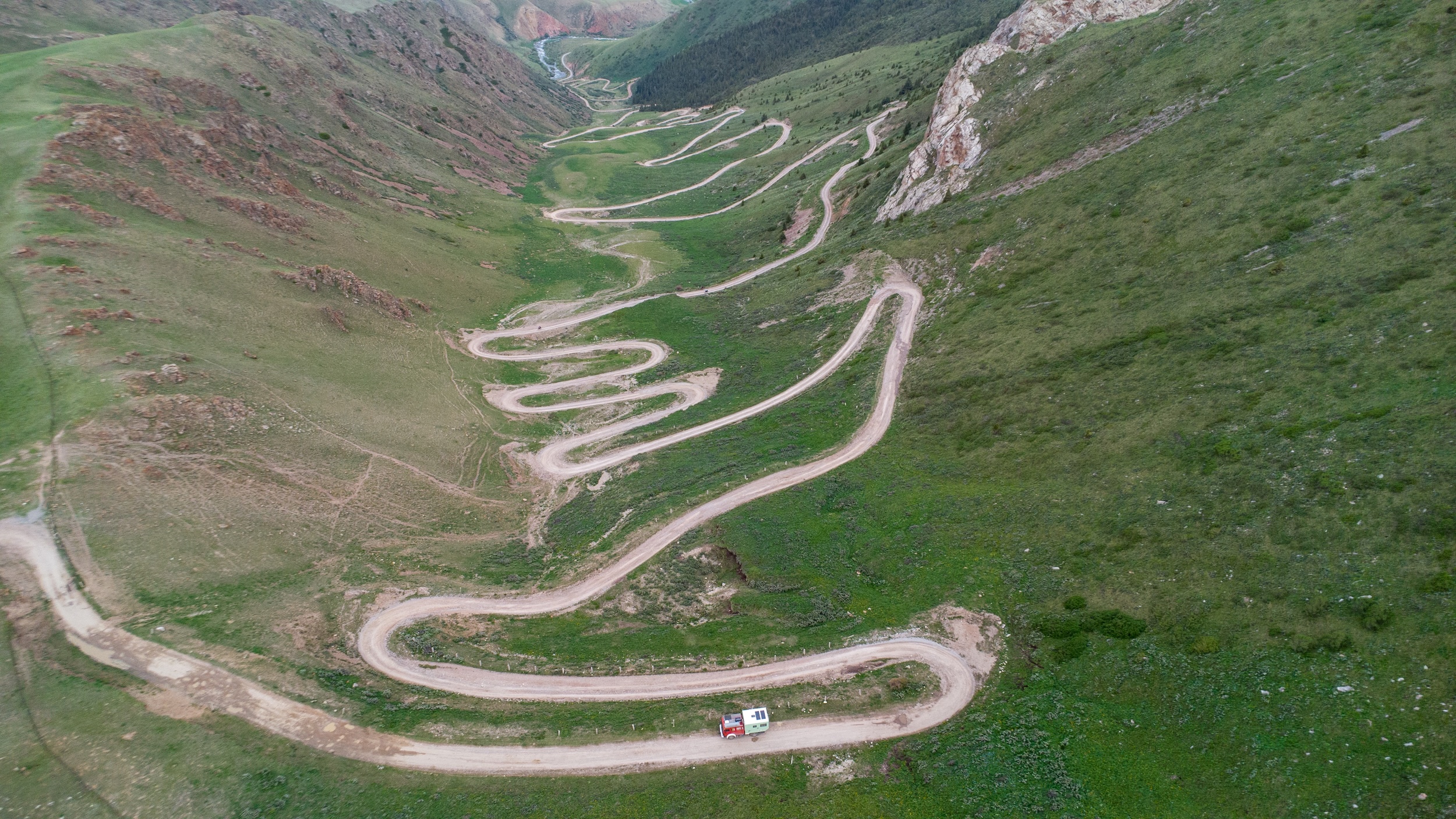
Nothing is worse than a sick or injured child. While the shock still lingers for us adults, Elva is already playing happily with Hanno again, and we carry on with our trip, first, as planned, to Son-Köl. We reach the lake over the Teskey-Torpok Pass, better known as the Parrot Pass. Its 33 hairpins are quite something. At the top, wide country stretches out, with lots of horses and, how could it be otherwise, two yurts. It’s Kyrgyzstan straight from a picture book, only it’s real.
Two girls come running out of the tents, waving. They speak a little English and invite us into their yurt. One of them starts stirring a big vat at once and we each already have a large glass in our hands. Mare’s milk, fermented. It’s definitely not to our taste, but we somehow manage to get it down. A second glass, though, we politely decline.
Kazakhstan: a thorn in the military’s side
Kyrgyzstan has cast its spell on us and we almost lost sight of our actual goal, Mongolia. Is the route getting too long, the long drive too tiring? In the end we do manage to tear ourselves away from the country and race through Kazakhstan.
Luckily the roads in the east of the country are very well made, so we make good progress. After several very long days of driving we don’t reach the last town before the Russian border until around midnight. The spot we pick to sleep is right next to a small playground. So far so good, if it weren’t for fists hammering on our door at half past one in the morning. When I open it, I’m looking three heavily armed soldiers in the eye. They look just as baffled, because I’m standing in front of them in nothing but a T-shirt and underpants. We’re to clear off, they tell us, but after a passport check they let us stay because of the children.
Half past six in the morning, the same scene, only this time I’ve pulled my jeans on. Again we’re told to leave. They give us half an hour. But not ten minutes later there’s another knock. “What is it now?” I think, a little stressed. And a moment later I’m slightly ashamed of the thought. A young soldier brings chocolate and iced tea for the children and lends me his smartphone, because I still have to look something up for the Russia crossing and have no signal of my own.
A little later two soldiers escort us to the border. Driving now in daylight, we realise what all the fuss was about: behind the playground there’s a very tall hedge, and directly behind it a large military base.
Russia: turn up too late and you can’t leave
Russia was really only a transit country for us. So the huge fields surprise us all the more. Grain and sunflowers as far as the eye can see. But the Altai Mountains in particular win us over, and we’d happily spend more time here. The people are friendly and warm, we feel at ease. But first we want to make our dream come true: Mongolia.
It’s within touching distance. The border officers at the exit sadly see it differently. Even though our passports are stamped out, we’ve officially left the country and the vehicle has been checked, a border worker announces: “I have bad news for you: the Mongolian border is already closed, we’re not allowed to let you leave.” We’re disappointed, since we were at the border by 2:30 pm.
We’re to leave the truck on the border grounds and find a hotel on foot, that’s his helpful advice. In the mostly Muslim part of the country and with two dogs, no easy task. After several rounds of talking, we’re allowed to drive the truck just outside the grounds and spend the night there. They keep the vehicle papers and the dogs’ passports as security. Before we go, our exit stamps are cancelled.
The next day we go through the whole entry procedure again, including a vehicle check, a phone check and a spoken interview, before we’re finally allowed to leave.
Mongolia, first impression: ripped off
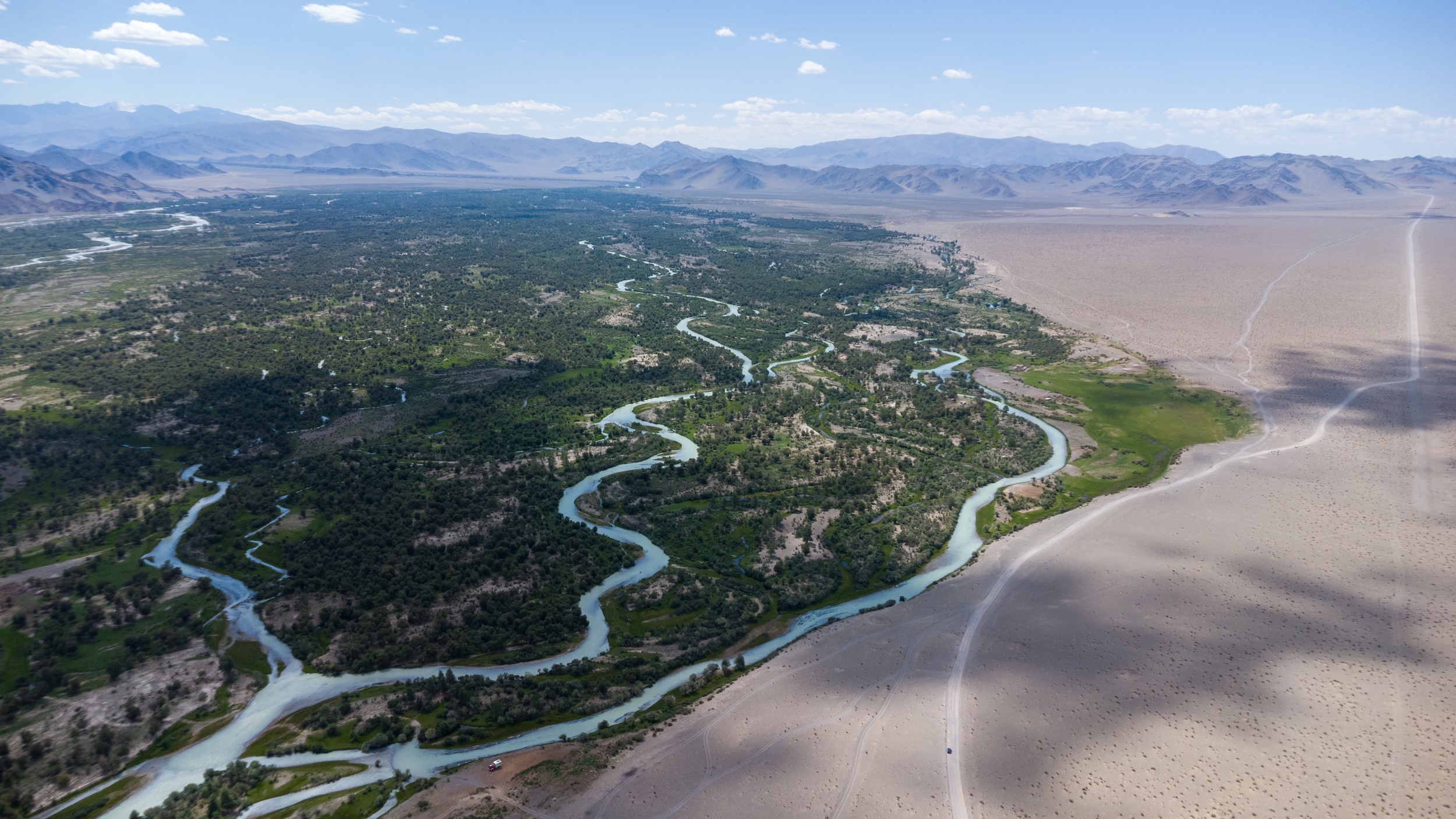
We’ve reached our goal. We’re in Mongolia. We can hardly believe our luck, but sadly our joy is dampened a little. Not 30 kilometres past the border we find a good place to sleep, horses trot past us, big birds circle overhead. Into this scene a car comes driving. The driver introduces himself as Chiak and invites us to a Naadam festival in his town.
One of the last of the year, because the season is really over. Naadam festivals are the country’s most important celebrations and a visit was on our wish list too, but until now we’d thought we were too late for one.
At the same time he offers us jeep tours into the Altai Mountains. And because we still have no internet to contact him with, he’s got a SIM card ready too. At unbeatable rates, of course. “I don’t have any tugrik.” No problem, I could just as well pay in roubles. Chiak works it out for me: this many GB for this many tugrik makes this many roubles. “Best price.” My head spins and I pay. Only later do I realise I paid 40 euro for 15 GB.
A blessing in disguise
Frustrated by the con, we call off the visit to the Naadam festival, even though we probably won’t get another chance to attend this traditional celebration. About 50 kilometres on, while we’re looking for a place to park in the centre of Ölgii, we spot a fire-engine-red old Mercedes Düdo. German number plate and, best of all, there’s a balance bike on the roof. A clear sign of travellers with a child.
A short while later we get to know the family. The three of them have been living in Mongolia for a year already and are on their way to Ulaangom. “Just come with us,” they suggest, and we agree at once. There’s a lot we can learn from them about Mongolia: they spent the winter in a yurt with a nomad family, they’re working on a documentary and on a book in which they want to tell their story.
Without Chiak’s sly sales trick we wouldn’t have driven to Ölgii that day and would surely have missed the family. And by the way, in a few days one of the biggest Naadam festivals of the year takes place in Ulaangom. How quickly something first taken for bad luck sometimes turns out to be a great stroke of fortune.
Naadam festival: parked in for three days
The Naadam is seen as Mongolia’s national festival above all others. Some compare it to the Olympic Games. The festival centres, though, on the three traditional Mongolian sports: archery, horse racing and wrestling. The biggest Naadam takes place every year in Ulaanbaatar.
The festival in Ulaangom is apparently every bit its equal. For three days we follow the red Düdo through the Mongolian wilderness towards Ulaangom. We see the last tarmac in Ölgii. What follows is kilometre after kilometre of corrugated track, gravel roads and stony passages. In short: it shakes, wobbles and rattles at every corner.
On the edge of town we already spot big yurt villages, put up by and for the crowds of visitors. Following the flow of traffic, we first drive to the racecourse out of town. Only at night do we return to the actual festival site, the stadium of Ulaangom. We’re lucky, the spacious car park is almost empty.
When we look out of the fire engine the next morning, we can’t believe our eyes. Without us noticing, we’ve been completely parked in. Left and right, in front and behind, cars and small vans everywhere. People even park in underneath us: for many a visitor our fire engine is a welcome bit of shade. Again and again single people, sometimes whole families, lie under our vehicle, make themselves comfortable and seek shelter from the sun.
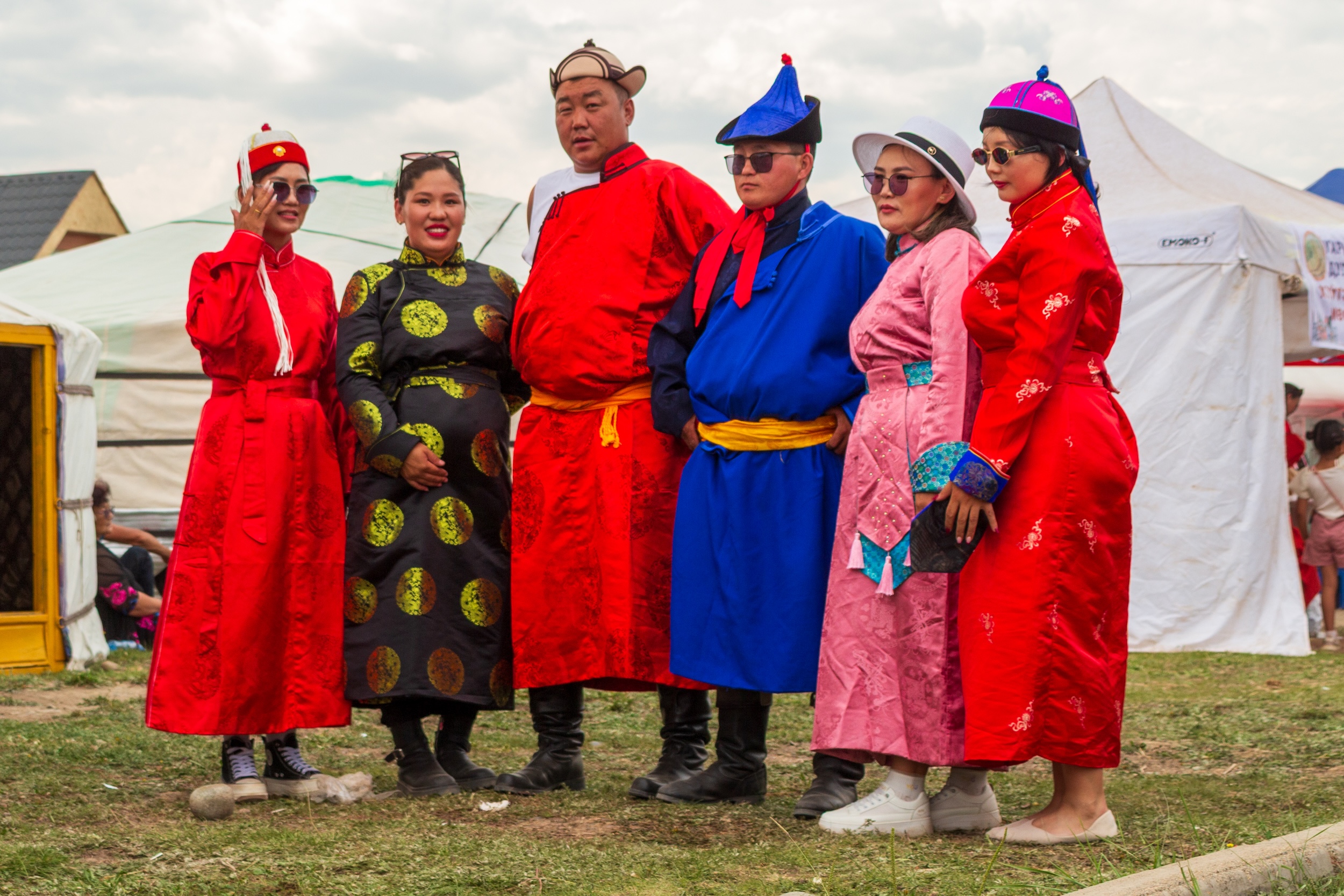
We catch little of the sporting contests themselves. Instead we get swept up in the huge opening ceremony and the party mood all around the stadium. People are dressed in bright colours, wearing their traditional deels. Riders move through the crowds on their horses, bouncy castles and fairground rides are set up. The mood is exuberant. From babes in arms to the very old, every age group is here, all celebrating together.
And us? We extend our stay, from the two days originally planned to three. Forced to, but not unhappy about it. Because only after the festival officially ends and the rides and food stalls are taken down does the car park slowly empty out and the fire engine get released by its besiegers.
On the trail of the eagle hunters
At the end of our little tour of Mongolia we visit a very special place. The “Eagle Hunter Cultural Center”. Even as we arrive, the staff give us a warm welcome in the car park. Straight away they lead us into the two modern yurts with many exhibits from eagle hunting. Some are several hundred years old and the staff’s great pride.
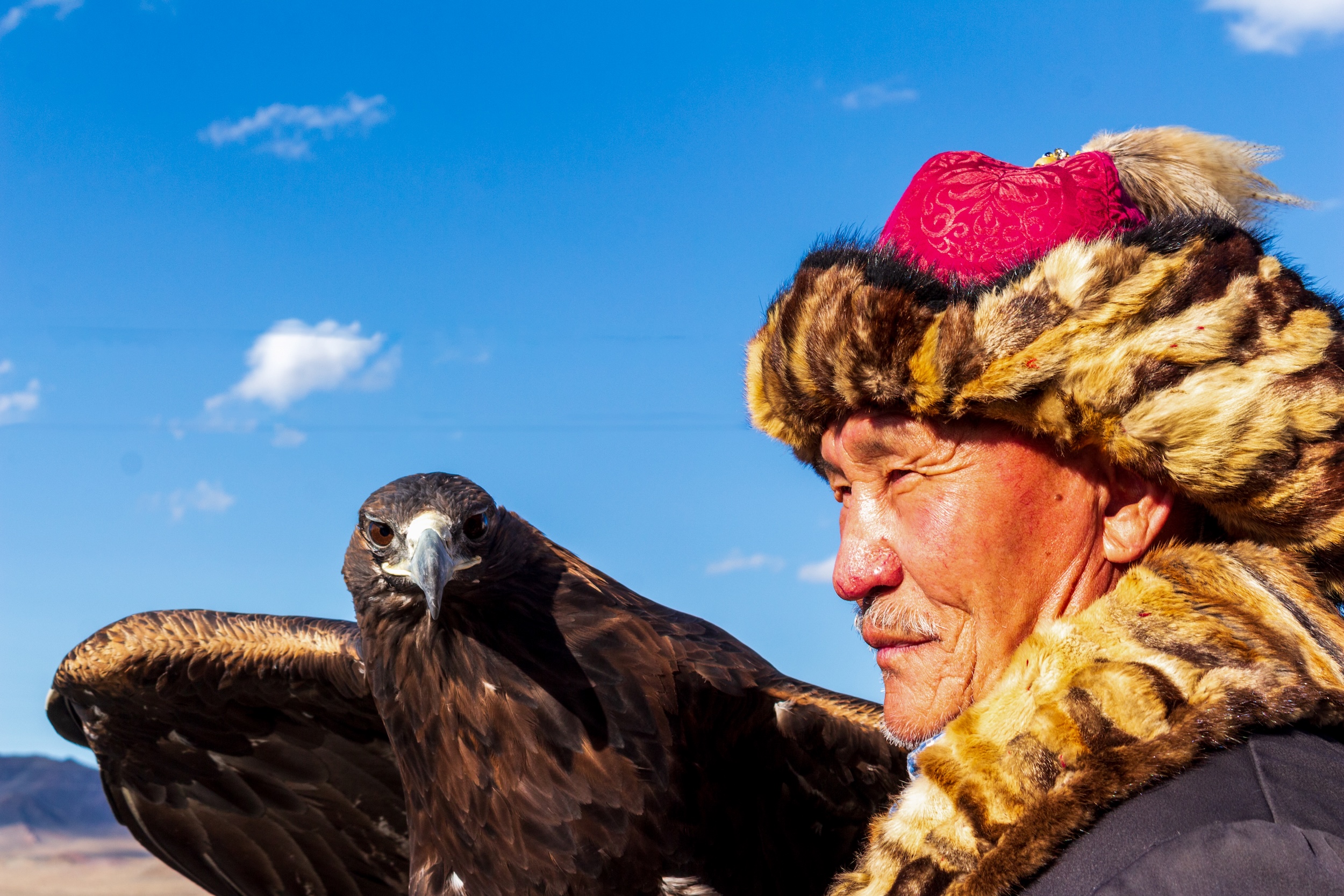
As no other visitors are there, we get a little private tour and detailed explanations of the history of eagle hunting, its birds and its tools. And all that for just 5 euro a person, even though the modern site only opened a year ago. For its work in making the tradition accessible to future generations, the centre made the cover of Time magazine and is among the “World’s Greatest Places 2025”. We too find the visit thoroughly worthwhile and memorable. At the latest when a real eagle hunter in traditional dress actually stands in front of us with a real eagle.
At the destination
In Mongolia, near Ulaangom to be precise, we reached the point of our trip that lies furthest from home. As the crow flies the distance is more than 5,500 kilometres.
Not everything went the way we’d hoped. The truck suffered and, worse still, there were Elva’s broken bones. We were lucky, and it all turned out more or less lightly. Even the worst experiences, much as we could have done without them, still brought something good with them: new, close friendships.
Here in the Mongolian steppe we turn our vehicle around and from now on drive towards the sunset, homeward. In our luggage, many memories and images of wonderful places, new acquaintances and friendships, and a great treasure of experience. And we’re only halfway through our trip.
Contact Alex Güldenzopf:
Email: feuerwehrreise@web.de