

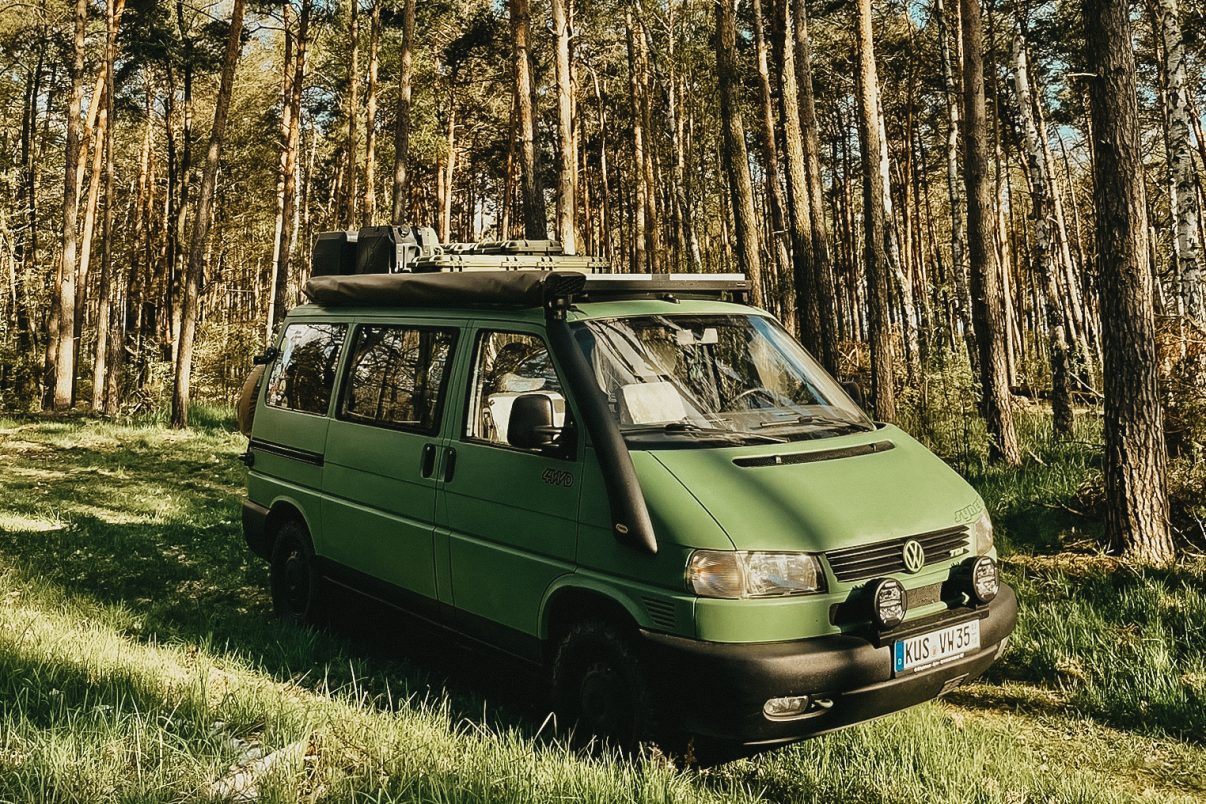

Jana and Max built out their T4 Syncro Multivan “Otto” entirely on their own, with help from the whole family. The build is absolutely functional, including a clever part-worn-clothes compartment, and it has turned out beautiful and cosy too. Admittedly, being made in hardwood, it came out a little heavier. An absolutely successful build. See for yourself!
Why did you go for the T4 Syncro?
We wanted a reliable car with sturdy technology that can largely be serviced yourself. On the engine, it mattered to us to get a diesel, ideally with a turbocharger, since the bus is quite heavy when fully loaded and we did not want to be a traffic obstacle. Four-wheel drive was fairly secondary at first, but in the end it swayed us to buy. That it would be a VW bus mattered to us, since we have a very good VW workshop nearby, so we can quickly turn to specialists for bigger problems. And of course, in a way, because a T4 is just a T4.
Did you build the van yourselves?
We built the van entirely ourselves. In the house of Jana’s grandparents, where we also live, there is an old joinery workshop that belonged to Jana’s great-grandfather. Luckily Jana’s grandfather had learned a few tricks from his father and helped us. So we could do it all ourselves, even if sometimes with improvised solutions, despite having no prior experience. For the electrics, Max got support from his father. In general the whole family was there for us, even for little things like the sewing work.
What was the goal of the build?
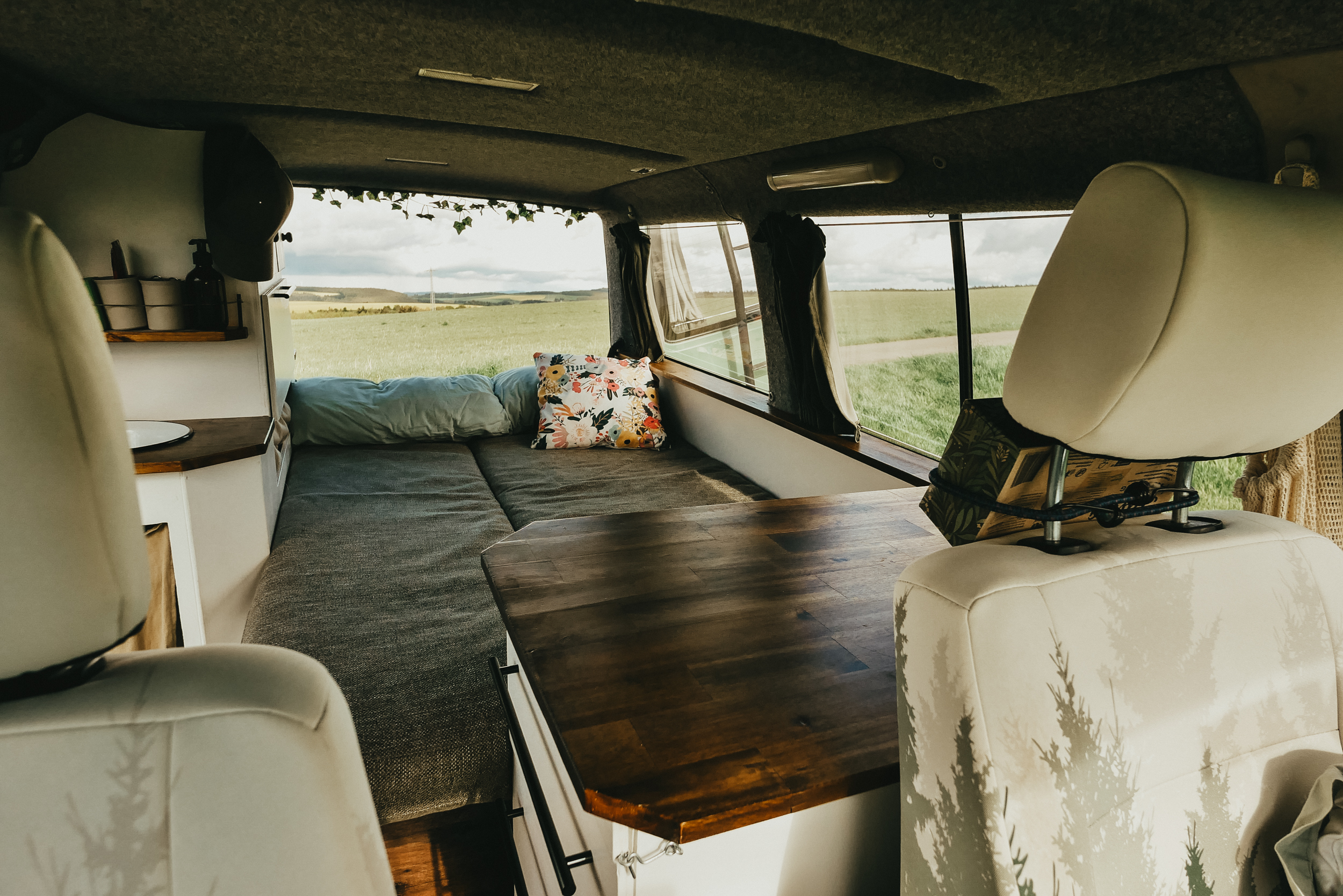
Our original plan was to keep the folding rear bench as a bed, since the bus is designed as a Multivan. But over time it became clear that this simply does not offer enough storage. Jana steered us in the right direction there with some good persuading. At the moment we could take out the bed and the cabinet next to it with a few screws to use the bus as a van, but that has never been necessary so far. Our main goal was to build it so that we can easily take longer trips of 2 to 3 weeks too.
How did you go about the build and the planning?
We read a lot and drew inspiration from Instagram, forums and so on, and wrote to others. In the end we simply sat in the bus for several hours, thinking, measuring, drawing, and starting all over again whenever a new idea came up.
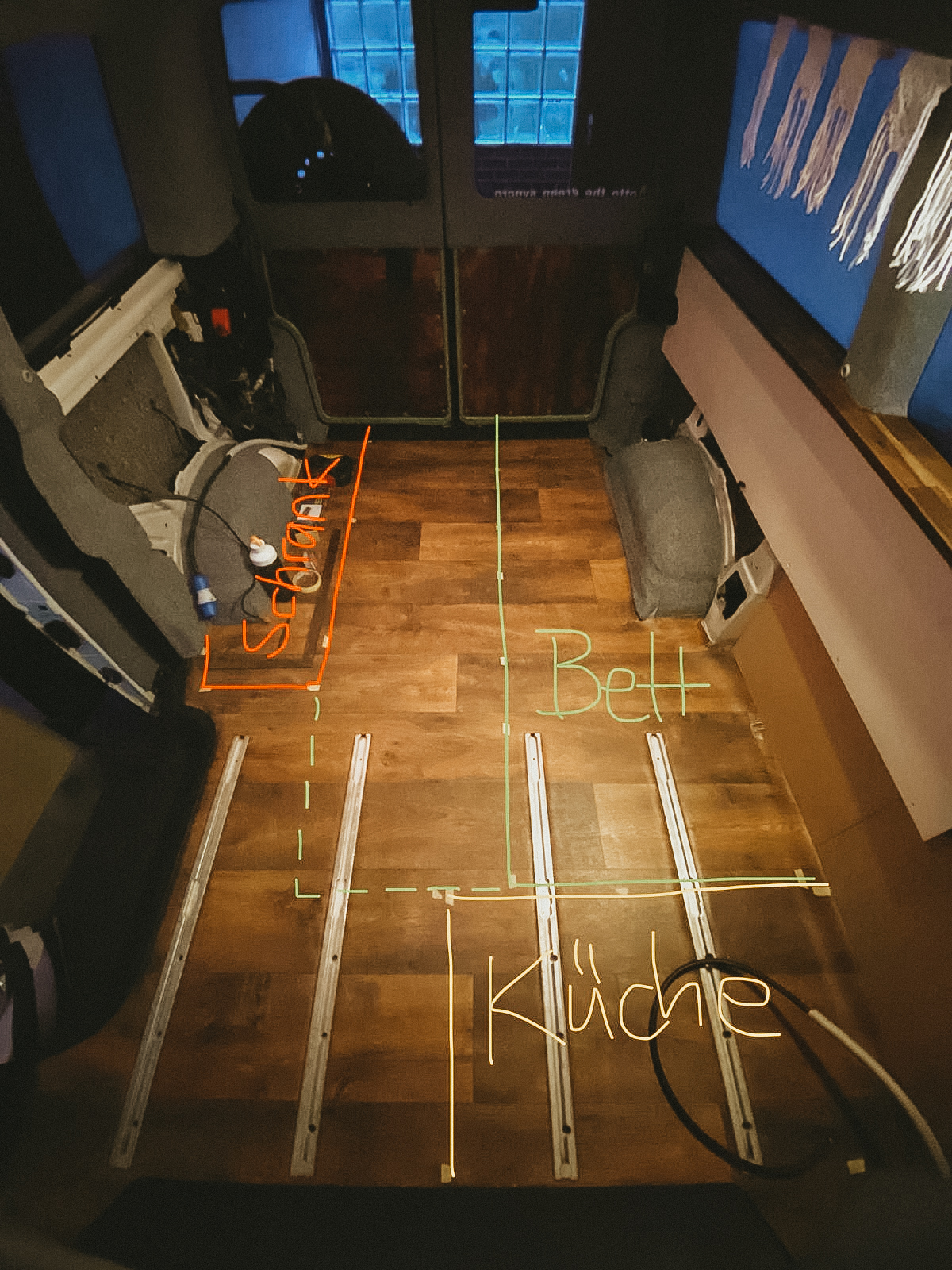
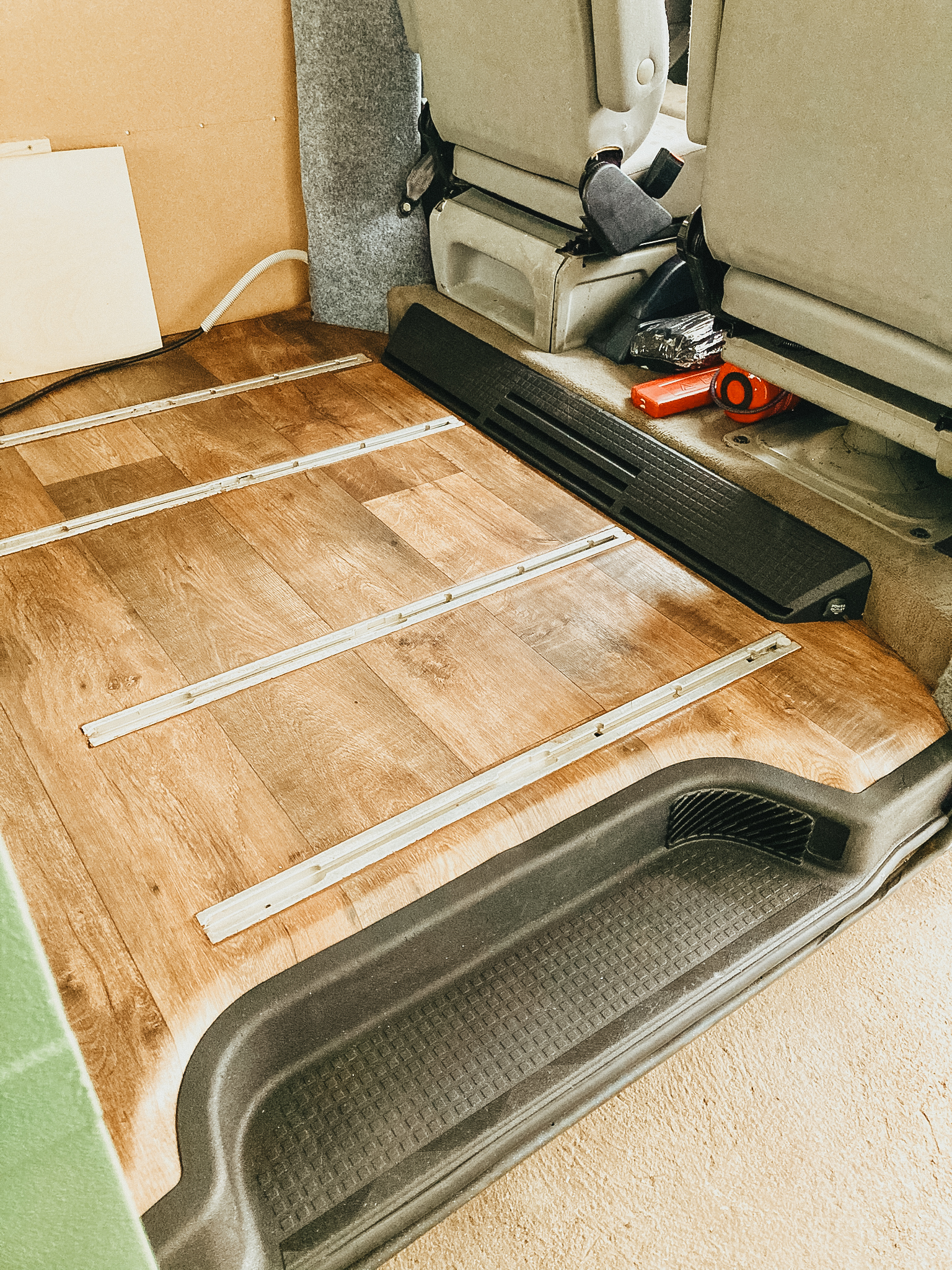
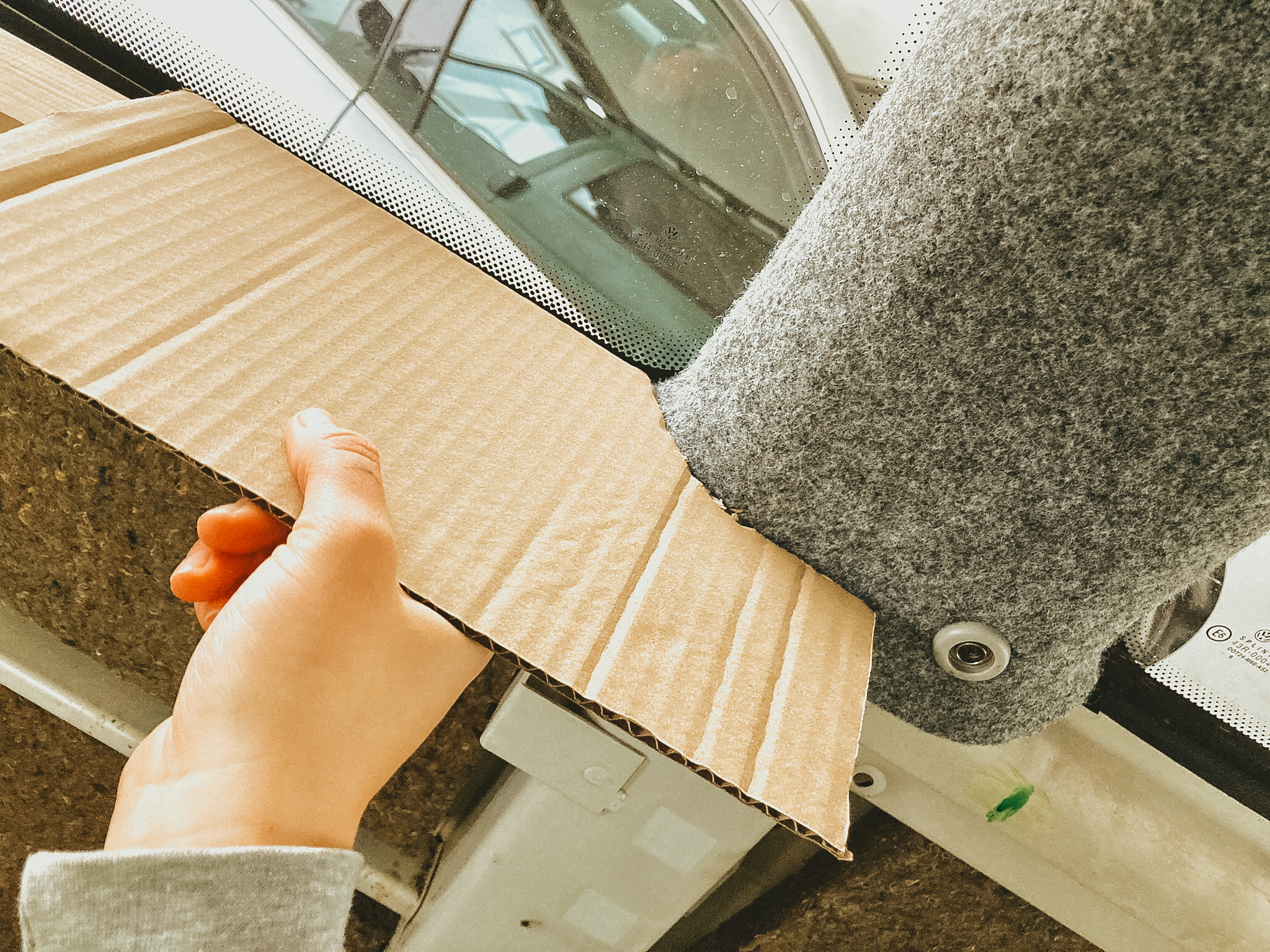
When it came to actually doing it, we also worked with cardboard to get templates for the curves, corners and edges in the bus just right.
What kinds of cabinets did you build? Which materials did you use?
We started the build during the Covid period, when wood was hard to get. So we used a lot of what was already in the workshop or found through classified ads, for example an old slatted bed frame that we built in completely. But that also meant we had to work with what was there, and that made the build heavier overall than it needs to be. The hardwood of the slatted frame does hold up superbly, but it also brings quite some weight with it.
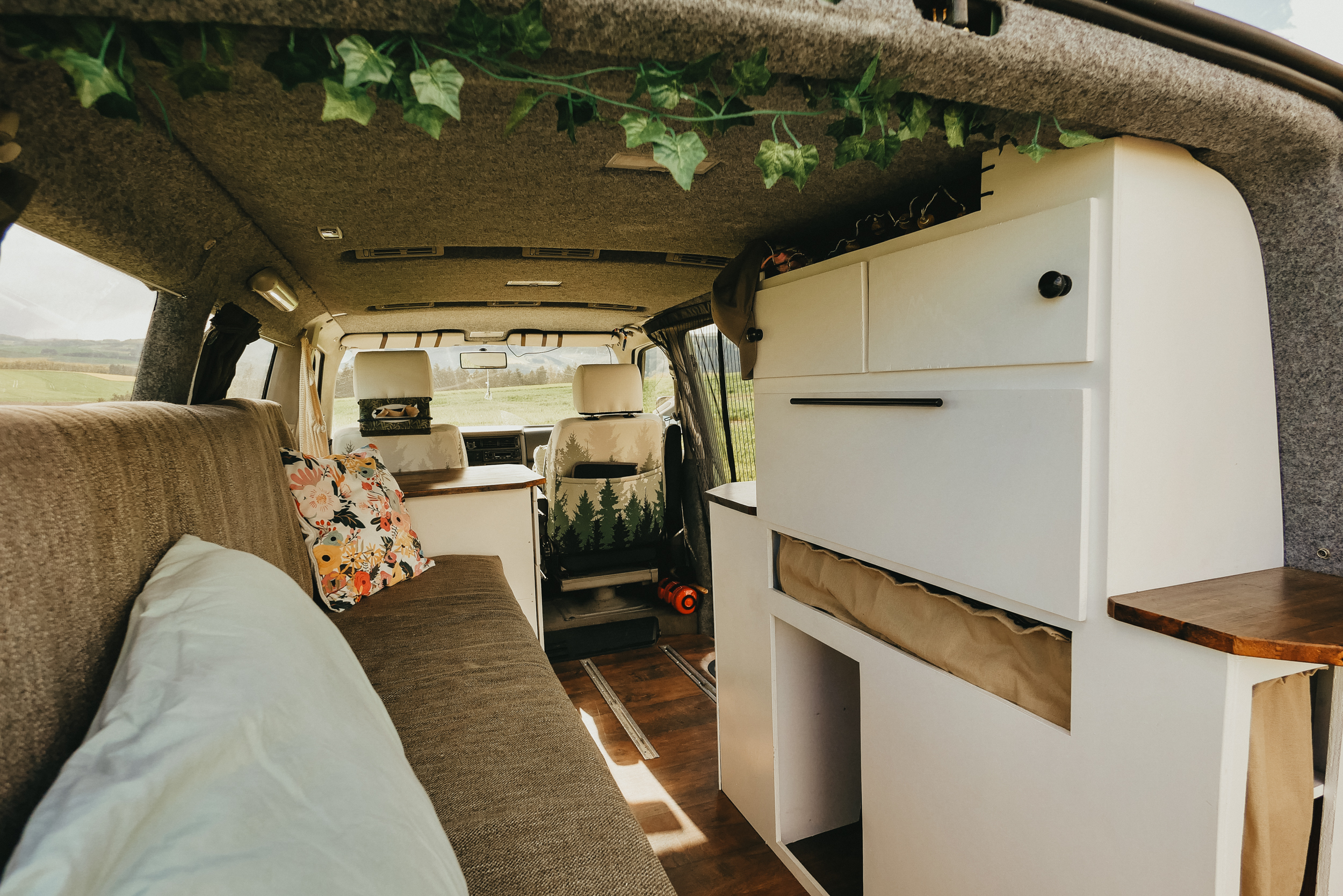
The cabinet cladding is 12 mm poplar plywood and the substructures are mostly leftover spruce.
What is special about your build?
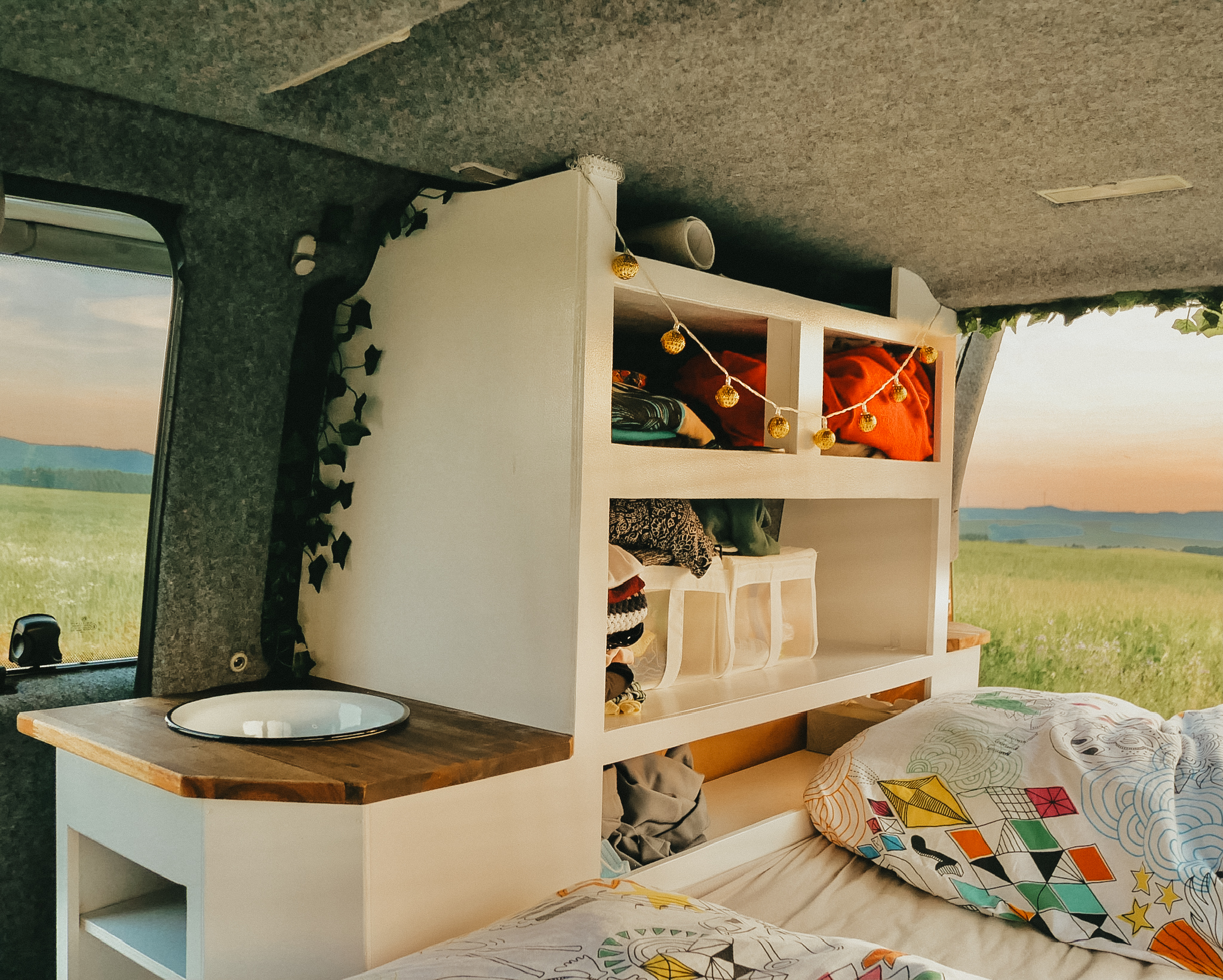
Our interior is kept fairly plain and does not necessarily stand out from others, but that was never important to us. For us, function is what counts.
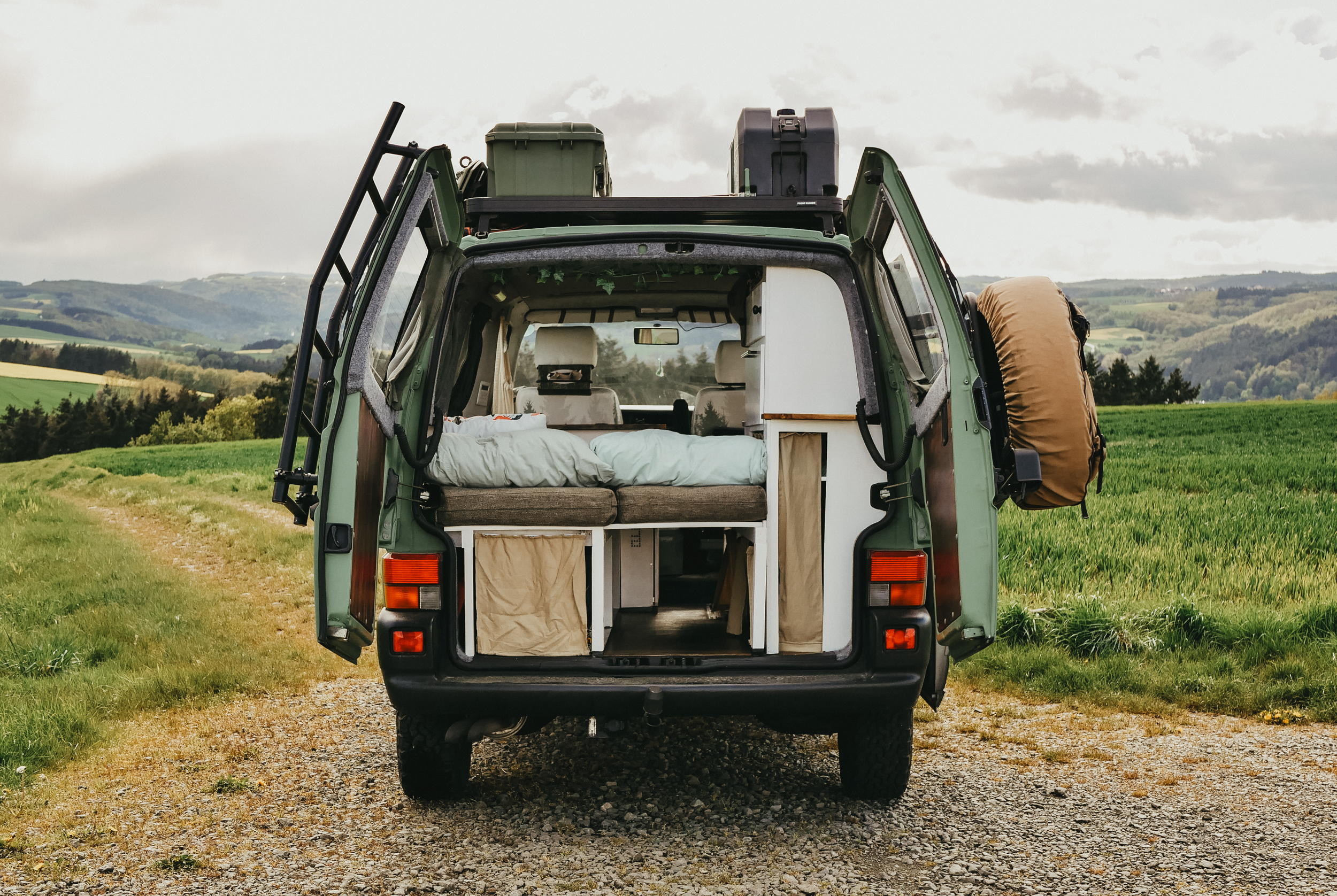
For example, there is a “part-worn compartment” that stands in for the typical “clothes chair” at home. We were also able to fit in a laundry compartment: when the bed is pulled out, the opening is covered, but if you lift the mattress slightly, you can simply throw the laundry down into the cabinet.
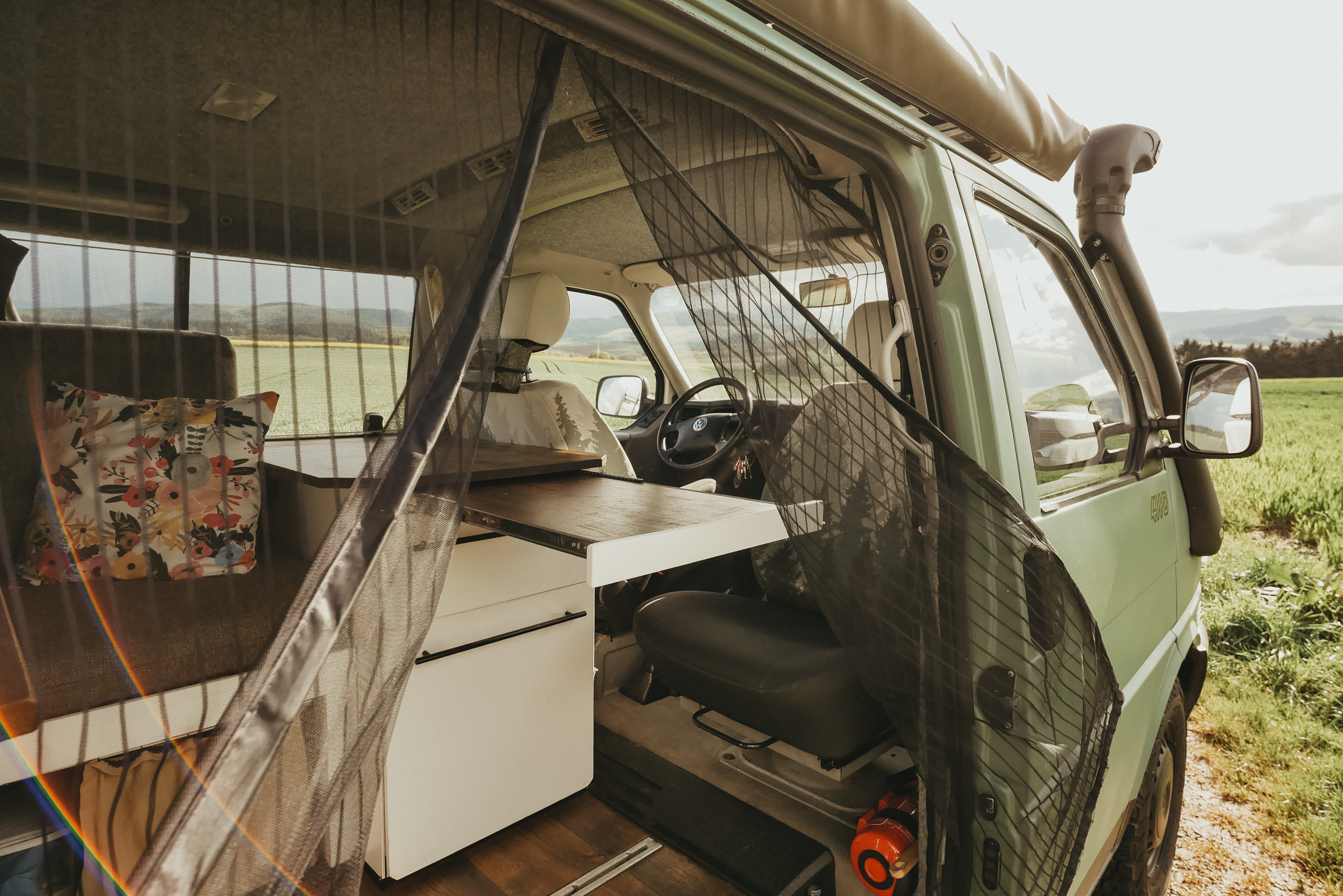
A lot came about by chance. For instance, the sliding-window screens fit perfectly into the substructure of the kitchen cabinet, under the cool-box slide. The table between the kitchen cabinet and the driver’s seat was a happy accident too. As an extra, we have a third seat on rails at the back that we can fit and remove as needed.
How long did the build take?
That is hard to say exactly, because the build stretched over a long period. We bought the bus in June 2020 and, because of the daily commute to work, could at first only work on it on Saturdays. A few days of holiday went into it too. Basically it was a continuous process that developed step by step.
Roughly how much did the T4 Syncro build cost?
For the interior we estimate the cost at around 1,500 to 2,000 euro, including the electrics and all the small parts, though we are not entirely sure. On the mattresses, for example, we saved: it is the cheapest Ikea mattress, some mattress felt and a fabric cover that a lovely seamstress from the next village sewed for us for 35 euro.
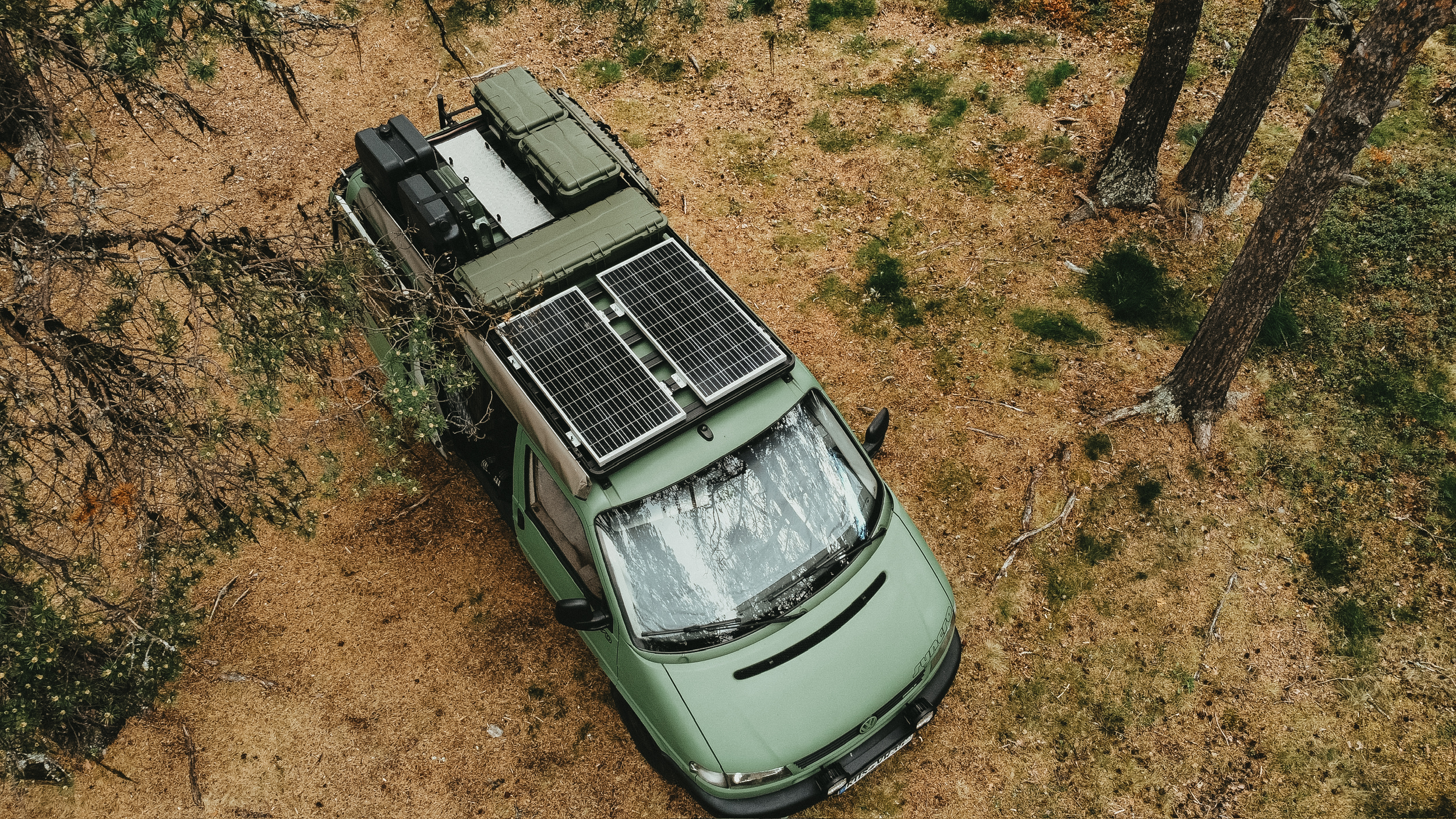
In total, the cost for the bus, including the lift, a new paint job, roof rack and all the maintenance work, comes to around 7,000 euro.
What is still on the to-do list?
Here and there a few small improvements are still to come. For example, the big drawer in the kitchen cabinet is currently quite stiff, but since it basically works, we keep putting off the problem a bit.
We are also still missing a holder for wine glasses. Since we kept the trim on the headliner, shelves on the ceiling or along the upper edges would be impractical. We already have a few ideas, let us see what works best.
The vehicle’s details:
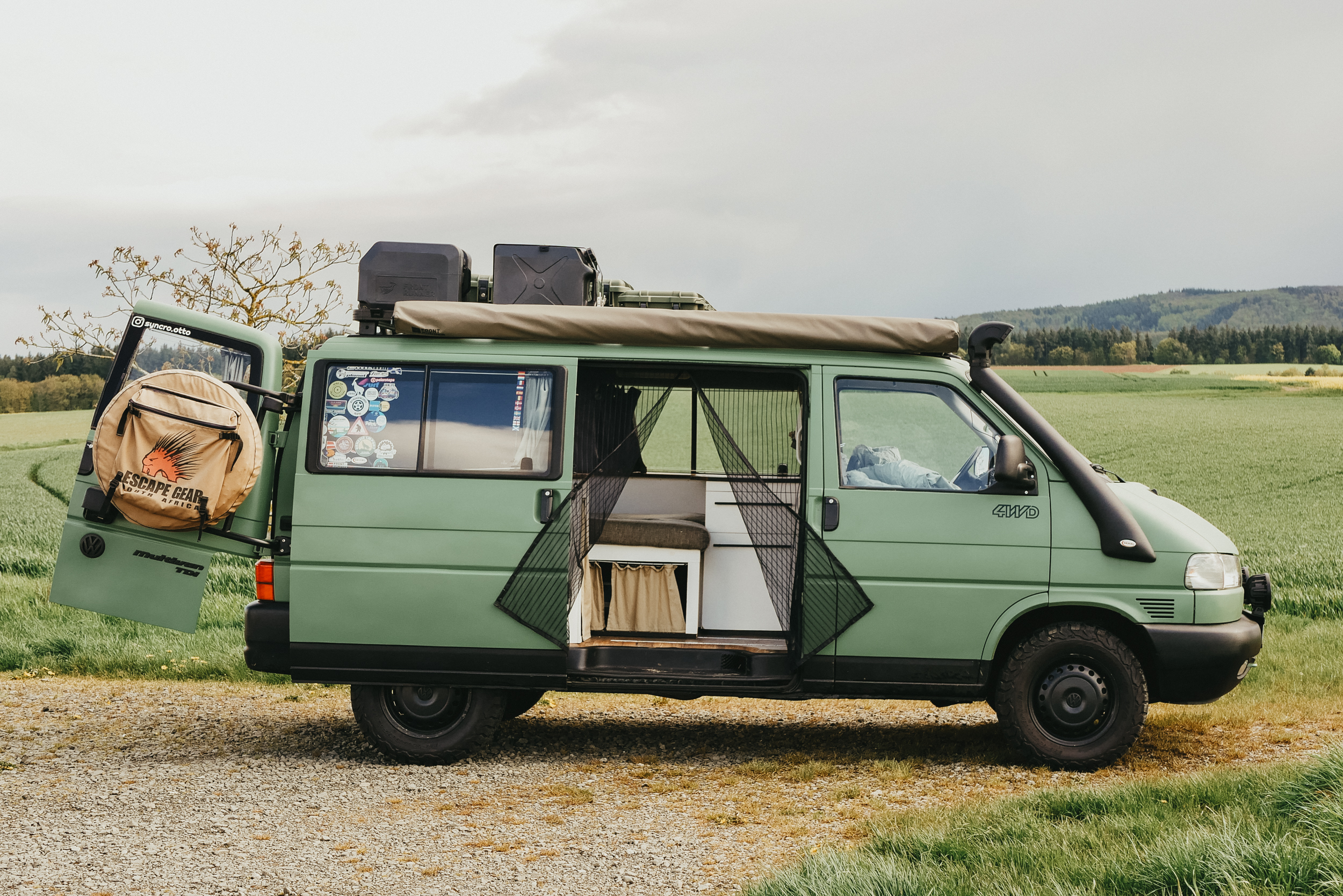
- Model: T4 Multivan Syncro, short wheelbase
- Year: 1999
- Colour: green (originally white)
- Engine: 2.5 TDi ACV
- Tyres/wheels: 215/75 R15 BF Goodrich KO2 on original steel wheels.
- Skid plates on the engine, gearbox and rear differential
- Suspension: Seikel
- Snorkel: Mitsubishi L400
About us
To introduce ourselves, we would each like to describe the other:
So, Jana is one of the most life-loving people I have ever met. It is simply fun to have such a cheerful, lively person around. She is incredibly creative and always has an eye for the beautiful things in life. Thanks to that rather pronounced creativity, she was responsible for a large part of planning the interior, or rather, she made sure it turned out beautiful and homely in the end. Professionally, Jana has a lot to do with food and helping people. So she probably has one of the loveliest jobs on this planet. To be precise, she is a qualified dietary assistant and added a BSc in dietetics on top of that training. It would be an understatement to say she loves her job. She burns for it. She would also love to discover the whole world and get to know every stone in person. Otto and I are, of course, happy to help with that.
And Max is actually called Maximilian, but that is always so hard to call out. In short: I think the qualities I love most about him are his calm, level-headed energy, the urge towards a healthy perfectionism, I sadly have an unhealthy one. And that in one moment he is quite unashamedly the funny little boy, and in the next the most grown-up realist. He completed a Master of Science in risk management at the HSU in Hamburg, and he genuinely enjoys his current work with the Bundeswehr, despite all the long journeys back and forth across Germany. With his love of cars and technology in general, he can also read up on the knowledge he needs for hours. He has already been able to fulfil the dream of a VW bus with Otto, just like that of the VW Beetle. So he, or rather we, spent a good while on it too.
Jana, Max and Otto on Instagram.
Looking for more inspiration for a T4 build? Here is an article about Christine and Lukas’s VW Bus T4 Syncro build.