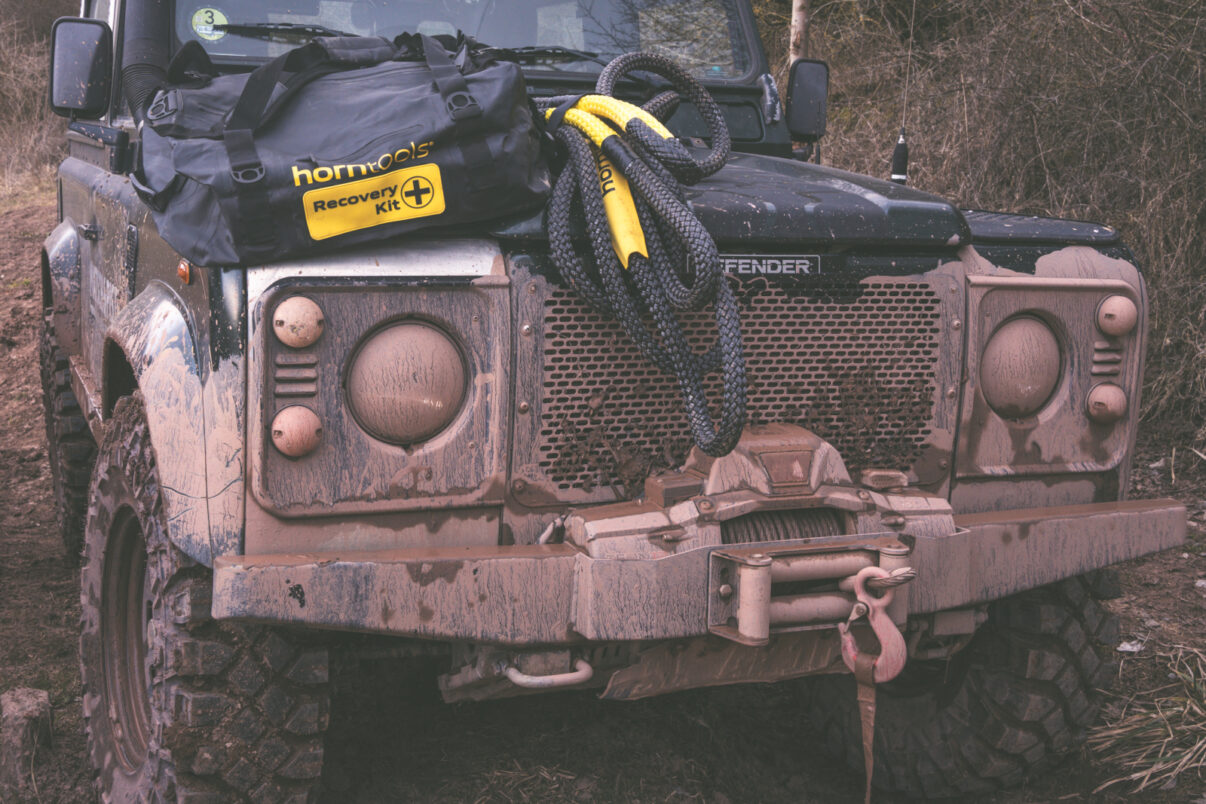

The horntools recovery kits contain all the accessories you need for a simple vehicle recovery. The good thing about the horntools kits is that all the gear is properly marked, so it’s tested and safe.
With the recovery kits, horntools offers a basic set for the three possible types: vehicles without a winch using kinetic ropes, vehicles with a winch and synthetic rope, and those with steel cable. In each kit the gear is packed in a practical, waterproof bag. The kits can of course be extended with individual components as needed.
Recovery Kit Kinetic
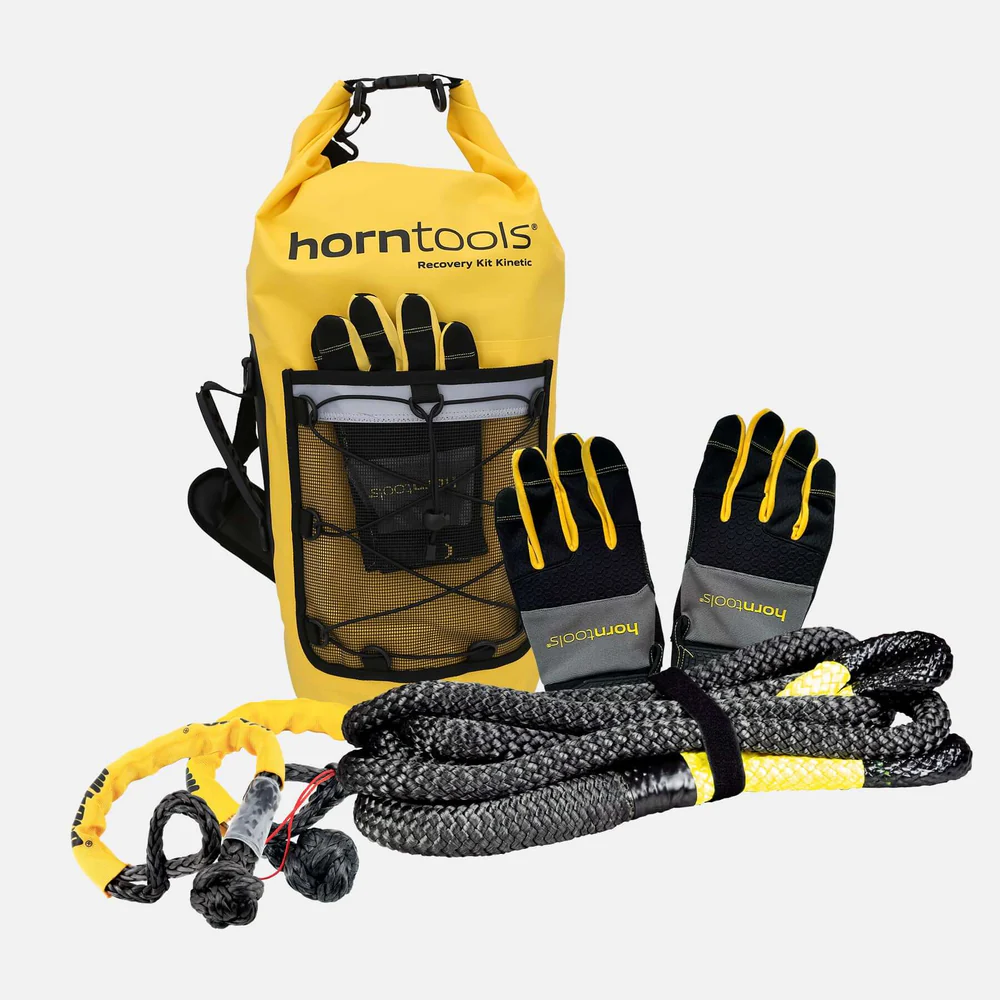
For vehicles without a winch or for desert trips, kinetic recovery ropes are a very good means of vehicle recovery. The kit contains:
- 1x kinetic recovery rope (6T WLL / 12.7T breaking load / Ø x length: 24 mm x 8.0 m)
- 2x soft shackles (WLL: 14 tonnes)
- 1x pair of winch gloves
- 1x waterproof carry bag made of 500D PVC tarpaulin
The 6 t WLL (Working Load Limit, see Recovery in the field with straps and ropes done right) is a well-judged figure for 4x4s up to 3.5 t gross weight. The pulling load is often overestimated, especially when the vehicle isn’t stuck up to the wheel hub in mud. Then often letting the air pressure down and a small tug is enough to free the vehicle.
Get yourself the horntools Recovery Kit Kinetic.
Our tip
Add the horntools 5-metre tree strap to the kit as well. It’s a nearly rigid strap that should be used before the kinetic rope. Pulling gently and slowly with a rigid strap is the first and gentlest recovery method. Without a jerk or a run-up, you try to pull the vehicle a little further. If that doesn’t work, then switch to the kinetic strap.
Recovery Kit Basic
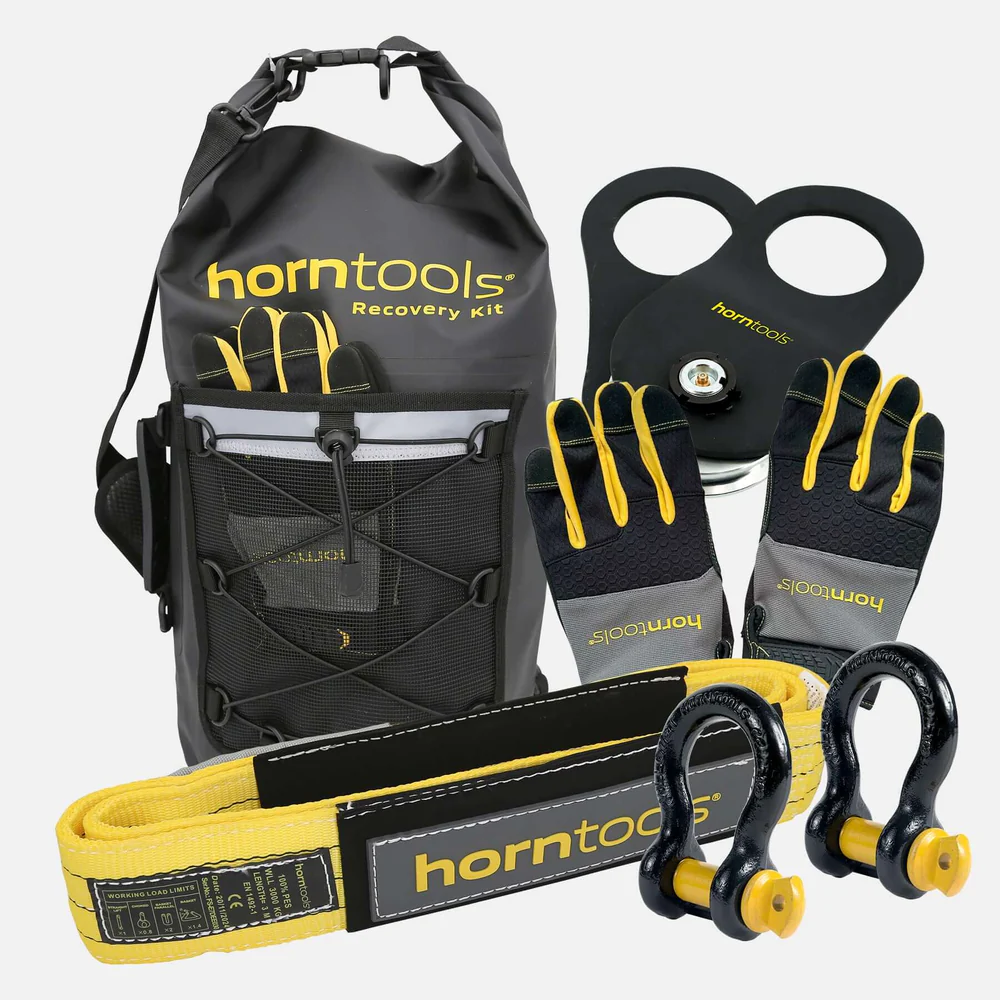
The set is meant for vehicles with a winch and steel cable. It contains everything you should have as a minimum of accessories for your winch with steel cable, the snatch block in particular. With this set you can mainly carry out a self-recovery. The tree strap serves as an anchor aid for your winch, or, when you need more pulling force and want to work gently on the gear, as an anchor point for the snatch block. To connect everything, two steel shackles are included (read our article on steel shackles: steel shackles).
- 1x 2 m recovery strap: a double-stitched strap with a breaking load of 21 tonnes and a working load of 3 tonnes, fitted with a sliding protective sleeve to guard against damage.
- 2x bow shackles, 4.75 tonnes
- 1x snatch block (12 T breaking load)
- 1x pair of gloves
- 1x waterproof black carry bag made of 500D PVC tarpaulin
Pack the horntools Recovery Kit Plus Steel in your vehicle!
You can read how to do winch recovery properly here: Winch recovery done right.
Our tip
If you’re heading into the desert, pack a kinetic recovery rope as well. When recovering in sand dunes, combining a winch and a kinetic rope is very helpful. Depending on the situation, sometimes one, sometimes the other gets you further. Use soft shackles with the kinetic rope. The horntools kinetic recovery rope: kinetic recovery rope.
Recovery Kit Plus Steel
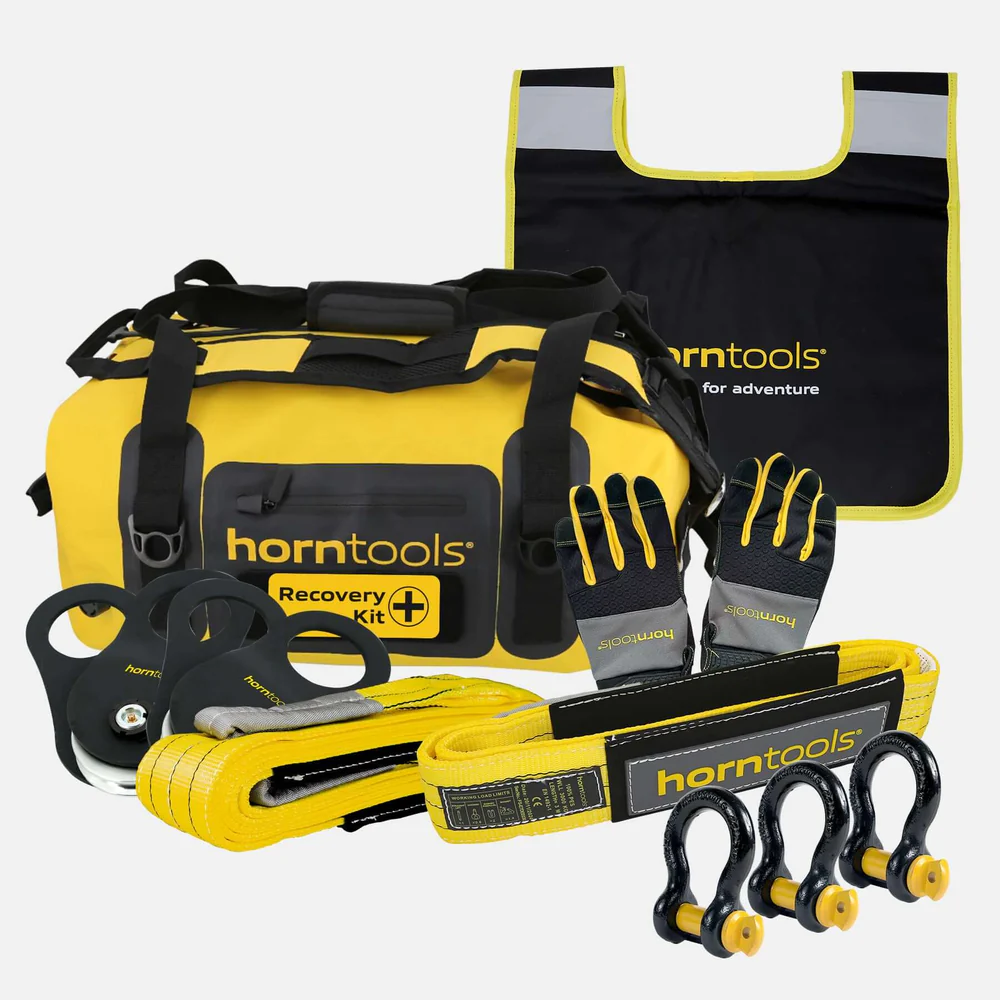
The Plus kit can be used for more involved recoveries. With two snatch blocks you can redirect and build a block and tackle. The recovery straps in different lengths can be used flexibly, and the protection blanket adds extra safety.
- 1x 3 m recovery strap (WLL: 3T / breaking load: 21T)
- 1x 6 m recovery strap (WLL: 3T / breaking load: 21T)
- 3x bow shackles (WLL: 4.75T)
- 2x snatch block (WLL: 4T / breaking load: 12T)
- 1x pair of winch gloves
- 1x winch protection blanket
- 1x Expedition Bag 40 L yellow (HDBAG40Y)
- 1x Patch (HPATCHPVCS_RECKIT)
Our tip
With a third snatch block and a fourth shackle you’re already kitted out to competition level. Then you can even shift your vehicle sideways with your winch.
Pack another horntools snatch block in the bag.
For perfect safety, use a second protection blanket too, since they’re best laid on the rope at the start and at the end of it.
More safety with the horntools safety blanket.
Recovery Kit Plus Synthetic
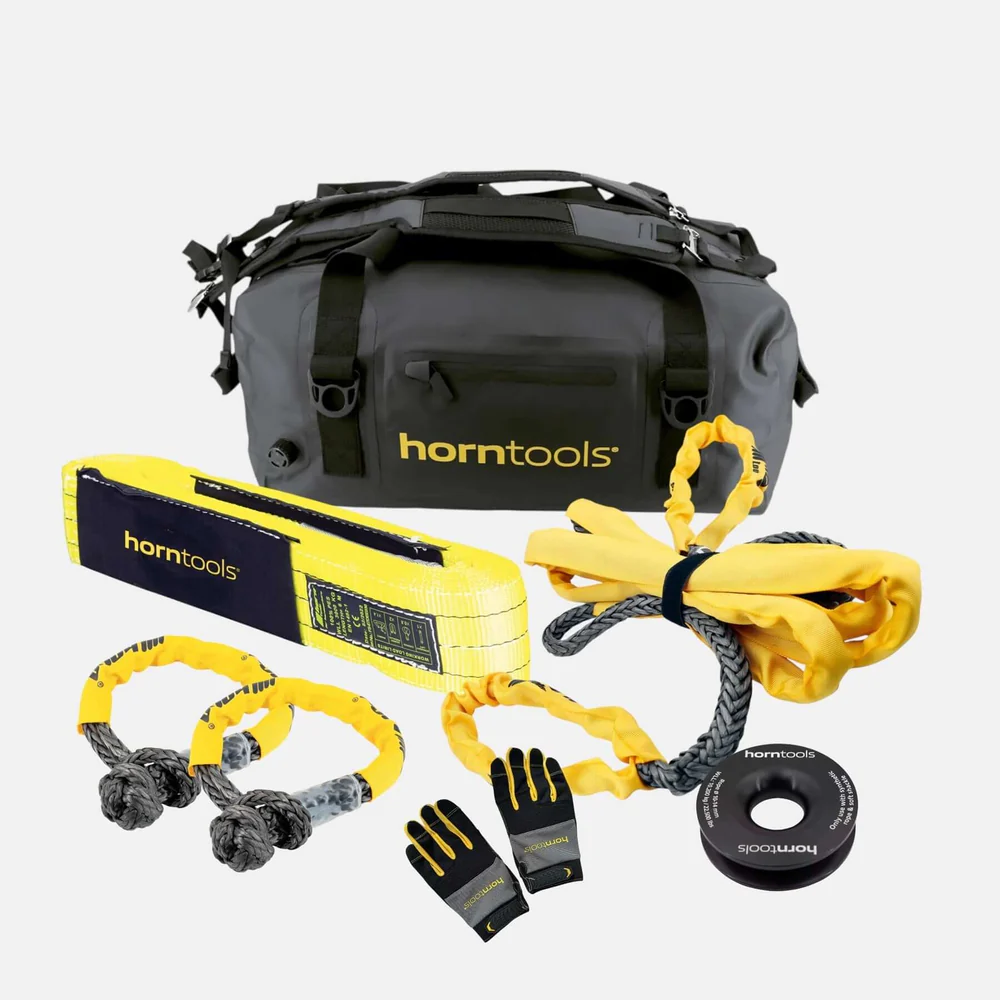
If you’ve got synthetic rope on your winch, this is the kit to go for. It’s matched to synthetic ropes, with a snatch block and several straps. We’ve already written about this set in more detail and tested it: horntools Recovery Kit+.
- 1 x Expedition Bag, waterproof, 40 litres (black)
- 1 x patch (“Recovery Kit Plus”)
- 1 x pair of winch gloves
- 2 x soft shackles with anti-chafe protection (14 tonnes WLL / load)
- 1 x snatch block / winch ring for synthetic rope (10.2 tonnes WLL / load)
- 1 x 5 m tree-strap extension (12 tonnes WLL / load)
- 1 x recovery strap, yellow (3 m long, 3 T WLL / load)
Our tip
Add the kinetic recovery strap to the kit. In some situations a kinetic recovery strap is quicker and simpler to deploy than using the winch. Use soft shackles with the kinetic rope. The horntools kinetic recovery rope: kinetic recovery rope.
The six stages of vehicle recovery
No sooner is the vehicle stuck than the “wild” recovery often begins. Yet there’s a simple, safe order you can and should follow for every recovery. It starts with simple, gentle, safe means and moves towards more dynamics and force.
- Four-wheel drive & locks
This might sound a bit odd, but it’s meant seriously. Have you engaged four-wheel drive and your diff locks? In the rush that does get overlooked sometimes. - Weight and digging out
Before you even think about recovery gear and using a second vehicle (if there is one at all), reducing the vehicle’s rolling resistance can be enough. That means clearing obstacles from in front of the wheels, digging them free, turning a steep ramp into a gentle exit. If everyone gets out of the vehicle or other weight can be unloaded for a moment, that alone helps get the vehicle free. And if the vehicle does have to be pulled later, a lighter vehicle is easier to recover too. - Improve traction, tyre pressure
Simply letting down the tyre pressure can achieve a great deal. In many cases dropping the pressure is the most effective way to get further. Depending on the situation, improving traction by laying branches, stones or recovery boards under the wheels helps too. - “Towing” with a second vehicle
Only now, setting the recovery board aside, does a recovery aid come into play for the first time. Towing is the gentlest, most careful way to recover with a second vehicle. The pulling vehicle is connected to the stuck vehicle with a rigid strap or rope. It slowly puts the rope under tension and tries to pull the casualty out without a jerk or a run-up. If that doesn’t work, move on down the order. Please don’t carry on with a run-up! - Winch
Now we’ve arrived at the winch. All the earlier steps help it with the pull. - Kinetic strap
The last option, before your vehicle is lost in the field for good, is the kinetic rope. With this method dynamics and force rise sharply, so start gently here too. If it doesn’t work, raise the intensity slowly, but not without limit, because then it gets dangerous and uncontrollable.
Our video on the horntools recovery kits
You are currently seeing placeholder content from YouTube. To access the actual content, click the button below. Please note that data will be shared with third-party providers in doing so.
© Images: horntools