


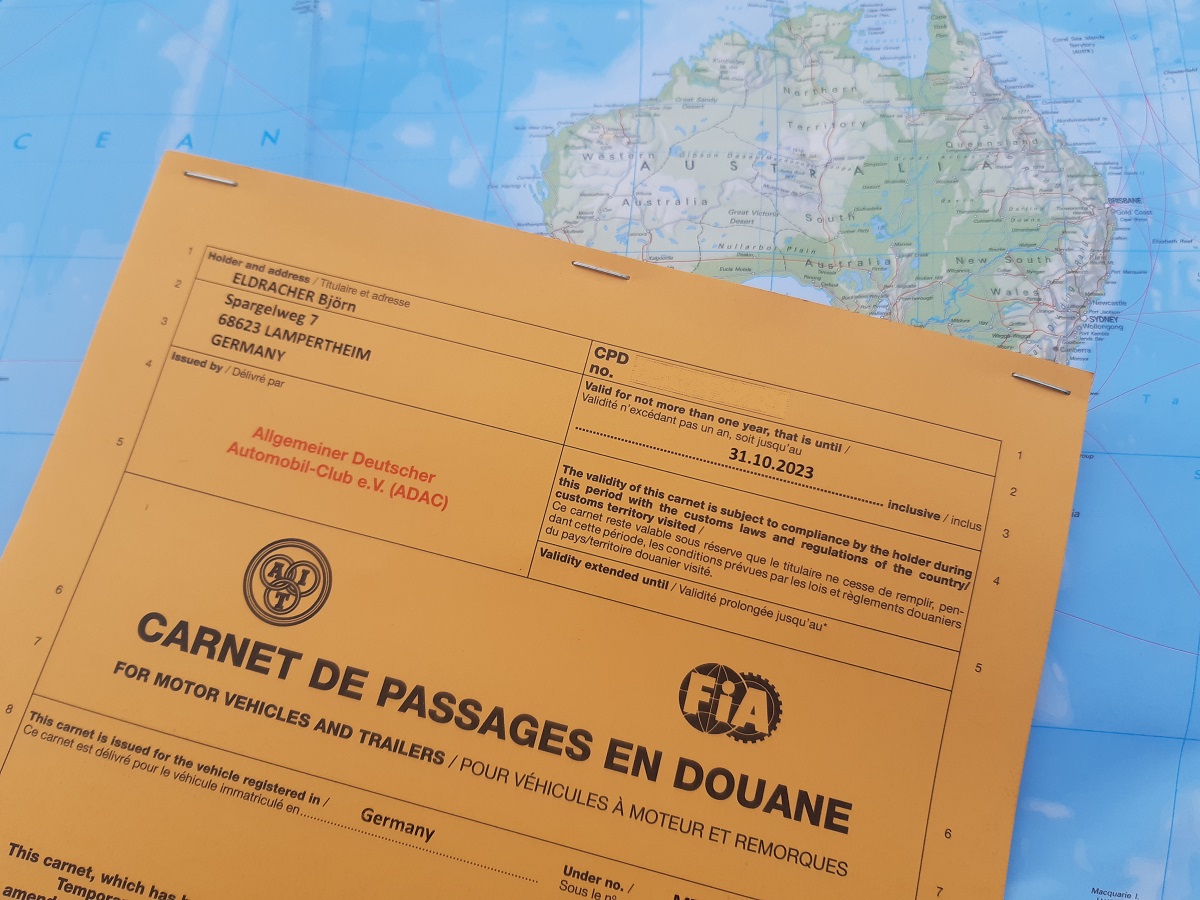

Having covered the international driving licence and its vehicle equivalent, as well as the topic of a second passport, in the previous parts of this series on documents for expeditions, part four is now about the Carnet de Passages.
If you’re planning a trip to Iran, Australia or Africa, you will surely have come across the Carnet de Passages. It all sounds terribly complicated, but it really isn’t. We show you how to get a Carnet de Passages for an off-road expedition, where you need it and what else there is to keep in mind.
The Carnet de Passages is your vehicle’s passport
That describes it quite well. In some popular travel countries you need an extra document to import your vehicle. Sometimes it is required, sometimes it makes things easier than a Temporary Import Permit (TIP for short). The Carnet de Passages.
The Carnet de Passages is a customs document and an internationally recognised guarantee for the payment of customs duties and import charges, which allows you to import your vehicle into another country temporarily and free of duty. Because in principle, when you cross the border you are importing goods, in the form of your vehicle. And that normally means import duties are due.
The Carnet de Passages thus makes the border crossing easier for you, and in some cases it is a condition for it. Your vehicle is described in detail in it, for example by the chassis and engine number. To have a Carnet de Passages issued, you lodge a deposit. This serves to settle the customs debt in the event that the vehicle stays in the country, for example through a sale. The amount of the deposit to be lodged depends on the value of the vehicle and the region in which the Carnet de Passages is to be valid. Currently, for example, a deposit of €15,000 is required for a vehicle worth between €25,001 and €50,000 for the Southern African Customs Union when issued by the ADAC. For a vehicle worth between €75,001 and €100,000 the deposit is already €40,000. The deposit can be lodged by transferring the security to an account or as a bank guarantee. You can find a precise overview on the ADAC website, more on that later.
By importing your vehicle temporarily under a Carnet de Passages, you undertake to observe the laws and regulations of the country you are travelling in, and in particular the customs conditions for import and export.
Where you need a Carnet de Passages on an off-road expedition
A Carnet de Passages is required in Australia and New Zealand, in some African countries, in Iran and Iraq and in many other popular travel countries. In some countries it is recommended to carry one. The ADAC has a very good overview of this on its site. You apply for the Carnet according to your route.
If you use it in countries where it is not strictly required, then pay particularly close attention to the correct handling at the borders to avoid problems later. Because in exactly those cases the border officials are not always familiar with it. We explain how to use a Carnet de Passages in detail later.
In practice, as so often, it can look completely different. And although almost everyone will probably tell you that a Carnet de Passages is required for certain African countries, travellers do of course keep proving that it also works another way.
Applying for and issuing a Carnet de Passages
Carnets de Passages are administered by the Alliance Internationale de Tourisme (AIT) and the Federation Internationale de l’Automobile (FIA). The issuing itself is usually delegated to the local AIT/FIA automobile clubs. In Germany that is the ADAC. In Austria the well-known ÖAMTC used to issue Carnets de Passages too, but has withdrawn from that line of business. ÖAMTC members can apply for their Carnet de Passages through the ADAC. In Switzerland you get a Carnet de Passages from the TCS Switzerland.
Let’s assume it is issued in Germany. To have a Carnet de Passages issued, the ADAC currently charges €230 for members of an FIA club. Without membership, €330 is payable. There may be additional costs if delivery or forwarding by courier is wanted or needed.
For the application you need:
- the signed application
- one copy each of the applicant’s passport or ID card
- a copy of the vehicle registration certificate Part I
- for motorhomes and camping vehicles, a current proof of value is now also required
- where applicable, the declaration of joint liability signed by the vehicle owner, if you are not the owner
- where applicable, a bank guarantee
The additional proof of value became necessary after problems arose due to vehicle values being declared far too low. Time and again, applicants sadly tried this way to keep the deposit to be lodged as small as possible.
To apply, you fill in the application and send it, in good time before departure, together with all the documents by post or email to the ADAC. The deposit as per the table is to be transferred in advance to the account named in the application. The issuing costs are to be paid as well.
The Carnet is issued with a validity of one year. A start date up to four weeks ahead is currently possible. Forwarding by courier can also be arranged against payment of the corresponding costs. That makes sense whenever you first travel for some weeks or even months before you reach a border where you need the Carnet de Passages.
Using a Carnet de Passages on an off-road expedition
Once you get the Carnet de Passages and have signed it, the first thing you do, as with all important documents, is make a copy and keep it separately and safely. That can help if it is lost. You are liable for the consequences arising from loss or even misuse of the Carnet. By the way, the Carnet is an official document and remains the property of the issuer. So keep it very carefully. Also check the Carnet closely for completeness and correct details after you receive it.
The Carnet contains a whole range of data about your vehicle and about you. Because a Carnet de Passages can, at least with the ADAC, only be issued to one person (the registered keeper) and one vehicle. If the keeper and the driver of the vehicle are not the same person, problems can regularly arise at border crossings, for example. In the last part we already pointed you to the topic of a power of attorney for this case. Have another look if needed.
The Carnet de Passages has 25 pages for the border formalities. Each page is in three parts. The bottom part is stamped and torn out on entry into a country and stays with customs (importation voucher). On leaving the country the middle section is stamped and torn out (exportation voucher). It also stays with customs. The third section is stamped on entry and exit. It stays in the Carnet de Passages and is your proof of correct import and export from the country in question (counterfoil).
At the borders you watch and check closely that all of this is done correctly. The refund of your deposit, or any customs claims, depend on clean and orderly documentation.
Return and onward travel
On returning to your home country, or re-entering the EU, the Carnet de Passages is stamped for the last time and the certificate of whereabouts is filled in. After that you present it to the issuer and, once it has been checked and if everything is in order, you get your deposit back. By the way, if you didn’t need the Carnet on your trip, you can send the unused Carnet de Passages back to the ADAC without filling in the certificate of whereabouts.
If the vehicle is irreparably damaged along the way, for example by an accident, or lost or stolen, and stays in the country, be sure to have this documented by the local police (also on the certificate of whereabouts) and agree the further steps with the customs authorities and the issuer of the Carnet de Passages.
If you travel on after the validity of the Carnet de Passages has expired, please arrange a follow-on Carnet in good time. You will find plenty of other good and important information about the Carnet de Passages on the ADAC page on the subject.
You have to act again in good time before it expires
For onward travel you then need a follow-on Carnet and, for that, the same documents as for the first application. You send these to the issuer again a few weeks before the validity expires. The ADAC can also send the new Carnet by courier to many countries around the world, against reimbursement of the costs.
With the old, still valid Carnet de Passages you then leave the current country, have it stamped out and enter the next country with the new Carnet. In some countries it is also possible to have the new Carnet stamped in within the country. It is best to find out about this on site. You send the old Carnet back to the issuer by the safest possible route. The ADAC also needs a copy of the first inside page of the new Carnet, which contains the new stamps and the vehicle data.
Another option when the Carnet de Passages expires is an extension within the country, which is usually possible for up to three months but does not entitle you to travel on to another country. You have to apply for this extension about four to six weeks before the Carnet expires, with the issuer and the local automobile club in the travel country.
Many travel plans are so individual that we cannot go into every single case. The ADAC runs a border-traffic department. There, during telephone hours on +49 (0)89 76 76 63 38, you will in our experience get friendly and competent advice.
In the first part of this series on documents for expeditions we covered the international driving licence, and in the second part we introduced the international vehicle registration. The third part is about a second passport when travelling. You’ll find more tips for preparing your next trip on our topic page Trip planning.
Which other topics around travel documents interest you? Write to us. We look forward to your suggestions.