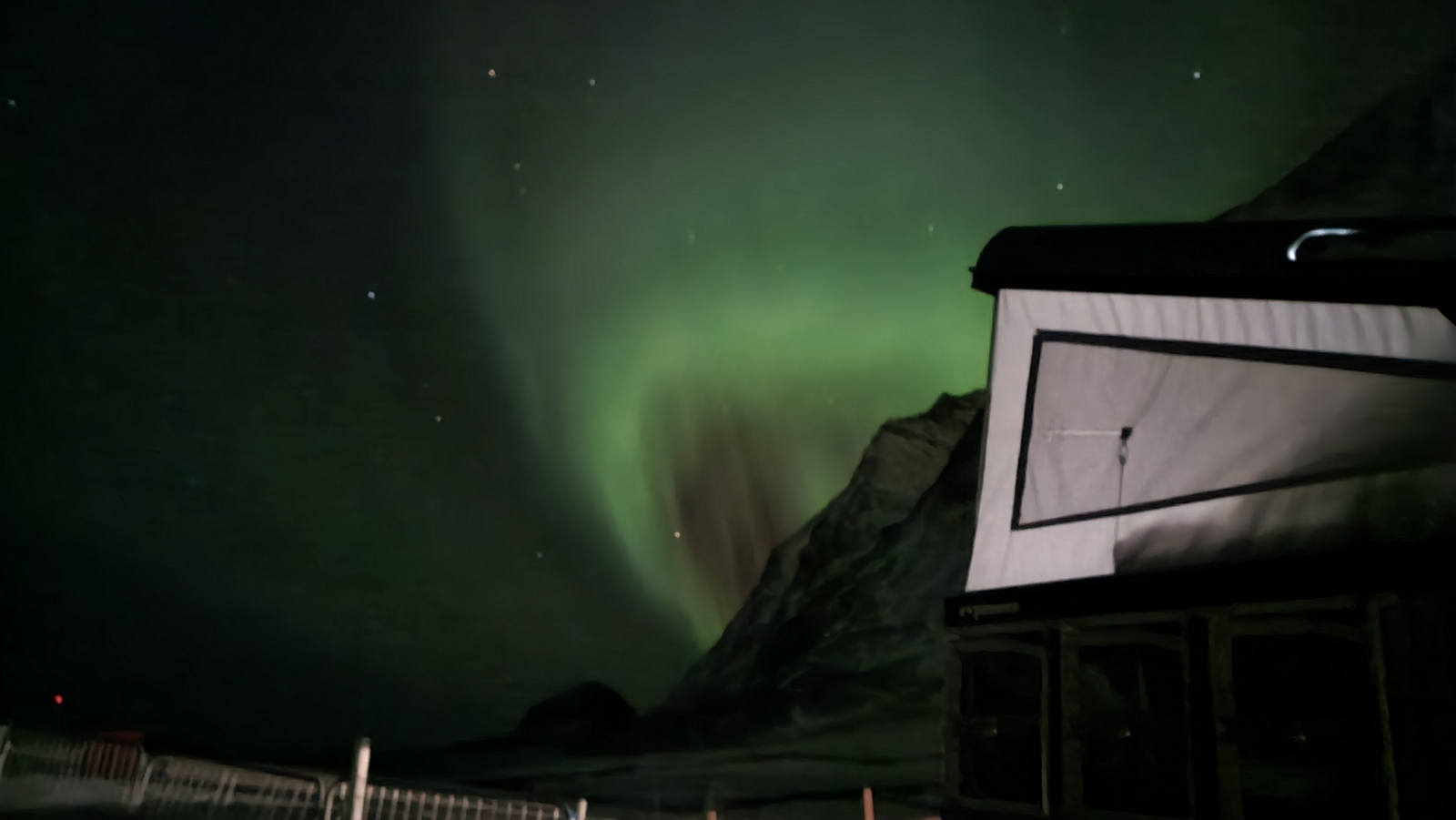
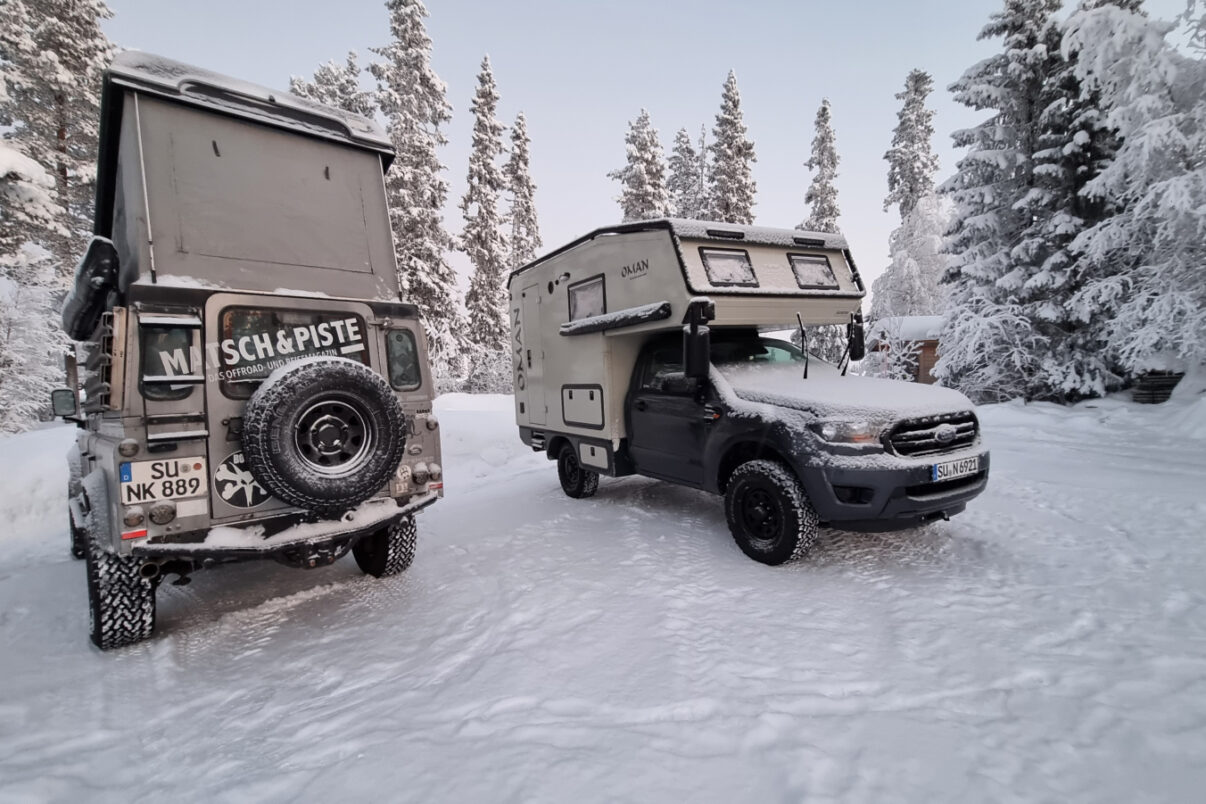

It was meant to be a relaxed winter-camping trip in Scandinavia. We had reckoned with temperatures around -20°C. But then we ran into one of the harshest winters in decades. At temperatures below -40°C, the vehicles and we were pushed to our limits. How we prepared for the -20°C, what problems we hit in the end and what we experienced, you can read in this report.
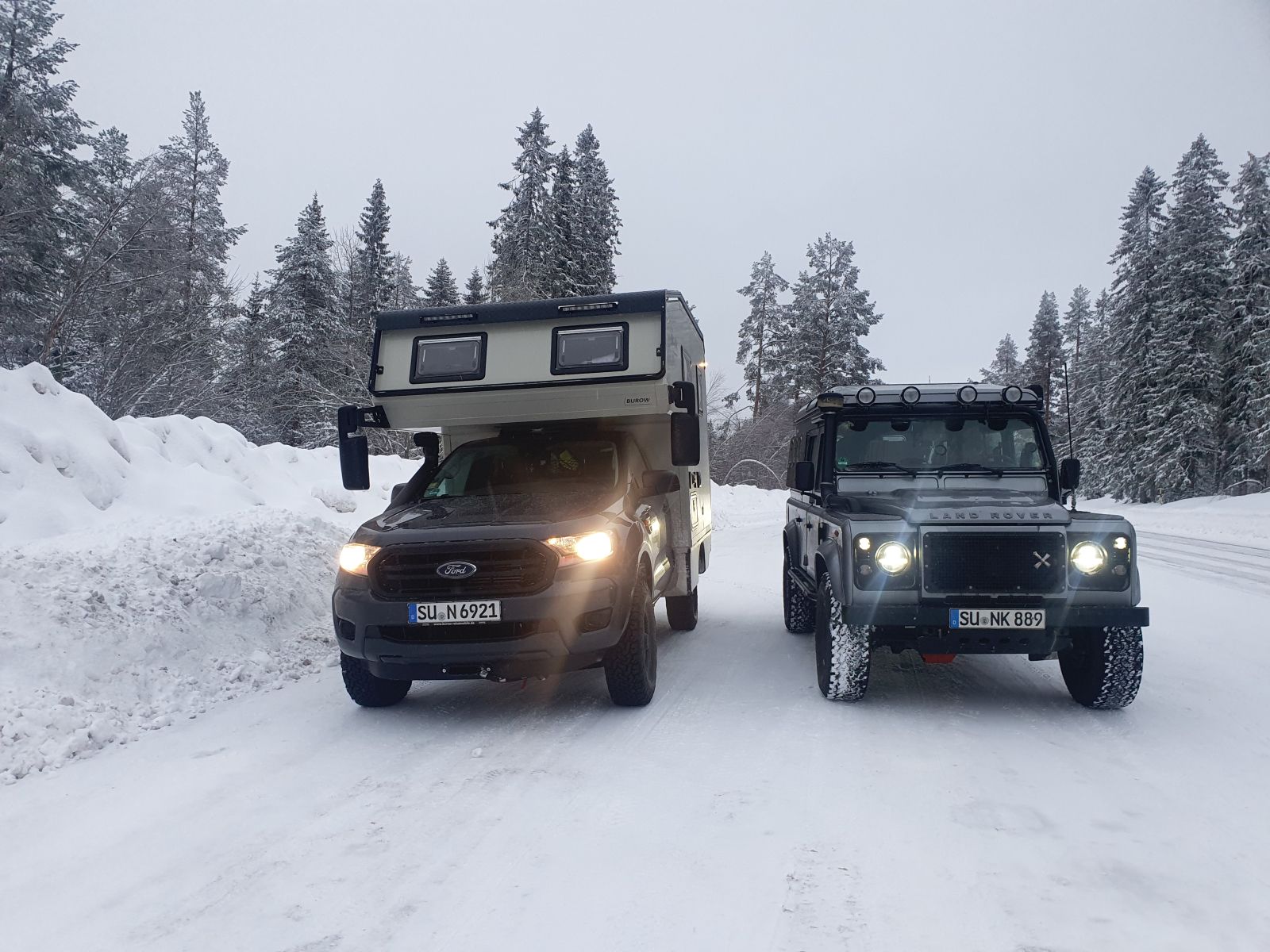
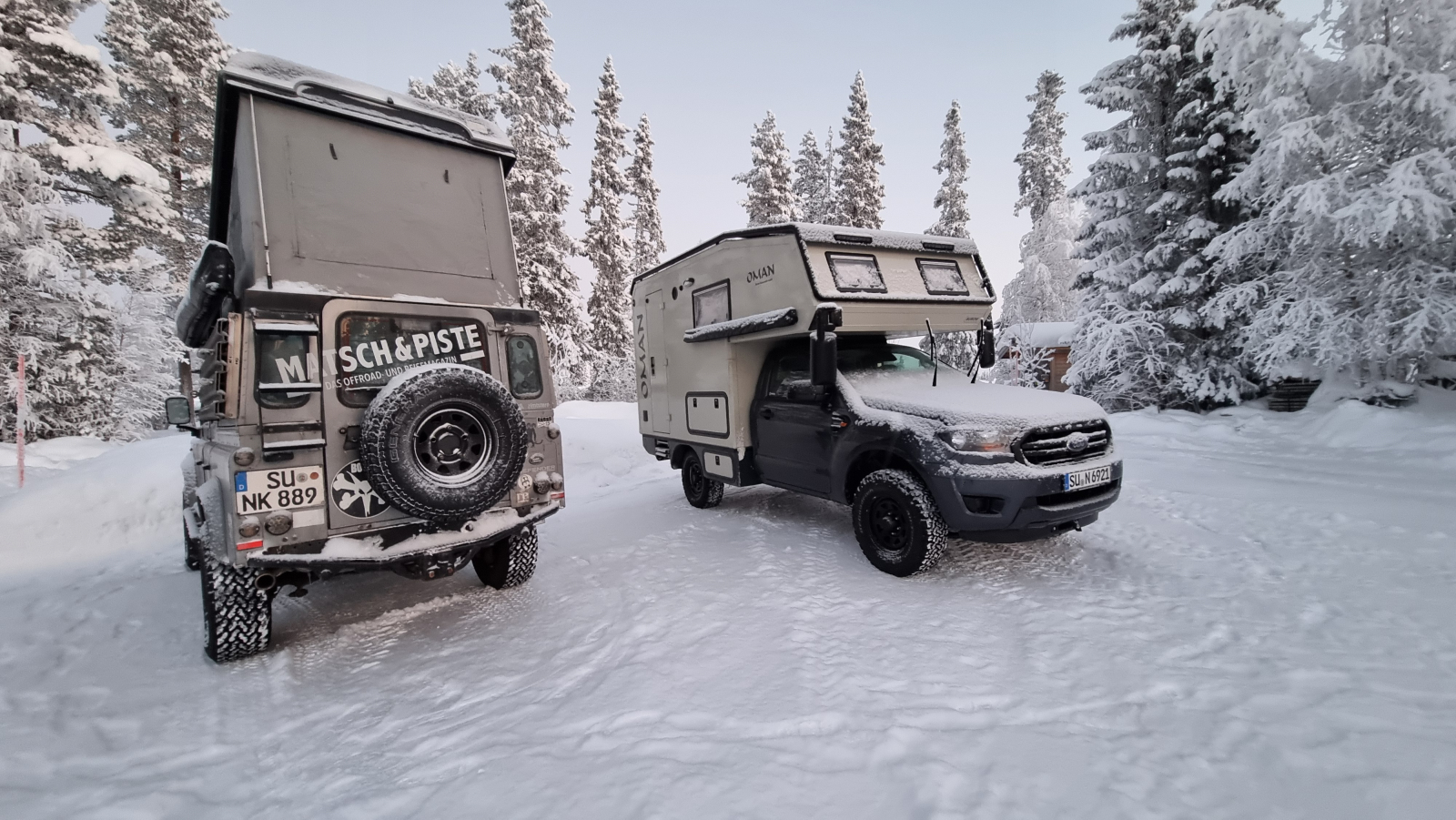
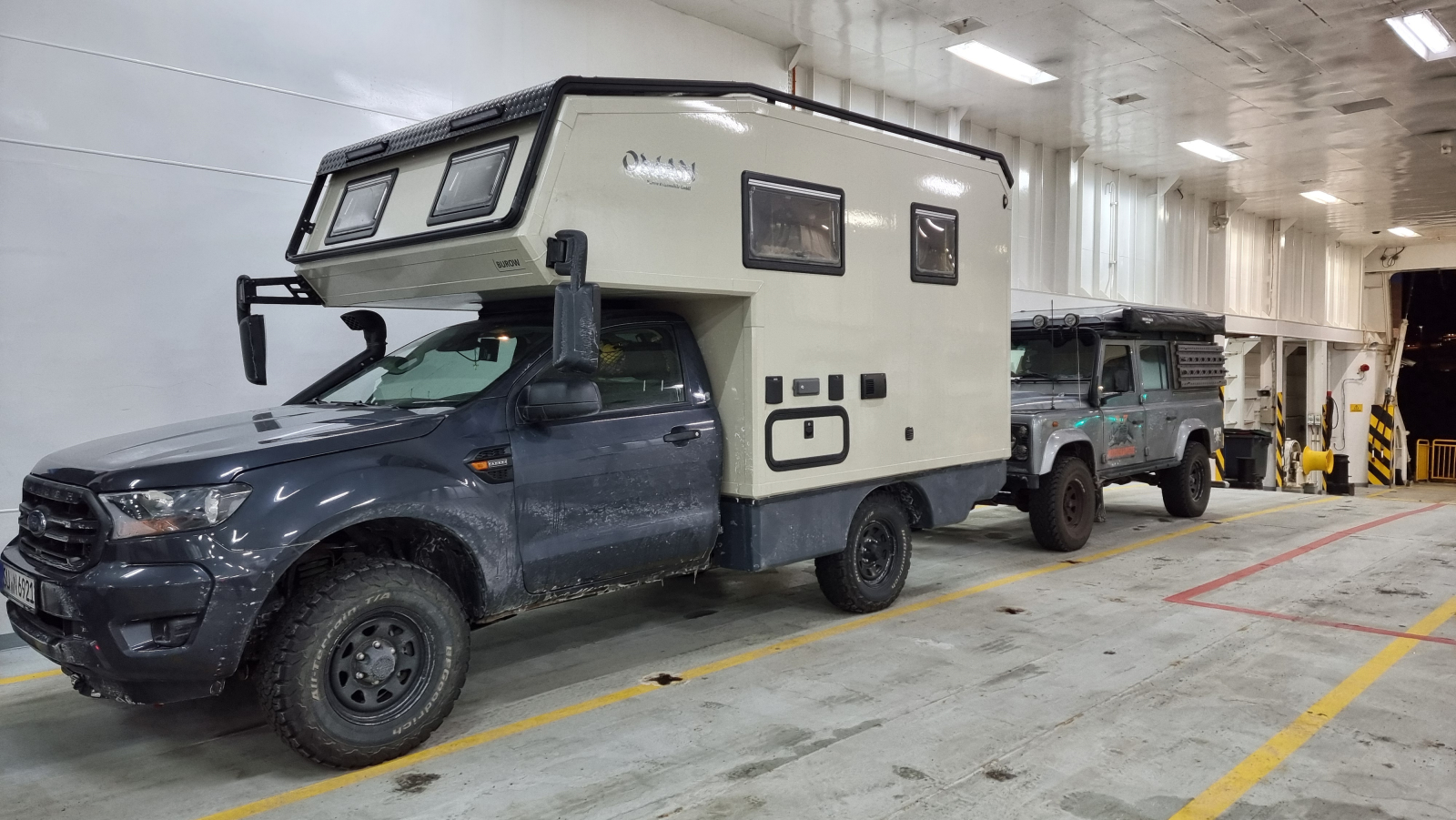
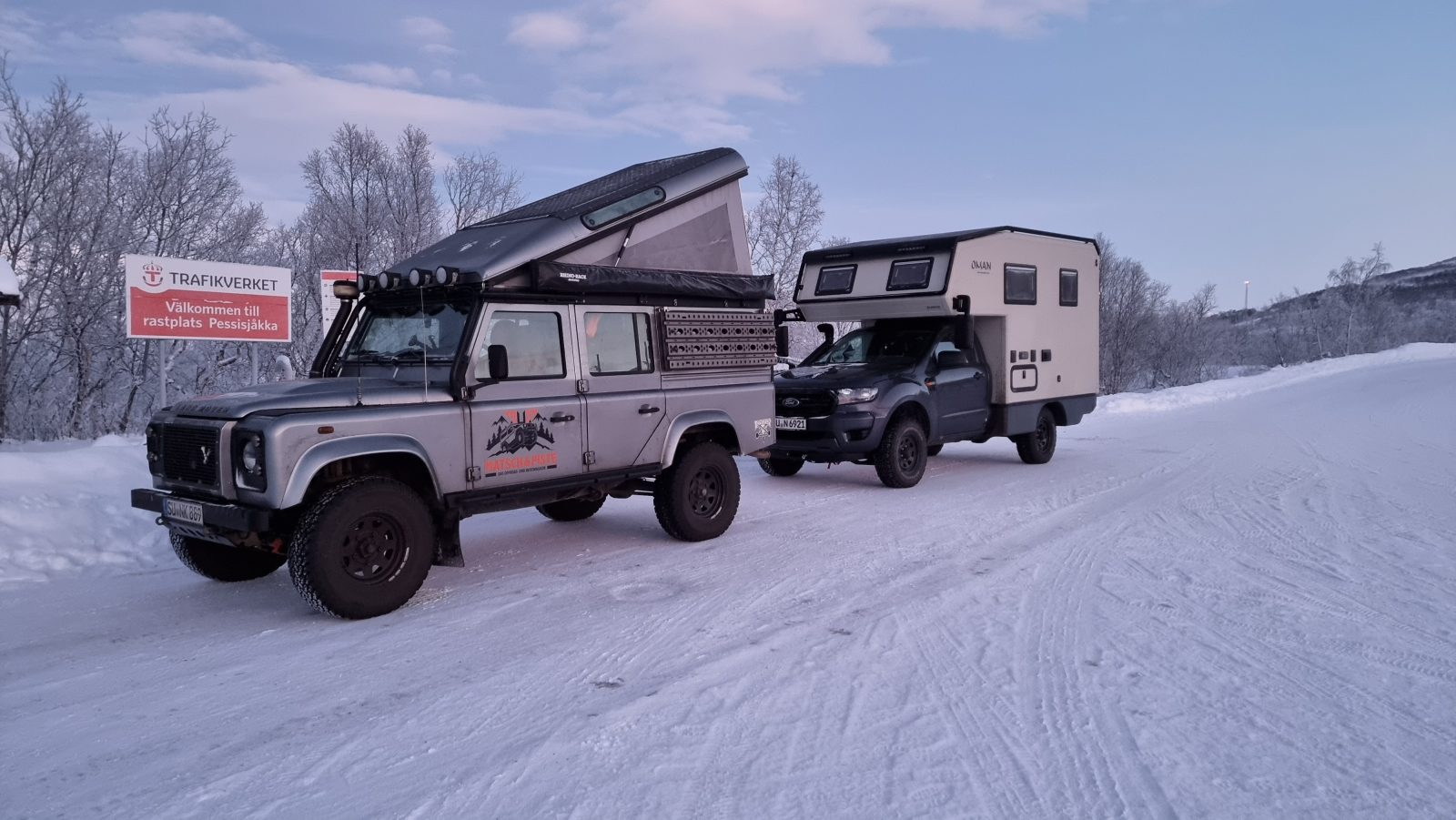
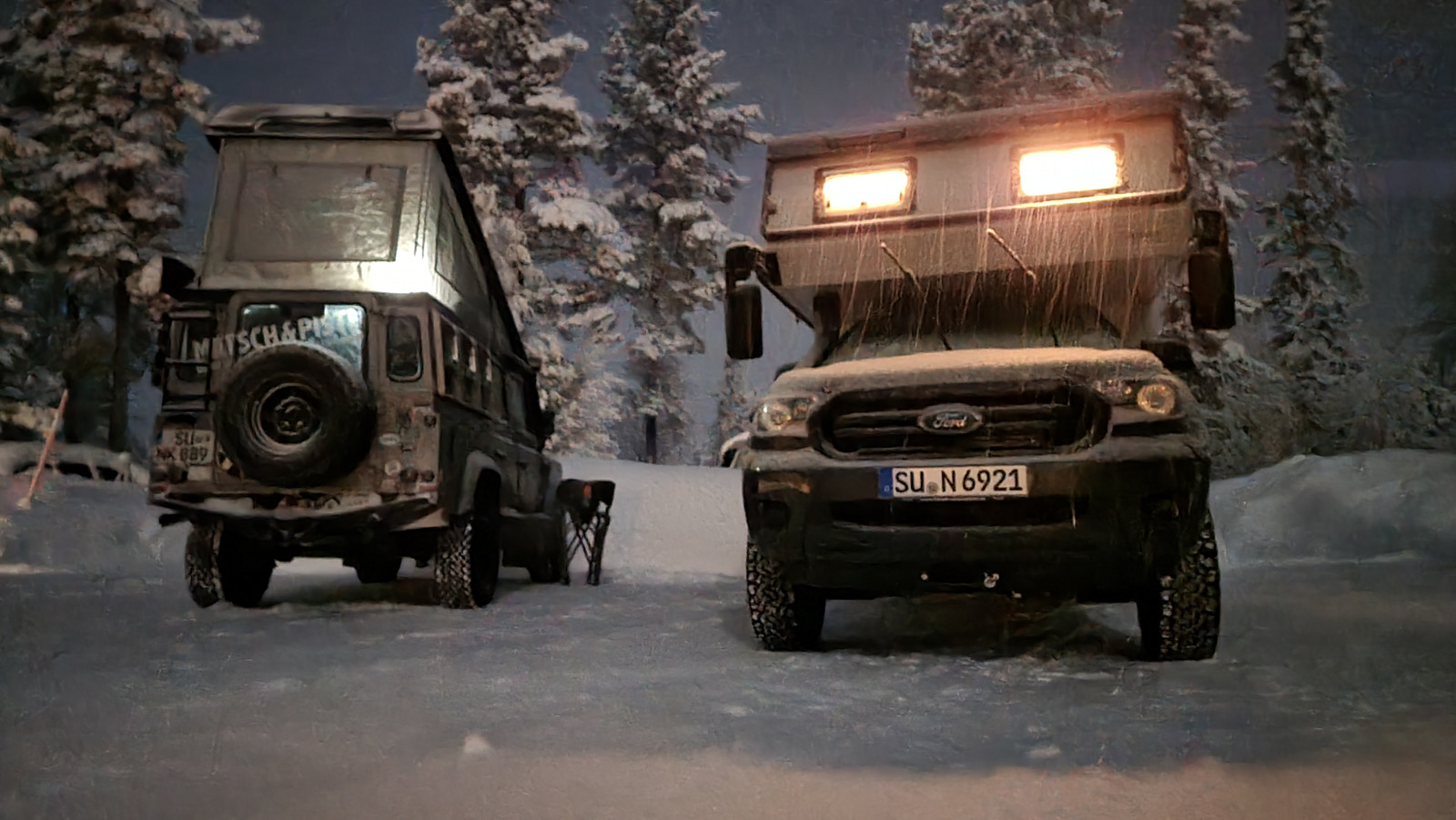
Of course we weren’t naive or unprepared. We had certainly reckoned with temperatures down to -25°C and below. “We” means me with a Land Rover Defender Td4 Station Wagon with a pop-top roof, and Kim & Niklas from @bubi.tours, who were out in a Burow motorhome Oman based on the Ford Ranger.
The preparation
Since we were travelling in completely different vehicles and set-ups, the preparation went differently. I’ll call Kim & Niklas Team Burow from here on. Team Burow set off with a Ford Ranger from 2022 with an Oman body from Burow Reisemobile. That is, a vehicle with AdBlue, an insulated cabin, fresh and waste water tanks, a night heater and everything a motorhome has to offer. I turned up with a Defender 110, partly insulated (floor, rear side walls), a night heater and a pop-top roof with no side insulation. So far so good. For driving on snow and ice we had AT tyres, Team Burow went for BFGoodrich KO2, me for General Grabber AT2. On top of that, each of us had a set of snow chains along.
The vehicles
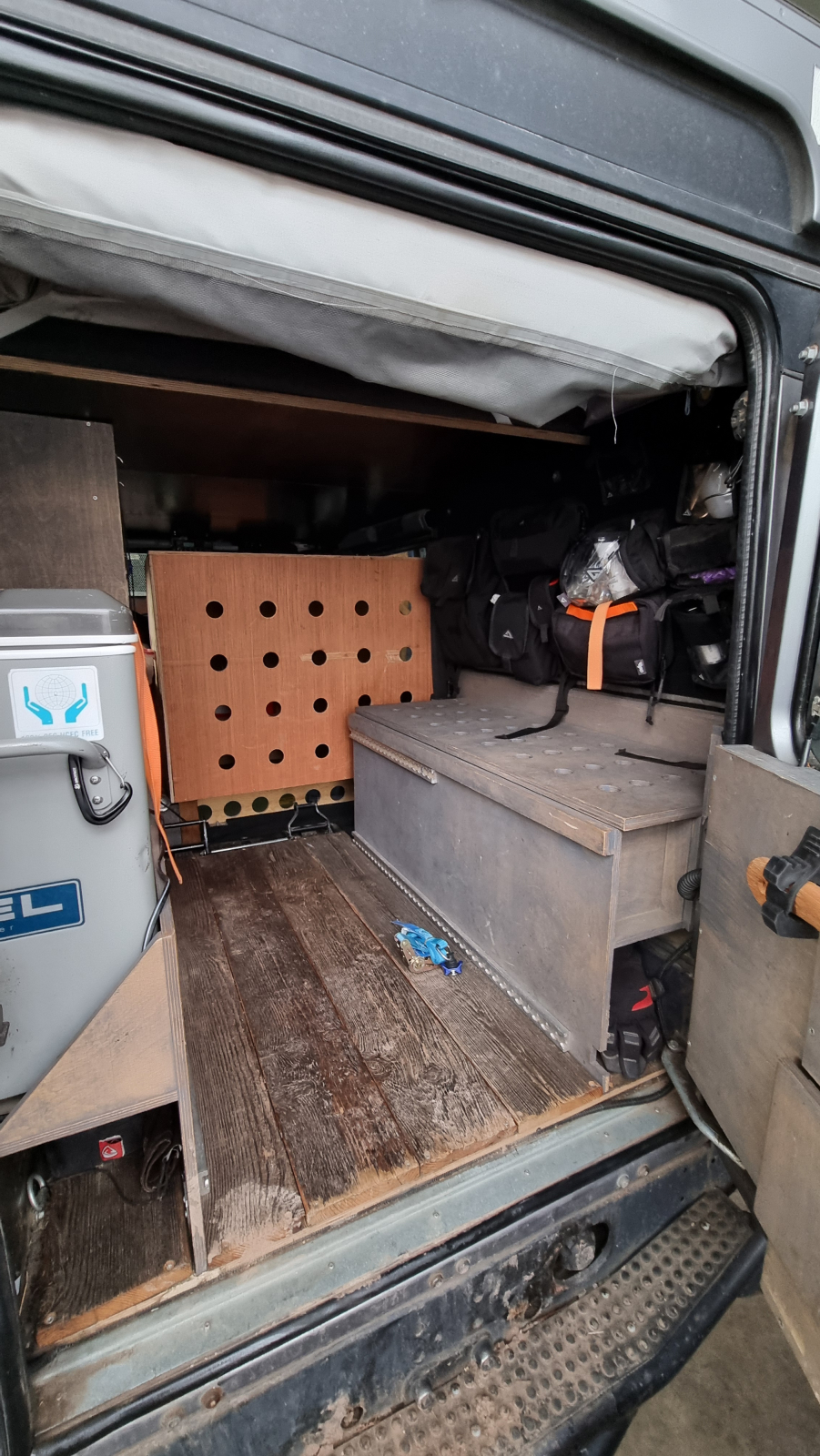
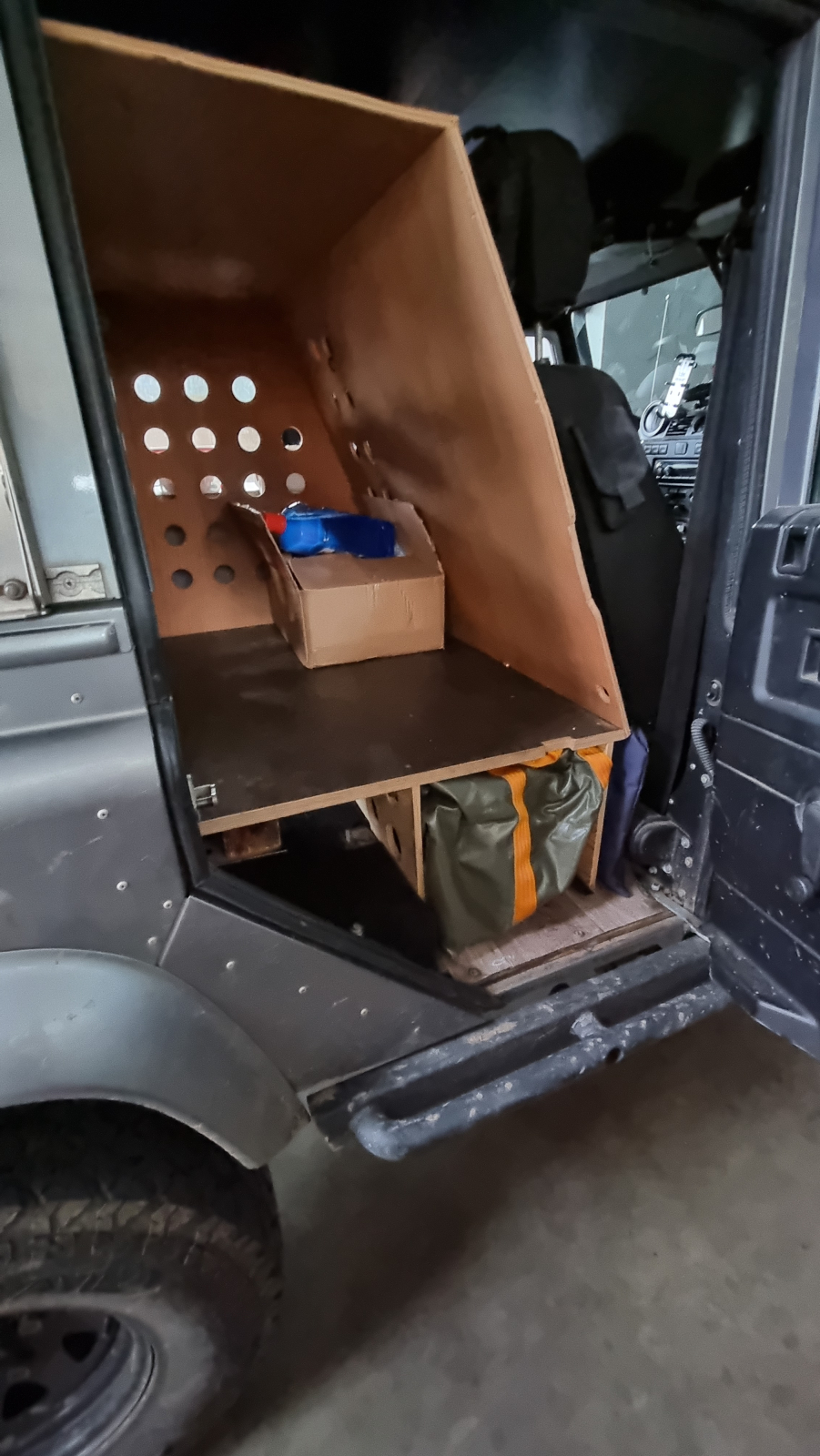
Besides the personal gear, the main focus was on getting the vehicles fit for the cold temperatures. All cold-relevant areas were checked and improved where needed. As I don’t have the luxury of much space in the vehicle, I also worked out a way of loading it so I could reach and do as much as possible from inside.
In detail that means I stowed a set of crockery and cutlery and bread in the bench seat. Sausage, cheese, milk and meat I kept in the cool box, which was also to serve as a table for the stove. The night heater works in that area, while probably not much warm air reaches the side compartments. I kept my supplies in a transport box in the dog crate, reachable through the rear side door. It’s a bit cooler there than in the boot.
Of course a set of Blidimax thermal mats was along too. I covered the side windows with them permanently, and the rear side windows too. When it gets cold, I plan to cover the remaining windows with them as well. That should help keep the warmth in, especially as the tent fabric of the pop-top roof isn’t insulated and a lot of cold will get in there.
My plan was to keep the interior above 0°C at all times, while driving and when parked. As the Burow motorhome’s cabin is decoupled from the vehicle heating, the 6 kW Truma diesel night heater ran there the whole time, even while driving. By remote control the two of them could regulate and monitor it very conveniently from the driver’s cab. The waste-water tank drain was left open so no water stands in the uninsulated tank. The fresh water was to be protected from freezing by its contact with the heated cabin air.
Engine oil
Normally we don’t give it a thought. In most cases we don’t have to. But if really low temperatures are to be expected, you should have a look at the data sheet for your oil. The pour point is given there. Below this temperature, oil loses its ability to flow. A few degrees colder and the gel point is reached, at which the oil then solidifies. Lubrication only works down to the temperature given at the pour point.
The oil in my Defender works down to -42°C, it’s a 5W-30 multigrade oil. If you know you’ll be going beyond these limits, you have a problem. You have to stick to the engine manufacturer’s specification for the oil. The more modern the engine, the tighter the limits are set. There is the viscosity figure, which says something about the oil’s resistance in relation to temperature. But there is also the oil specification, which states whether the oil is suitable for diesel particulate filters and catalytic converters, for example, or not.
As long as the specifications fit, oils with a lower viscosity are generally better suited to colder regions, because they stay thin enough despite the cold. If you normally run a 5W-30 oil, a 0W-30 could be the better choice, if it’s approved. With such oils the pour point can be lower too.
Also think about your return. If you drive many kilometres in warm temperatures on the way back, a 0W-20 oil can be too thin, because it can’t stand up to the heat-induced thinning of the oil. Then it gets too thin, the oil pressure drops and, in the worst case, the oil can’t hold the pressure it needs to at the necessary points.
What applies to the engine oil applies to the axle and gearbox oils too. All of them have to be fluid enough at the low temperatures and mustn’t get too thin when they warm up. Look at the data sheets.
You see, it all has to fit together. A good vehicle maker gives you a table in the handbook or workshop manual showing the temperature ranges in which which viscosities can be run. But it’s also clear that off-the-shelf oils can be run at low temperatures without trouble. In fact I’d see -40°C as the limit. Anyone who wants to go beyond that should look closely into the relevant fluids and switch to the necessary oils before the trip.
Coolant antifreeze
Of course I checked the engine antifreeze beforehand. I started out with frost protection down to -25°C, Team Burow had protection down to -35°C even without extra preparation. It’s best to get yourself a refractometer. With it you can check the washer fluid and coolant antifreeze and, if the battery isn’t maintenance-free, the acid level of the battery too. Especially if the vehicle hasn’t been serviced for a long time, if the coolant hasn’t been changed or if water has often been topped up, the frost protection can have changed. You should know in any case how yours stands.
Fuel
Both vehicles have diesel engines. We made no preparation at all for that, no heating sleeves or the like were bought or fitted. The motto was: whatever the Scandinavians drive at home, we can drive too. We only made sure that when we arrived in Sweden we had run the tank down as far as possible, so we could fill up there. I can also say at this point that we can already close the diesel topic, because that’s exactly how it went. The diesel gave us no trouble.
It should be said, though, that in Finland you have to watch the grade. There’s the Arctic diesel and, alongside it, a non-winter version. Acquaintances of Team Burow, who were there at the same time, filled up the wrong diesel and promptly ran into problems. For Sweden and Norway, at least, the local supply always worked frost-free.
Fresh and waste water
On the Burow the fresh-water tank sits only partly in the heated interior. It’s built through the cabin floor, so the upper part is in the storage space but the lower part is outside. The waste-water tank is outside the insulated cabin, and at least the drain stub is supplied directly with warm air.
For lack of any tanks, I took a 20-litre water canister, which I kept inside. For drinking I use bought water bottles and, since it was simpler to handle, for brushing teeth too.
Other things on the vehicle
I smeared all the door seals thoroughly with Vaseline. Should it need re-applying during the trip, at a pinch lip balm does the job too. I didn’t need to top it up and the Vaseline worked well.
For a traction emergency I packed a few snow chains. It’s strongly advisable to practise fitting them. Bear in mind that if you want to fit them in the cold and by torchlight, perhaps in heavy snowfall and possibly at the roadside, it has to go quickly, safely and correctly. You don’t want to be crouching there with frozen fingers, holding on to the crumpled instructions with their tiny print so they don’t blow away, while fiddling with the ice-cold metal chains, only for the chain to wrap around your axle after a hundred metres.
Personal gear for winter camping in Scandinavia
For personal gear there was clothing to suit low temperatures. Thermal trousers (to -15°C), thermal over-trousers (to -10°C), snow boots (Meindl Sölden), a thick winter jacket, the Tvioddi from 66 North, hats, gloves, warm Nakatanenga merino winter socks. Plus a fleece jacket and long shirts. Absolutely recommended, and indispensable both for cold protection and for comfort, is a proper merino base layer. I go for long 200-weight long johns and vests. 200 means 200 g/m2. The garments should have at least 80% merino content. This material not only keeps you warm, it can also be worn for several days without any problem or smell.
For sleeping I used an Ajungilak sleeping bag, rated comfortable down to -20°C. Plus there was the night heater.
The plan
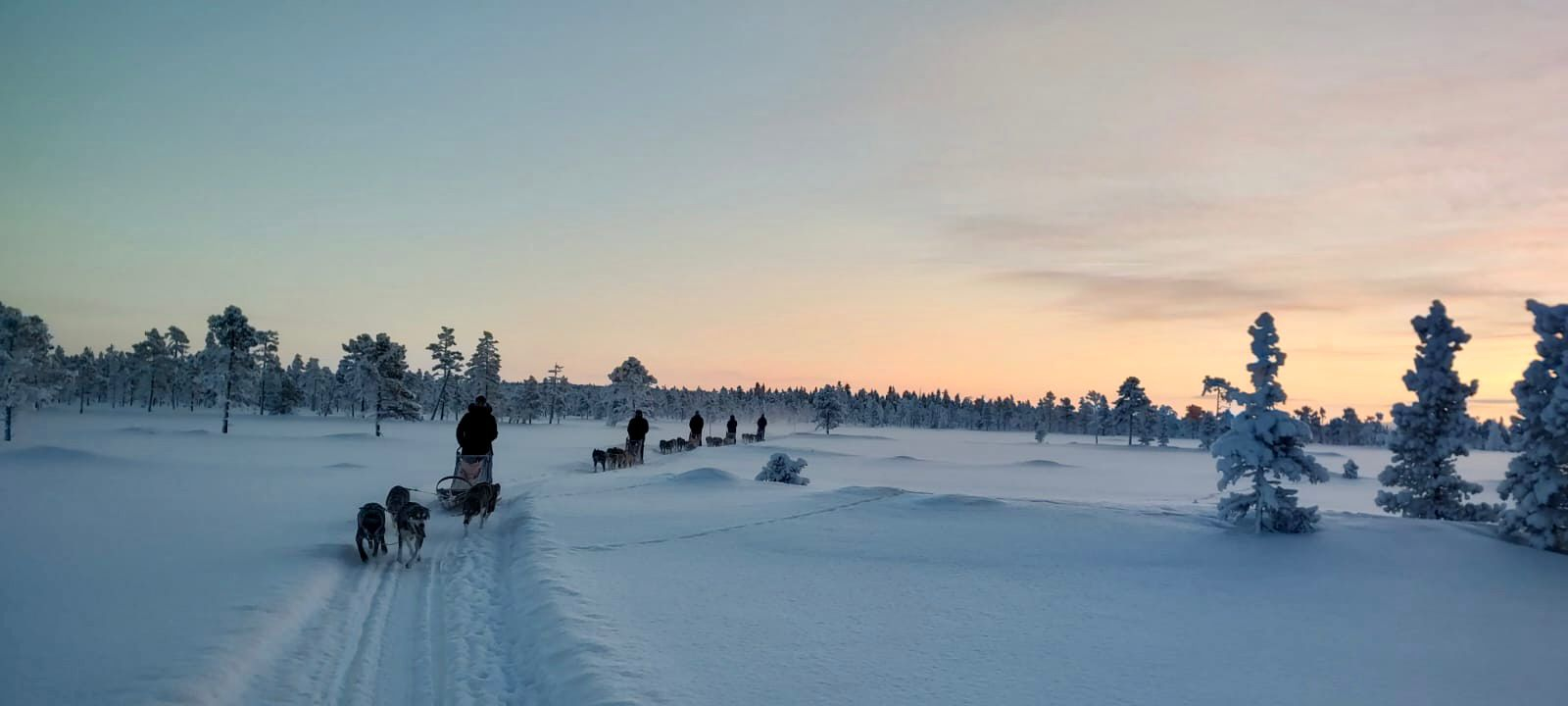
Our plan was first to see in the New Year in Lapland, just below the Arctic Circle at Veijejaur, and to do a husky tour on New Year’s Day. All three of us are dog lovers and dog owners too. Kim & Niklas had therefore tracked down a provider who treats his dogs very responsibly. That mattered to us. Our choice fell on Uschi and Steffen, who also turned out to be loving and helpful hosts. From Veijejaur we wanted to cross the Arctic Circle to travel on to Rovaniemi in Finland. Finally the Lofoten in Norway, from north to south, were on the programme. But as it goes: “Man plans and God laughs.”
How it turned out
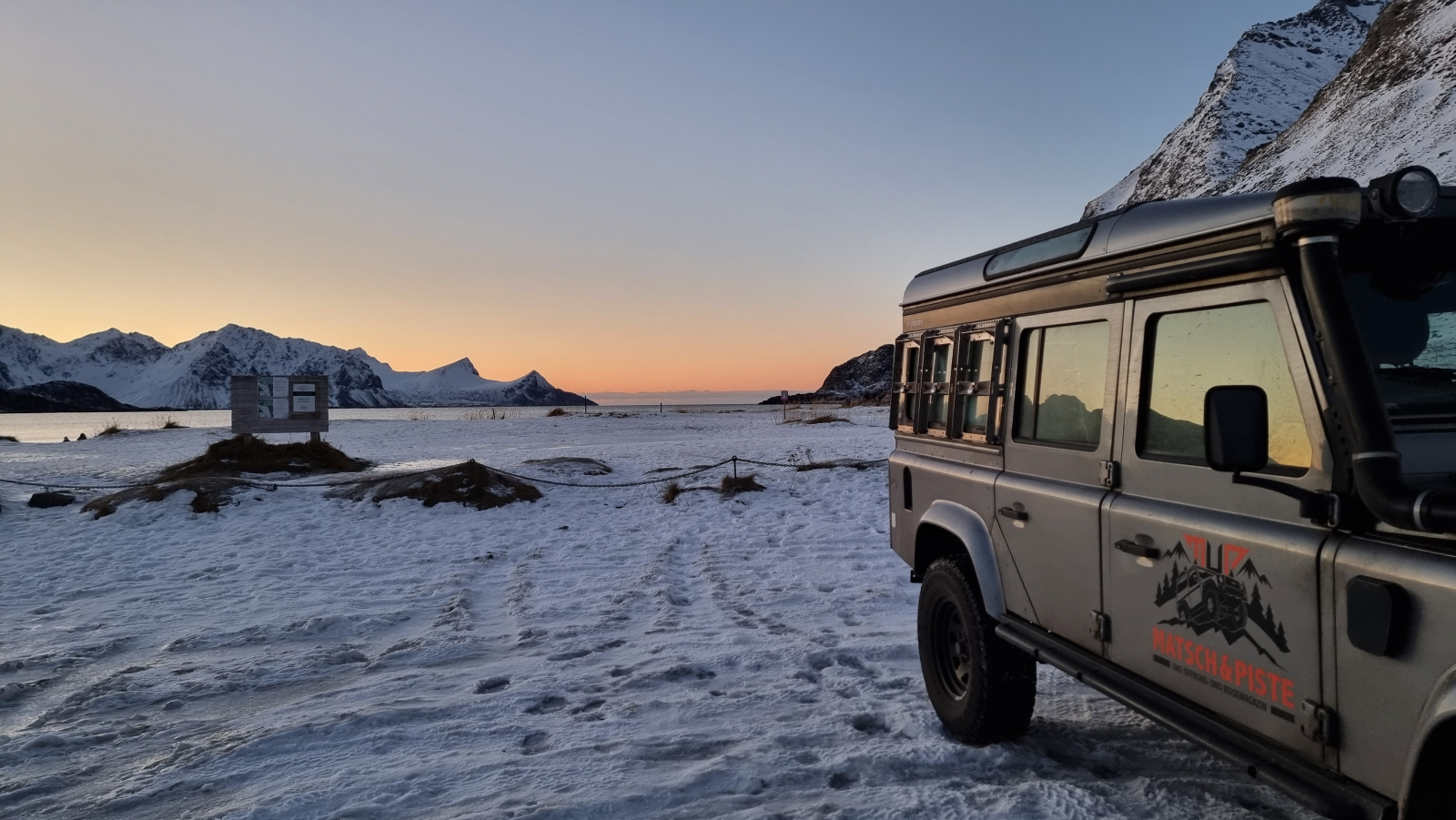
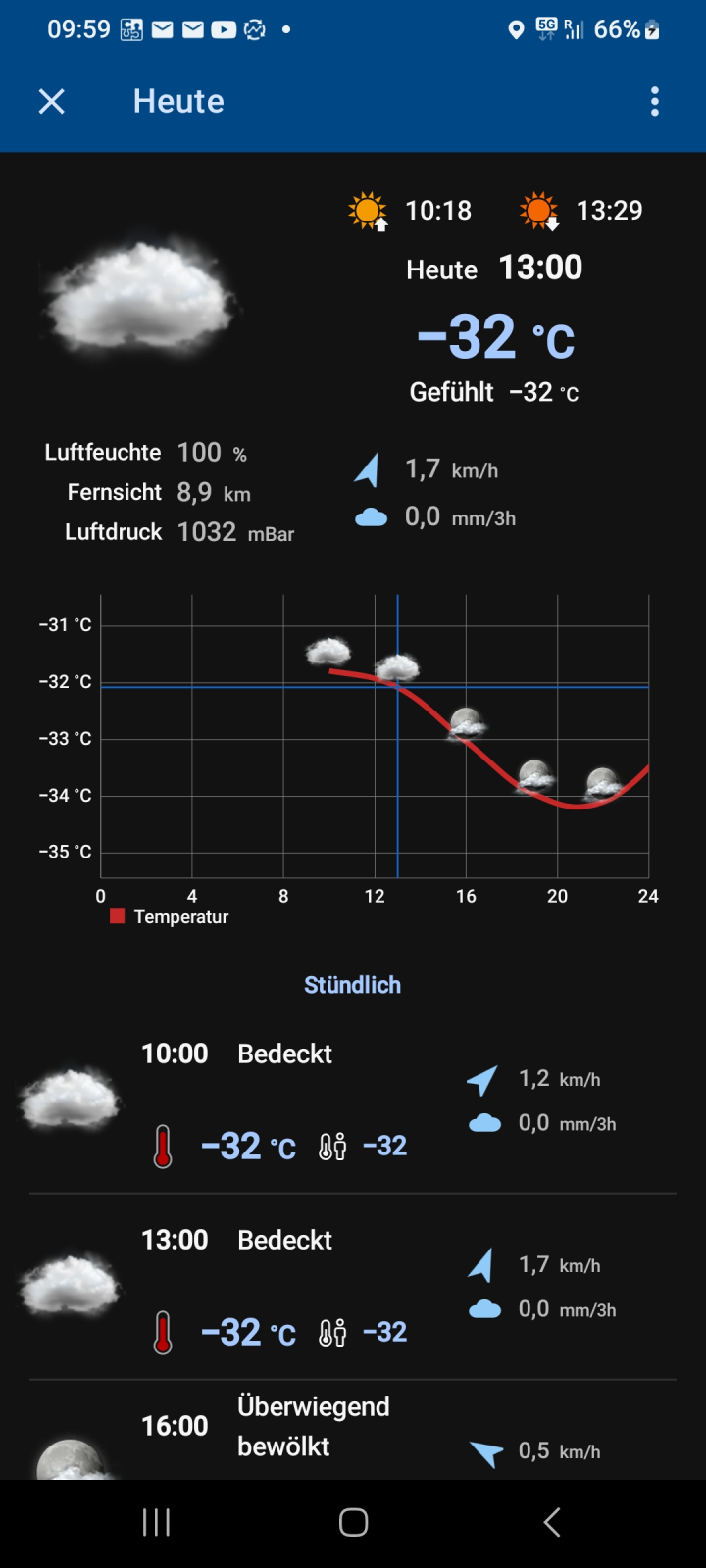
At first everything went to plan, meeting Team Burow in Karlstad, on to Östersund and on 31 December 2023 to Veijejaur. The temperatures there were already dropping steeply, and on New Year’s Eve and New Year’s Day we were at -25°C. On 2 January 2024 they sank to -32°C at night. Now we had to reshuffle the cards, because the temperatures here were set to fall further, which they did. For our destination in Finland, -38°C to -42°C were forecast. We already sensed this was no longer doable.
Winter camping at -32°C
More precisely, on the Burow the waste-water tank was already frozen at the drain. Fine, not the biggest problem. But we didn’t want to risk burst pipes. With a hairdryer and fan heater there was nothing to be done without a sheltering hall anyway. As we found out later, the fresh-water pump had already died of the cold.
From now on we folded the wipers off the windscreen before every longer stop. The danger of accidentally operating the wiper lever while the blades are stuck to the glass is too great. That can cost you the wiper mechanism. In the weather and road conditions that is absolutely undesirable.
The real worry, though, was more about the engines. I had already raised the antifreeze because of the announced temperatures, but I didn’t know to what value. Stupidly I hadn’t brought anything to measure it. For our actual destination Rovaniemi it was too cold either way (oil pour point and coolant antifreeze). We only wanted to have to stand with the engine running in an emergency.
Fleeing into the warmer cold
So we replanned and took the Lofoten as our destination. The Gulf Stream runs along there and keeps the temperatures in check, -2°C to -10°C depending on the spot, showed us yr.no, the site supported by the Norwegian Meteorological Institute, which shows the weather conditions for all of Scandinavia and the rest of Europe too. It’s also available as an app: yr.
To learn something about the roads and conditions, we used the site ViaMichelin. There you can get information on weather-related closures, mandatory convoys and road conditions.
The problem was, we had to cross the coldest pass in Sweden, which holds the national low-temperature record of -52°C. But what were we to do? In the south of Scandinavia everything was sinking into the snow, so much so that even the military turned out to free people from their cars. In Finland it was colder still than the -30 degrees at our current location. The only alternative was the Norwegian coast.
The low point of our winter camping in Scandinavia
On our drive we then reached -40°C. The landscape changed. The landscape with snow-covered trees gave way to a frost landscape. Everything white and frozen, the air absolutely dry. Fascinating.
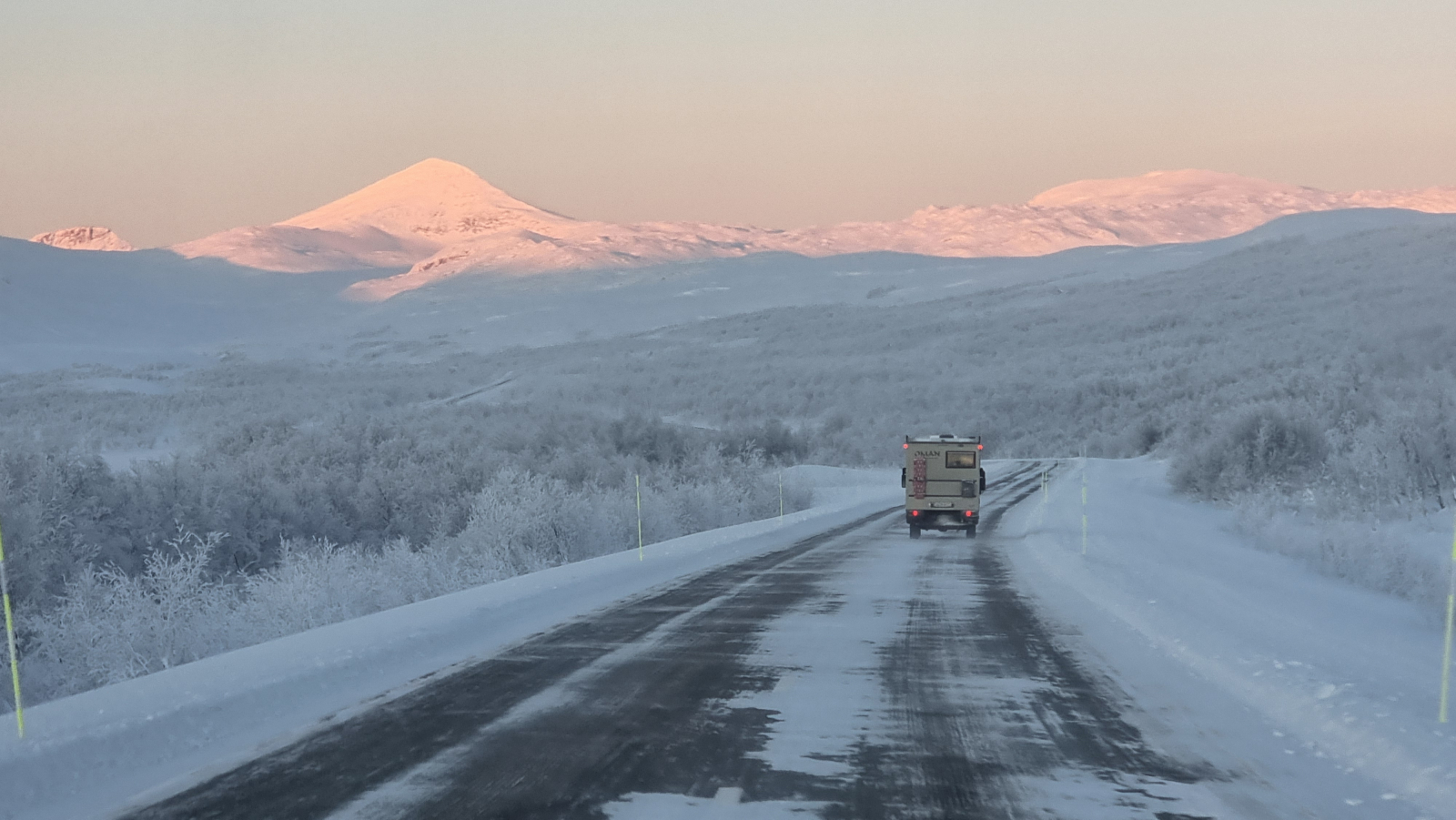
Luckily the vehicles held out. In the coldest area of the trip, my vehicle heating no longer managed to create any real comfort. It just about kept it warm enough that I didn’t really start to freeze. In return, the windows iced up from the inside. The moisture in the car, carried in by snow on the shoes and by breath, settled everywhere as ice. First on the sides, then on the windscreen. Scraping ice from the inside was new to me too.
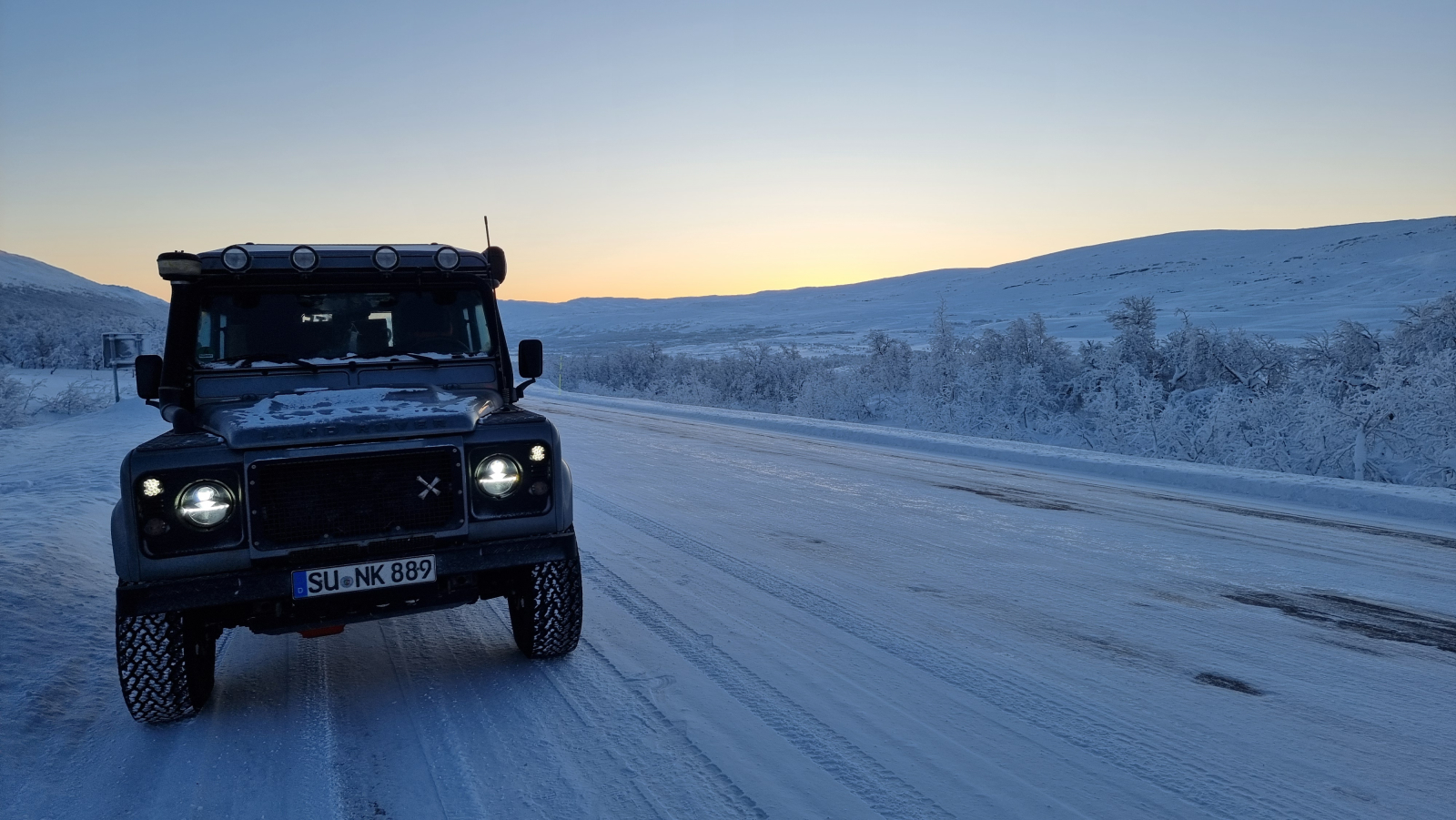
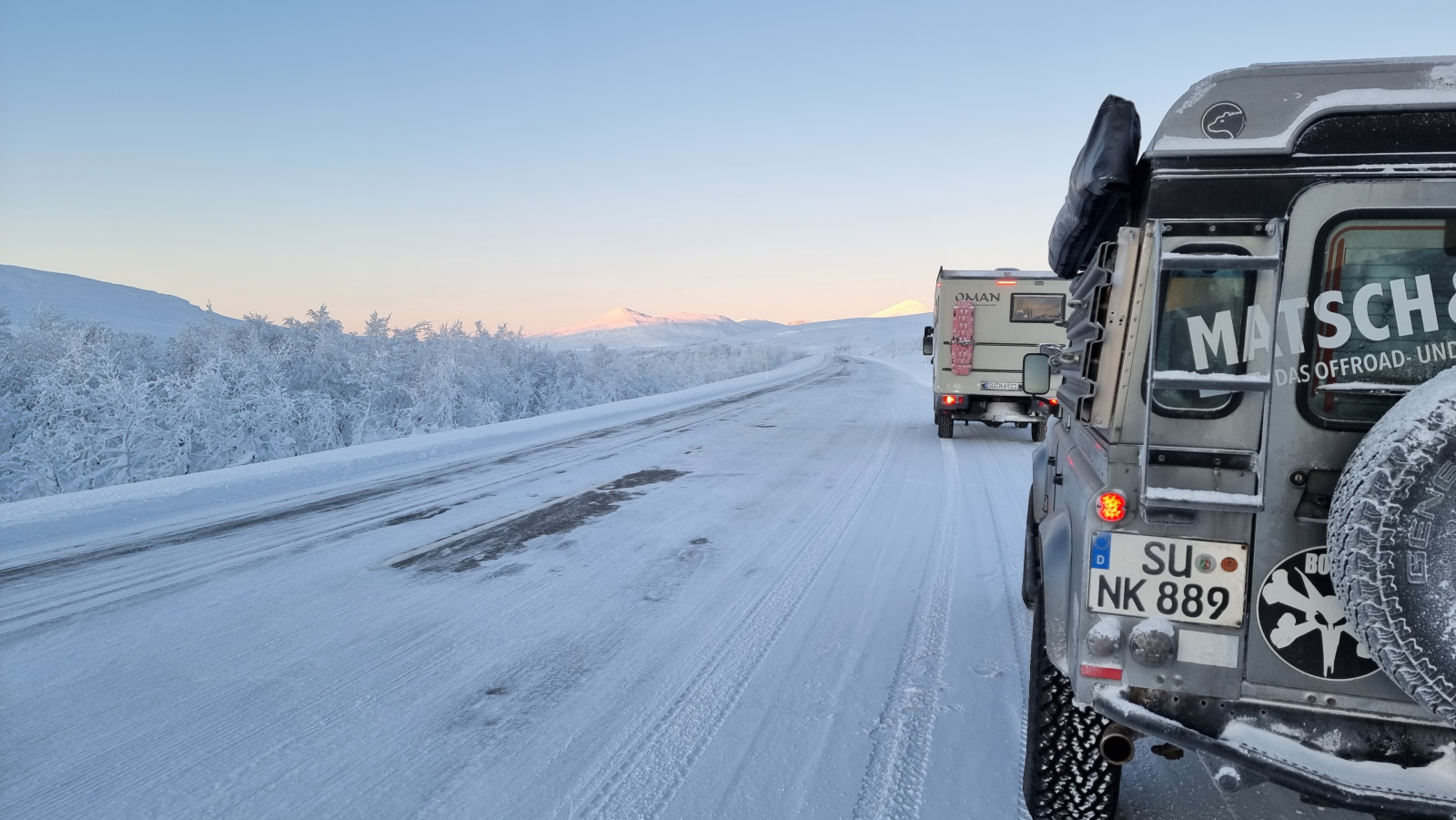
This was the limit for me, where I could still do anything with the vehicle heating alone. Now, for the first time, I switched on the seat heating and the night heater as well, because in the boot everything was already threatening to freeze. I also hoped that, with the much smaller interior volume when the roof was folded down, the night-heater air blown into the boot would eventually take effect at the front too. It took a while, but that’s how it was.
Team Burow could feel the cold in the driver’s cab too. Even in this modern vehicle the normal heating couldn’t keep the outside cold fully out. Only, if it got even colder for the two of them, the night heater would be no use, because the cabin isn’t connected to the front. They have to get everything heated enough with the engine’s heat.
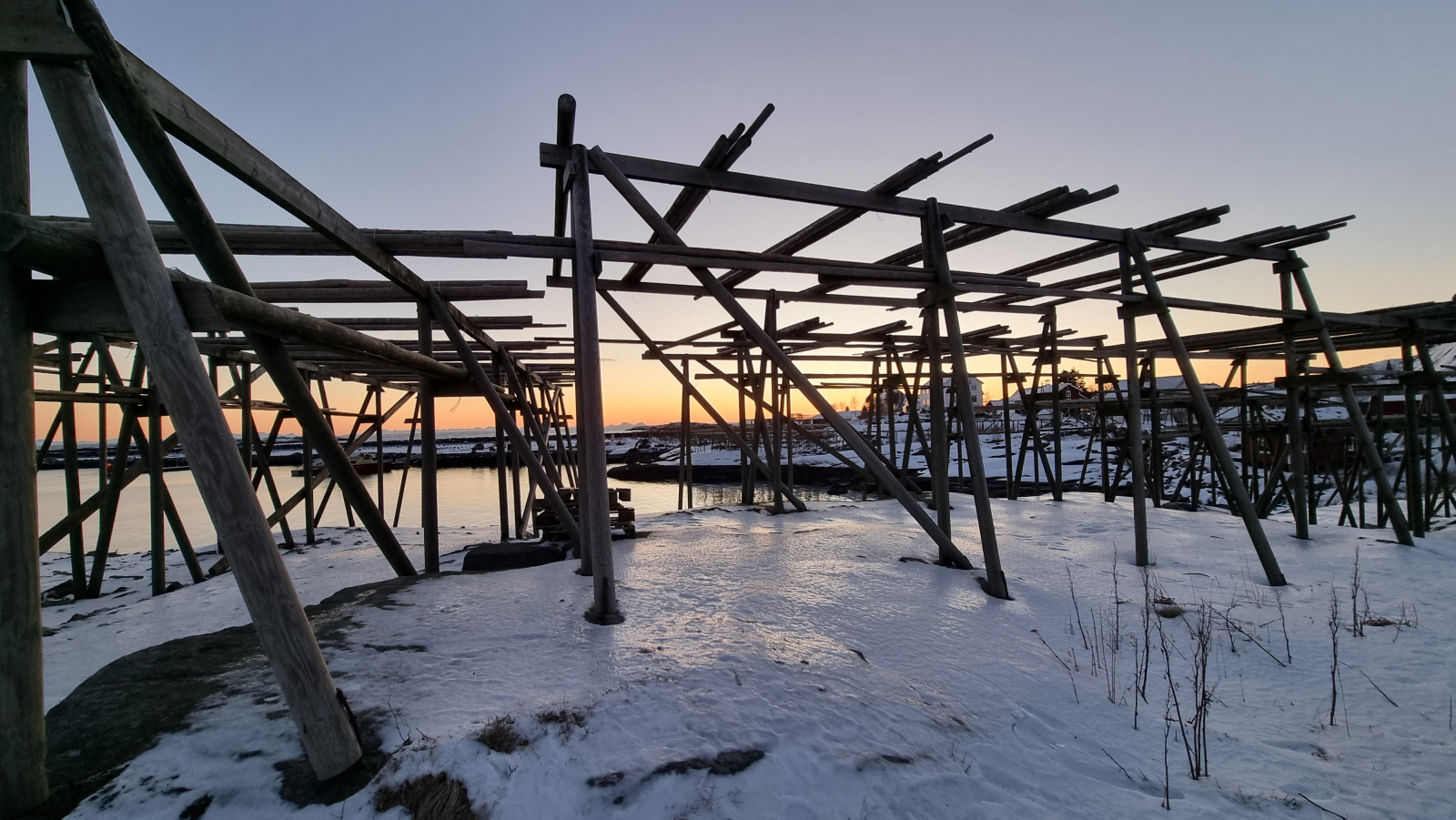
When we then reached Norway and drove down from the mountains to the coast, the temperature rose quickly and the whole situation eased again. Even so, the water and waste-water pipes on the Burow stayed frozen.
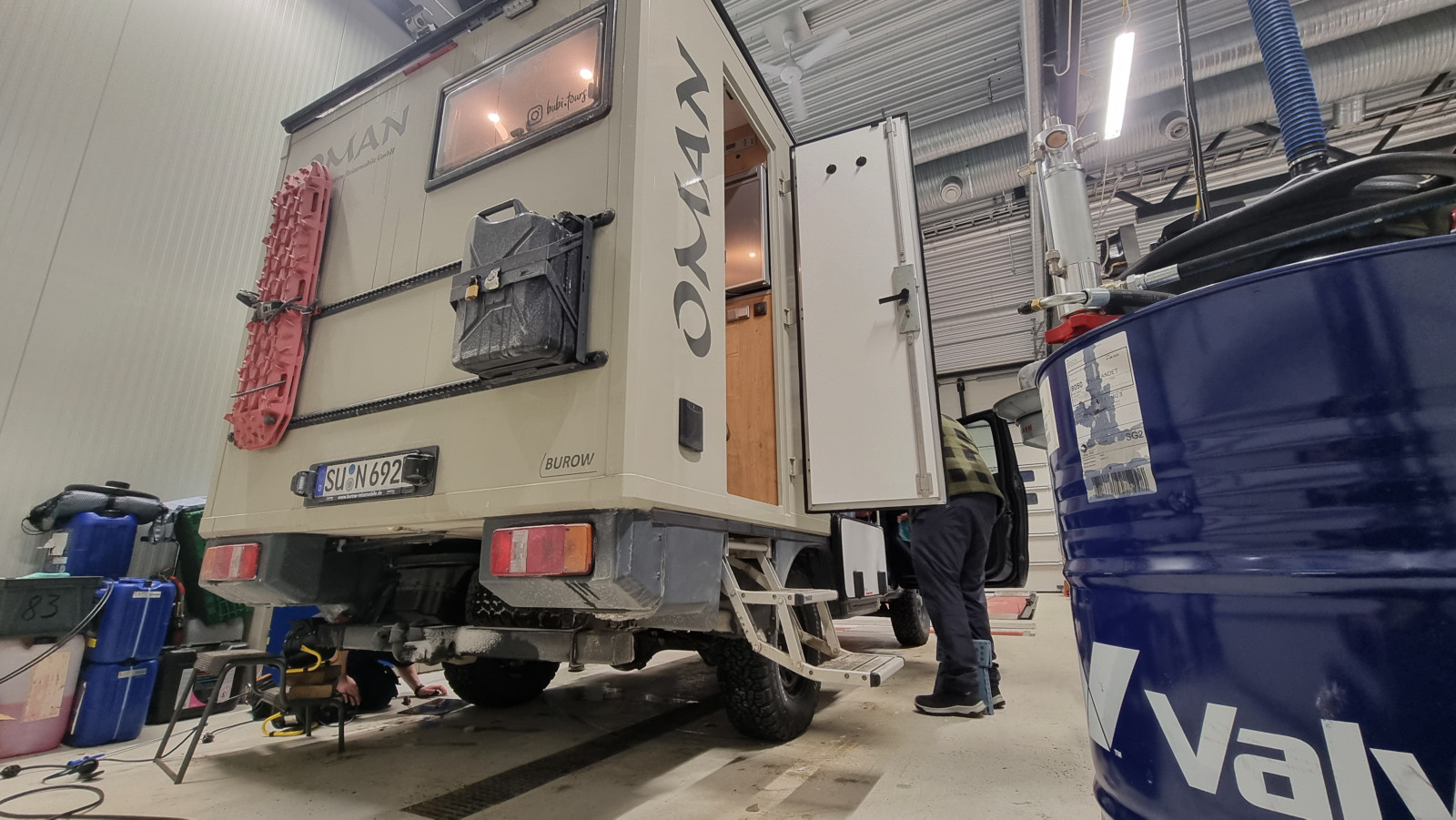
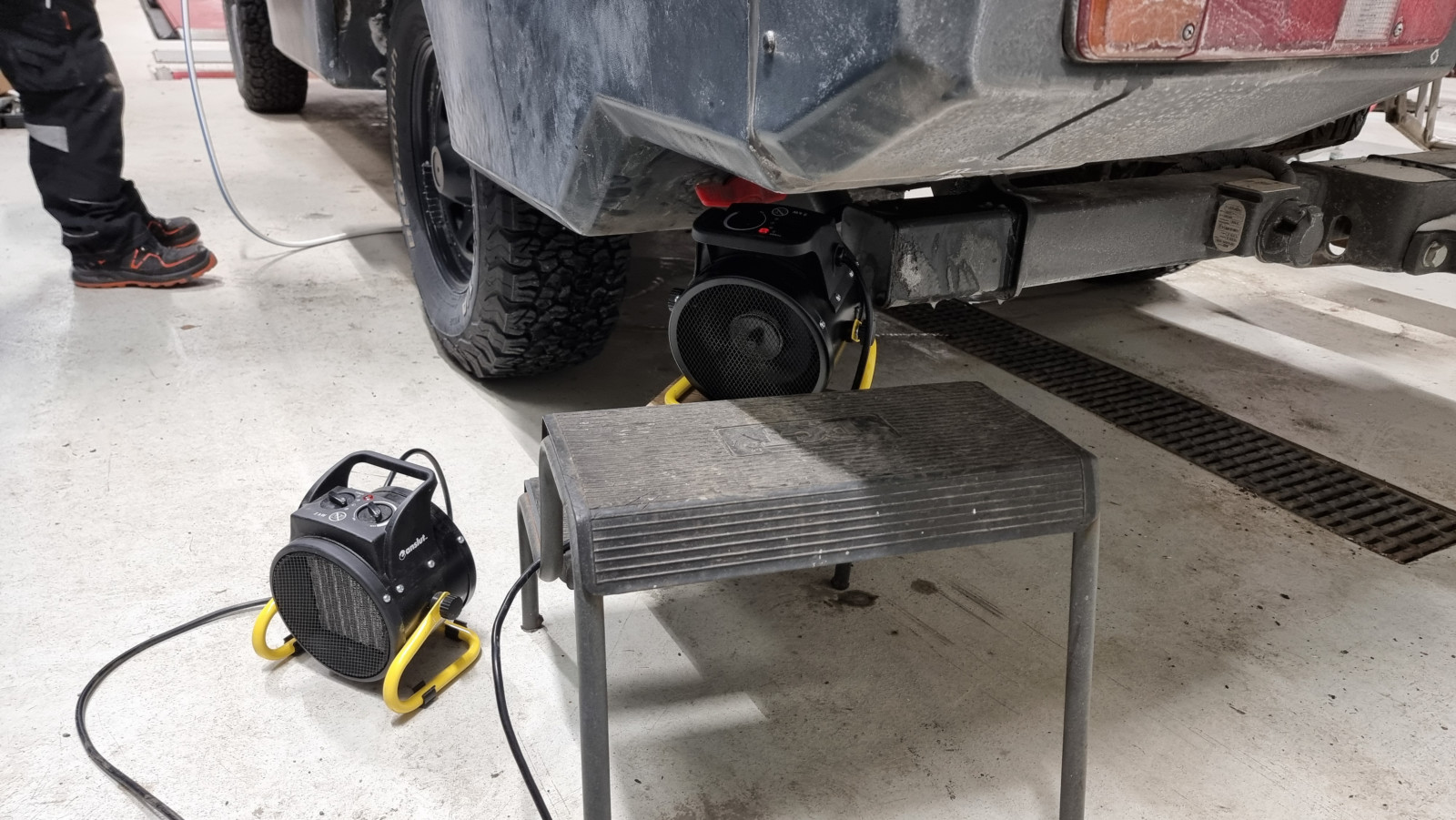
So they could thaw out again, we looked for and found a motorhome workshop that luckily had a hall space free. Fan heaters were brought straight away to quickly free up all the pipes again. On the occasion, all the spots in the vehicle that had got damp from condensation were dried too.
The situation eases
By ferry we then crossed from Bodø to Moskenes. That’s very easy. Just drive up, pay (about €50) and off you go. The crossing takes about three hours. Now we reached the Lofoten and thus milder temperatures. In return, a cold, damp, biting wind blew here. Unpleasant, but not threatening. But we were out of the worst.
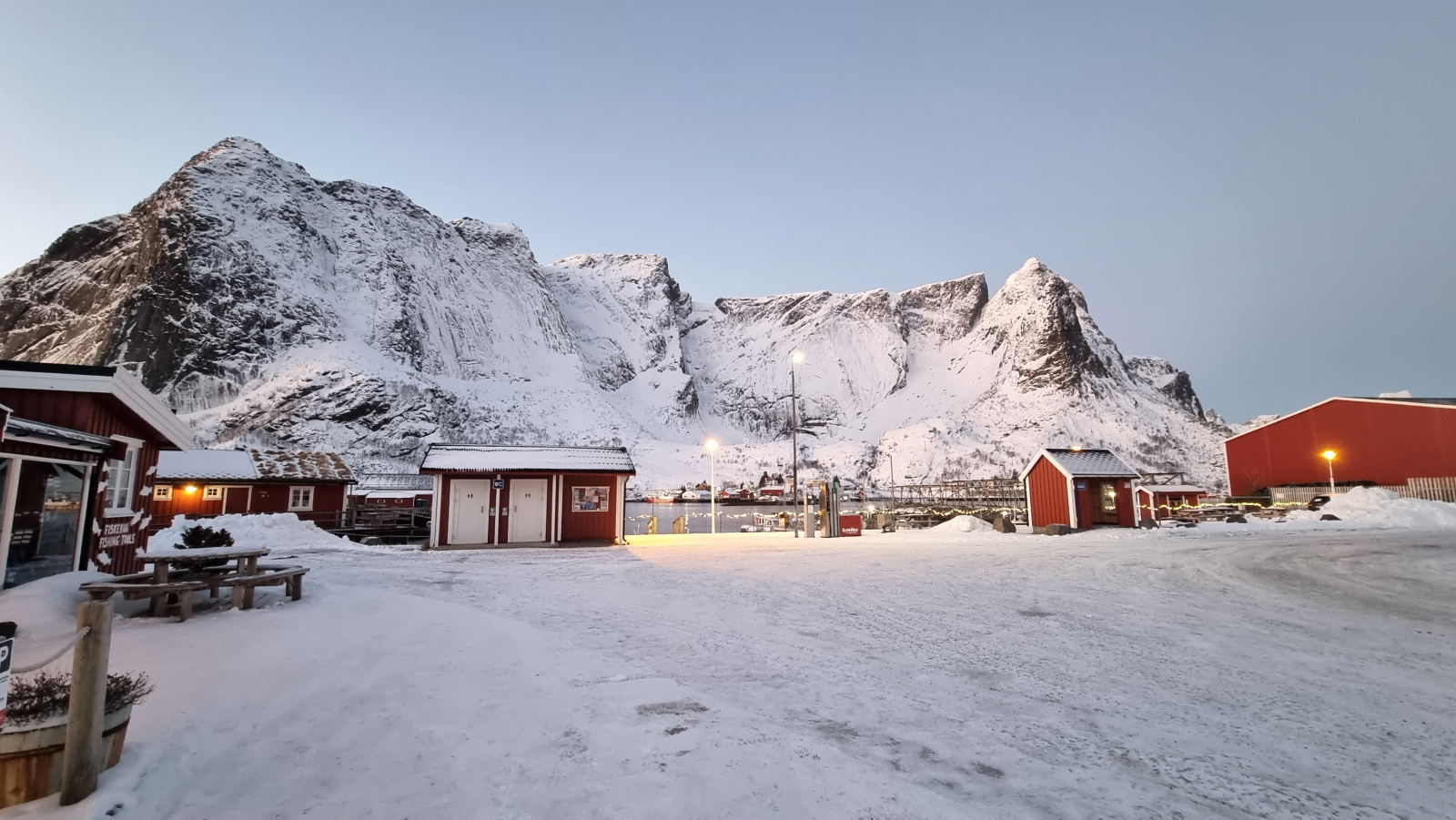
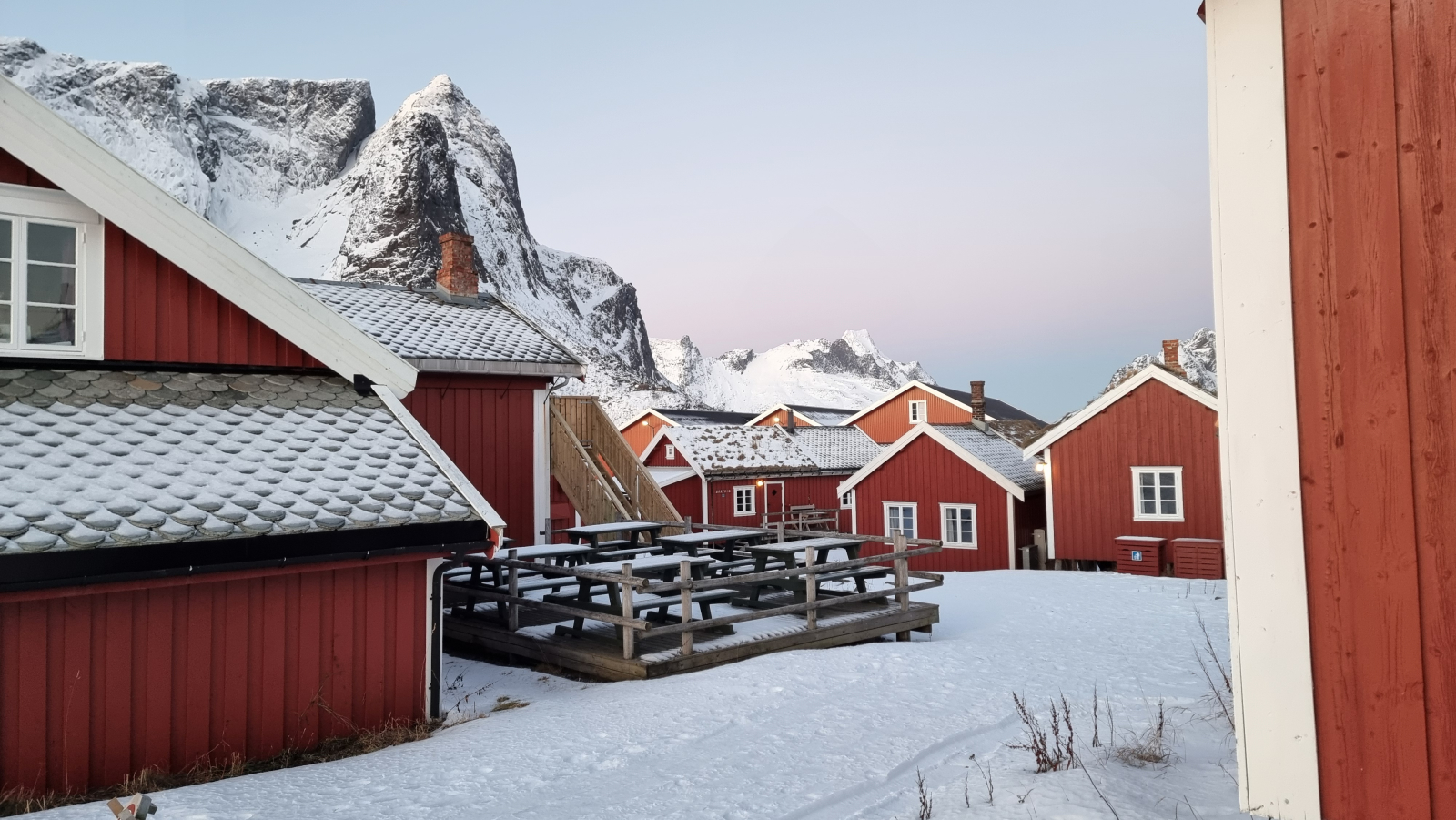
But the next limit already appeared. Three days later it was due to rain there. That means completely iced roads, possibly closures. That would leave us stuck on the Lofoten. So we moved quickly, but without haste, to the north and left the island group four days later.
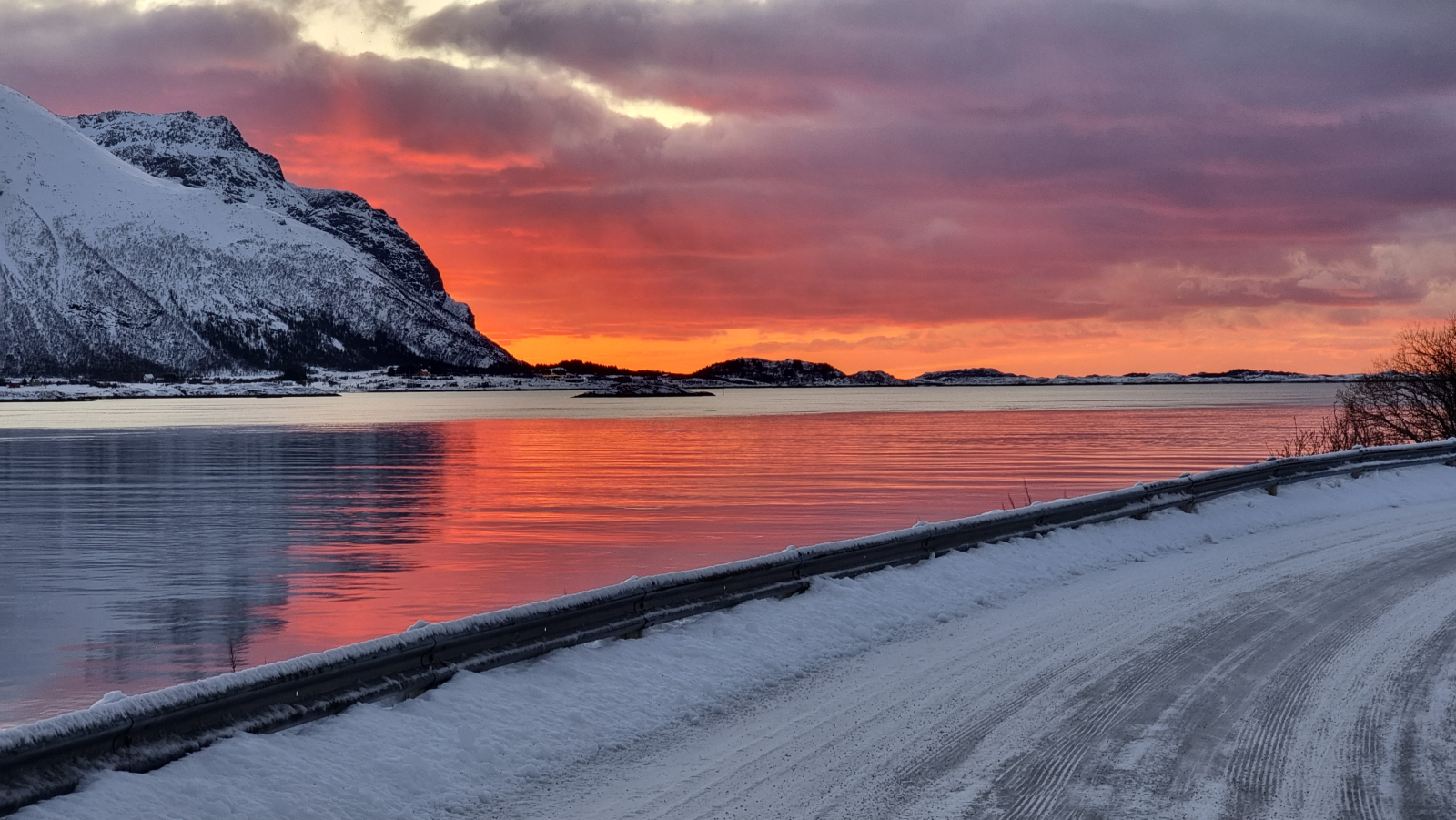
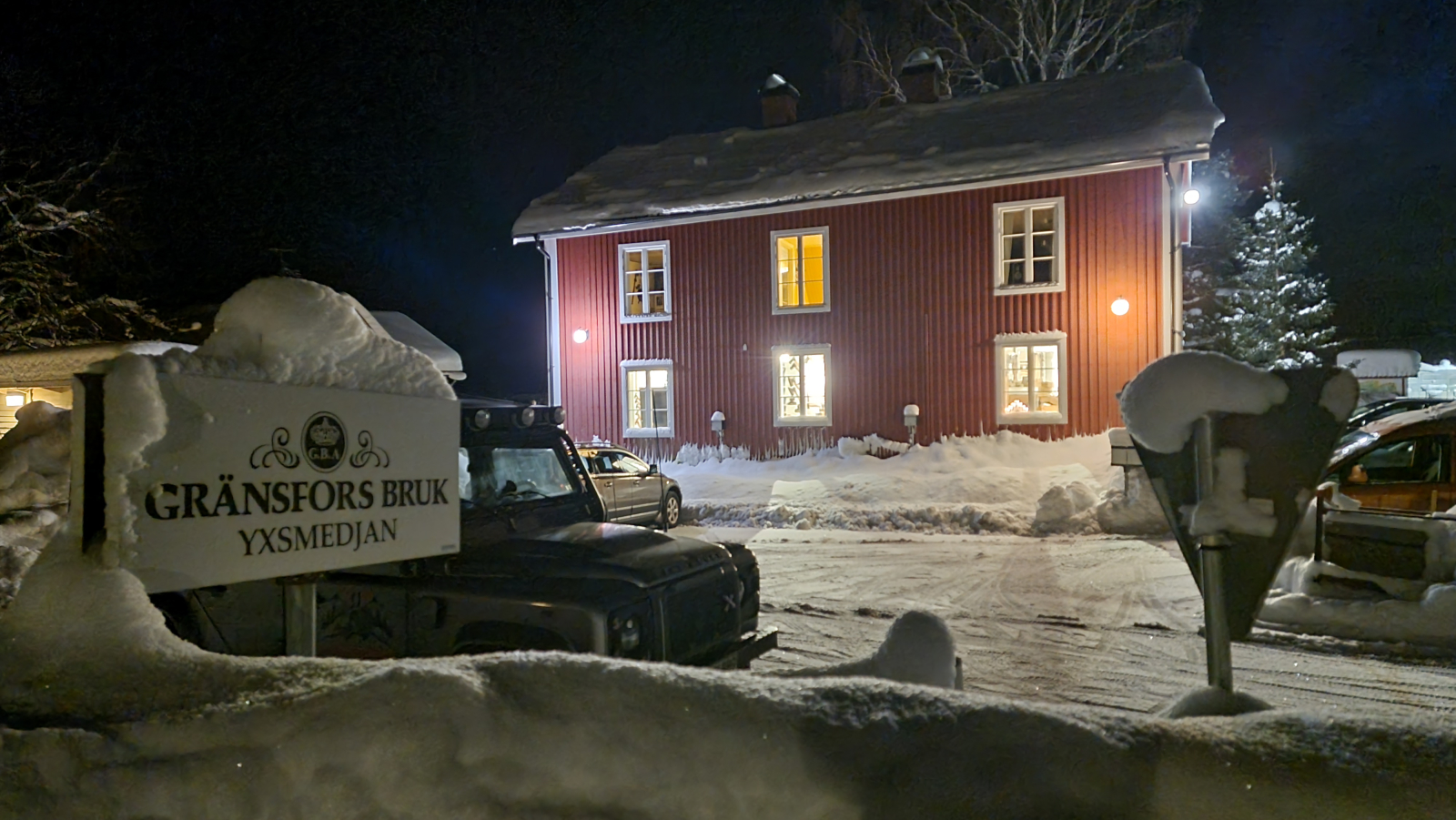
Now it was time to say goodbye. Team Burow has a whole two weeks more time than me. For me it now went via the Abisko National Park to the east coast to begin the journey home. The E4 there is better and mostly built as a dual carriageway, and there are more places where you can stop, fill up or get help. It also let me drop in on the famous axe forge Gränsfors Bruk.
Winter camping in Scandinavia, the experiences in detail
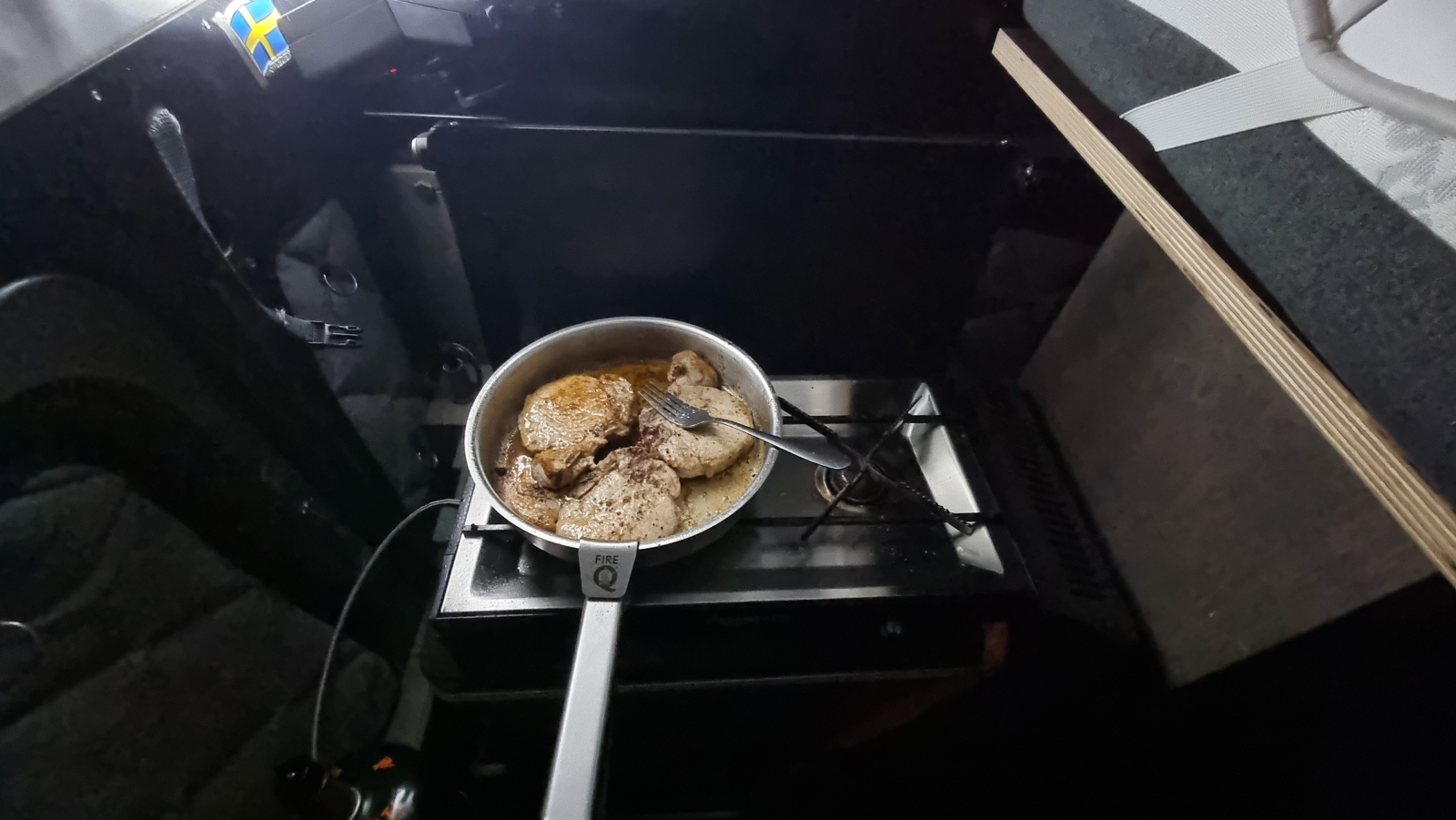
In general you can say the more life normally happens outside the vehicle on a trip, the better organised you should be. You should think about what belongs in the warm vehicle and what doesn’t. You want to leave the vehicle and rummage around outside as little as possible. Every “door open, door shut” lets cold in. Some tasks can’t be done outside, or only with difficulty. That includes personal hygiene, for example, and partly cooking or eating. Bread is hard to butter at umpteen degrees below zero. A gas stove with winter gas also has a hard time heating anything in an ice-cold wind.
Personal gear
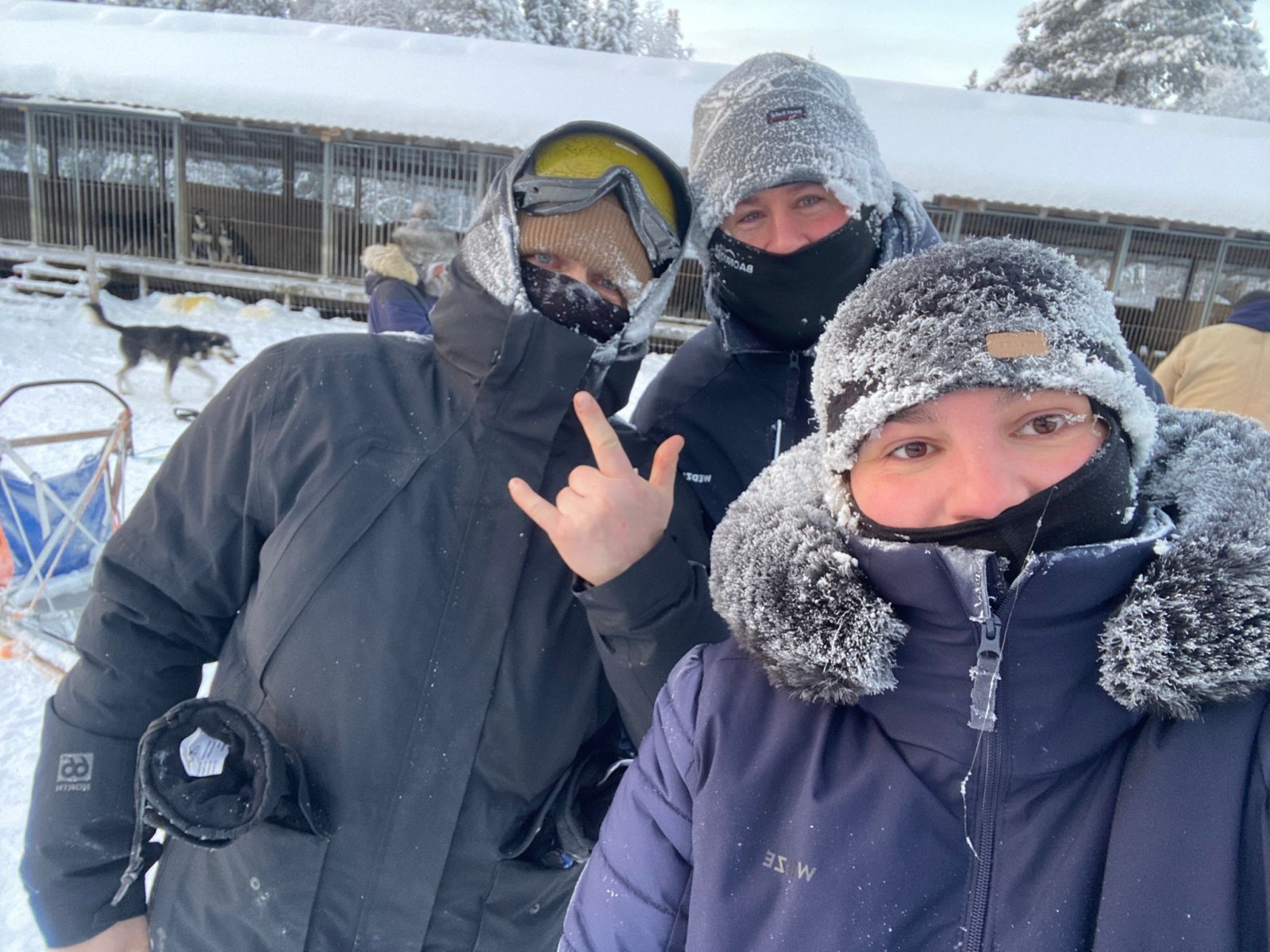
This area covers the clothing and the sleeping bag. Here I had few problems, apart from the boots. The merino base layer proved itself again in every respect. Over the long johns I then wore the thermal trousers daily. For the dog-sled ride and in a lot of deep snow, the thermal over-trousers on top, as they cover the boots too. For the comparatively short spells in the iciest temperatures, absolutely enough.
On my upper body, besides the merino vest already mentioned, I wore a T-shirt and a long cotton lumberjack shirt. As I didn’t break into a sweat, I didn’t have to worry about drying ability. If exertion, work and sweating with wet or damp are to be expected, the cotton shirt would be out of place. Over it I wore either a warming fleece jacket with a normal winter jacket or the thick Tvioddi from 66North.
With the snow boots I made a mistake. The boot itself is completely fine, but I chose it to fit and thus far too small. As our dog-sled guide told us, who drives barefoot(!) in her boots, for such cold temperatures a boot like this should be chosen 2-3 sizes bigger. Even the warm Nakatanenga merino winter socks can’t help there. Each on its own is a great choice, but as the boots matched my shoe size, my socks and thus my feet always had contact with the upper material.
When snow then gathers at the toe of the boot during dog-sledding, the cold inevitably creeps into the boot. And that gets very unpleasant. But if the boot is bigger, a well-insulating air gap remains between the outer material and the socks and feet. That was missing for me, which is why I got really ice-cold toes on the sled very quickly.
Hands and hand protection
I’m not a glove type. My hands are insensitive to cold for our latitudes. Even during the trip I never had the feeling I needed gloves, apart from the dog-sled ride. Hands in the jacket pocket was enough. Even so, good, warming mittens should be along if you spend longer outside and don’t always want to walk around with your hands in some pocket.
When the hands are needed outside, it only takes a few minutes before they seriously start to hurt. You can’t touch metal any more, let alone hold it. Mittens are recommended because the fingers stay together and each isn’t stuck in a single finger section, so the hand can keep itself much warmer. In any case the little hand warmers are recommended; they give off eight to twelve hours of warmth and so guarantee frost-free, warm hands. I imagine it very difficult to impossible to repair anything on the outside of the vehicle with bare hands at temperatures beyond -15°C to -20°C. Then a heated hall is needed in any case.
Sleeping and sleeping bag
I slept in the pop-top roof, which has a three-sided tent fabric. Down to about -15°C outside temperature I did without the night heater. It has 2 kW and heats the small space very strongly, which I find unpleasant when sleeping. At outside temperatures around -15 degrees, it was around 0°C and slightly above inside the vehicle. In the morning, though, some things were frozen, e.g. the cleaning wipes.
So from then on the heater had to run on a low setting (14 to 16°C) to prevent the water kept inside and other things like food, drinks and so on from freezing. At -30°C outside I thus reached about 5°C to 7°C inside the vehicle. It was pleasant to spend the night in the Ajungilak sleeping bag and nothing froze inside the vehicle.
Above all it’s important that the head is protected. At -30°C my hat was no longer enough, the hood of the sleeping bag had to step in. It should adapt to the body’s shape, so the body needs little energy to heat it. The shoulder area should be able to be pulled shut with a drawstring, to prevent the warm inside air from escaping. Likewise the hood should be able to be pulled shut around the face. Otherwise the body constantly has to reheat, because a lot of warmth is lost through the head (thin skin, a lot of blood flow).
Personal hygiene
How do you wash at clearly sub-zero temperatures? If the thermometer only sinks slightly below zero, a quick wet wash with water, a flannel and soap is doable outside too. The most important spots quickly cleaned and dried off, and a pleasantly warm and yet fresh feeling sets in. But when there’s deep frost, that no longer works like that. At least for me, unpractised and not used to it.
Because of the vehicle size and the build, my personal hygiene normally takes place either outside or in the sanitary facilities of the campsite. So if the latter isn’t available, an alternative is needed. I found it in fragrance-free cleaning wipes for babies. As my body barely sweated because of the temperature, I could very conveniently do everything with these wipes in the vehicle. When there was then a chance to shower every few days, that complements it very well.
And what about going to the toilet? If you don’t have your own toilet along, business is done as on other trips. During the day we drove to filling stations or service stations and went to the toilet there quite normally. As at one spot we had a completely unheated and open toilet, where the inside temperature was the same as outside, I can now say this works without a problem too. Thankfully the toilet seat was a polystyrene-like one, which didn’t feel so ice-cold and didn’t “stick fast” either. But despite the bared behind, the cold didn’t make much more difference than if you’d simply spent time outside.
Otherwise, in Sweden and Norway you’ll find numerous spots with free or paid (credit card!) heated and clean toilets. Really exemplary! Hold the credit card in front of the scanner and there’s the saving “click” of the door lock. Hopefully.
Vehicle and tech
Before the trip I’d have seen myself as the limiting factor. In hindsight I can say it was the vehicle. With the right personal gear, and as long as things like the night heater work, a person can put up very well with even these low temperatures. It would of course be something quite different if the supporting tech weren’t available. The night heater, working together with the Blidimax thermal mats, worked very well together. With them I could insulate the large window areas as a cold bridge; only the pop-top roof remained as a cold source that I couldn’t switch off.
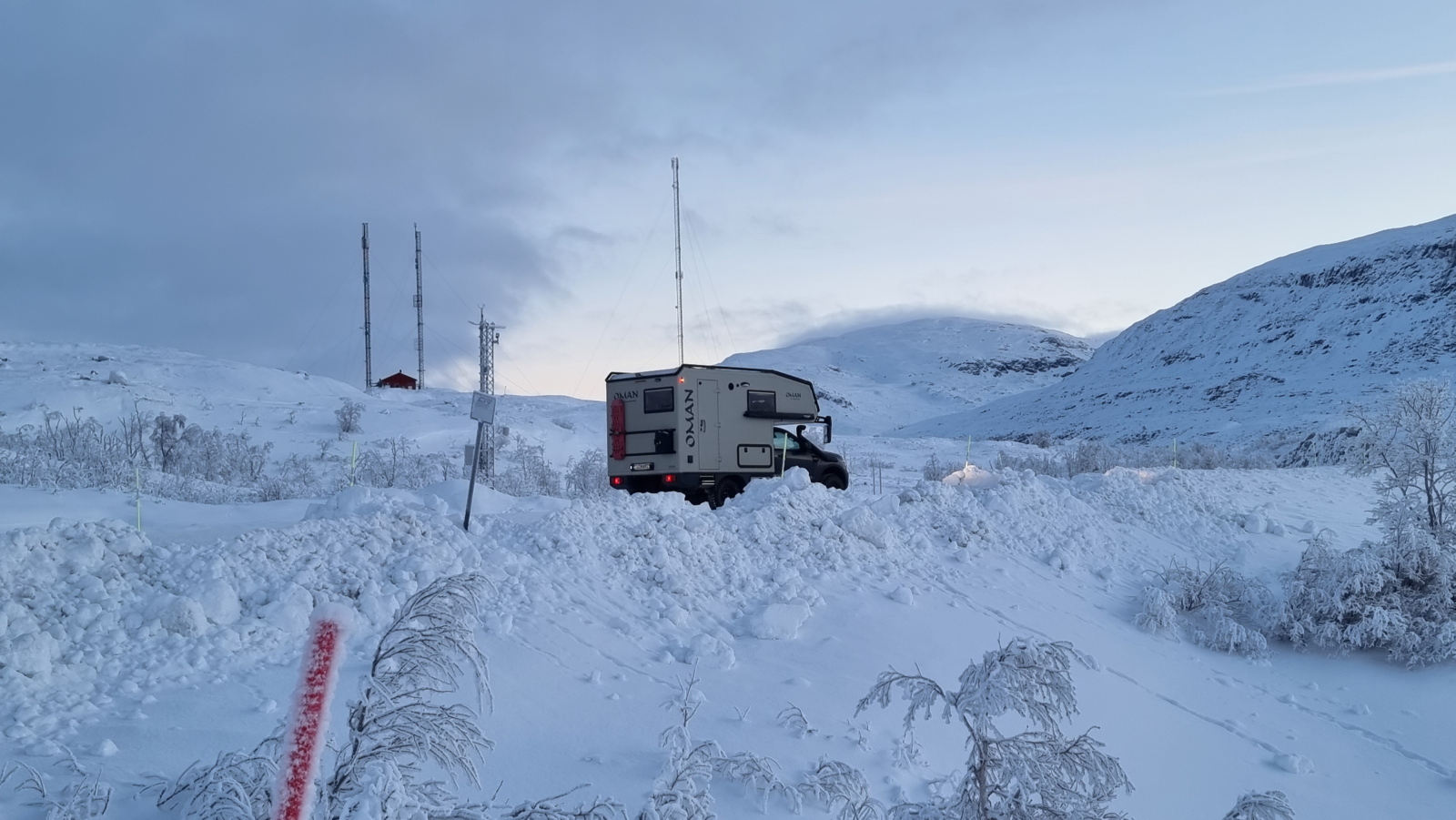
What did turn out to be limitations in the end were that the waste-water tank drain on the Burow froze despite the heating, and that at the very low temperatures ice also formed in the Burow’s fresh-water tank. That could surely be solved by emptying the tanks and not using them. But with the engine antifreeze and the oil too, we came close to the limit. Such things can be dealt with at a pinch as well. You could cover the radiator grille to prevent icing, and to keep the oil and fuel fluid you could let the engine run. That, by the way, is quite the practice in Scandinavia when it goes below -40°C.
Coolant antifreeze
With the coolant antifreeze you should take along at least one litre of the required antifreeze as a concentrate, that is, unmixed. Should you unexpectedly have to raise the frost protection, that only works by increasing the concentration. If you have ready-mixed fluid, you only top up the fluid level, but you don’t raise the frost protection.
But careful! You mustn’t use too much antifreeze either. Normal is a water-to-antifreeze ratio of 50:50, which according to my antifreeze gives protection down to about -25°C. If you raise the dose of antifreeze too much, problems can arise at warm temperatures, because too much antifreeze reduces the heat dissipation in the engine. The maximum ratio should on no account exceed 30:70 (water to antifreeze), because antifreeze diluted too little then freezes as early as -13°C. You’d only be making it really bad then. If needed, after your return you should change your antifreeze or dilute it back with water so you get back to the 50:50 ratio.
I had to raise the frost protection when it became clear we’d hit -30°C and colder. Hence my little, simple example calculation, which I quickly did in my head on the road:
I knew the coolant was filled in a 50:50 ratio. To get to 40:60, which with my antifreeze means -35°C, I have to raise the antifreeze share by 10 parts. For that a simple rule of three:
50 parts = 3.5 litres
60 parts = x litres
60 x 3.5 : 50 = 4.2. So I need 4.2 litres of antifreeze and 2.8 litres of water in the system. As there were already 3.5 litres of antifreeze in there, I had to raise it by 0.7 litres. Luckily the expansion tank was almost empty again (that’s a Defender thing and normal). The stuff escapes somewhere, so I had to assume the antifreeze had gone too. My calculation didn’t quite fit any more, since a good 1 litre in the 50:50 ratio was no longer there out of the 7. So I only poured in 0.6 litres of antifreeze.
Now a silly problem arose. I had nothing to measure with. So take your refractometer along, to be able to adjust and measure the frost protection. Also pack the right antifreeze at home. The wrong ingredients can lead to problems and damage. Antifreezes fall into two big families, with and without silicates. At least here you should know what your engine needs.
The searching, and any translating of the texts on the products (works excellently with the photo function of Google Translator on your smartphone), can then be skipped. Remember the name “Biltema” too. That’s a big retail chain where you get vehicle accessories and which is found in many places. There you can buy oil, antifreeze and a measuring device for the antifreeze.
So what about the expected -40°C? It was clear to us that we could only drive through this cold zone. Should we come to a stop, we would let the engines run. That was about the antifreeze, yes, but just as much about the oil and about keeping the battery alive so the engine could still be started the next morning.
I’m not comfortable with the thought of having to let the engine run, because many modern engines have an oil-pressure problem at idle in connection with the energy-saving low-friction oils. Especially if they are stop/start engines. Here the low temperature helps again, because cooler oil is thicker and the oil pressure rises again, but we still wanted to avoid this situation if possible.
The consequences of too little antifreeze
If the engine isn’t sufficiently frost-protected and the coolant freezes, damage occurs. The engine block can crack. Engines therefore have freeze plugs, which are meant to protect the engine from the damage of the expanding fluid. These are pushed out by the freezing fluid and give way. Still-fluid coolant can run out. So the engine escapes destructive damage, but it’s no longer ready to drive. The plugs have to be replaced first.
Another problem can occur while driving. Through the icy airflow blowing around the fine tubes in the radiator, the coolant in the radiator can freeze. This interrupts the flow and the engine overheats, with all sorts of consequential damage. Should you notice freezing, don’t drive on. Here only thawing helps, either in a warm hall or with fan heaters. Anyone with enough room in the car should feel free to take an electric fan heater with an extension cable. That way you can perhaps get yourself into a hall where there’s power, and you’ve got the heater to thaw it out with you already.
To prevent icing, you can cover the radiator, at a pinch with a piece of cardboard. You should then monitor the engine temperature, especially if you drive up a mountain pass under load, for example.
AdBlue
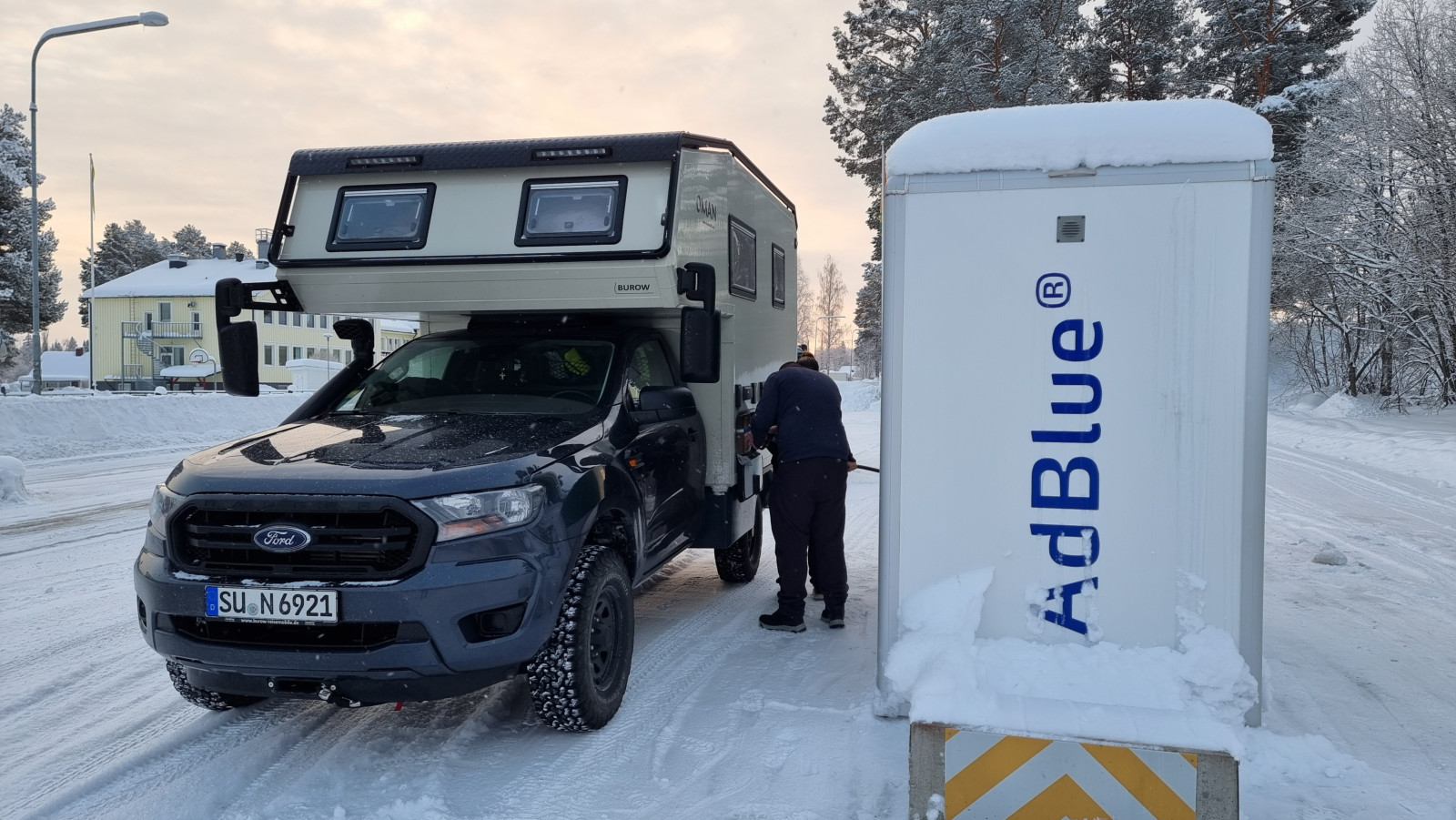
Actually the AdBlue system shouldn’t cause any trouble. AdBlue freezes at -11.5°C. The legislator knows this and grants the vehicle makers 20 minutes after engine start. Within this time, they have to make sure AdBlue is available. For that, the lines are heated. In any case, don’t be surprised if you still get error messages and a shutdown warning, as was the case with Team Burow’s Ford Ranger. From about -10°C the vehicle warned that it would only allow 800 kilometres more of driving until a further start of the engine is prohibited. Here the legislator may switch off your car if it no longer gets any AdBlue. Not that any system absolutely needs AdBlue to function, but the required emissions values are simply no longer met.
We suspect that the AdBlue lines were exposed by the motorhome conversion. Between the driver’s cab and the living cabin, a great deal of ice and snow settled on the vehicle frame where the lines run.
Team Burow observed this, and it seems that after a few kilometres AdBlue was available again, the message got a reset, only to freeze again at night. So there was the 800 km message once every day. As long as it didn’t count down, we decided to ignore it.
Light
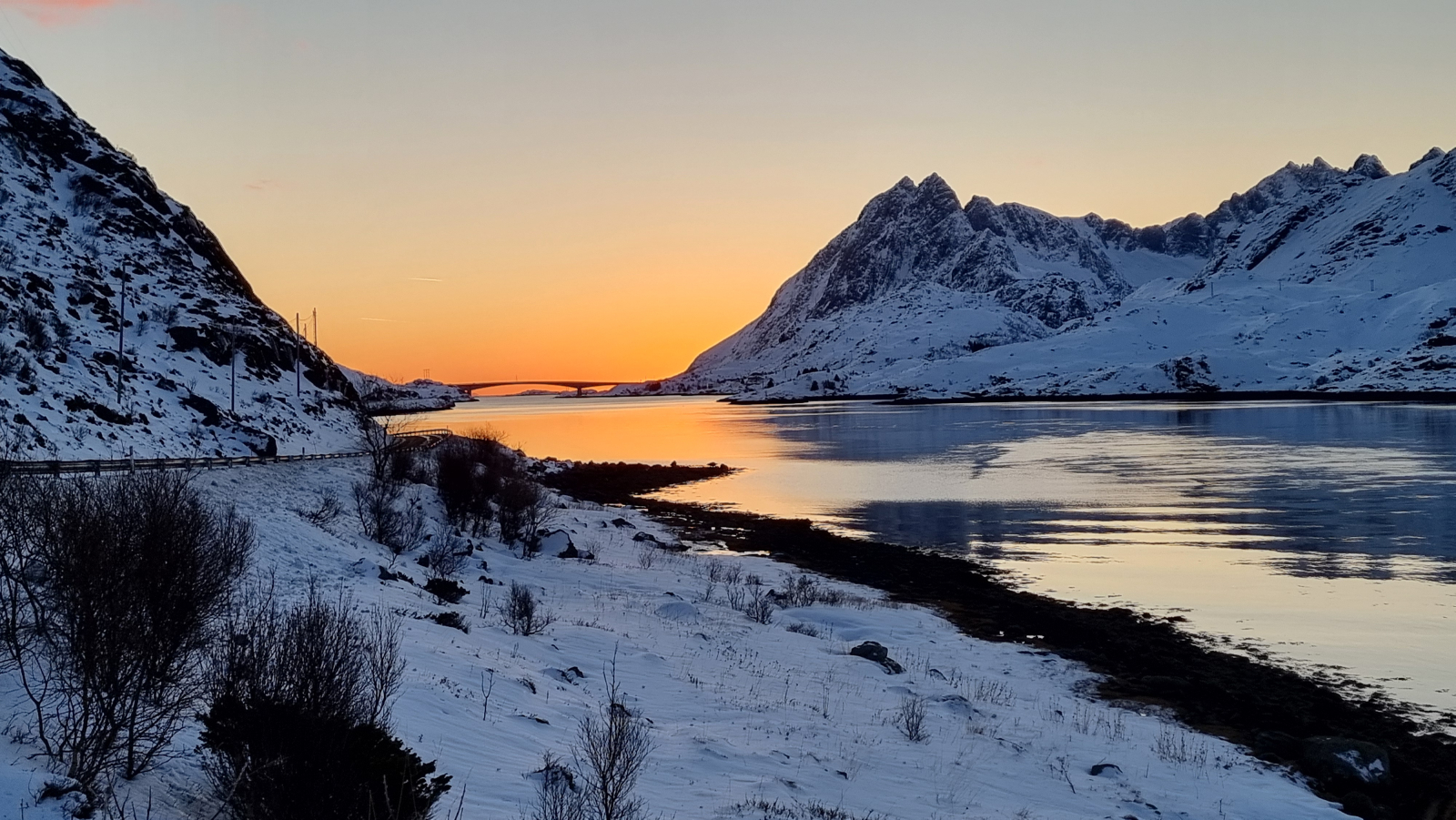
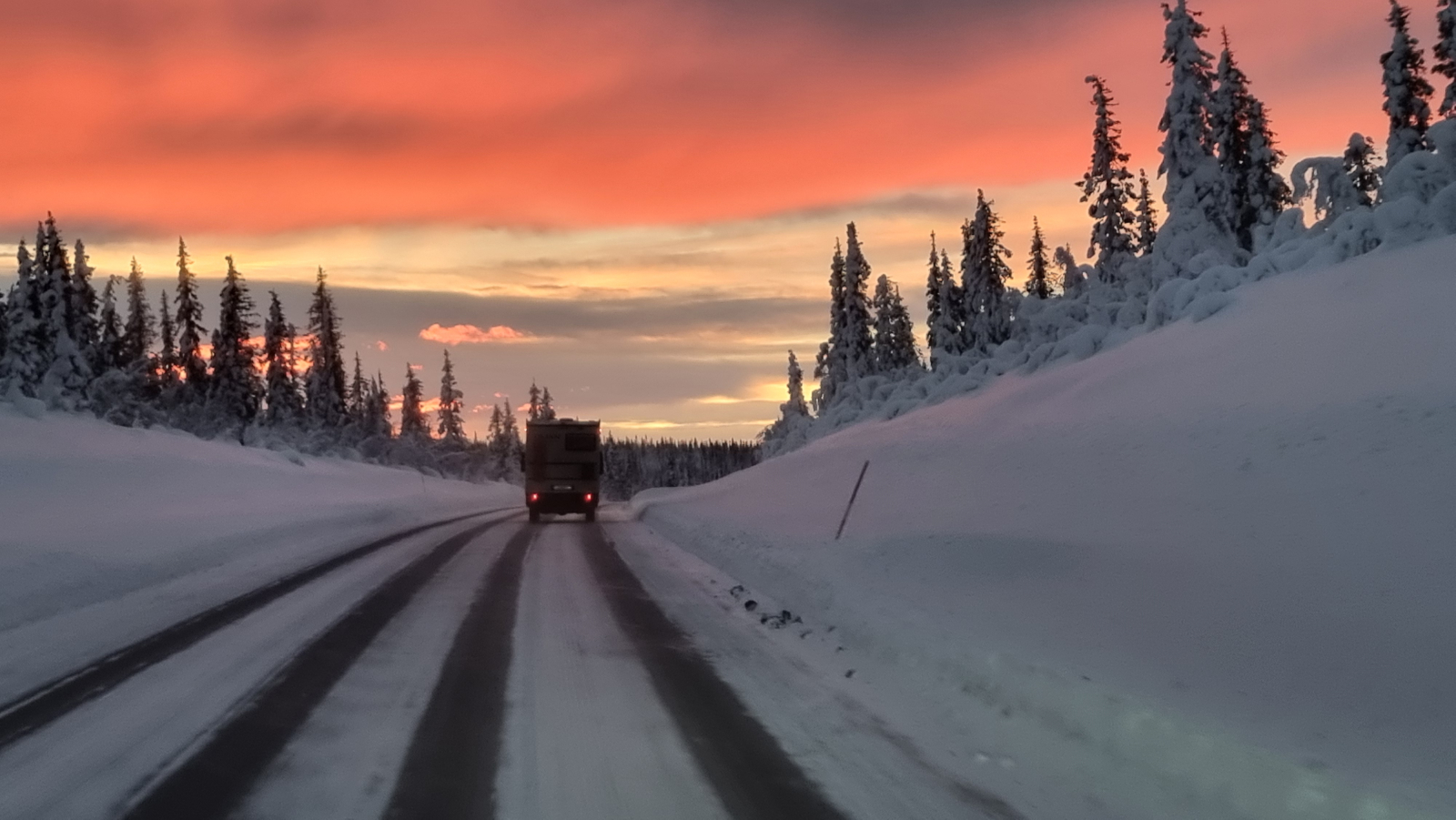
Light on the vehicle and for yourself is essential on a winter trip to Scandinavia. Even below the Arctic Circle we only had a few hours of daylight. Around 4pm it was dark. Above the Arctic Circle (begins at latitude 66° 33′ 55″) the sun doesn’t rise at all any more. There you have 1.5 to 2 hours of twilight. But that in fantastic colours. The red and orange rays of sun that shine out from behind the horizon set the snow-covered mountains ablaze and the water reflects like glowing lava flows. Absolutely worth seeing.
My Defender is fitted with Nolden 7″ LED main headlights and four Hella Luminator X Compact driving lights. It should be said, on the long, dark and lonely roads more light is absolutely recommended.
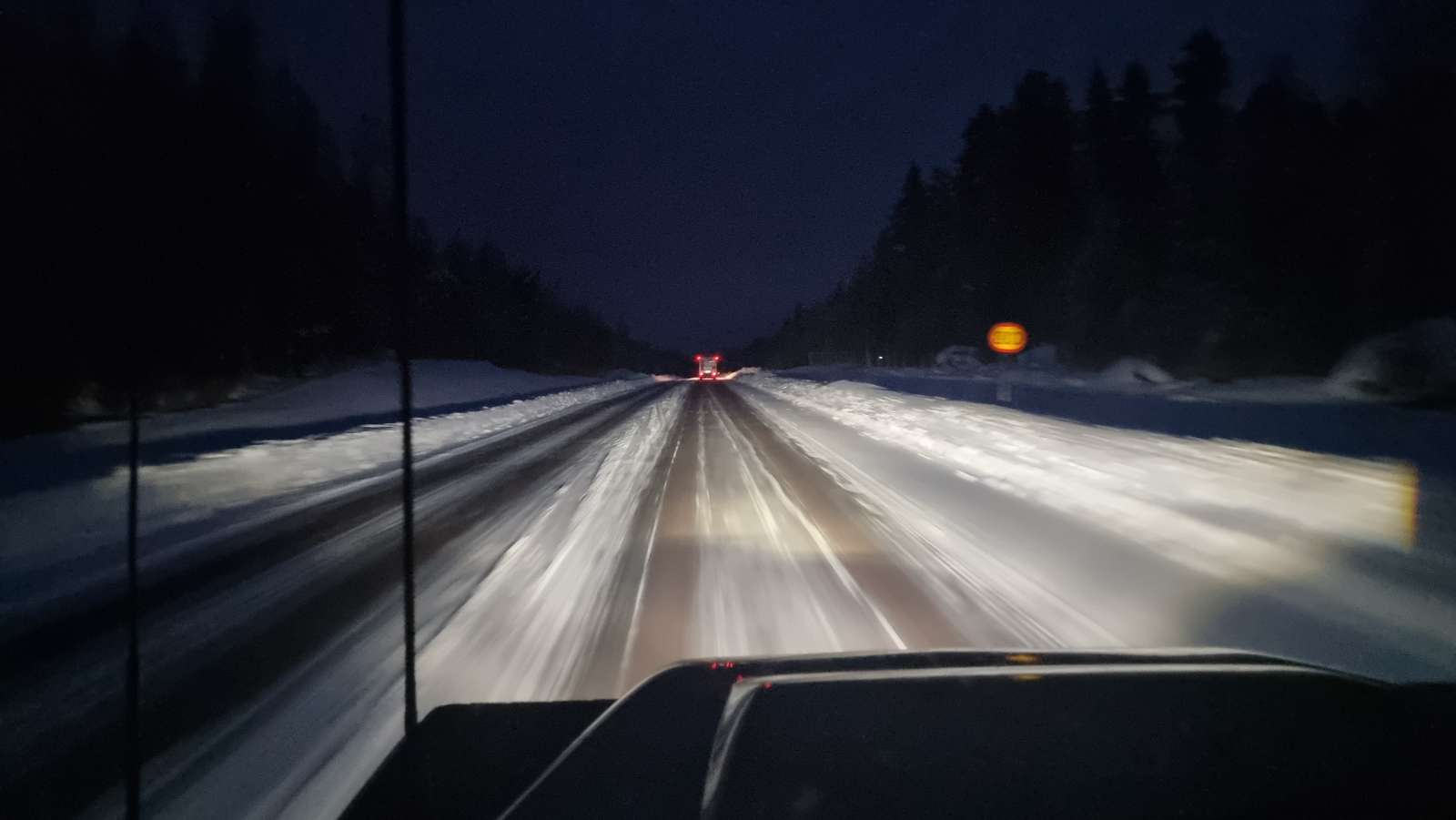
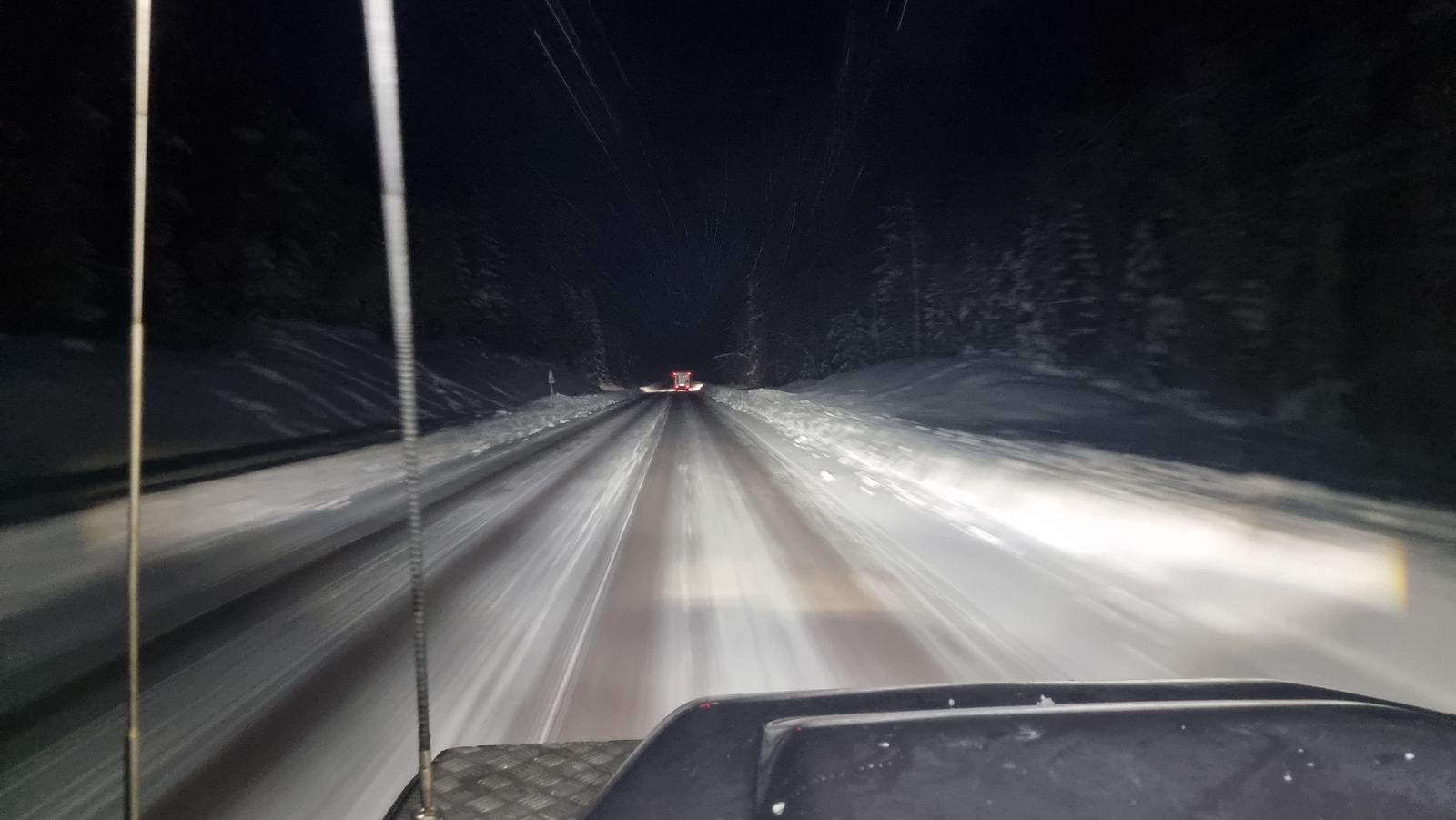
Of course, there it was! The LED-icing spectre. Something that scares everyone and keeps haunting the forums. “Don’t LED headlights ice up in winter?” As a European dealer and specialist for LED vehicle lighting, I of course watched this very closely on my vehicle and on Scandinavian vehicles. There’s no better opportunity.
In any case, the Scandinavians apparently get on wonderfully with unheated LED lights. They have to, because there aren’t any, or at least no notable number of, vehicles with heated LED lights. That alone is a hint that it probably isn’t a mass problem.
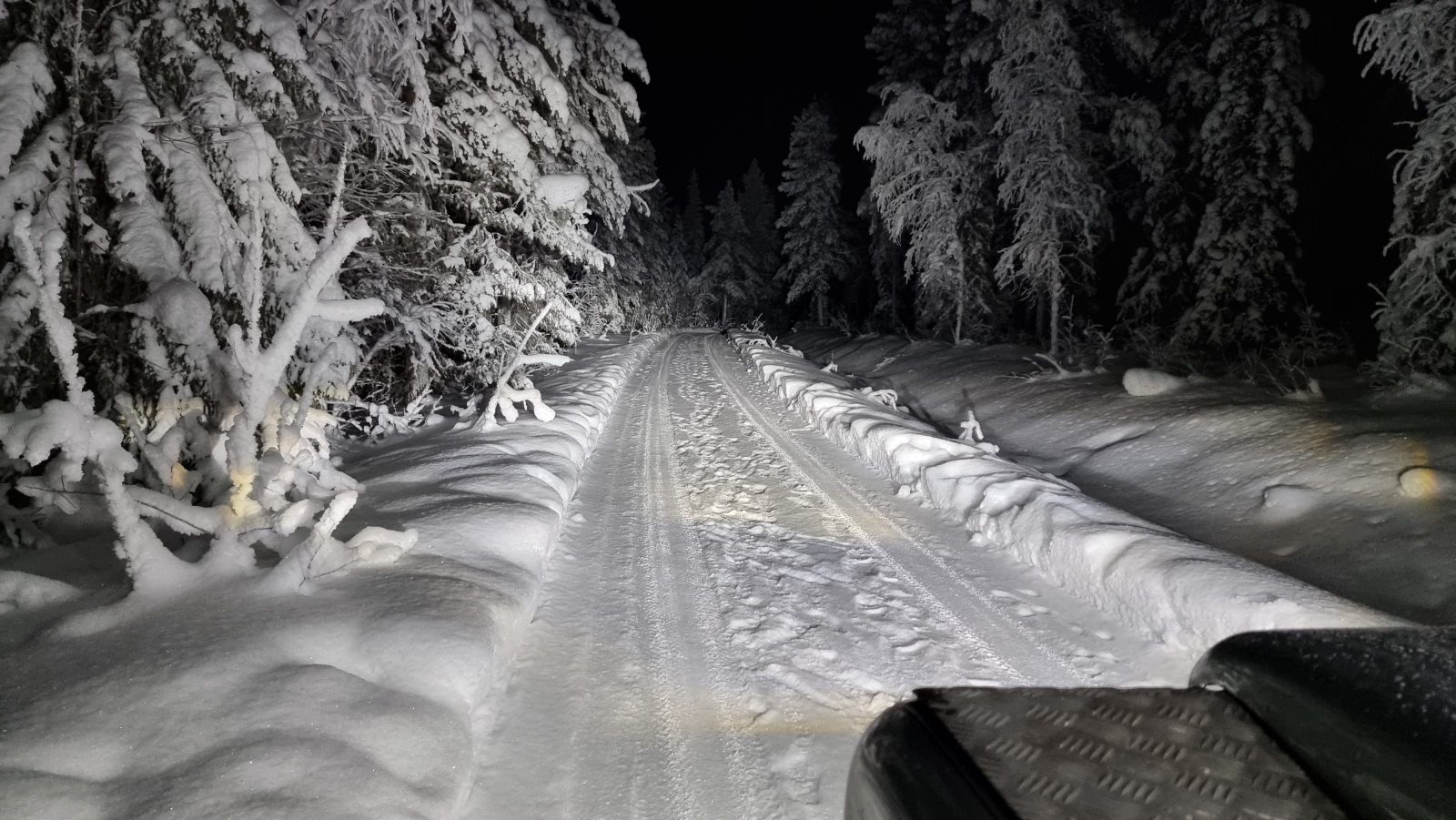
If you look at the Scandinavians’ vehicles, you’ll see they are quite normal cars, as with us in Germany. From the light colour you’ll also notice that by now most of the vehicles there have LED headlights. That’s surely also down to the comparatively high number of electric vehicles, for which halogen light is far too energy-hungry. Only very rarely did I see xenon lights.
In Sweden there’s also no strict regulation of high beam. A lot is allowed; only the brightest driving light mustn’t exceed the reference value of 100 (= 430,000 candela). You notice that very clearly there when a truck comes towards you whose entire front appears like a white wall of LED light.
Winter drives in Scandinavia call for a lot of good, far-reaching light
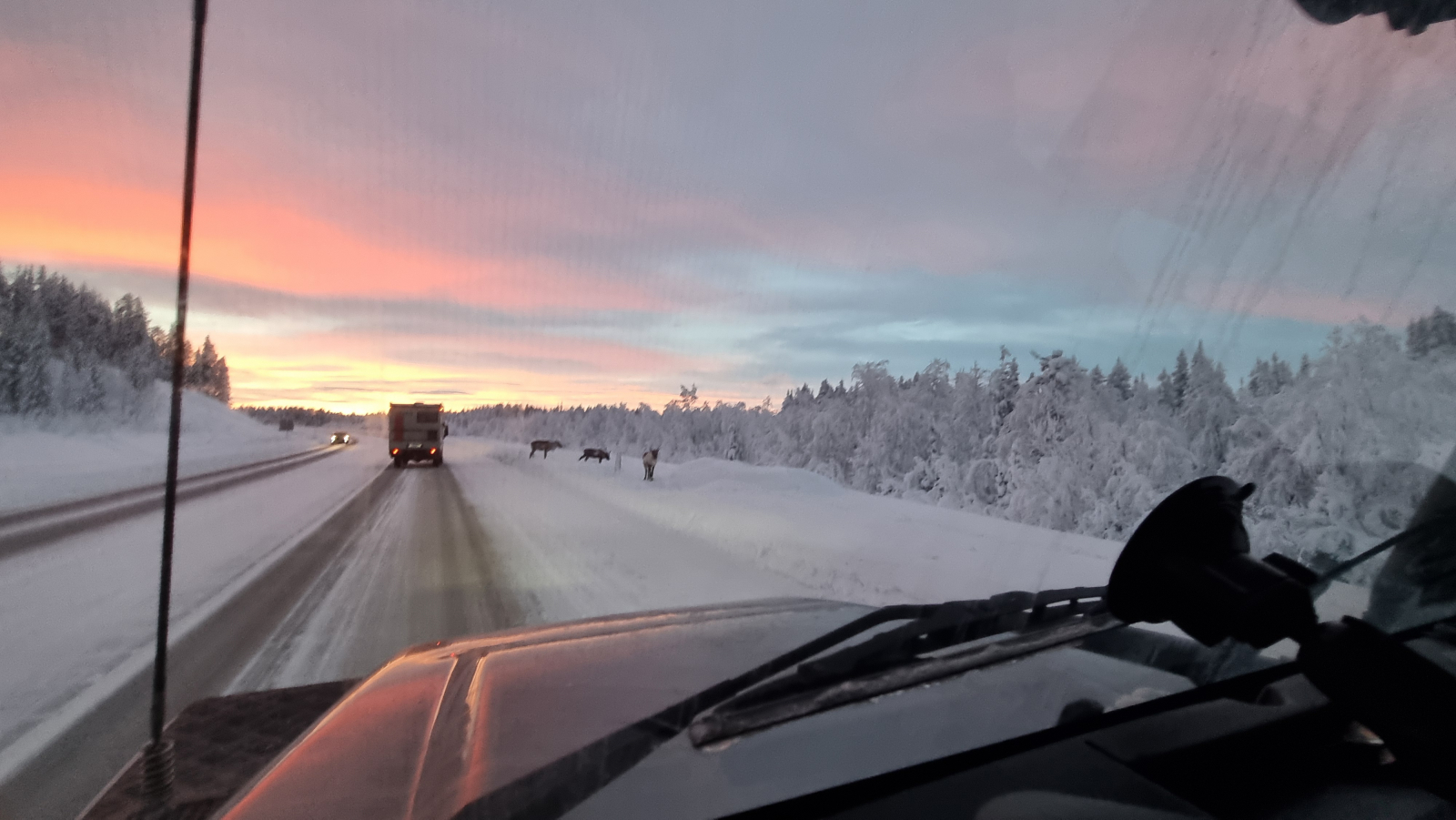
Anyone who’s been in Scandinavia in winter quickly understands that a different attitude to good, bright light prevails there. You only have to look at the roads there. Long, straight roads that lie in the dark almost constantly for months, are completely iced in winter, plus the constant danger of animals crossing. We saw reindeer standing at the roadside several times. We also often saw animal tracks leading from one edge of the road to the other. In Sweden, roughly 20 to 25 metres beside the road are mostly cleared and unvegetated. That’s very helpful for spotting animals in time.
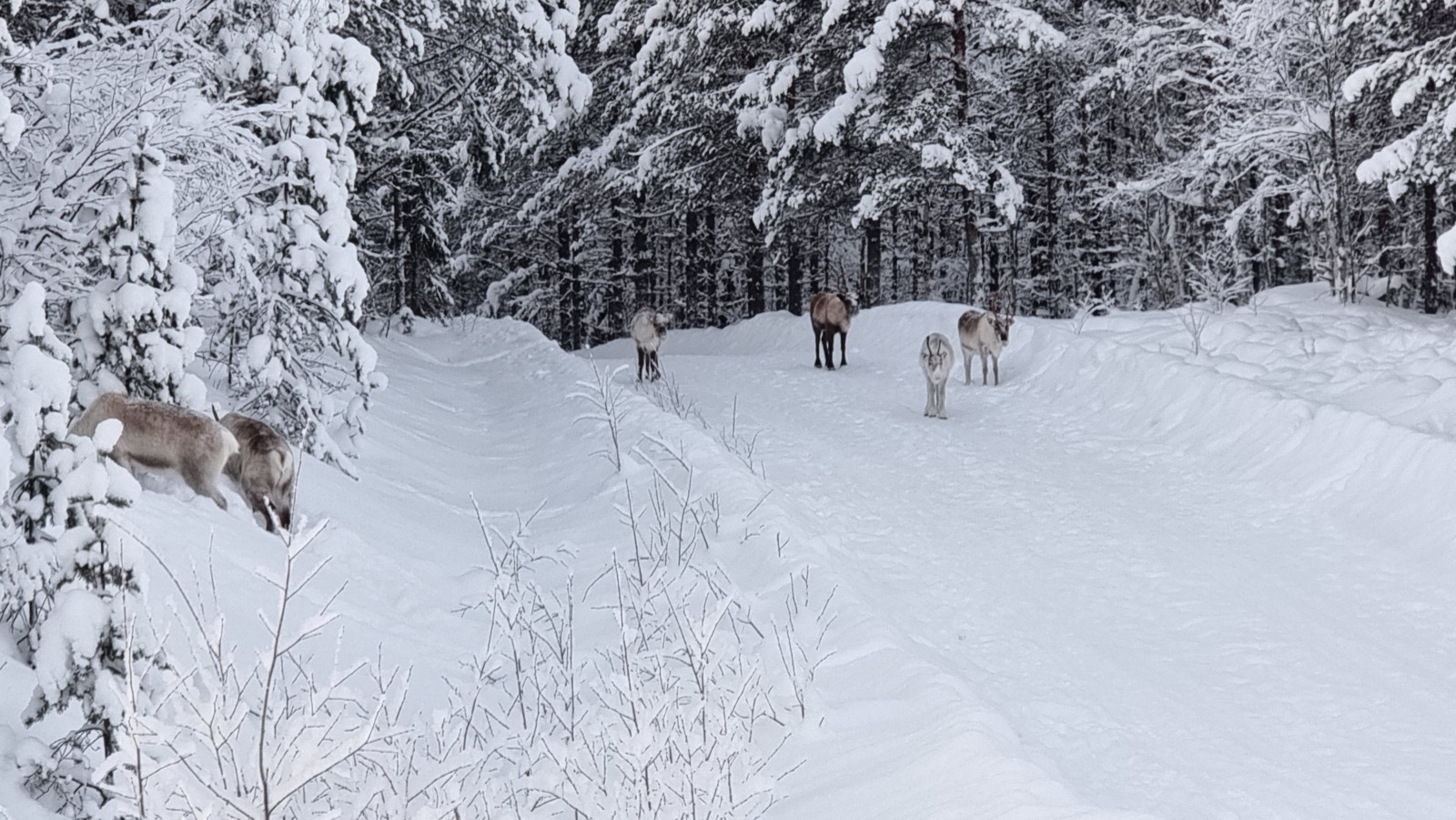
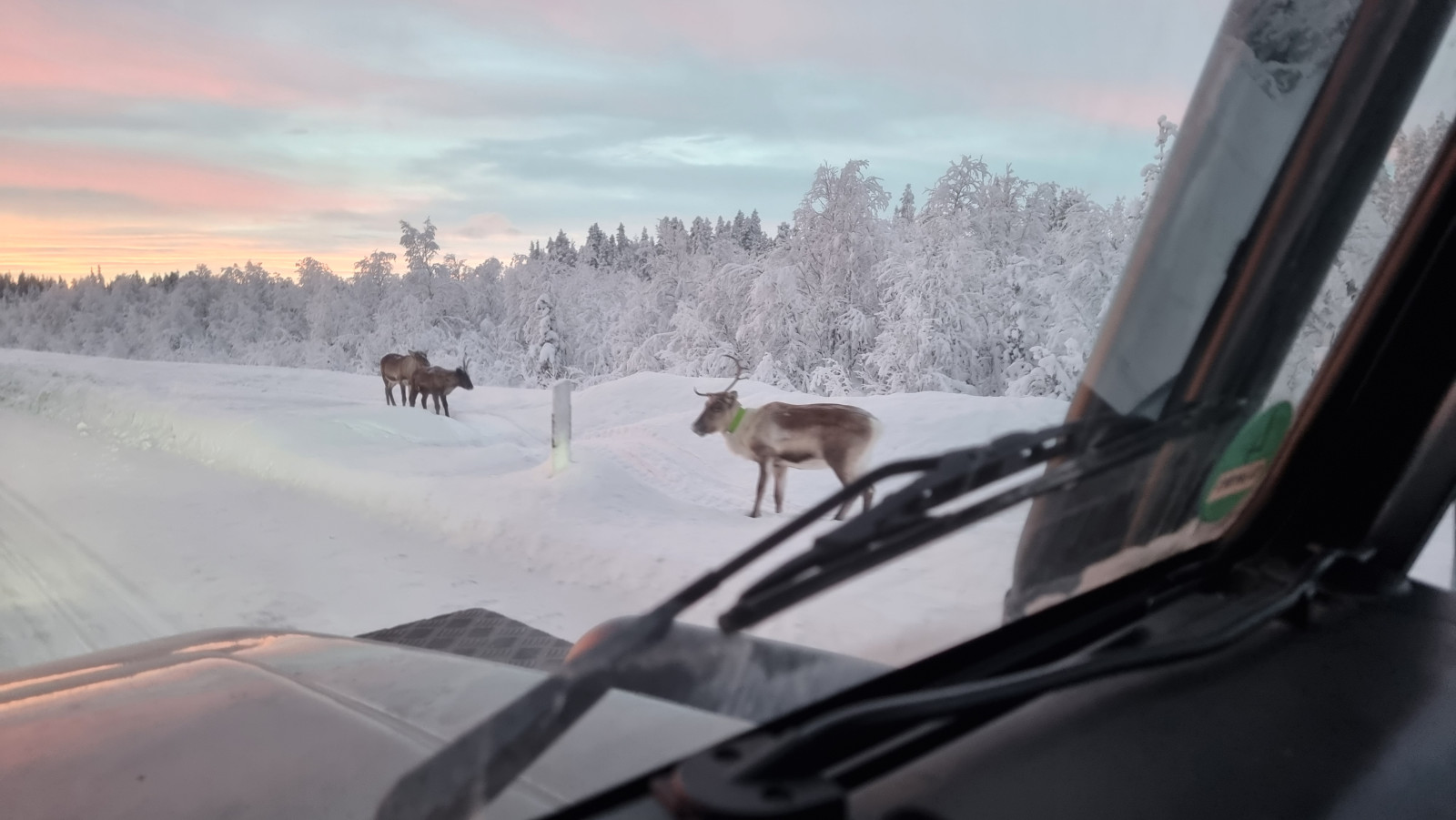
It’s now clear to me why so much strong high beam is allowed there. It’s no use spotting an animal at the roadside or even on the road with normal light, because on the iced surface you simply can’t stop in time. The earlier the animal is spotted, the better and the more briskly you can drive. That isn’t the same as speeding. The Scandinavians drive there with studs at a sensible 80 to 90 km/h, as is allowed. Especially in Norway, where heavy penalties threaten for driving too fast. But to stop in time, normal halogen light simply isn’t bright enough.
Team Burow would have liked the light of an LED headlight, but for the Ford Ranger of this year there’s currently no solution, so the work-light light bars fitted by Burow had to do.
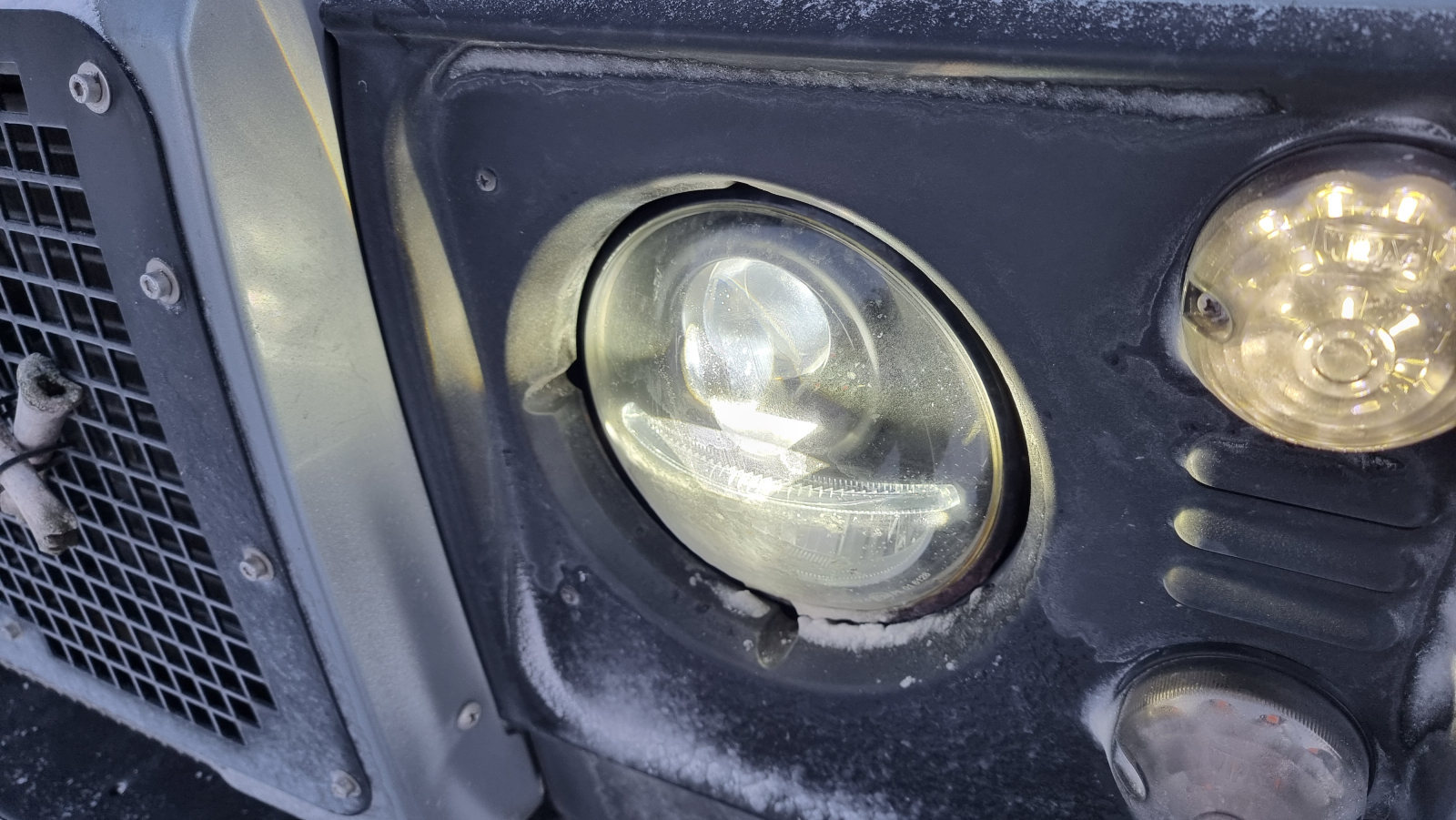
But how was it with the icing of the LED 7″ main headlights? As expected, it only happened once, when we were on the way from Karlstad to Östersund and had an outside temperature of -2°C. Otherwise, on the rest of the trip it didn’t happen again. Why? Because only in the temperature range between about 2°C and -7°C does the snow pack and stick. When it gets colder, the snow is so dry that it doesn’t stick at all any more. Since I always drove behind Team Burow, I always drove through the whirled-up snow, and in the colder regions we also had light snowfall. In that, the switched-on dipped beams didn’t ice up.
Now, on the Land Rover Defender the fitting position of the headlights supports icing. The lights are surrounded by a kind of funnel that prevents the snow from being blown off to the side. Snow can gather there over time. But that didn’t happen either. If your headlights are exposed, it won’t happen there either.
The personal lighting kit
While in my workshop I go for the LEDLenser H5-Work head torch, for the trip I needed a small head torch with a red light. Red light prevents self-dazzle and preserves your night vision. So I took a Petzl Tikka along. I used almost only the red light.
In addition, a small pocket torch, a Nitecore M21C, was always in my jacket pocket, which has an angle-adjustable head. Very handy. It also helped out here and there in the vehicle, as it has a magnetic base. Mainly, though, I used the LedLenser iF3R inside. It lasts a long time, has several brightness levels, a strong magnet and can be fixed in almost any position. I put it on the pop-top-roof frame, where it always held securely even while driving. When I spent time in the car or cooked, I used its brightness level 1 or 2, which gave off absolutely enough light. I charged it before the trip and didn’t have to recharge it during the journey.
Tyres
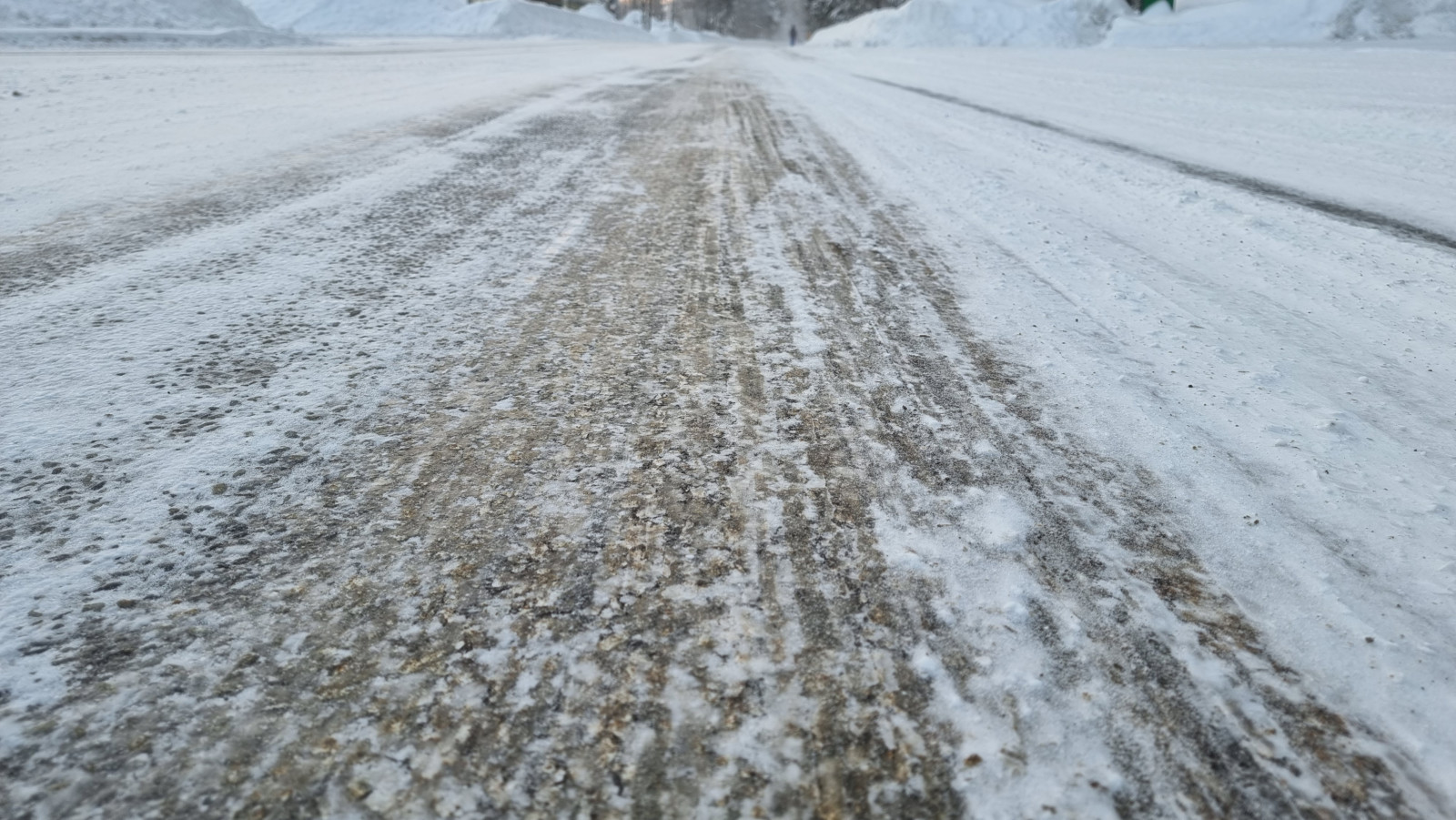
The roads during our trip were as good as NEVER snow- or ice-free. Most of the time the wheel tracks were covered with ice and the strips thinly covered with snow. Deceptively, the ice strips often look like dry tarmac. Controlled test braking, when you’re alone on the road, quickly shows, though, that it’s always frozen and slippery.
The Scandinavians very often run studs in their tyres. Anyone whose tyres are prepared for studs can get a set at Biltema and quickly fit the outer rows of the tyres with studs using a cordless driver. We had to get by with the AT tyres as they are. Of course AT tyres, even with the 3PMSF symbol, are no top winter tyres like normal cars have. Even so, we got on with them astonishingly well. The rear of the Burow tended to break away a few times, but that’s just how it is with rear-wheel drive, and the weight of over 3.2 t pulls to the side here and there. Niklas then engaged his four-wheel drive and with that the danger was largely banished.
While the Scandinavians overtook us at an easy 90 to 100 km/h with studs, we behaved very cautiously. A speed between 50 and 70 km/h was still doable on most stretches without a problem. With the Defender’s permanent four-wheel drive I couldn’t find any problems at all. On snow there were no problems either. On smooth ice we got along well, slowly.
More on the topic of how tyres grip at all can be found in our guide: How Tyres Work.
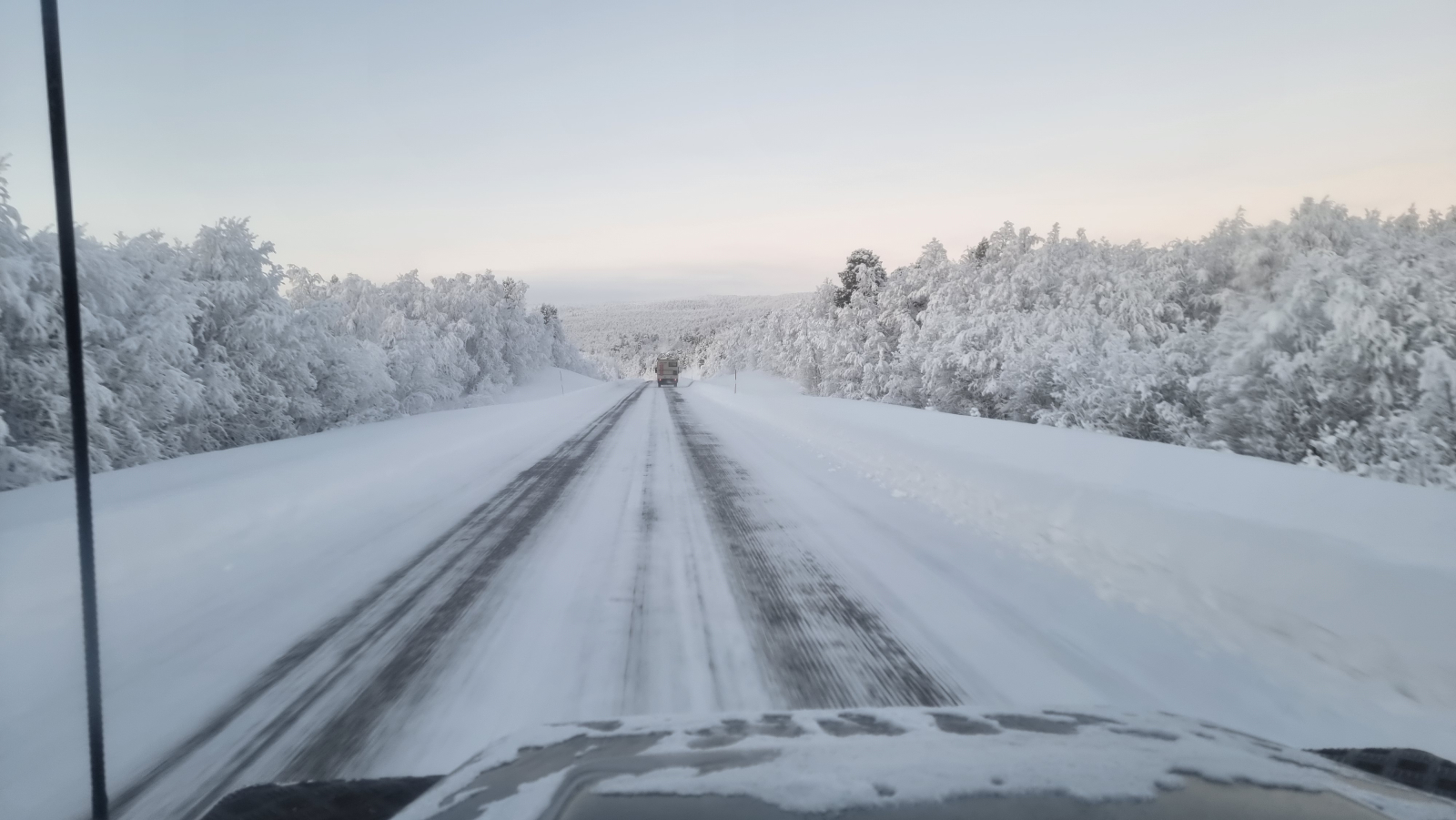
“Four-wheel-drive vehicles brake better,” Ferdinand Piëch, engineer and father of the Audi Quattro, told us at its launch a good forty years ago. Even though the press took the sentence over unchecked back then, it isn’t true all the same. No, when it comes to braking we’re all equal. Keeping your distance is therefore extremely important on the iced roads. The ABS braking system keeps the vehicle safely in its lane, but the price for that is an immensely long braking distance. If a large vehicle in front brakes, one you can’t see past, and you’re too close, you can only prevent the collision by taking off into the snow on the verge. And hopefully there’s only snow there. Because choosing the oncoming lane to dodge into can be even more fatal.
Preparing motorhome tech for winter camping in Scandinavia
Besides the car, there are other technical systems that can be affected by the cold. In a motorhome or a 4×4 converted into a camper, that would primarily be the water supply and disposal. If all systems lie in the insulated and heated cabin, problems normally aren’t to be expected. Almost. Because even if only 10 centimetres of the waste-water hose sticks out of the heated area, it freezes up in minutes at temperatures like these. First an icicle forms, it gets thicker and thicker and then the pipe is blocked. Even tipping warm water down the drain doesn’t help then; only the radiant heater helps.
It gets worse if the tanks don’t lie in the insulated area, possibly even exposed to the airflow. On Team Burow’s the water tank lies in the heated area, but the outer skin isn’t insulated. The waste-water tank lies in the outside area, protected only by sheet metal, and only warm heater air is directed at the waste-water hose leading outside. That still worked down to about -15°C, after which the outlet froze up regularly. The tank was already set to run through, so no ice forms in the tank itself, but once the drain is frozen and you don’t notice it.
At some point it was so cold that the fresh-water tank inside started to form ice on its surfaces, despite its position in the heated space. This can be countered within limits. For a transit through cold areas, for example, by keeping it as full as possible. That reduces the amount of cold air in the tank, which encourages freezing. In the end a limit is simply reached at some point. Then the tanks are best kept empty and you switch to canisters or water bottles, kept in the sufficiently heated cabin.
Luckily the Burow’s cabin is insulated. At these temperatures I could have put up with it alone in my Defender, but it wouldn’t have been pleasant or nice. There was simply too little space for that, and the uninsulated pop-top roof always made for a very cold zone. I did my things, cooking, eating, washing and sleeping, in the Defender, but how good that at Team Burow’s I got cosy asylum every evening. For two of us it would have been far more uncomfortable with the Defender. We’d have managed to organise it, but it wouldn’t have been relaxing. It’s something quite different when you know that every evening, or once it’s got dark, you can retreat into your mobile, warm hut. There you can take off the warm things for once, stretch your legs and enjoy a glass of wine or whisky without it steaming in front of your nose with every breath. Those are the unbeatable advantages of a vehicle like that.
For emergencies
One thing became clear to us: as long as everything works, even if with small problems, you can enjoy the winter weather and this fascinating landscape to the full. But what if something breaks or you have a breakdown? No one is immune to that. So you’re well advised, and the locals take this very conscientiously into account, to be prepared for an emergency.
The most important thing is protection from the cold and communication. Besides winter clothing (which should deserve the name), you should have warm blankets and enough to drink along. The air there is very dry, so you breathe out a lot of fluid. I noticed that a slight feeling of thirst always accompanied me.
Mobile reception was available almost throughout, but that need not always be so. Anyone travelling completely alone should perhaps think about a satellite phone, for hire for example. There are huts to be seen everywhere, but often these are summer residences, uninhabited in winter. You’ll also keep finding huts that protect you from the worst, except from the cold. But in Sweden firewood is very often kept ready at such huts and spots. So if you have to go on on foot, take firelighters and something to light along.
Speaking of on foot, slip-on spikes are very helpful if you have to move on ice for longer. These can be quickly pulled over the shoes and then offer good footing.
In the winter months, on top of the cold, darkness prevails there for most of the day. Above the Arctic Circle you have a maximum of two to three hours of twilight. A powerful torch and a head torch for every fellow traveller have to be available. If you’re already in an uncomfortable situation, you don’t want to make an emergency out of it too, because someone trips or falls.
Also very helpful are chemical warming inserts for the shoes and for the hands. With them, eight to twelve hours can be bridged. Always keep a few sets of them ready. That may sound only like comfort, but comfort is safety. Only if I feel at least almost comfortable do I have a free head for the important decisions and one problem fewer.
Animals that can become dangerous to you are rather rare in winter. The bears are asleep, but there are wolves. About 48 packs and 27 pairs have been counted in recent years for Norway and Sweden. There’s an attempt to keep the population at about 300 animals. So an encounter isn’t out of the question, though in Finland the likelihood is higher. However, special culls have repeatedly been allowed for Lapland in recent years, because reindeer from breeding stocks were killed. Where there are reindeer, wolves can in principle be around too. You should generally give moose (elk) a wide berth, especially the bulls. Even bears and wolves get out of their way, because they are extremely able to defend themselves.
You want to go winter camping too?
If the pictures and the article have given you a taste for winter camping, then read our guides on this topic:
Kim & Niklas, Team Burow
These are my two friends Kim & Niklas. Niklas finally fulfilled his dream of his own motorhome two years ago and, after long, intensive research and getting to grips with the whole subject and their needs, decided on a Burow motorhome. The two of them already did a months-long trip through southern Europe with the Burow last year.
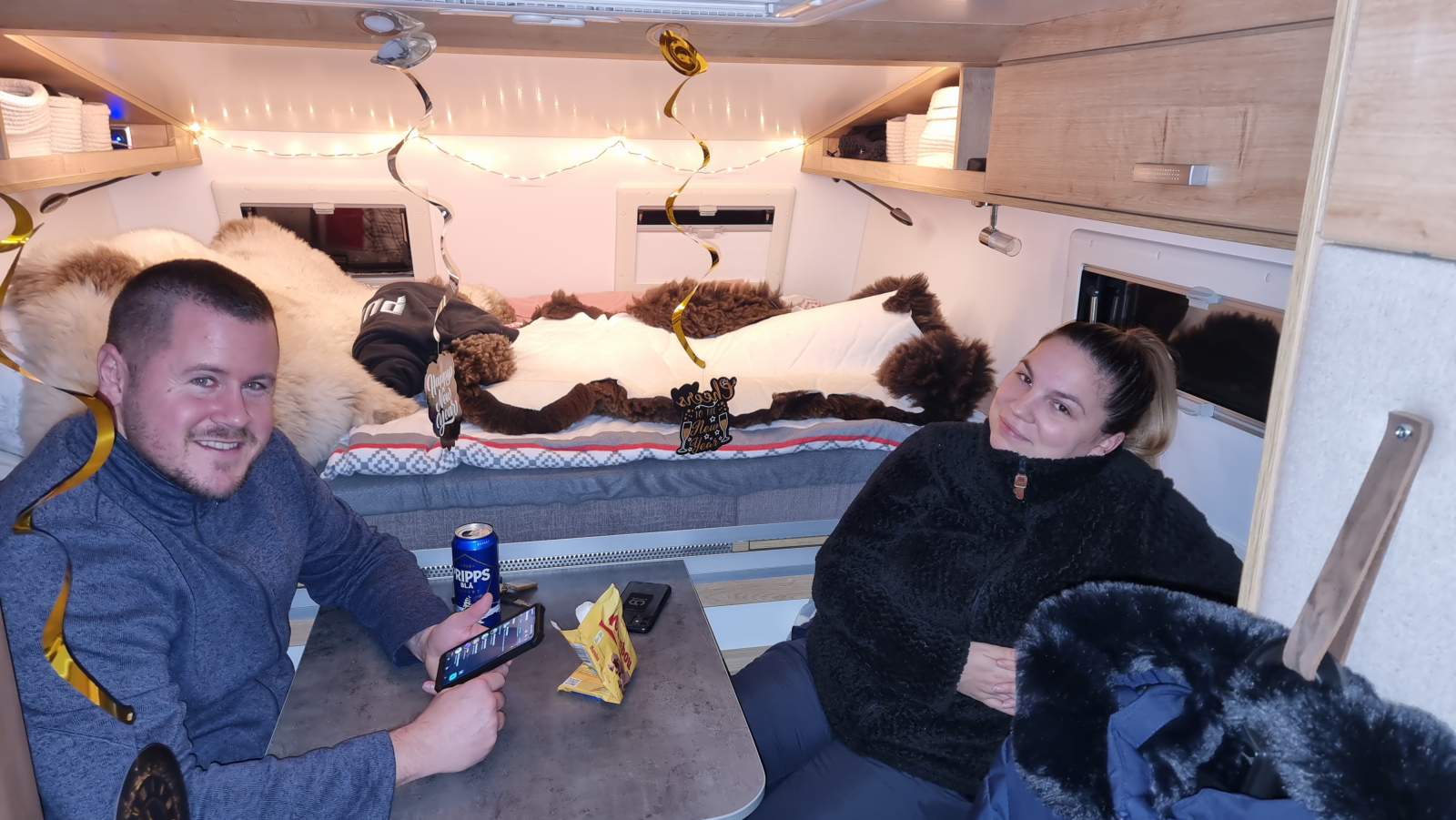
They took me along on this trip and it was a real and valuable experience for me. It showed all of us the limits, and also that our vehicles are exactly what we want for travelling. With a few changes, the Burow motorhome can surely be made permanently fit for these temperatures. I think that would be harder with the Defender.