


Artificial intelligence is making its way more and more into our hobby too, and recently we looked at the possibilities of AI here on Matsch&Piste. In what follows we take a look at how trip planning with ChatGPT works.
In this article we showed you how artificial intelligence and overlanding can be usefully combined. Applications like the chatbot ChatGPT can help with route planning and suggest worthwhile destinations, give country-specific tips, name entry rules, suggest the kit you need and much more. All this can speed up and ease the research. But are there limits too? And how do we have to question the AI so that what comes out is really what we hope for?
What is ChatGPT, actually?
ChatGPT is an abbreviation and stands for chat and “generative pre-trained transformer”. This chatbot was already presented in 2022 by the US software house OpenAI. What’s behind it? Well, with this chatbot from the software company OpenAI the user can communicate much like with a human. The basis is a language model trained with a large number of documents. ChatGPT can be used in a browser version or, on the road, as an app on the smartphone or a tablet, which you may have with you for navigation anyway.
To test the AI we came up with various scenarios
Entry requirements
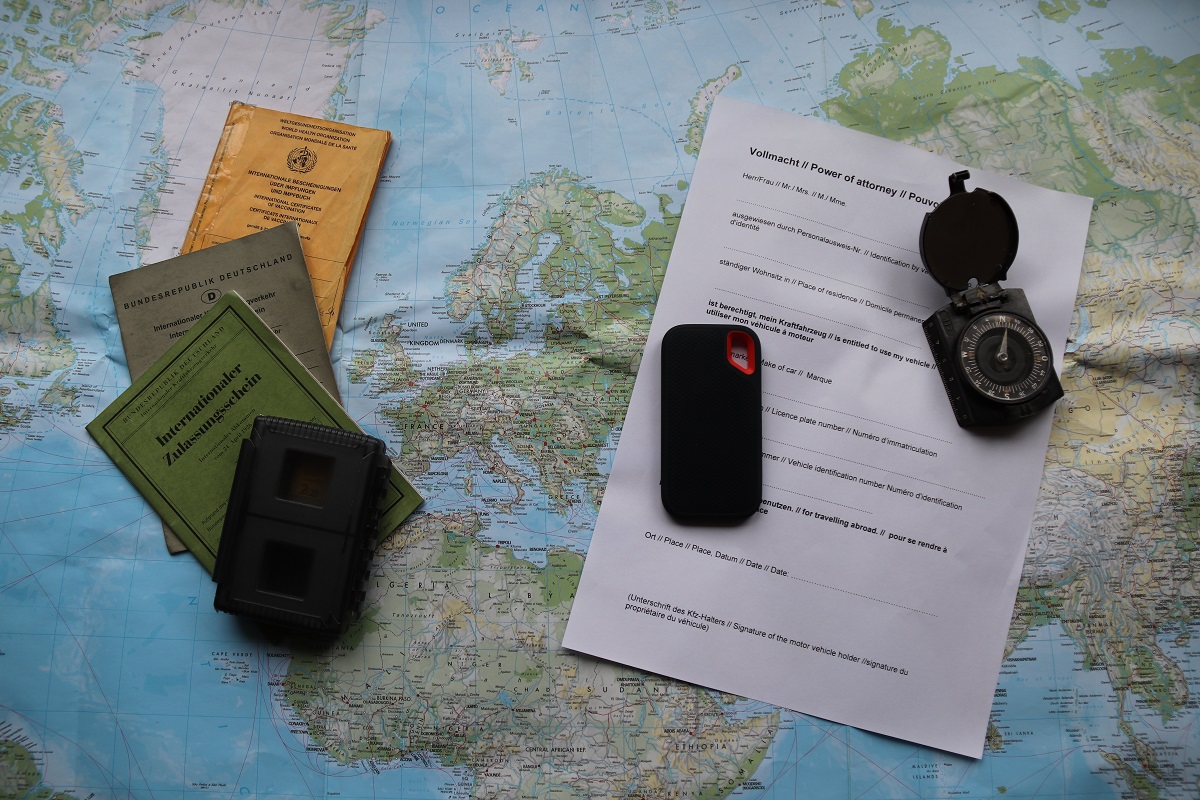
This scenario is about a vehicle-based trip overland to the United Kingdom. Besides the entry requirements and conditions, we’re interested in which personal documents and which vehicle documents are needed.
Another scenario deals with a trip to Morocco, a country popular with off-road travellers. Here too we want to know what the entry requirements are and which documents are needed for the border crossing and the trip.
Kit
Next we turned to the kit. For that we assumed we want to take a two-week camping holiday with a 4×4. The trip takes place in Europe, warm climate, and on board are two adults and a dog. The question is: what do we need for it, what do we have to take?
Vehicle preparation
Good vehicle preparation before a trip matters. And so in this scenario we asked the AI what we have to prepare on the vehicle for an off-road holiday in the Tunisian desert. On the 14-day tour we’ll be moving mainly in the sand and the dunes with a Land Rover Defender. So much for the idea.
Navigation
Navigation matters on the road and already in the tour prep too. We want to test the AI on that as well. For that we came up with two more concrete scenarios.
For one, we want to get an off-road route from the AI. Namely between the places Camprodon and Ribes de Freser. These are in the north of Spain. Here we of course want to drive an unpaved track and not on tarmac. And then we’re also interested in getting to Iceland with our own car.
We tried out how we have to question the AI to find useful and helpful information
We first ask about the entry requirements
Question to ChatGPT: “We want to travel by car, so overland, to the United Kingdom. What entry requirements and conditions apply there, and which personal documents and which vehicle documents are needed?”
The answer, provided in seconds, is extensive and well structured. Right at the start it contains the very current note on the ETA procedure, the electronic travel authorisation, required since April. The personal documents and vehicle documents are named in full. Especially good: ChatGPT names sources, e.g. the pages of the German Federal Foreign Office, where the traveller could then look up further with a click. The so-called further notes are good and helpful too. Here ChatGPT names and explains, among other things, the left-hand traffic and the headlight adjustment, and briefly covers toll and low-emission zones. There are no details on this query, but at least a link to the London transport authority. Here it honestly has to be said too that the rules on low-emission zones in many countries, and in the UK too, are complex for the traveller. Have a look at the article here on Matsch&Piste on that. We sadly miss a note on the nationality plate.
ChatGPT also gives notes on carrying requirements, like high-vis vests, but without details. So how many high-vis vests have to be carried we don’t find out straight away with the question above. For that a real conversation with the chatbot is needed. And now it gets interesting. To the question “How many high-vis vests have to be carried in the UK?” ChatGPT states that there’s no legal duty to carry high-vis vests in the vehicle. This is recommended, though. A contradiction to the first statement, where the chatbot still said there was such a duty. Correct, according to our research, is that for private purposes in the United Kingdom there’s actually no requirement to carry high-vis vests.
On with the trip planning with ChatGPT to Morocco
“We want to take a trip by car to Morocco. What entry requirements and which documents are needed for the border crossing and the trip there?”
Here too an overview of the documents. The keen reader trips over one point at once. ChatGPT thinks it knows that a Carnet de Passages is needed for the temporary duty-free import of the vehicle into Morocco. The author pricks up his ears and asks: “Is a Carnet de Passages needed for a trip by car to Morocco?” The answer is clear, no, no CdP is needed, the vehicle is registered in the Moroccan customs system on entry. Phew, lucky again.
There follow further notes on the planned trip, e.g. that certain quantities of tobacco, alcohol and perfume may be imported duty-free on entry. ChatGPT doesn’t name details on the first attempt. We know this already, here the traveller has to ask specifically and develop a conversation.
A bit of kit on top
Question to ChatGPT: “We want to take a two-week camping holiday with a 4×4. The trip takes place in Europe. In a warm climate. We’re two adults and a dog. What do we need for it, what do we have to take?”
The chatbot spits out a long and well-structured list. It starts with notes on documents, then come many things for the dog, even a first-aid kit for dogs is thought of. Then comes the rest of the kit, divided by, for example, sleeping, cooking and food, hygiene and health or clothing. The chatbot thinks of leisure activities and kit for emergencies too. There follow simple notes on camping or wild camping and the note to plan rest days without driving, especially for the dog. That’s great.
Beginners in particular get really useful first tips this way and can then ask specifically. And at the end ChatGPT gives the note: “Do you have special plans (off-road adventure, beach, mountains)? Then I can give even more targeted tips!” So ask again!

Good vehicle preparation matters
Having learned from the questions so far, the author asks very specifically: “We’re planning an off-road holiday in the Tunisian desert. On the 14-day tour we’ll be moving mainly in the sand and the dunes with a Land Rover Defender. How should we prepare the vehicle for it?”
The answer follows promptly and is extensive. Here too the structuring stands out. All sorts of kit are listed, most of which seems sensible too. Here, though, ChatGPT doesn’t differentiate between different tour profiles. The good thing here too, though, is that emergency kit and communication are covered. At the end there follow valuable notes on route planning and logistics, like the supply of spare parts.
But somehow this isn’t the answer we expected. The question was about vehicle preparation, and ChatGPT leans more towards vehicle equipment and personal kit. So ask again: “How do I service my vehicle for a 14-day desert tour through Tunisia?”
Now it gets a lot better. ChatGPT has all sorts of sensible recommendations for servicing beforehand with numerous details, the chatbot even covers play and wear on track-rod ends, and on the road too, e.g. regular checks, retorquing bolts and so on. These are notes beginners can do something with too. The chatbot doesn’t go into detail here, nor into the fact that we explicitly told it the vehicle type. Here we’d have expected vehicle specifics, like special tools and particulars, to be taken into account. Roughly like in our articles on tools for travel.
Let’s look at the navigation and route-finding scenarios too
With trip planning with ChatGPT, questions on navigation and route planning can’t be missing either.
“Please name me an off-road route between the places Camprodon and Ribes de Freser.”
The result is surprising. There’s first a short profile of the route. Start, intermediate stop and destination are named with GPS coordinates, figures on the length and driving time are given with a note on weather influences. Then comes a bullet-point route description that contains, among other things, notes on the track surface. The chatbot rounds the whole thing off with information on the recommended kit. We can do something with that straight away.
“I want to go to Iceland with my own car. Please tell me something about getting there.”
ChatGPT first spits out a few helpful notes on the ferry MS Norröna of the shipping line Smyril Line, including information on departures, the process and price indications. Then come notes on vehicle preparation and kit. We didn’t even ask about the latter, but it’s helpful anyway. Now ChatGPT asks: “Would you like a particular route or highlights for your Iceland tour?” OK, so ask further, and we know this already. And getting there involves more than the ferry. So, “How do I get to Hirtshals for the departure of the ferry MS Norröna?” ChatGPT gives various options for that. Among them one you surely hadn’t thought of, namely via Stockholm. Not so relevant for us now, but owed to the question, there are further figures on getting there by train and plane. There follow a few more tips on getting there and ChatGPT asks again: “Do you already have an exact starting point for your trip?” A conversation develops…
Asking ChatGPT the right way
We see that the result you get from the AI depends heavily on the way you ask. Simple question sentences don’t do it. Sometimes a real kind of conversation is needed, or giving as many parameters as possible already in the first question. The basic rule is, the more details and keywords you supply, the better the result gets. The reason is that the AI uses the count of a word and the connection of the words of the whole question to determine the relevance and understand the meaning. The information source is then all the internet content, like blogs. So if you ask for “off-road”, “route” and “Spain”, roughly speaking internet and blog content (with which the model was fed) is prepared as an answer that contains these words. It’s also about probabilities in the AI’s answer.
So formulating the right questions takes practice and the participation of the asker. You also shouldn’t assume that an AI answer is then all-encompassing or correct. Because it lives off the information it finds online and can’t check it for correctness itself. Because the AI can only access what’s there too. And you know it yourself, in blog posts, articles, forums and other sources the right, and certainly the up-to-date, information isn’t always there. We’ve looked at this and other aspects in our article on the sensible use of artificial intelligence in overlanding too.
By the way, we’ve taken a closer look at further AI and asked these questions too. You’ll find the results and experiences we gathered soon in a further article here on Matsch&Piste.
Have you ever used AI for trip planning and questioned chatbots on it? What are your experiences with trip planning with ChatGPT?
© Photos: Björn Eldracher