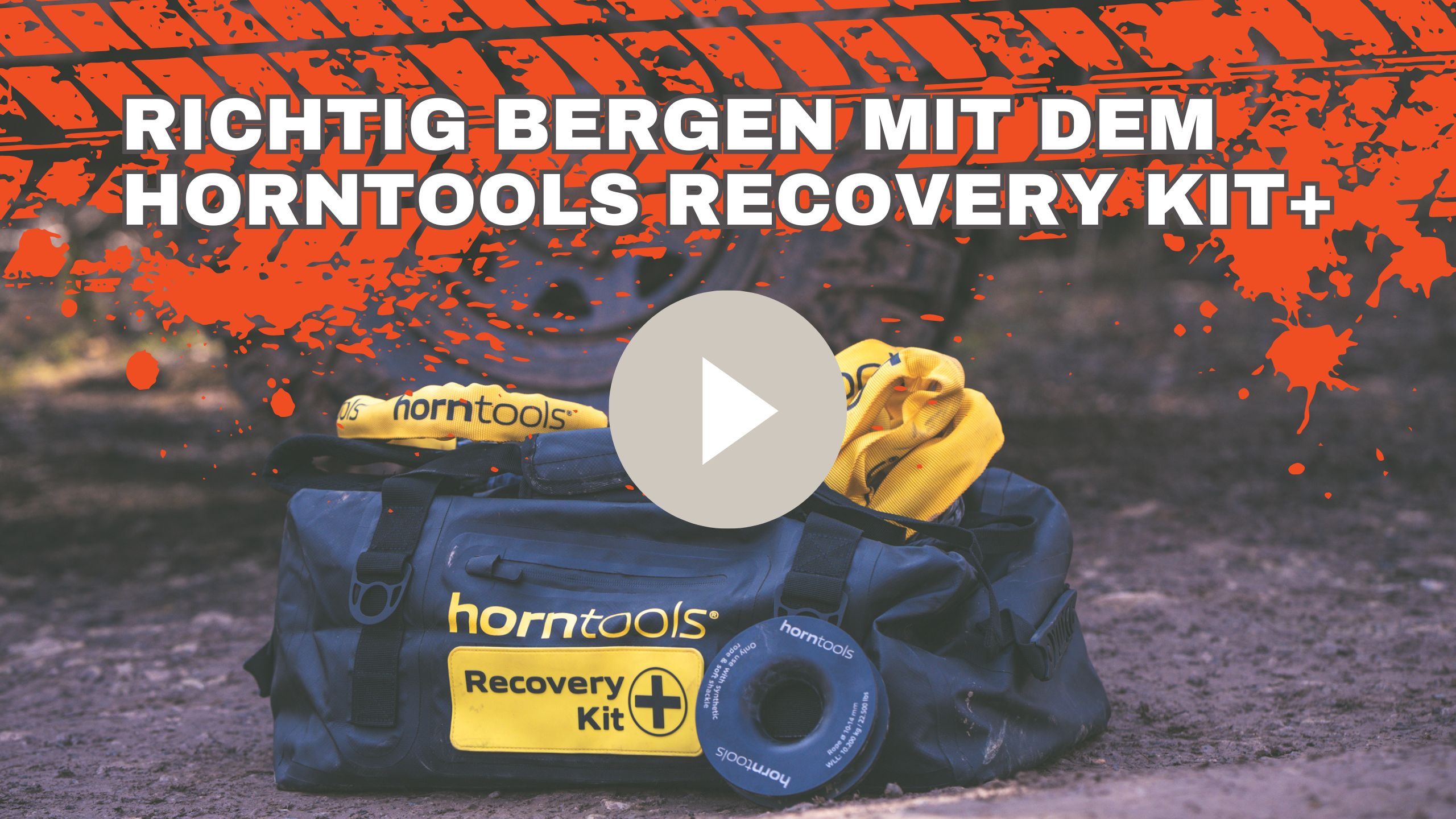

Advertisement: Anyone who wants to put a recovery kit together has a choice: individual parts as needed or a ready-made complete set. We took a closer look at the recovery kit from horntools, and we reckon: this thing has something to it. Why it’s a good choice and what you should watch out for in use, we show you here.
If you read Matsch&Piste regularly, you know our articles around the subject of recovery, and you know how much value we place on sensible, safe gear. It was with exactly this eye that we tested the horntools Recovery Kit+ too. But first, very practically: what’s in it, and what do you get for your money?
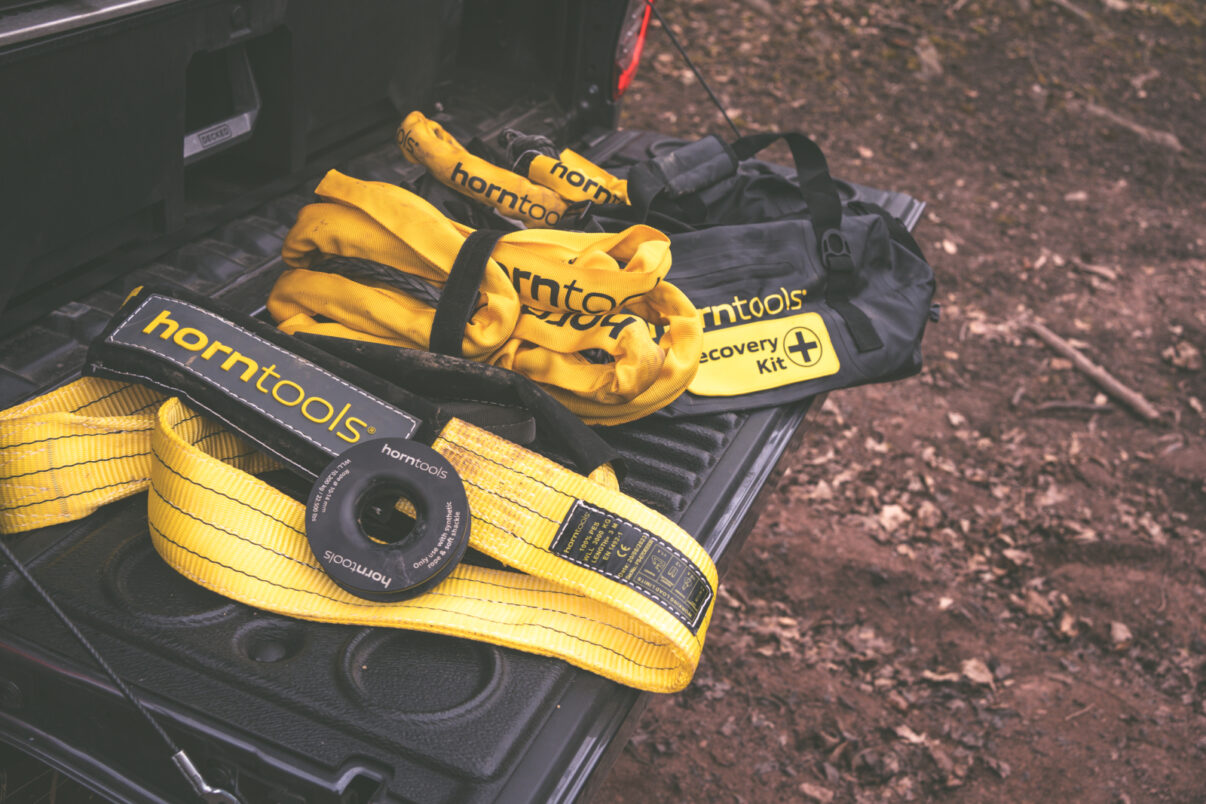
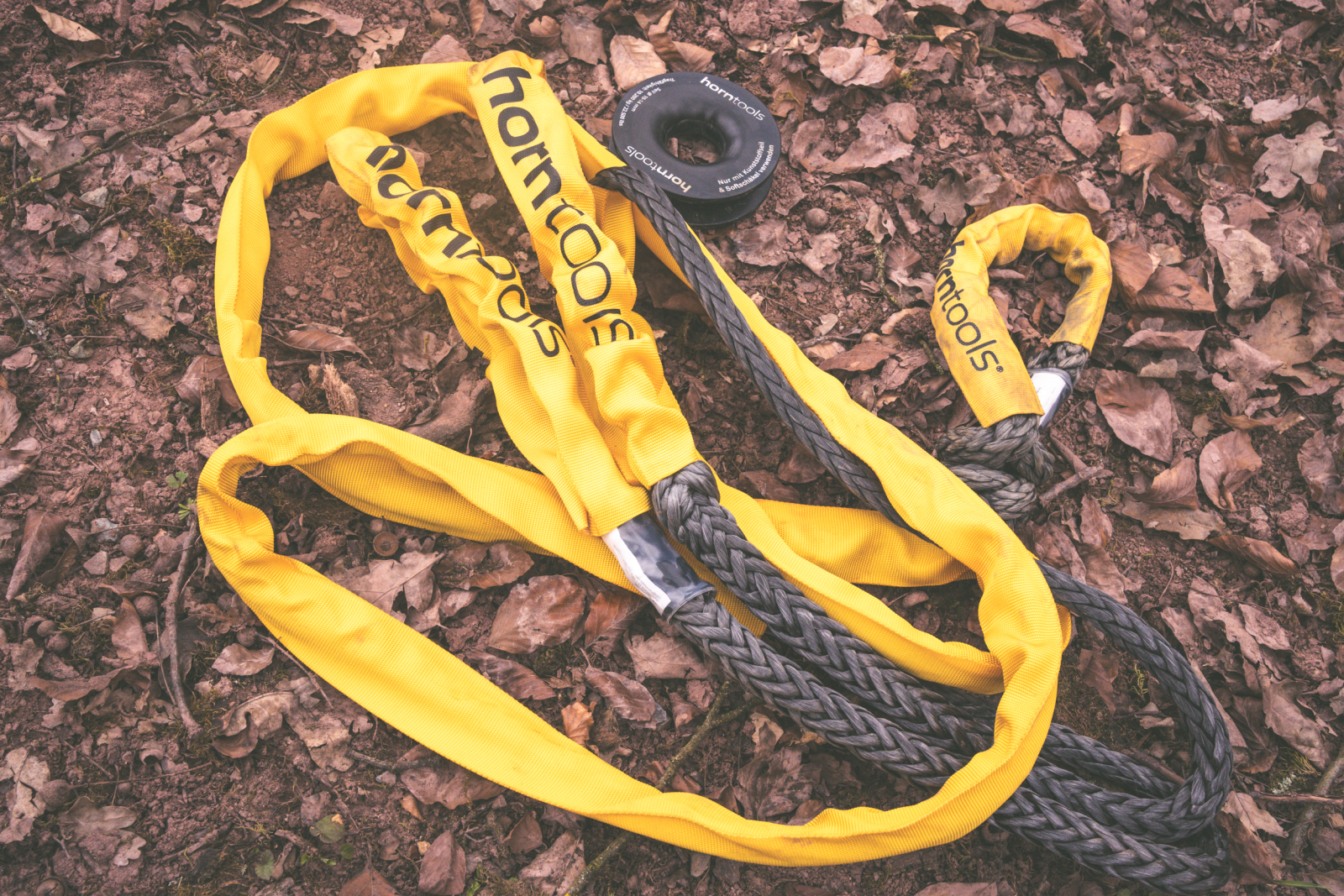
The contents of the horntools Recovery Kit+
The most striking thing: the complete recovery gear sits in a rugged, waterproof bag. When you open it, you’ll find the following accessories, all designed for use with a winch with synthetic rope:
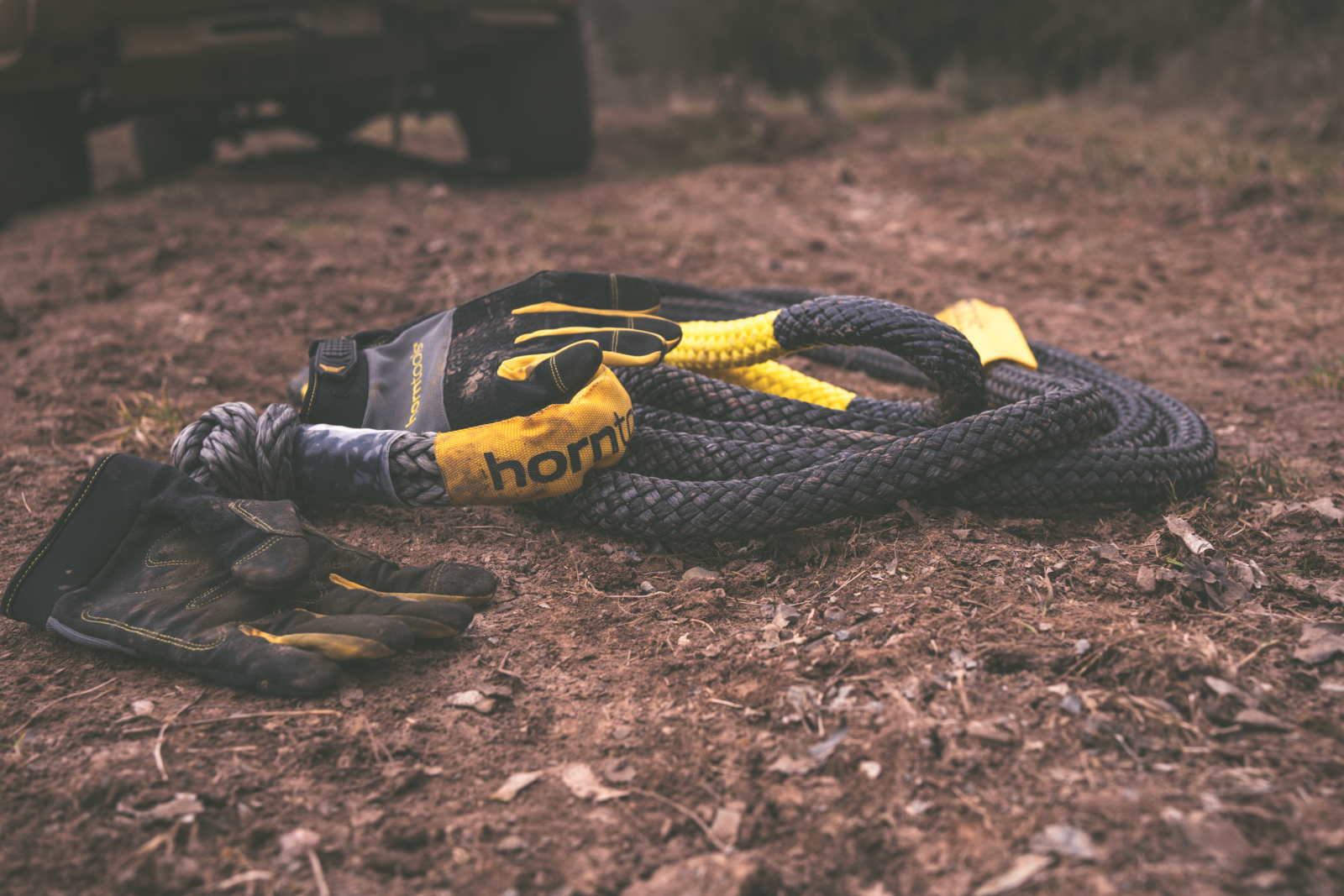
- A pair of protective gloves
- A flat sling, WLL straight pull 3 tonnes, looped 6 tonnes, triangle 4.2 tonnes, choked 1.5 tonnes
- A recovery rope, WLL 12 tonnes
- A snatch ring for synthetic winch ropes of 10 to 14 mm diameter, WLL 10.2 tonnes
- Two soft shackles, WLL 12 tonnes
The kinetic recovery rope isn’t included in the set, but as it’s sensible we tested it too.
The bottom line: the horntools Recovery Kit+ is a really good start if you have a vehicle with a winch and synthetic rope. With this gear you can use trees as an anchor point, extend ropes, connect vehicles or set up a redirect, for example to form a block and tackle. You don’t need more than that to begin with. Anyone who’s out off-road, whether travelling or simply for fun in the terrain, is solidly equipped with it.
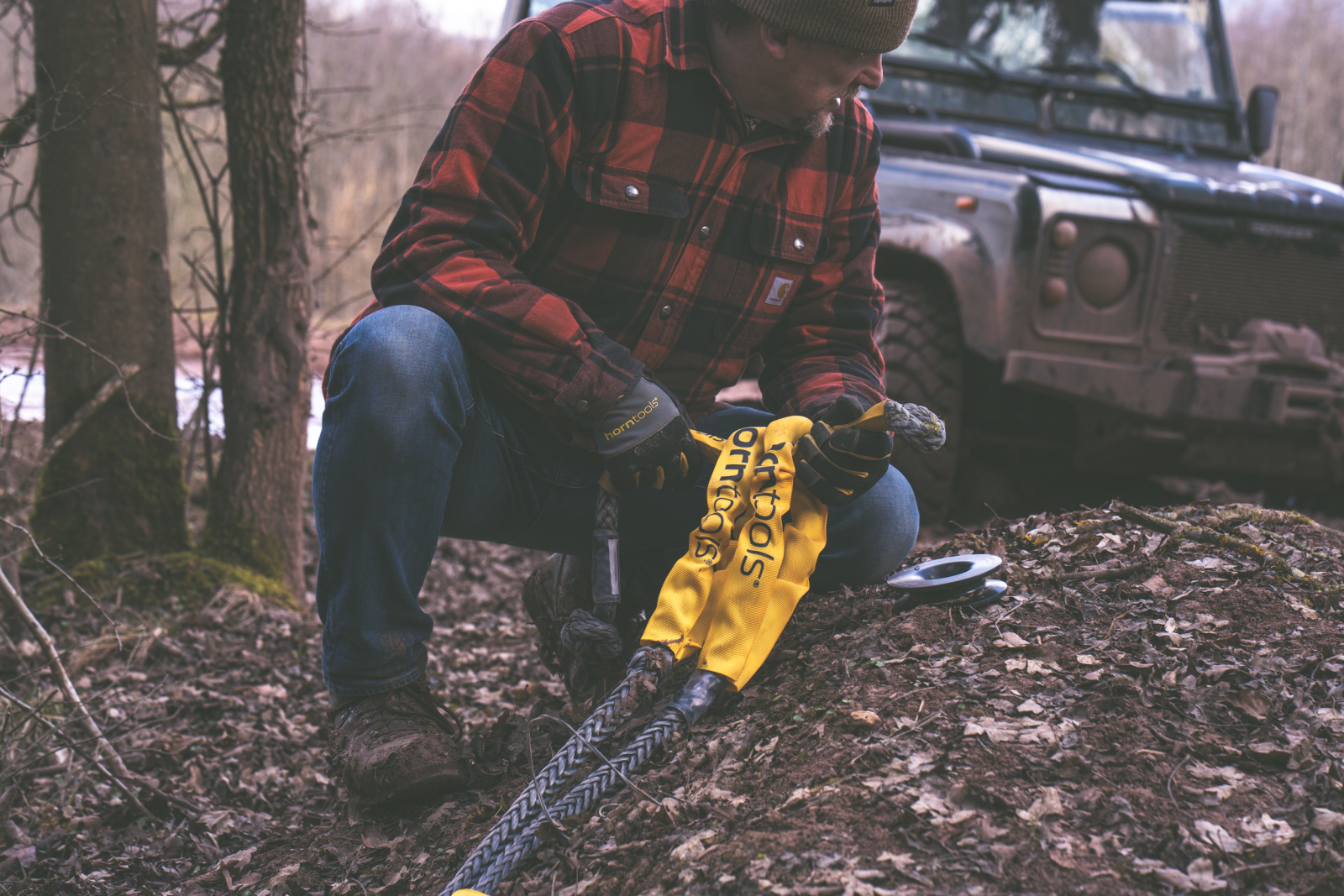
The bag and contents in detail
Let’s go through the set piece by piece. Every item has its purpose. Let’s start with the bag.
Waterproof, tear-resistant bag
A bag like this is practical, and especially well suited to recovery gear. It’s waterproof, which means: it’s allowed to open a bit more stiffly. The advantage? Dry things stay dry, and wet, dirty stuff doesn’t soil the rest of your gear or the interior. So you protect the gear and everything outside the bag too. If the straps and shackles are properly caked in mud after a hearty recovery action and there’s no clean water nearby, just throw the stuff in the bag. Bag shut and all the dirt stays safely packed away. Later you can rinse out and clean the gear and the bag under water.
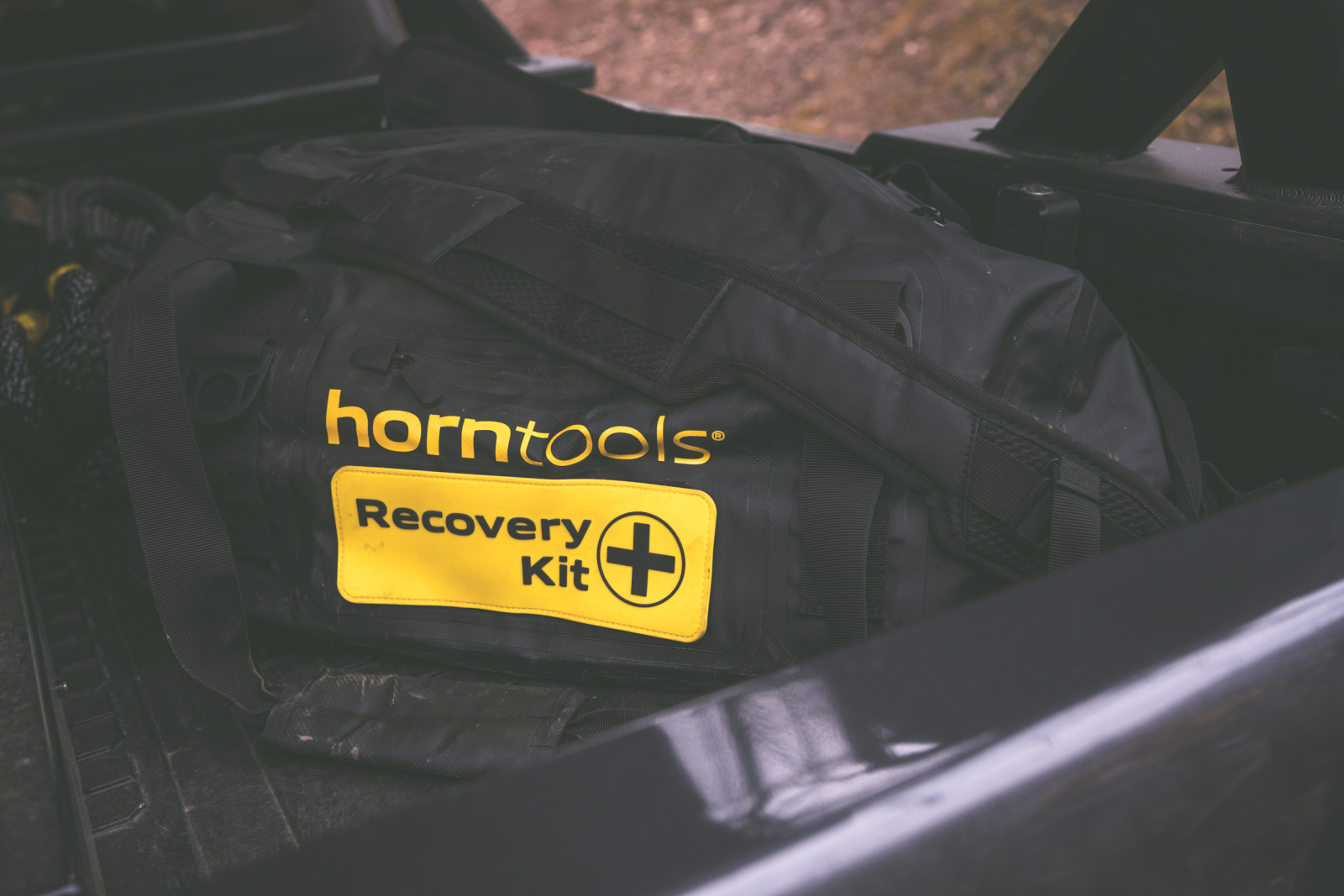
Anyone who doesn’t want the bag in their 100,000-euro luxury off-roader in the first place can simply strap it onto the roof rack. There are metal eyes on the side specifically for that.
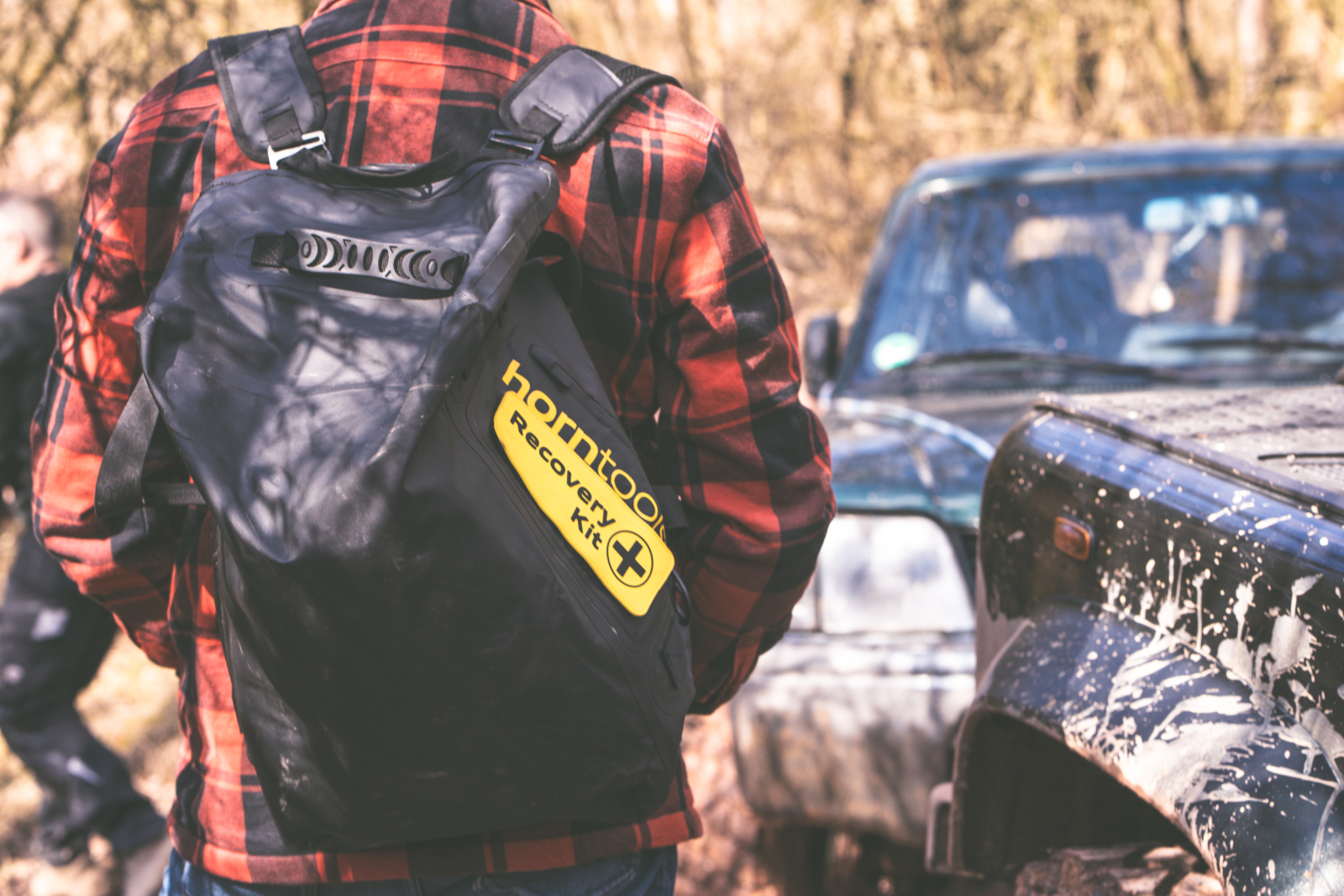
It’s very sensible too that you can carry the bag on your back like a backpack. If your vehicle and the one to be recovered aren’t right next to each other, you can comfortably transport the gear over there that way.
Flat tree strap WLL 3 tonnes
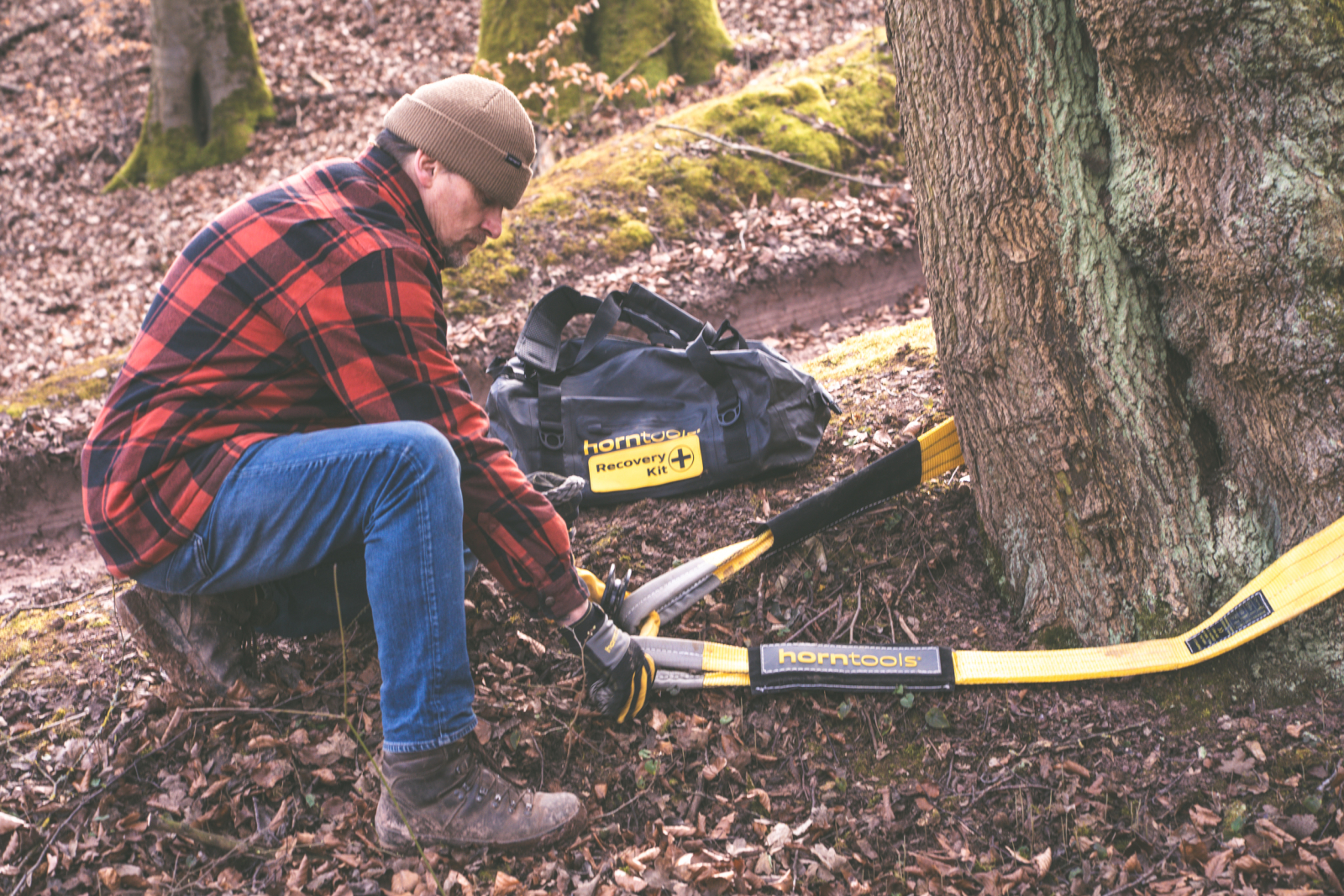
When recovering with trees, the tree strap is compulsory, and for good reason. It protects the tree just as much as your gear and can be used in many ways.
With a flat tree strap, the number of fibres that can take the load when looped is higher, as they spread over the flat surface and don’t lie on top of each other. It has a WLL of 3 tonnes, 6 tonnes when looped round the tree. That’s enough for the usual winch pulling forces, which mostly go up to about 5.4 tonnes. At both ends the strap has sturdy loops, for safe and easy handling.
Round rope, WLL 12 tonnes
The rope is 5 metres long and has a WLL of 12 tonnes. You can use it to extend the winch rope. You should also use the rope when your winch has to apply more than 3 tonnes of pull and you’re using a snatch ring. Because otherwise, in an extreme case, twice the winch pulling force can act on the snatch ring and the flat tree strap would be overtaxed. If you need such a high winch pulling force, then you’ve perhaps failed to reduce the vehicle weight and the resistances. Or the vehicle to be recovered is a truck, in which case you need different recovery gear.
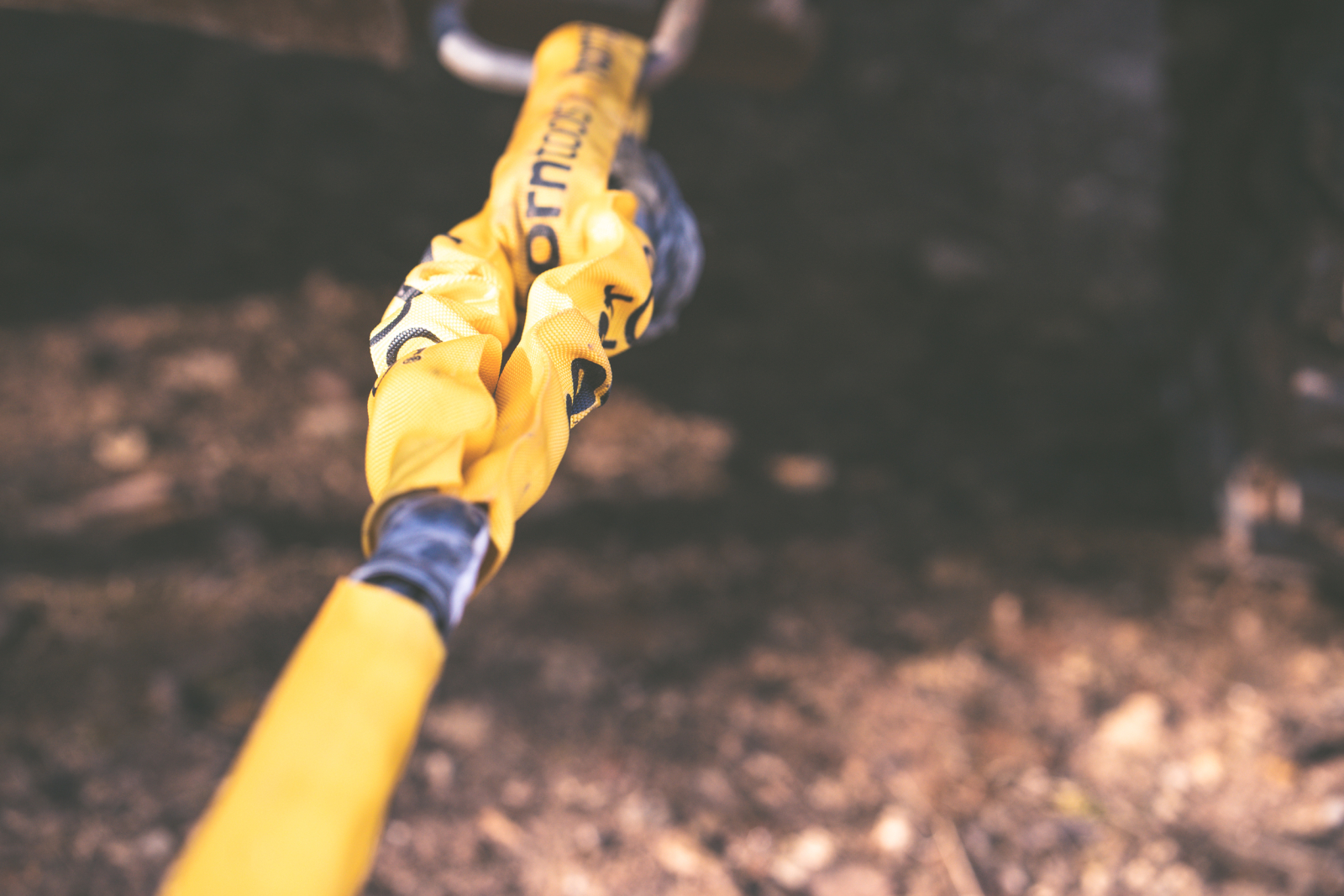
But that’s actually only rarely the case. Otherwise you can use the round rope for any extension in a straight pull or to directly connect two vehicles via suitable anchor points.
You use the rope in the gentlest form of recovery: the simple pulling out. But please remember, don’t jerk or drive into the rope with momentum. This variant of recovery is more of a tow than a jerk out. If that doesn’t work, you can fall back on other gear and techniques. A few tips on that come at the end of the article.
Snatch ring WLL 10.2 tonnes
Anyone who has a winch should have a snatch ring. I’d say: absolutely essential. A snatch ring is a simple item with a big effect. Assuming self-recovery, it lets us create a block and tackle in the simplest way. That means the winch only has to apply half the force for a given load.
That spares the gear and the vehicle’s power supply too. A winch can quickly demand several hundred amps. With the usual battery sizes of around 100 Ah and the support of the alternator, that’s still quickly the limit. On top of that, the power diodes in alternators don’t like being run permanently at maximum load. With the snatch ring you halve the load and the speed. That way you can control the process better.
It often happens that the pulling vehicle and the pulled vehicle aren’t in a line. Classic situation: a vehicle without a winch gets stuck going uphill. It’s no use that a fine, stately tree offers its services as an anchor point, because the vehicle has no winch. In this case you can position a vehicle with a winch to the side of the tree and lead the winch rope to the vehicle via a redirect.
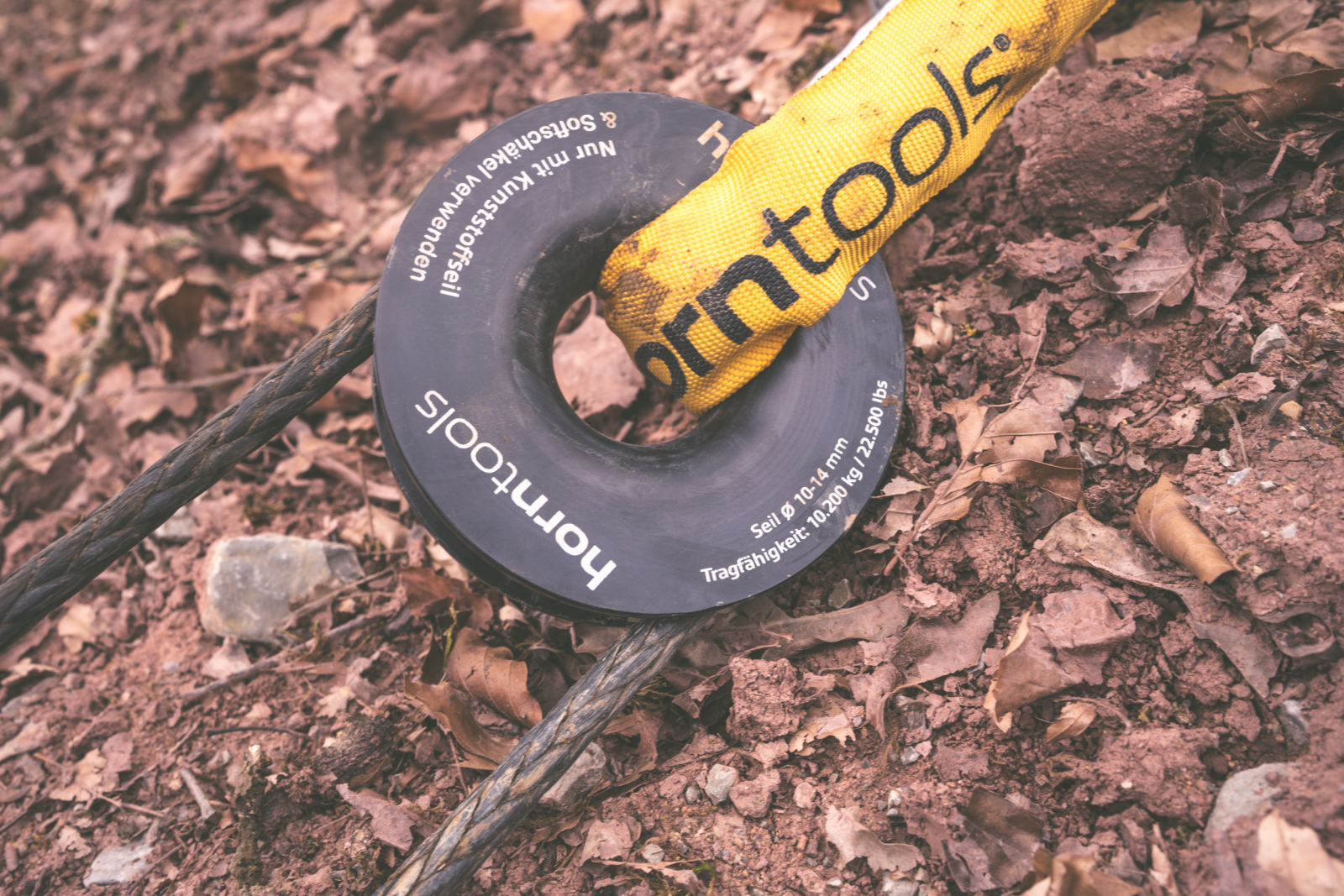
The horntools snatch ring is small, light and incredibly practical. It manages without moving parts, is therefore low-maintenance and has nothing that can break. These rings were criticised for a long time, by me too. It was said that the great friction generated heat, which harms synthetic ropes. In practice, however, that hasn’t turned out to be a problem and these rings have proven themselves.
Soft shackles WLL 14 tonnes
The nice thing about soft shackles is: they can be sized for high loads without becoming heavy, bulky and large. The soft shackles in the horntools Recovery Kit+ have a full 14 tonnes WLL. That’s already truck quality and so offers a car-based off-roader plenty of reserve. And reserve means safety.
Good soft shackles, like those from horntools, have a sensible protective sleeve that protects against abrasion and sharp edges. Of course synthetic shackles should never be placed around sharp edges, but if you’ve overlooked something, a damaged eye with sharp edges or the like, the shackle isn’t ruined straight away.
In the horntools Recovery Kit+ you’ll find two soft shackles. With them you can use all the rest of the gear in all sorts of combinations. For my taste there could be one or two more, so get yourself some extras from the horntools shop.
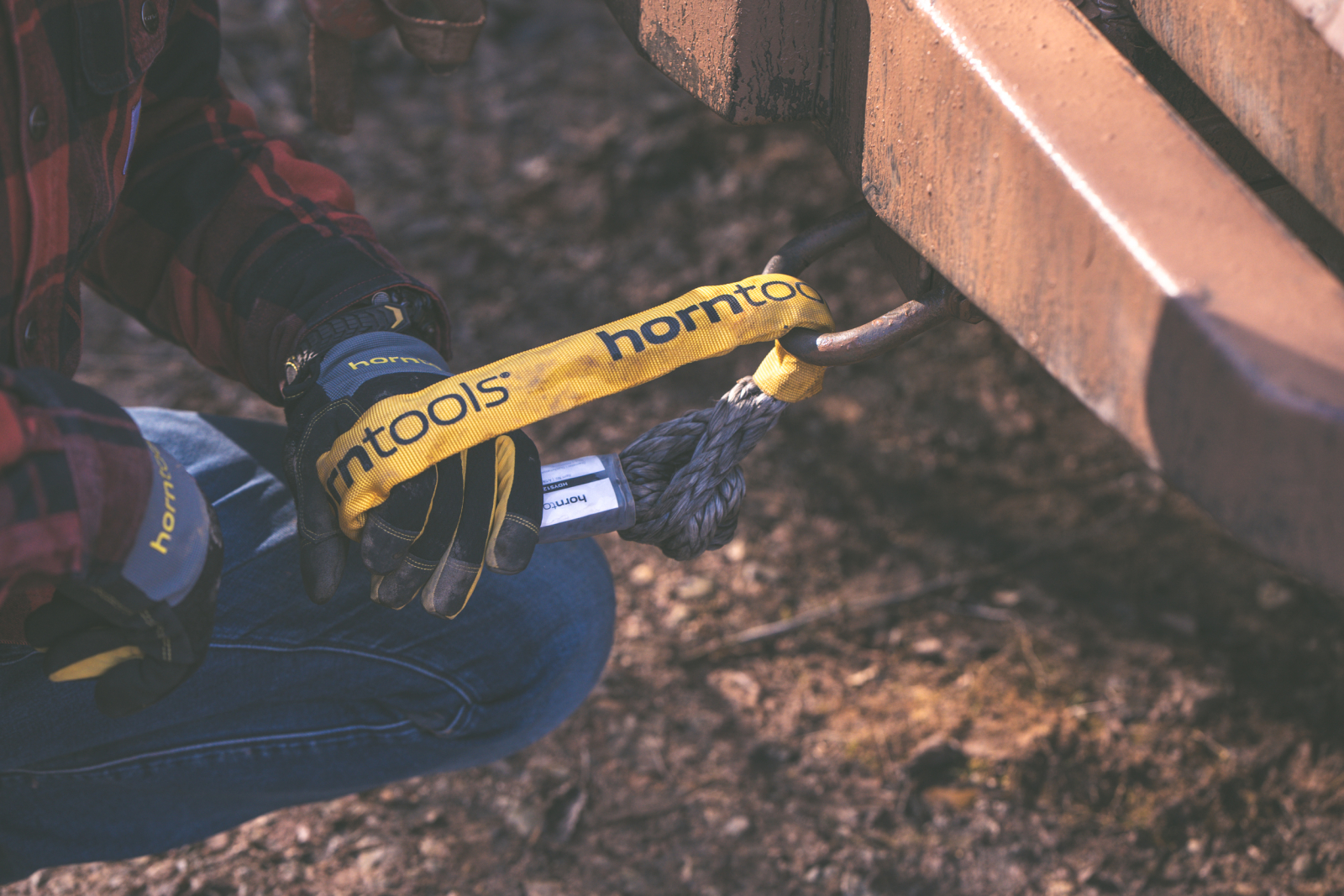
A typical scenario in which you need the soft shackles: put the tree strap around the tree and pull the soft shackle through its loops and attach the snatch ring to it. Now, because of the redirect, the winch rope is often too short to lead it back to the car. So you take the 5 metre extension rope, hook the winch hook into it and fix the loop of the rope to the vehicle with the soft shackle.
The kinetic recovery rope WLL 6 tonnes
As a sensible addition or for vehicles that don’t have a winch, the kinetic recovery rope is recommended. It has 30% stretch with which the energy to pull the vehicle out is stored. The principle is that energy is stored in the rope via the stretch by the pulling vehicle, which is then released again with a delay. The pulling force builds up comparatively slowly and is thus introduced more gently into the stuck vehicle.
When you work with it, set up a bridle. For that it’s recommended to buy a second round rope from horntools. With the bridle you avoid introducing the load one-sidedly into the vehicle frame and spread the load over two points. It should be as long as possible, to achieve favourable angles. It also prevents you from unintentionally turning the vehicle while pulling. If you can only use one strap or rope, it should be at least 5 metres long.
If it doesn’t work first time, try with a bit more run-up. Let 2 to 4 minutes pass between the individual attempts, so the rope can contract again. Tried too quickly in succession, the rope gets stiffer and stiffer and the effect of the gentle jerk disappears.
The strong loops at both ends are additionally coated with polyurethane. Anyone who only wants to use the kinetic rope should definitely buy two soft shackles as well. Because with a kinetic rope you shouldn’t use steel shackles. If your destination is a desert, you should have a kinetic rope along too.
General tips for handling the gear
Finally, we want to give you a few valuable tips along the way. Especially for those who aren’t already old recovery hands.
- Safety first!!!! Safety always comes first. Never underestimate the loads and forces at work. They can be considerable!
- During recovery, only the people directly carrying out the recovery stay near the vehicle. That’s usually a maximum of two! The person supervising the recovery and the driver. Everyone else please keep 1.5 times the winch rope length away, even though synthetic ropes aren’t heavy and can’t form projectiles. But you surely don’t want a whipping rope in your face, and what if something breaks off the vehicle?
- On the winch vehicle, raise the bonnet; with a redirect, on the other vehicle too when pulling from the front.
- On a slope, never stay below the loads!
- Never exceed the WLL!
- Never use someone else’s recovery gear. You don’t know its history and condition. In an emergency, examine the offered gear closely.
- If you help recover someone else’s vehicle, look at the anchor points doubly closely! Rust? Corrosion? Undersized? Then keep your hands off it!
- Avoid shock loads!
- After each use, wind the winch rope up neatly, layer by layer. If necessary, unwind it first. Make sure the rope doesn’t jam between two layers or pull between two layers. That prevents shock loads.
- During winching, keep the engine on so the batteries are supported.
- Run the winch in intervals. The cables and the gear heat up. Neither is good. The battery can also “catch its breath” briefly that way.
- If the engine is off, definitely work with one or more snatch rings on the block-and-tackle principle, to spare the battery as much as possible.
- If your recovery gear isn’t in order, is damaged or shows long thinned areas, dispose of it. Better to buy new, intact gear than to risk the vehicle or even your health!
- When recovering with the kinetic rope, set up the longest possible bridle!
- Between the individual recovery attempts with the kinetic rope, wait 2 to 3 minutes so the rope can contract again.
Then a few general tips on how to proceed
It’s always advisable to reduce the weight of the vehicle to be pulled and to reduce the resistance. Anyone who doesn’t have to be in the vehicle should get out. For safety reasons too. Heavy water cans? Take them off.
Check whether you can free the wheels. You can, for example, shovel away firmer mud. And you can lay branches under the wheels so that the engine’s own power can have a supporting effect. Of course also recovery boards or sand ladders, if you have any with you.
The most sensible order for recovery techniques
- Reduce the tyre pressure. If not already done or not enough, let air out of the tyre. Right down to 0.8 or 0.6 bar. Perhaps that already gives you enough traction. In a case like that, by the way, it’s smart to have a compressor on board straight away, to pump the tyres up again.
- Next, try to support the traction with sand ladders, branches and other material under the tyres.
- The third stage is pulling out with another vehicle. Connect the vehicles with the rigid strap or the rope from the horntools Recovery Set. The towing vehicle moves off gently, the rope is slowly brought to tension. That’s the gentlest and most careful kind of recovery with the help of another vehicle. There’s no dynamism in it. If it doesn’t go any further or the towing vehicle’s wheels spin, don’t carry on, choose the next technique.
- Only now, fourth, does the winch come into play. Best with a redirect, if the length of the rope is sufficient. Remember, with the 5 metre recovery rope in the Recovery Kit+ you can extend the winch rope. In most cases it should work now. If it doesn’t work with the winch either, you really are dealing with a more difficult situation.
- As a last resort, only the kinetic rope is left. In some cases, such as in desert sand, it can be that only the winch and kinetic rope come into play. The difference from the previous techniques is: all the others offer good control over the process. If the vehicle is too heavy to pull out, the winch tends to give up and stop, it’s the weakest link in the chain (always provided your gear is in order and correctly sized). It’s different with the kinetic rope; here dynamism comes in that you can’t control so well. That’s why this use stands last in the list. Make sure you don’t accidentally build a catapult. The anchor points on the vehicles must be safe and rugged. Tow hitches that form a lever are taboo! The tow hitch of a classic Land Rover Defender, for example, is firmly fixed to the frame at the top and bottom, so there’s no lever there. That’s OK. Hitch extensions that you put in a tube, or ones that set the hitch ball low (popular especially with lifted off-roaders), are likewise taboo!

The Winch app
To be able to estimate the loads you’re dealing with, use the Winch app. Here you can create vehicle profiles, enter data like weight and winch pulling force as well as gradient and surface. As a result you get the approximate pulling load and how it distributes across the individual rope layers.
The app is available in the Google Play Store and in the Apple App Store.
Verdict on the horntools Recovery Kit+ and the kinetic rope
I’m often asked which recovery gear is the right one. In the past I always searched out proper gear in the individual shops. I don’t need to do that any more, because I simply recommend this set plus the kinetic rope.
The horntools Recovery Kit+ is primarily intended for use with synthetic winch ropes. Some of it can also be used with steel winch ropes, for example the straps and shackles. But anyone who has a steel rope on the winch is better off reaching for the horntools recovery set up to 9 t. That contains a snatch block for steel ropes and steel shackles.
I find the gear proper, because it has the necessary markings and thus passed the tests that ground-pull gear should have. WLL or MBL. It’s sized so that you can safely use it with winches up to 6 tonnes of pull. How to use the gear correctly is written here, you see it in the video and there are several articles on it here at Matsch&Piste.
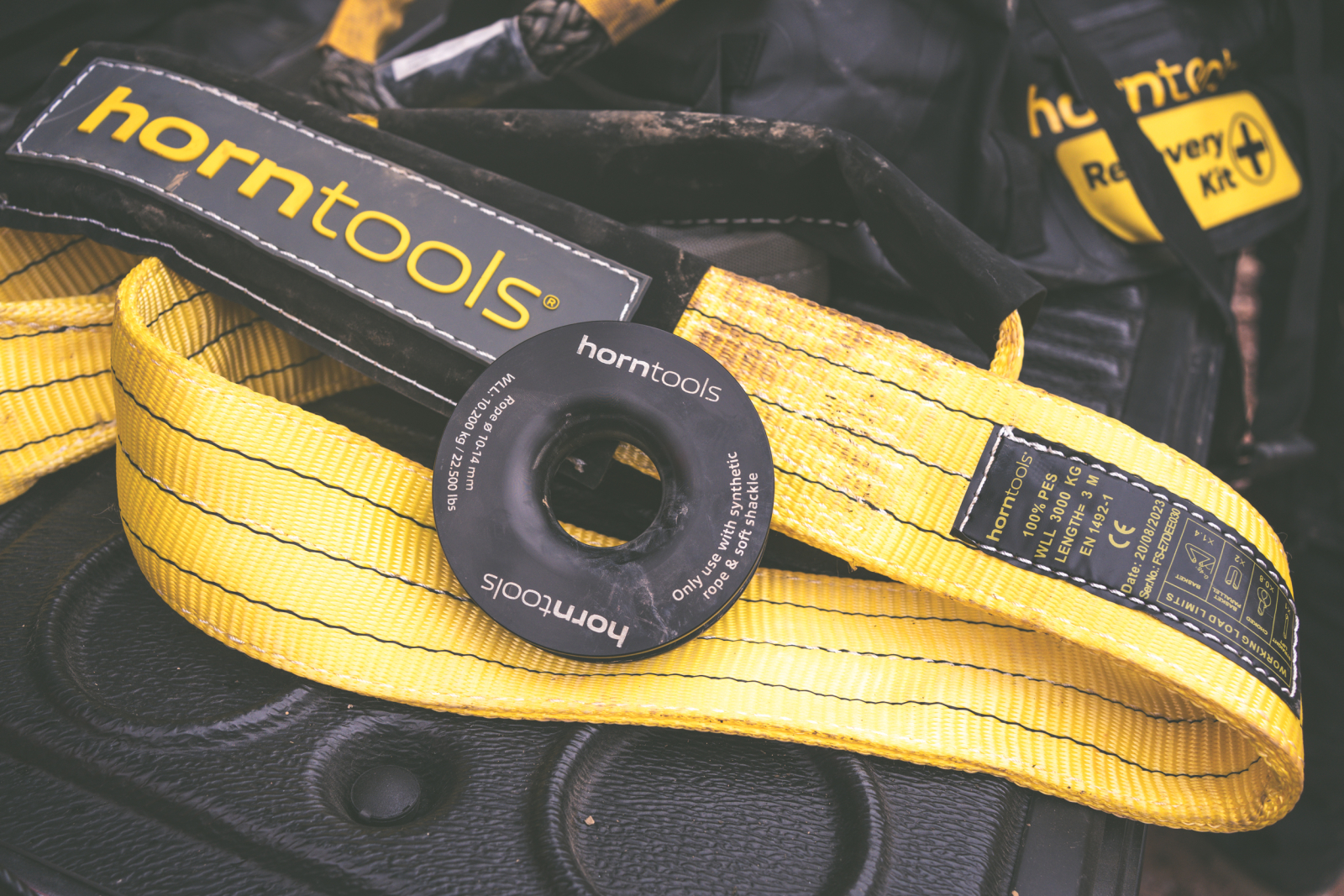
The icing on the cake in the set is the bag, and another goodie is the gloves. Gone are the days when the filthy gear simply lay around in the car or in a manky box. Everything is waterproof and you can rinse and clean it after use with a hose or pressure washer.
Anyone planning more in the terrain can then simply top up from the horntools shop with additional straps, shackles or snatch rings.
That’s how I imagine a good recovery set.
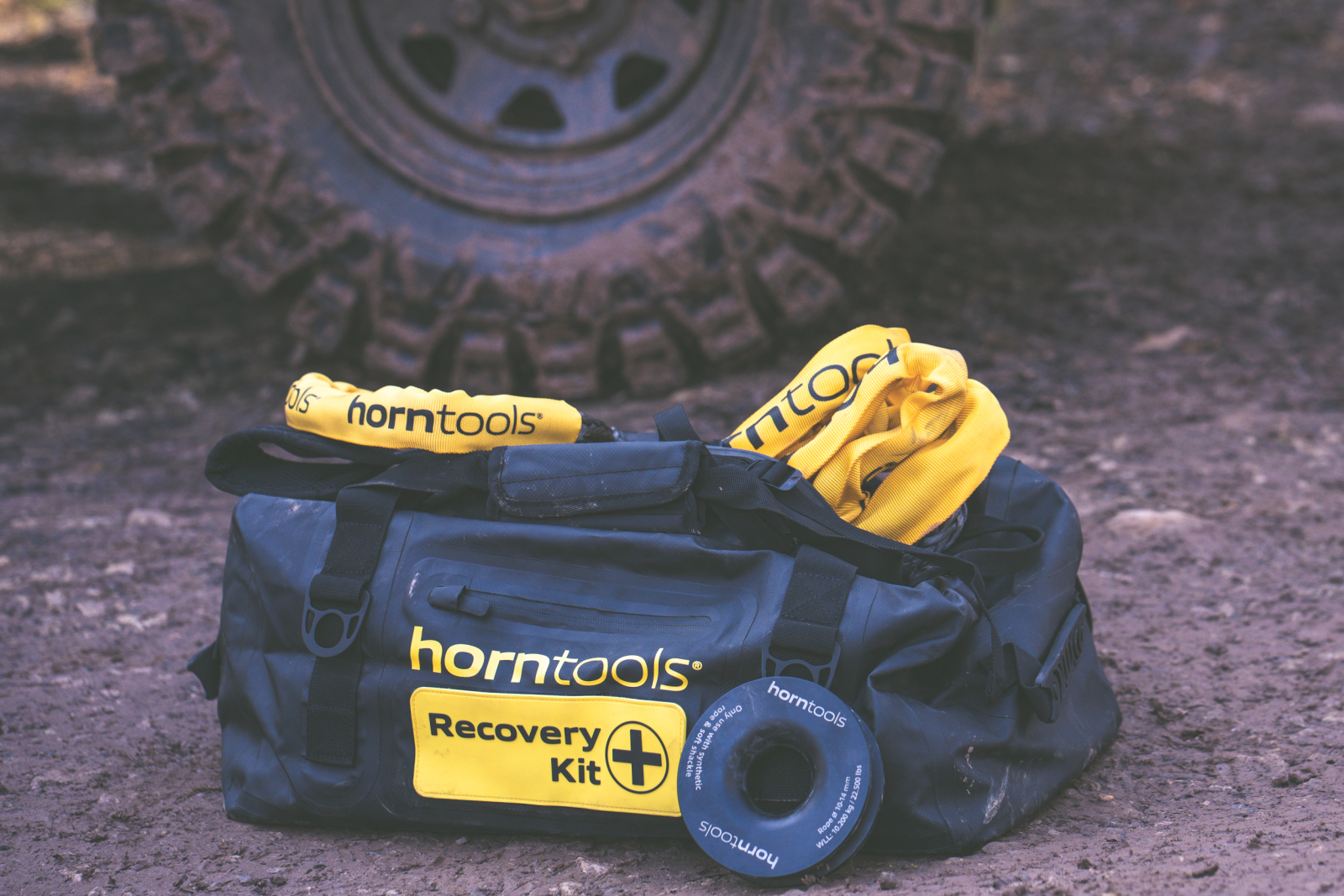
A set for steel ropes will be available shortly!
By the middle of the year, horntools is additionally bringing a new Recovery Kit Plus Steel to market, specially for winch use with steel rope. There, all the shackles and snatch blocks are replaced by ones made specially for steel ropes.
In the video here we show you everything once more