

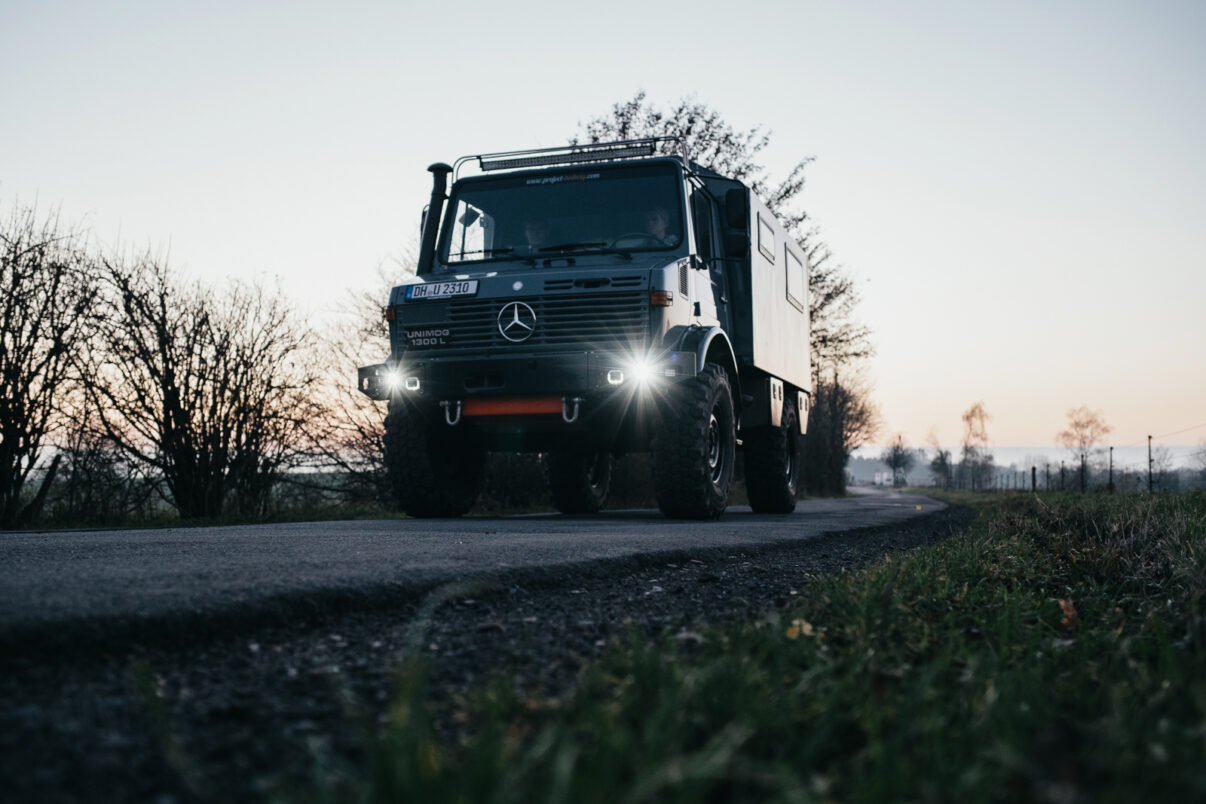

A new spectre is haunting the 4×4 and travel scene: the new toll requirement. At least for owners whose vehicle has a permissible gross weight of more than 3.5 tonnes in the papers. That affects quite a few down-plated travel and expedition vehicles. We asked who is really affected.
From 1 December 2023 a new toll arrangement applies. The short information only said that from then on trucks from 7.5 tonnes technically permissible total mass (tzGm) would be affected too, with motorhomes exempt. So with our Iveco 90-16 truck, down-plated to 7.5 t, we might be liable for the toll too, because it is not a motorhome. From 1 July 2024 the toll requirement is also to be lowered further, to vehicles with a tzGm of at least 3.5 t. That needs clarifying, so we got stuck into it.
Who exactly is liable for the toll?
That was the first question we had to clear up. Who is liable for the toll? Perhaps all the answers follow from that. Officially it reads like this:
Under Section 1(1) sentence 2 of the Federal Trunk Road Toll Act, the toll requirement applies in principle to motor vehicles or vehicle combinations
- that are intended for commercial goods transport (1st alternative)
- or that are used for commercial goods transport (2nd alternative)
- and whose permissible gross weight (zGG) is at least 7.5 t. This applies including a trailer.
If one of the two alternatives above applies, the toll requirement already applies. The alternatives are broken down a little more precisely:
Toll liability under the 1st alternative
This follows from the general purpose of the vehicle for commercial goods transport, on the basis of typical vehicle and body types. It exists, for example, for articulated vehicles or lorries.
The 1st alternative applies regardless of whether
- it is a private journey,
- goods are actually being carried,
- the carriage of goods is commercial or for own purposes (own-account transport), or
- the motor vehicle in question is exempt from vehicle tax.
Toll liability under the 2nd alternative
Motor vehicles or vehicle combinations with a permissible gross weight of at least 7.5 t without the typical vehicle and body types of commercial goods transport (such as self-propelled machines) can also be subject to the toll.
The 2nd alternative, however, requires that they are specifically used for commercial goods transport as defined by the Road Haulage Act.
What is decisive is a carriage of goods for payment or on a commercial basis within the meaning of Section 1 of the Road Haulage Act (commercial road haulage or own-account transport). The “tradesman exemption” remains. Vehicles between 3.5 and 7.5 t used for a trade remain exempt from the toll in future too. On the BALM website you’ll find the exemptions from the toll requirement:
“Toll-free vehicles that do not fall under the legal definition of a toll-liable vehicle under Section 1(1) sentence 2 of the Federal Trunk Road Toll Act are vehicles that
- are neither structurally intended for commercial goods transport (e.g. self-propelled machines)
- nor used in commercial road haulage or own-account transport for a carriage of goods for payment or on a commercial basis (within the meaning of Section 1 of the Road Haulage Act).”
We did have a few more questions about the toll requirement
That was too vague for us, and we didn’t clearly find our own vehicle in there. We thought of further cases we wanted to clear up:
- What about vehicles that are not used for goods transport, or whose purpose was never goods transport, and which are not motorhomes or mobile working equipment? This is where we’d place our Iveco 90-16, which was designed purely as a disaster-relief and emergency vehicle.
- What about vehicles that are or were intended for goods transport, or were even used for it, but are moved as an empty chassis? That applies, for example, to vehicles on the way to the vehicle converter.
We put these questions to the Federal Office for Logistics and Mobility, BALM for short. A good week later we had an answer from Mr Thiel, press and public relations office. Let’s first look at what the toll reform changes.
The toll reform has already begun
From 1 December 2023 the first changes already take effect. As one of the bases of assessment, the technically permissible total mass (tzGm) is now used instead of the permissible gross weight (zGG). This includes the trailer.
Mr Thiel from the Federal Office for Logistics and Mobility on this: “Since 1 December 2023, the Third Act amending toll law provides for the technically permissible total mass (tzGM) as the basis for assigning a weight class for the truck toll. This is entered in the vehicle registration certificate Part 1 under F.1. The tonnage limit is currently at least 7.5 tonnes technically permissible total mass. Vehicle combinations are only toll-liable if the tzGM of the towing vehicle is over 3.5 tonnes. The permissible gross weight, entered under F.2 in the registration certificate, is no longer decisive for levying the toll.”
The difference between the tzGm (F.1 on the registration certificate) and the zGG (F.2) is that the zGG is more of a legal maximum value covering the whole vehicle including load and occupants, which must not be exceeded. The tzGm is a technical value set by the vehicle manufacturer, describing the technical maximum mass of the vehicle without occupants. It ensures that no vehicle components are overloaded.
A good example is a down-plated truck. Its zGG can be 7.5 t, for example, while its design would allow a tzGm of 10 t. So the value now used is the one that corresponds more to the original vehicle purpose and use. In practice, down-plated vehicles are thus moved into a higher fee class too, as can be seen in the following table.
CO2 emissions now count towards the toll too
In addition, the CO2 emissions class is added, of which there are five. In return, the particulate reduction classes are dropped. From December 2023 a CO2 surcharge will therefore have to be paid. Per tonne of CO2, €200 is set. All vehicles with a technically permissible total mass from 7.5 t therefore incur, on top of the existing toll, a share for the CO2 emissions.
The new toll amounts in euro cents
Vehicles of the Euro classes 0 to V all get CO2 emissions class 1. From 1 January 2024, natural-gas and LPG-powered vehicles are toll-liable too.
| Vehicles | CO2 class | 7.5-11.99 t | 12 t-18 t | >18 t / ≤ 3 axles | >18 t / 4 axles | >18 t / ≥ 5 axles |
|---|---|---|---|---|---|---|
| Euro VI | 1 | 17.8 | 24 | 30.5 | 32.4 | 34.8 |
| Euro VI | 2 | 17.4 | 23.6 | 29.9 | 31.8 | 34 |
| Euro VI | 3 | 17 | 23 | 29.2 | 31 | 33.2 |
| Euro VI | 4 | 13.8 | 19 | 24.4 | 35.8 | 26.9 |
| Euro VI | 5 | 0 | 0 | 0 | 0 | 0 |
| Euro V /EEV | 20.6 | 27.7 | 35.5 | 36.3 | 38.9 | |
| Euro IV | 22.2 | 28.8 | 37.3 | 38.8 | 41.4 | |
| Euro III | 25.1 | 33 | 43.1 | 45.4 | 47.8 | |
| Euro II | 27.6 | 35 | 46.1 | 48.7 | 51.1 | |
| Euro I / 0 | 27.7 | 35.2 | 48.6 | 51.2 | 51.6 |
The limit drops to 3.5 t tzGm
From 1 July 2024 the toll requirement then applies from 3.5 t tzGm.
The more precise classification according to BALM
That describes the framework for now. What interests us, of course, are the exemptions that follow from alternatives 1 and 2.
Mr Thiel explains: “In Section 1(1) sentence 2, the Federal Trunk Road Toll Act provides for two alternatives of toll liability. Toll-liable are vehicles/vehicle combinations that are intended for commercial goods transport (1st alternative of toll liability) or are used for commercial goods transport (2nd alternative of toll liability).”
Of interest to us is how his remarks continue: “Decisive for the 1st alternative (purpose for commercial goods transport) is whether the vehicle, by its objective features (vehicle and body type), is meant predominantly to transport goods on roads. Decisive for the 2nd alternative (use for commercial goods transport) is whether, on the journey in question, goods are carried on a commercial basis or for payment.”
The decisive passage with which Mr Thiel answers us is then: “For former trucks from public authority stocks, such as the armed forces, the fire brigade and the THW, which because of special bodies (equipment bodies, firefighting tanks, etc.) have no purpose for commercial goods transport, toll liability under the 1st alternative does not apply. This also applies when such vehicles are converted into motorhomes and permanently and firmly fitted with living equipment, including toilet, shower, sleeping places, cooking facilities, living space, so that they lastingly serve the carriage of persons (not the transport of goods). For practical reasons (including presenting vehicle documents at checks), BALM recommends registration as an ‘other motor vehicle, motorhome’.
If such vehicles are used for purely private purposes (hobby, holiday) and not for a commercial or paid transport of goods, toll liability under the 2nd alternative does not apply either. For such vehicles, in this case, no toll is to be paid.”
On the specific topic of the empty chassis, we also get a short and clear answer: “If, as part of a planned conversion into a motorhome, the special body of the vehicle is removed, so that it is a pure truck chassis, then no toll is to be paid for such a vehicle either. Here too, toll liability under both alternatives does not apply.”
Everyone should register their vehicle
With these statements, the various cases and the various build stages of travel and expedition trucks can be classified well. In principle, everyone has to register their truck with Toll Collect and prove any existing registration as a motorhome. That way the vehicle is exempted, by its number plate, from the automatic recording on motorways and main roads. This recording is valid for two years and then has to be renewed.
More information from the Federal Office for Logistics and Mobility
Anyone who wants more information can get it from BALM: Amendment of toll law.
There are a number of other toll-exempt vehicle types, which can be found in Section 1 of the Federal Trunk Road Act.