

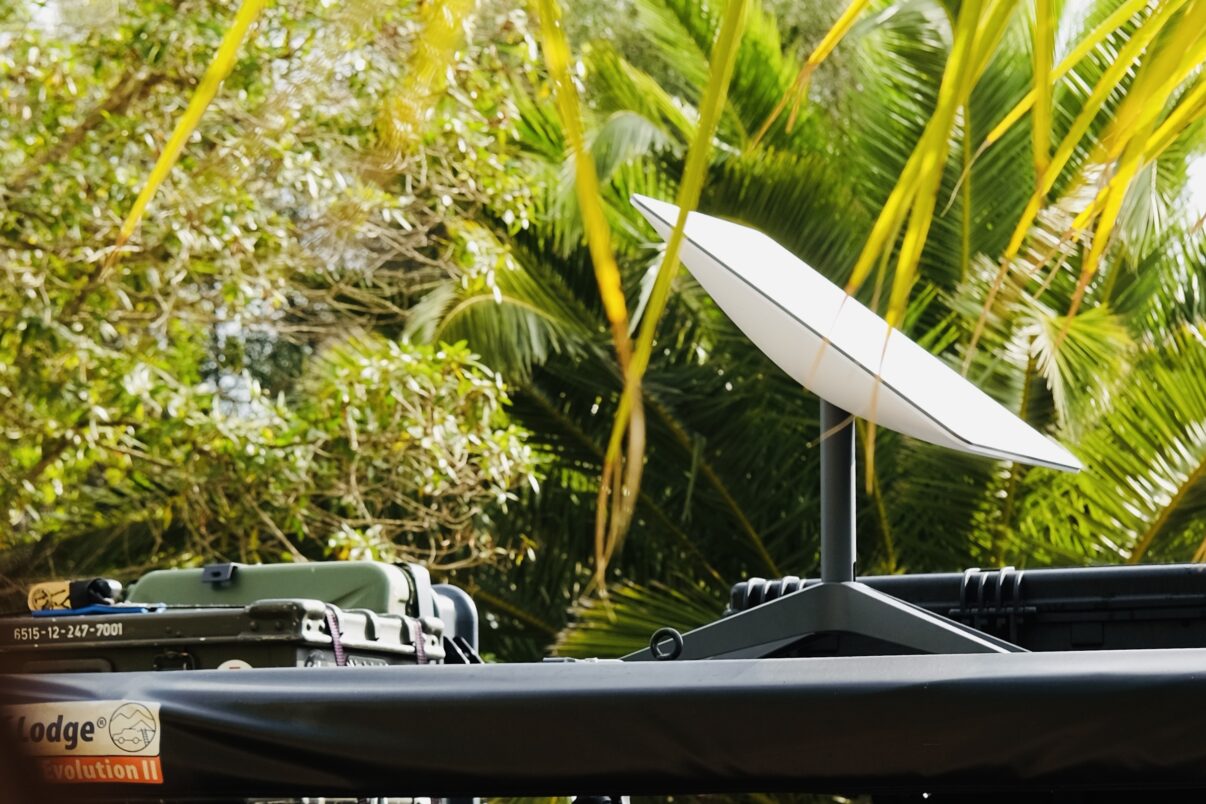

One way to get fast internet on the road is satellite internet, and by now Starlink is a real alternative for overlanders, instead of local SIM cards or slow wifi networks. But we wondered how well Starlink actually works in practice for travellers.
Plenty of overlanders these days want fast internet even when they are out in the wild. More and more people want to, or have to, stay reachable. A way to call for help in a breakdown, pulling weather data, or maybe the odd film on the road. There are many reasons. One solution is to buy local SIM cards at the borders and run them in a simple mobile router. That can get awkward over time, and if the mobile network is not particularly stable or fast, it works badly or not at all. Slow wifi from campsites or hotels is no good alternative either. Satellite internet itself is nothing new. But ever since Starlink came along, it has been the talk of the town, and travellers want it too. And for long-term travellers especially, it would be a great thing to have a system that gives you a fast internet connection anywhere.
How does Starlink work, and how can overlanders use it?
Starlink is a network of low-flying satellites that can deliver broadband internet. The satellite network, which orbits the Earth at around 550 kilometres up, belongs to Elon Musk’s tech empire. More than 5,000 of these satellites are said to be circling in space already, with many times that number still to come. You have surely seen them in the night sky at some point, racing around the globe like a string of pearls.
Newer Starlink satellites talk to each other using laser technology. With no ground relays at all, the kind you might know from the Globalstar satellite communication network, used for GPS messengers for example. The upstream and downstream of the user connections run in the KU band, a microwave frequency band in the gigahertz range for satellite communication. So in parts Starlink works much like internet over fibre-optic cable, but with a more direct connection and without the cable. On top of that the whole system is software-optimised. All of this is meant to deliver high reliability and high speeds. You will find more on Starlink technology here on the company’s website.
At the moment Starlink internet is available for large parts of North America, South America, Europe and Australia, and a few more countries, in Africa and Asia for example, are covered too. You can check this for your travel area on the Starlink availability map.
Hardware and contracts you need to use Starlink as an overlander
Before you get started, you first need hardware and the right Starlink contract to go with it. On the hardware side that means an antenna, a base to stand it on, the user terminal, a router and cables. You can either buy or rent the equipment. Starlink offers all kinds of contracts, so you have to check carefully which one fits your use. And there are price changes from time to time.
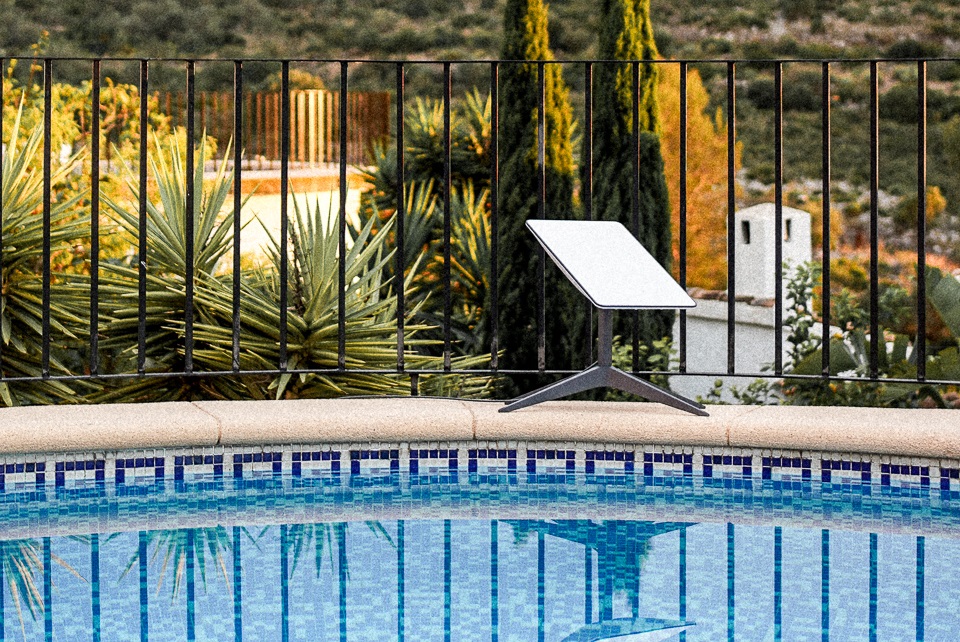
Once installed, the device should align itself automatically. For flawless operation the antenna needs a clear, unobstructed view of the sky all around.
So much for the technology and the requirements, which you can easily read up on online. But we wondered how it actually works in practice and, above all, on the move. So we asked around and talked to travellers who use Starlink on the road.
Starlink for overlanders running an online business from the road
Marcel and his family have been travelling full time for around two years, and that with a toddler and two dogs. Right now they are out within Europe in their Hilux with a roof tent, and in holiday homes here and there too. From 2024, with a fixed cabin on the Hilux, they plan to explore regions outside Europe as well.
He and his partner run an online business and regularly have to talk to their staff and their customers by video call. A dropped connection during a call with more than 50 people would be very annoying, and if it happened often it would surely hurt the business.
So Marcel has high demands on the stability, availability and speed of his internet access. Social media, Instagram for example, and Netflix to unwind in the evening come on top and use up extra data.
They came to Starlink because at some point during a months-long trip across the Balkans they had simply had enough of the hassle around local SIM cards. You know how it is: in many countries you do get a decent amount of data at relatively low prices, but sometimes the speed and reliability just are not there, exactly when a traveller like Marcel depends on a good, stable connection. On top of that, frequent border crossings mean constantly swapping cards. And in holiday homes rented along the way, the internet was often useless for his purposes.
Since Marcel had long been watching both Starlink and Amazon’s fairly similar Project Kuiper in development, he was all the more enthusiastic when Starlink announced it would offer its mobile version in Germany too.
How much work is the installation and carrying it in the travel vehicle?
The installation and setup are child’s play, Marcel tells us. Even when the pitch changes every day, everything is quickly packed up and stowed, and just as quickly ready to go again at the new pitch in the evening. He simply places the dish, depending on the local situation, right on the vehicle roof or on the ground somewhere near the vehicle. Thanks to the 20-metre cable included in the box, the overlander is fairly flexible here.
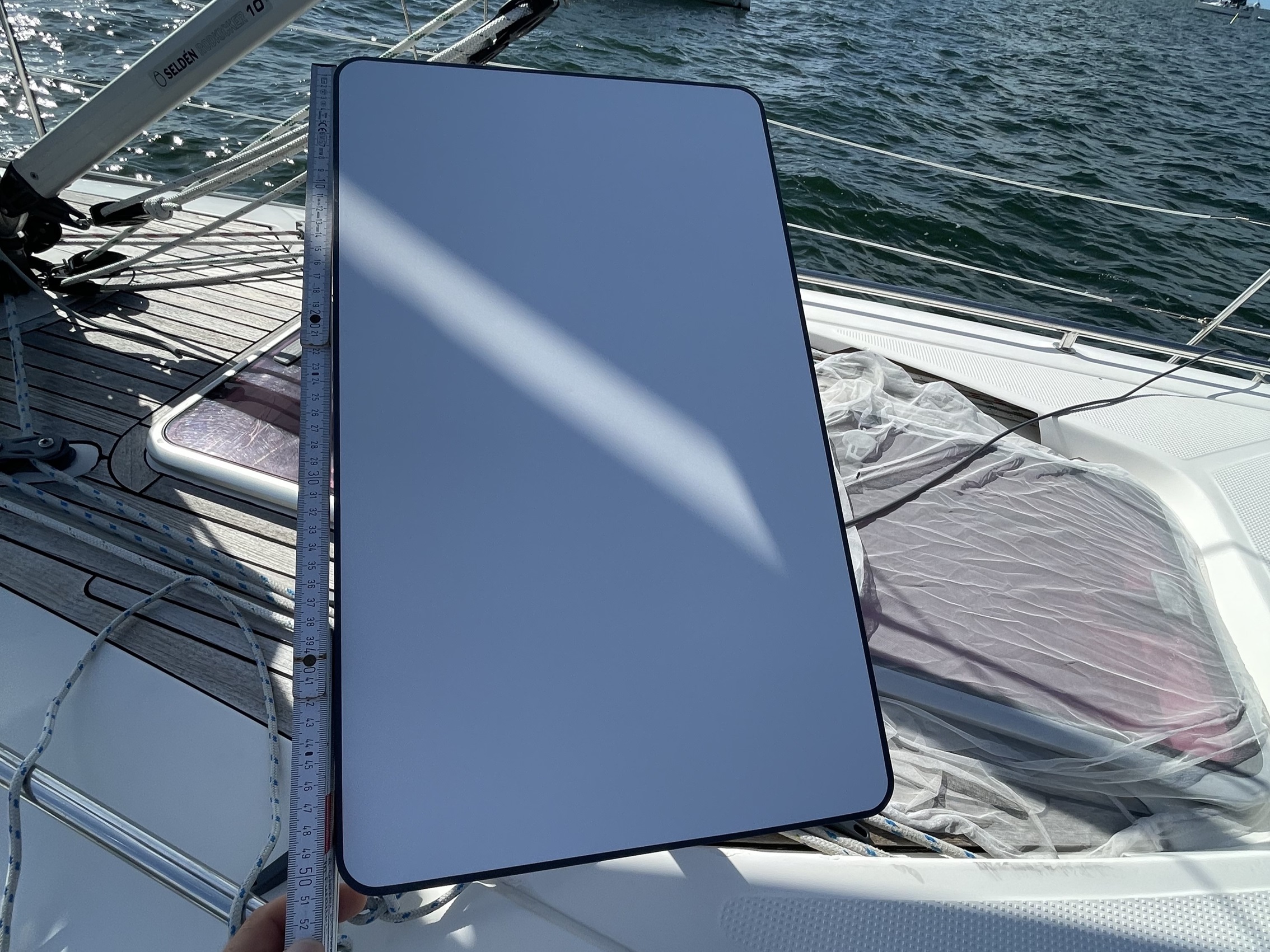
The antenna has found its permanent home in a standard Euro box, so the original carton quickly became surplus. Unfortunately the dish is fixed firmly to the antenna stand, so the whole thing is a bit bulky to transport.
Other overlanders have also reached for DIY solutions to transport it, and the market for ready-made solutions has reacted too. From the off-road paradise of Australia, the well-known outfitter DRIFTA offers a transport bag for the Starlink equipment.
And what about the bandwidth?
Marcel regularly checks the download and upload rate using the Starlink app. As a concrete example for one day and time (22 November 2022 at 18:20), he gives us 280 Mbit/s download and 32 Mbit/s upload. But those are figures he rarely reaches. Often they are well below that. After a reboot of the system, Marcel reports, he gets dream figures for download and upload at first. After a short while, though, those figures are out of reach again. On the contrary, during the day he often sits at 20 to 35 Mbit/s download. Marcel has a practical tip on this: “You should not rely solely on Starlink’s own app here, but also run an alternative speed test now and then.”
What are the experiences with the stability of the connection?
Marcel tells us of mixed experiences when it comes to stability. That covers the hardware and Starlink support. Right now he owns three routers, four connection cables and two antennas. All of that because the first kit suddenly had connection problems after just three months of use and was therefore useless. Starlink support reacted promptly and supplied various replacement components. But some of it was apparently used gear, better than nothing, and as a full-time traveller you have to organise the delivery, of course. After three months, in May 2023, came a completely new set that works perfectly.
On the stability of the bandwidth, Marcel also reports mixed experiences. The bandwidth swings often come down to the time of day and the number of Starlink systems in the area. Support explained to him that his occasional 7 Mbit/s download in the evening between 6 pm and midnight can well be down to the number of users active at the same time.
More and more people use Starlink, both privately and professionally, and the total available bandwidth is simply shared out. You know this from mobile phone networks too, the resources are finite. One thing for overlanders to watch could be Starlink’s so-called Fair Use Policy, which governs the allocation of data and priorities in the USA. Further expansion of the system could improve this. A five-figure number of satellites is planned, so the system is only just getting started.
And what costs does Starlink bring for the overlander?
Marcel paid 450 euro for the hardware. On top comes the monthly plan fee for the Starlink Roam / Mobile Regional plan, at 100 euro. This is a plan for location-independent use on the European continent. For use across continents you have to budget higher costs, and data at sea is billed separately. More on that later. You can switch plans conveniently through your Starlink account. An advantage for overlanders who want to stay flexible.
His chosen plan can be paused at any time. That makes the costs easy to plan and gives plenty of flexibility, even for travellers who are only out for a few weeks a year. Given that, at least for now, not every country is covered, you can pause the plan early, switch to alternatives and save money. Another advantage for travellers.
The prices change often, and there are repeated offers at reduced prices. So if you are thinking of buying, keep a close eye out.
An eternal topic for travellers: the power supply
Many parts of your travel kit are power-hungry, and that of course includes a Starlink system in the vehicle.
Marcel told us they handle the power supply with a portable solar power station. That gives good mobility. On the planned cabin, 400 watts of solar will fit on the roof, so there should be enough power. He shares one more practical tip: you can also set up a standby mode, for the night hours for example. That cuts the power draw.
Users have got creative, and not only with the power supply. The same goes for storage solutions and mounts. Online, anyone interested will find plenty of self-build solutions, and we will surely see a lot more DIY answers, and increasingly aftermarket products, in the near future.
Let’s get to the pros and cons. What works well with Starlink in practice?
Marcel is still delighted with the simple setup and the configuration via app. It is all plug and play, he says. The hardware plugs together quickly and the whole thing is intuitive to operate. Experiences here surely vary a lot, because what is intuitive for one person is a terrible, confusing mess for another. The only thing that helps is to try it.
In everyday travel especially, with pitches changing often, the quick setup and pack-down is a big advantage. Because you all know it from the road: whatever cannot be set up and taken down easily and quickly does not get used much in the long run.
Especially at the start, the graphic display in the app for spotting obstacles was very helpful. Remember, Starlink needs a clear view. And just how well Starlink can work with a clear view and few other users around, we see with the blue-water sailors.
Are there any criticisms too?
Marcel is less happy with Starlink’s technical support. As mentioned, he now owns a stash of spare parts. That is partly because they would just send something out and fix faults by trial and error, as he told us. On the plus side, though, support has improved a lot over the past few months.
How satisfied are users overall, and would they choose Starlink again?
Marcel answers this question with a clear “yes”. Because once the first problems were sorted, Starlink works reliably for him and the connection is fast and stable enough. In his experience the bandwidth does swing quite a bit over the course of the day. But the connection has not dropped for several months now, and across the working day there have been no more problems with video calls or up and downloads.
Even so, he hopes Amazon’s satellite broadband offering develops quickly. He reckons another provider could lead to price cuts, which in the end would benefit the customer.
Marcel goes on to say that he recommends the Starlink system to people who need a very reliable internet connection for work, have had enough of dealing with SIM cards and “finally want to tick the box on internet connection while travelling”.
And that is the big advantage of a system like Starlink. A reliable connection without having to deal again and again with various local providers, only with your Starlink contract at most, where you have several options. With a mobile plan the system is initially usable in the Starlink region (continent) where it was bought. Beyond that there are global roaming plans for worldwide use. Although even then extra costs can apply.
A few more interesting aspects
With sailors, or on so-called passage makers that cross the oceans, we often find similar problems to off-road travel. The solutions there are often better, tougher and more failsafe. Because on a boat the traveller cannot just pull over or drive to a workshop whenever something breaks.
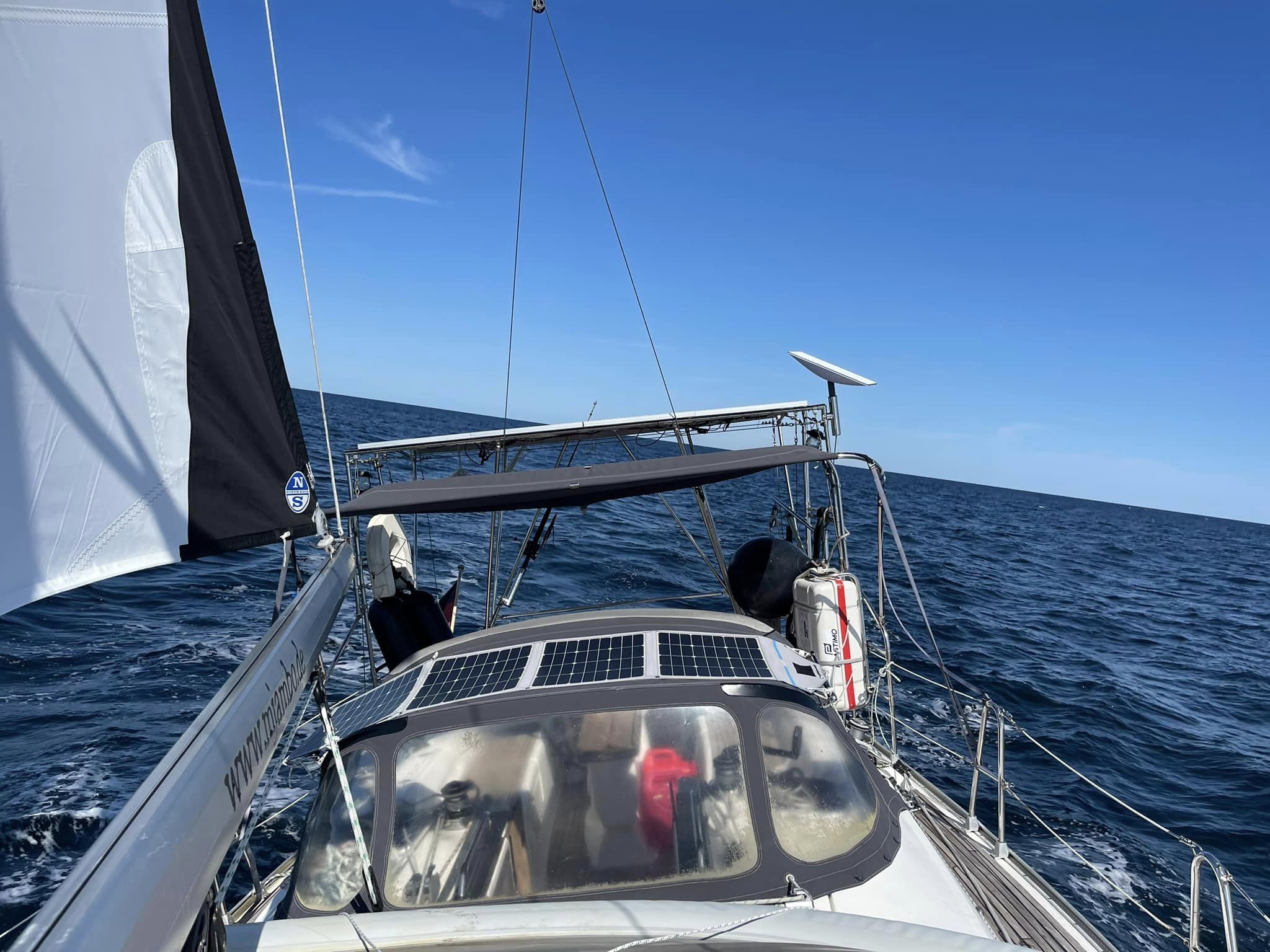
To add to this, we spoke with the experienced sailor Martin Daldrup. He has crossed the Atlantic several times, lived through wonderful and also dramatic sailing adventures and reported on them. On his sailing yacht Jambo he had Starlink in use. We had actually wanted to hold our conversation via Starlink while Martin was in the South Atlantic on his way to Cape Town. But sadly he had to give up the Jambo when she took on water and went under in a short time. After a dramatic, and at the same time professional, rescue operation, Martin is now safe and well in Germany and is already thinking about his next sailing trips.
When it comes to bandwidth, sailors far from any interference that could block the antenna’s clear view to the satellites, and with few other users nearby, reach good bandwidths. Martin gives us figures between about 50 and 200 Mbit/s download here (with much less on the upload, of course). These figures are reliably achievable. He was impressed that they hold steady despite the rolling and heeling of a boat. When the course changes, it naturally has to readjust. That is something that does not come up with a stationary off-road travel vehicle. In his experience, the automatic alignment of the antenna takes about 10 to 15 minutes. An acceptable figure. If a thunderstorm is nearby, the transmit and receive performance suffers, much like a TV signal.
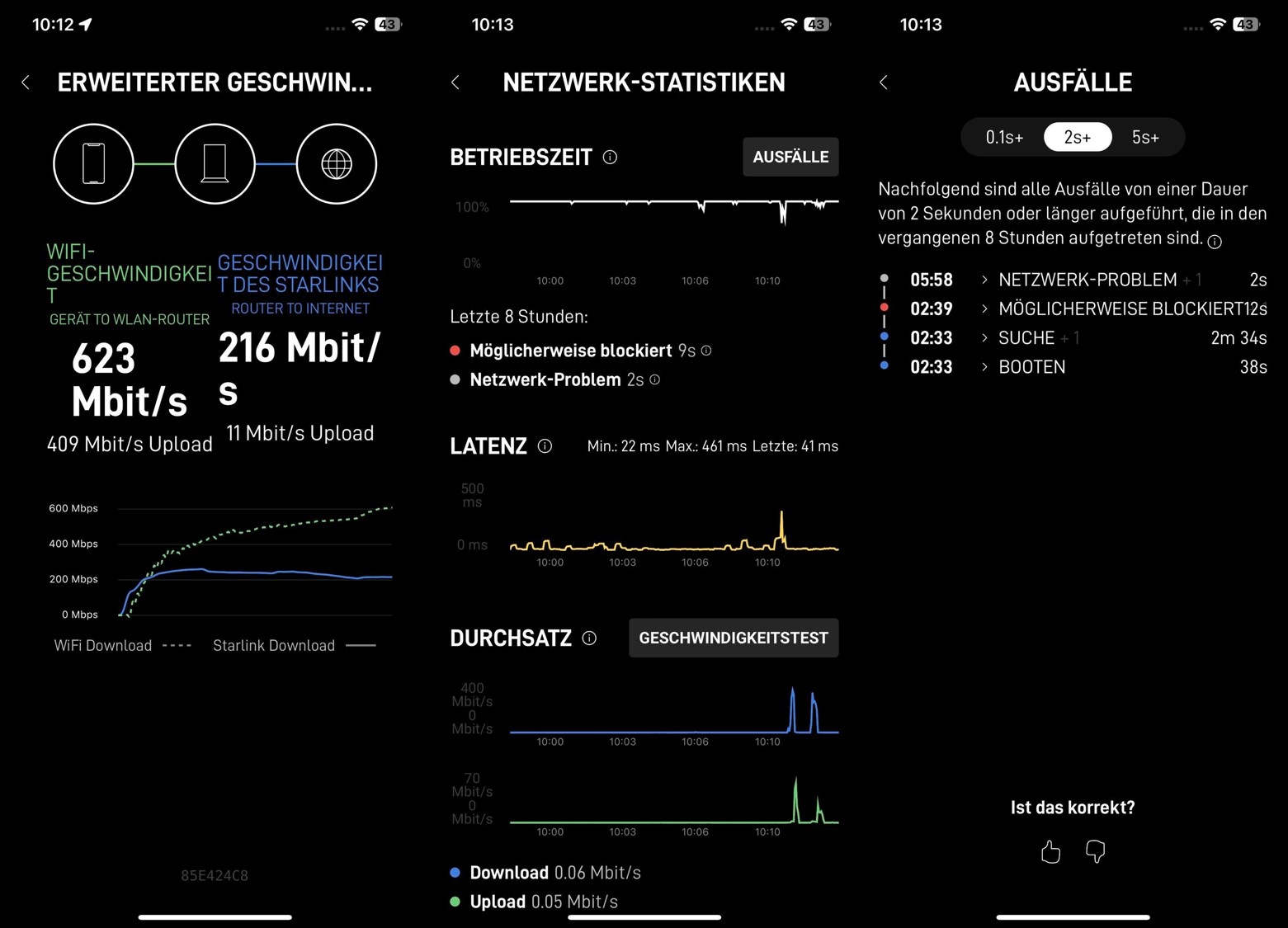
Martin uses a global roaming plan, which at 230 euro a month is not exactly cheap, but with which the system is usable on land and near the coast worldwide (for use out at sea there is an added cost of 2.27 euro per GB). An interesting plan for round-the-world travellers.
How well does the Starlink system stand up to the weather?
On a sailing boat the hardware is exposed to the environment and the weather, and often there is the added risk of corrosion from salt water. An interesting point for off-road travellers too, where the gear also has to withstand the elements. Martin’s experiences so far have been thoroughly positive. The outside of the antenna is made of sturdy plastic, the base has a quality paint finish. Worth mentioning in this context is the heating function built into the antenna. That clears the way for use in the snow. Martin had, by the way, removed the base of his Starlink antenna and mounted it solidly using a fishing-rod holder. A good idea that could find a use on off-road vehicles too, perhaps on a roof rack or for mounting on a roll cage.
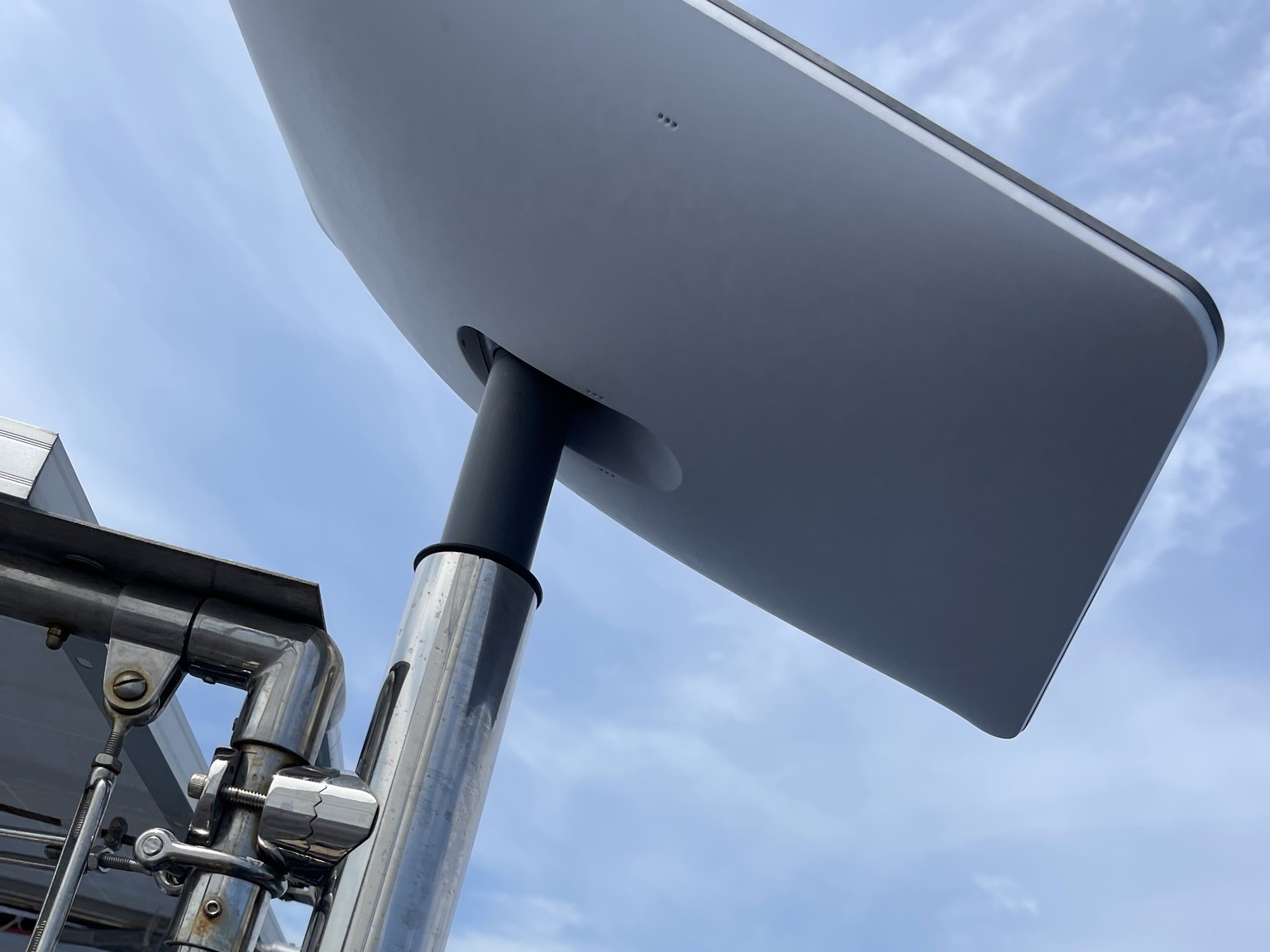
Since sailors face similar challenges to overlanders when it comes to powering hungry equipment, we asked about that too. You should budget around one kilowatt-hour per day for the Starlink system, says Martin. He powered his Starlink setup with a 3,000-watt inverter that was on board anyway. The 650 Ah of lithium batteries in total were fed by 850 watts of solar. As a rule that was enough for a base demand of 3.5 to 4 kilowatt-hours per day on board. On cloudy days a generator came in as well.
And finally, one more tip from Marcel
“I would warmly recommend the Starlink subreddit to anyone interested. A lot of the international experience on support, power consumption, problem descriptions and fixes is discussed there, and you often get help faster than through regular support. You will also find DIY guides for transport boxes for the kit and other useful travel helpers there.”
The verdict on using Starlink as an overlander
We can see that Starlink really is a good, working alternative to the usual mobile network, or even wifi, and that you can work well on the road with it. Technologically, there is of course more to come on speed. Marcel too told us he often has the feeling that the number of users is simply climbing far too fast for the infrastructure Starlink has available. That will probably change with the planned expansion. But the speeds already on offer, at acceptable latencies, are more than enough for most users and uses.
Constant reachability changes people’s everyday lives, and it surely changes holidays and overlanding trips too. Everyone should decide for themselves how to handle that. There is criticism of Starlink from a completely different direction too, by the way. It concerns topics like space junk and the risk of collisions in orbit. Astronomy fans are bothered in part by the impact on the night sky. Although it can be quite fascinating to watch the chain of Starlink satellites dart across the sky.

Using it does not come cheap, and whether buying it makes sense depends heavily on your own usage and your travel region. Either way, it is an interesting alternative to the admittedly tiresome business, over time, of swapping and topping up local SIM cards, or hunting for a halfway stable mobile signal or wifi when you need it. And Starlink plays its biggest trump card, of course, anywhere there is no stable coverage from mobile networks. It is certainly worth following Starlink’s further expansion, and the development of the alternatives too, like the already mentioned Project Kuiper or OneWeb. Above all, of course, for anyone who needs, or simply wants, a stable connection that is independent of local options.
Many thanks to Marcel and Martin for sharing their real-world experiences
If you want to find out more about Marcel and his family’s full-time travels, take a look at Instagram. There, Marcel Motyl regularly shares lovely travel pictures from the road on salzundbenzin.
You can follow Martin’s sailing adventures too. Visit his website for that, and on Instagram you will find great photos and information about his trips. A special highlight is Martin’s videos, which you will find on YouTube.
By the way, you can read more on the subject of internet and wifi in the car in our guide on it. And if you are interested in communication for emergencies, take a look at our guide and market overview of satellite messengers, because there are satellite communication solutions for that too.
© Photos: Marcel Motyl, Martin Daldrup, Moritz Jung