

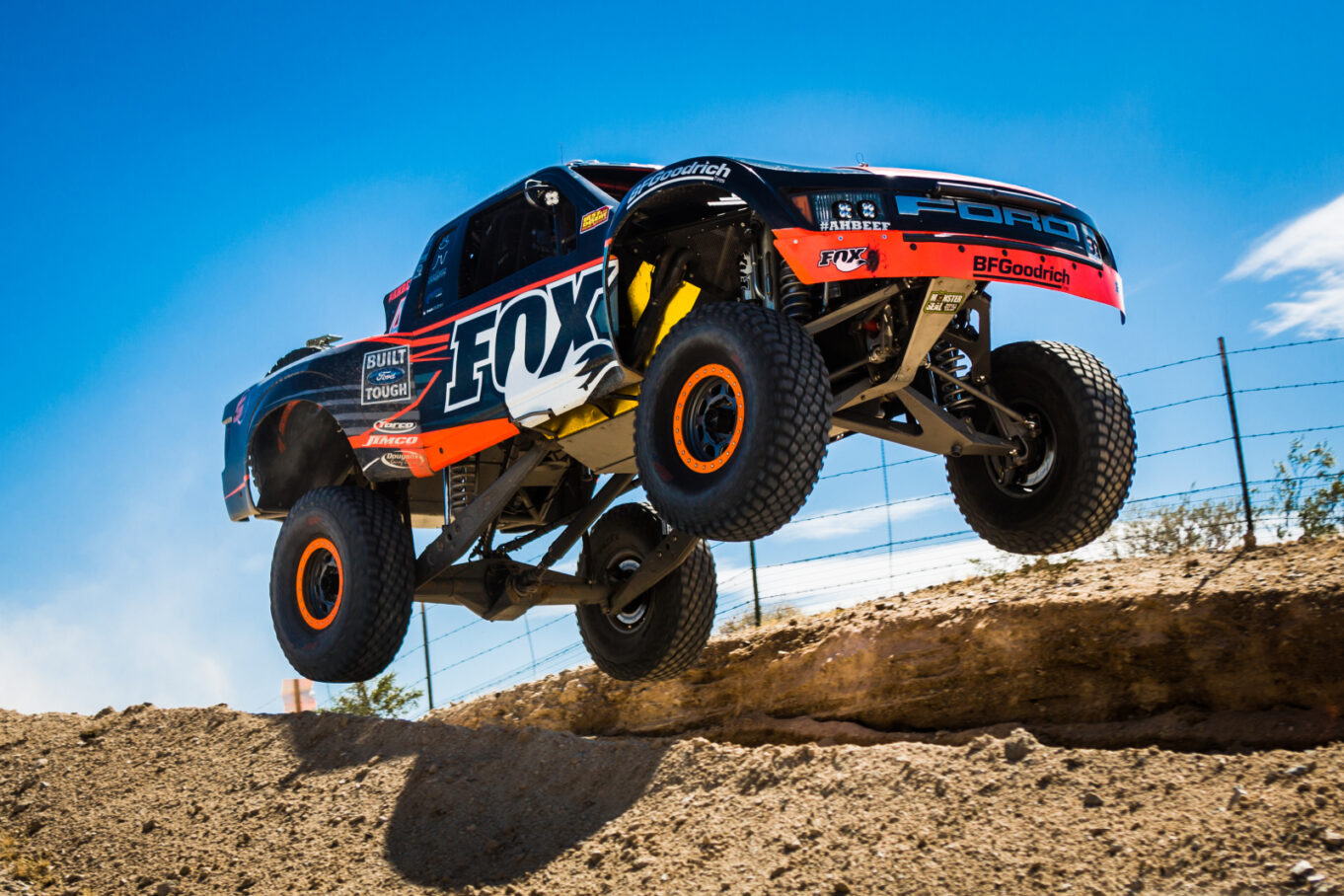

We already covered springs in the first parts of this series. Now it’s about the spring’s close partner, the shock absorber. How the two work together decides comfort, capability and safety when driving on and off road.
It’s often said that the shock absorber is a vibration damper and the spring catches the impacts. In fact, though, the shock absorber is both, which is easy to check if you look at the usual spring rates. With a spring rate of 100 kg per centimetre, an impact of 1 tonne is already enough to compress the spring by 10 centimetres, which can bring it to its stop, that is, it is fully compressed and has no more effect. So where does the rest of the energy go with impacts greater than 1 tonne? The damper turns it into heat. So it is heavily involved in catching impacts. But it also does the job of vibration damping. When the spring wants to release the energy stored in it, the shock absorber damps that release, so the body doesn’t start to oscillate.
If the spring could release the stored energy undamped, you would immediately have a system capable of oscillating. The vehicle would no longer settle, it would swing back and forth, rock itself up and no longer be controllable. You would be bouncing around in the vehicle constantly, and the wheels would lose their safe grip on the ground. So it’s clear: shock absorbers are among the critical, safety-relevant components of the vehicle.
In short, while the spring carries the load of the body and everything in it, the shock absorber controls the movements of the spring. The shock absorber draws off the energy stored in the spring, so the body settles, the wheels don’t lose their grip and the vehicle stays controllable.
In vehicle construction, a hydraulic-mechanical damping in the form of telescopic shock absorbers has mostly become established. A piston together with a piston rod moves through oil to create the damping effect. One side of the damper is connected to the vehicle body, the other to the axle or the wheel suspension.
This damper principle has proven superior, because it combines the advantages of small dimensions, precise damping, low friction and simple construction. Normal shock absorbers are maintenance-free, but not wear-free. If leaks occur or the effect fades, they are replaced. Higher-quality shock absorbers can be serviced, overhauled and reconfigured.

Designs
As general designs, you can distinguish monotube and twin-tube dampers, dampers in which oil and gas are separated or not, and by the working principle, whether the damping effect depends on the piston speed or its position. Alongside these there are also special forms like the MacPherson strut, the triple-tube and the upside-down damper.
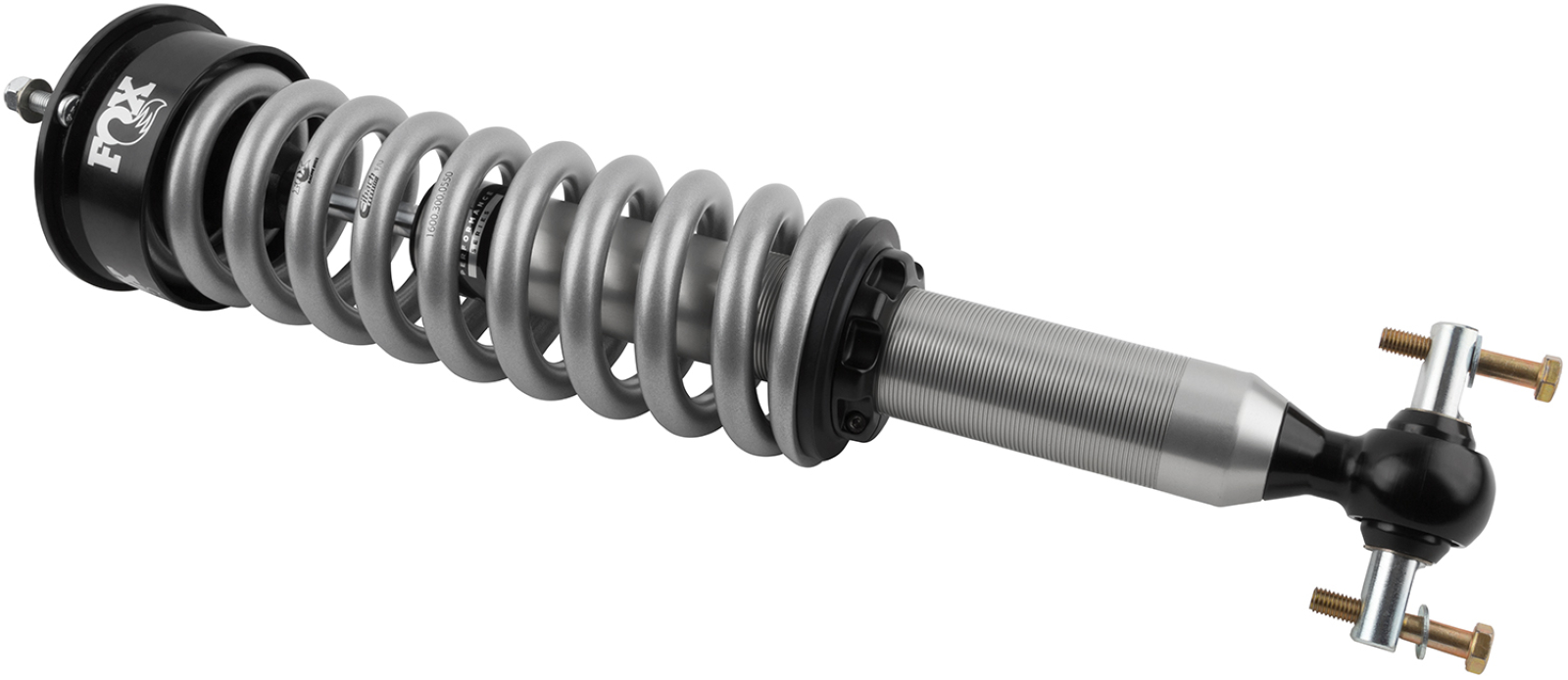
Shock absorbers can stand alone next to the springs or sit inside the coil spring. If the spring seat on which the spring rests is fixed to the damper, then it’s a coilover. If the vehicle height can be set via the spring preload using the rotating spring seat, the whole thing is called a threaded or adjustable coilover suspension. This is done using the ring, clearly visible in the picture, which can be turned up or down on the outer thread of the damper.
This space-saving design, with the spring pulled over the damper, is found both on classic vehicles with solid axles, on the front axle then, and almost always on more modern off-roaders when they have independent suspension. The MacPherson strut is built similarly, only it has further features and is part of the wheel location.
Unless we’re dealing with an emulsion damper, they all have one thing in common: they have a nitrogen gas filling. The nitrogen serves various purposes and is ideally suited, because its properties are very stable. For one, the gas can be compressed and so allow the volume compensation needed when the piston rod enters the working cylinder. The oil volume displaced by the piston rod has to go somewhere, after all. For another, the nitrogen is filled in under pressure, up to 30 bar and more are possible. This serves to prevent foaming and cavitation, which would otherwise happen very quickly. That can go as far as a loss of the damping effect. With today’s high-performance oils and valve technologies, lower pressures can also be run safely, which gives you more range for adjustment. More on that in the next sections. The pressure can also influence the effective spring rate at the wheel in question, because the gas resists compression.
Since the damper in most cases also determines the vertical freedom of movement of the wheel, damping elements are often built in at the top and bottom ends. In the event of bottoming out (full compression or extension), these cushion the piston striking home. If that’s not the case, there are, for example, axle limit straps on the vehicle that are meant to prevent the damper piston from striking the floor of the damper tube.
Monotube oil damper / emulsion damper
This type of damper is only rarely found in cars today. Twin-tube dampers are the norm. However, it is cheap, simply built and has its special uses.
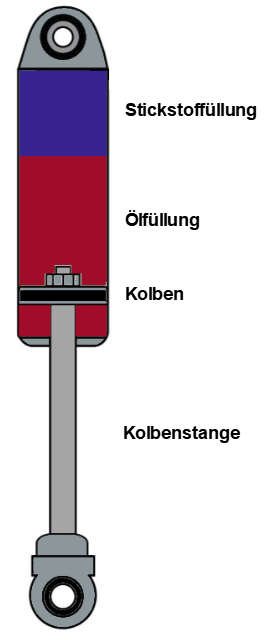
In the working space of the damper, the damper tube, there is oil and air. At rest, the air cushion is above the oil. When the piston starts to move in the tube, an emulsion forms very quickly, that is, air and oil are mixed together. This makes for more consistent behaviour over the whole travel, because there is no longer a separate oil and air cushion. However, the behaviour isn’t as consistent as would be desirable for many uses, because it keeps changing depending on the impulse frequency, the temperature and the mixing.
When the piston rod moves into the working space, the air in the emulsion is compressed. On extension it expands again. That means the whole pressure exerted by the entering piston together with its piston rod is supported on this air cushion distributed in the oil. The more the air bubbles were already under pressure beforehand, the harder the damper is. That is equivalent to an increase in the spring rate.
Problematic effects
If cavitation or foaming occurs, the damper quickly loses its effect. To push this point as far out as possible, the air, and therefore also the oil, in the damper is under pressure. The pressure makes for smaller air bubbles in the oil, so the piston, or its bores through which the oil flows, always meets oil and not just air bubbles. In addition, the pressure behind the moving piston increases too, which counteracts cavitation. But that only works up to a certain point.

Cavitation
Cavitation is one of the most dreaded effects in fluid dynamics, because it quickly reaches destructive proportions. Anywhere fluids flow, be it on ship propellers, pipe systems, turbines or in engines around the water pump and cylinder walls, cavitation can occur. When designing such systems, great care is therefore taken to make sure this does not happen under any circumstances.
Cavitation always arises when a fluid rapidly loses its pressure, so that it vaporises. You know it from camping at higher altitudes and low air pressure, where water starts to boil sooner, or the other way round from a pressure cooker, where higher pressure allows higher water temperatures without it boiling. Your engine cooling system is therefore under overpressure, so nothing starts to boil and vaporise too early.
When the piston moves quickly in the oil, an area forms behind it where the pressure drops quickly and sharply. If the temperature is also high on top of that, the risk of the oil vaporising rises even faster (low pressure + high temperature = early vaporisation). If the pressure drops quickly and far enough, vaporisation can start even at normal ambient temperatures. As a result, gas bubbles would form that no longer have a damping effect. As a countermeasure, the pressure in the damper is increased. The pressure on the oil then rises behind the moving piston too, the vaporisation point is pushed out, and the damper becomes more temperature-stable.
Fun fact: the pistol shrimp, which lives in the subtropics, can snap its claws shut so fast that a cavitation bubble forms which has a good 80 bar of pressure and reaches about 4,700 degrees Celsius when it implodes. That’s how it stuns or kills its prey.
When the piston rod has moved into the damper tube, the air wants to expand again. This has the effect that the damper, when removed, extends again by itself. That, by the way, is not a sure sign that it is still intact. It is only a sign that the damper is sealed to the outside. The piston inside the damper can still be leaky and the damper’s effect impaired that way.
Advantages
The advantages of the emulsion damper are its very simple construction, low cost and the large travel, because the whole working space can be used by the piston. It is a good damper for the normal road, and off-road it suits wherever long travel is required and slow driving is called for, for example in trials. In general you can say the harder, faster and longer the damper has to work, the softer it gets. That makes it useless for uses where the most consistent damping effect possible is required.
Disadvantages
The downside is that when it heats up it loses its effect much faster than the other types. It is therefore less suited to uses where you drive faster over uneven terrain. Another disadvantage of all monotube dampers is that a dent in the tube makes the damper useless, because the piston can no longer move freely.
Often it is listed as a disadvantage that its fitting position matters and the damper tube stands above the piston rod, so the air cushion is right at the top, because the piston shouldn’t move into the air cushion. But that isn’t quite right, as the rear-axle dampers of the Land Rover Defender or the Koni “Red” show, for example. On these emulsion dampers the piston rod is above the damper tube. This works because the weight of the body already pushes the piston down far enough that it stands in the oil. After a few metres of driving the emulsion is created, so the damper works over the whole travel. It is true that it depends on the damper model, but in principle both fitting positions exist. Whichever one the maker specifies, that’s how it has to be fitted.
Gas-pressure damper
An improved version of the emulsion damper is the gas-pressure damper. Instead of air, it uses nitrogen as the gas. The nitrogen is also put under pressure, to counteract foaming and cavitation.
Well-known damper types
FOX and radflo Air Shock
The FOX Airshock range, as well as the radflo Air Shocks, are examples of gas-pressure emulsion dampers filled with nitrogen. By filling with nitrogen at different pressures, the spring rate and the vehicle height can be adjusted. The piston can also be set via shims in rebound and compression (shims are explained in part 4). The special thing here is that they can be used without springs, because they take on their job too. To achieve this, the piston rod is much thicker than on the normal emulsion dampers from Fox.

They can be used as coilover dampers, but are only suitable for lighter vehicles.
Monotube gas-pressure damper with IFP
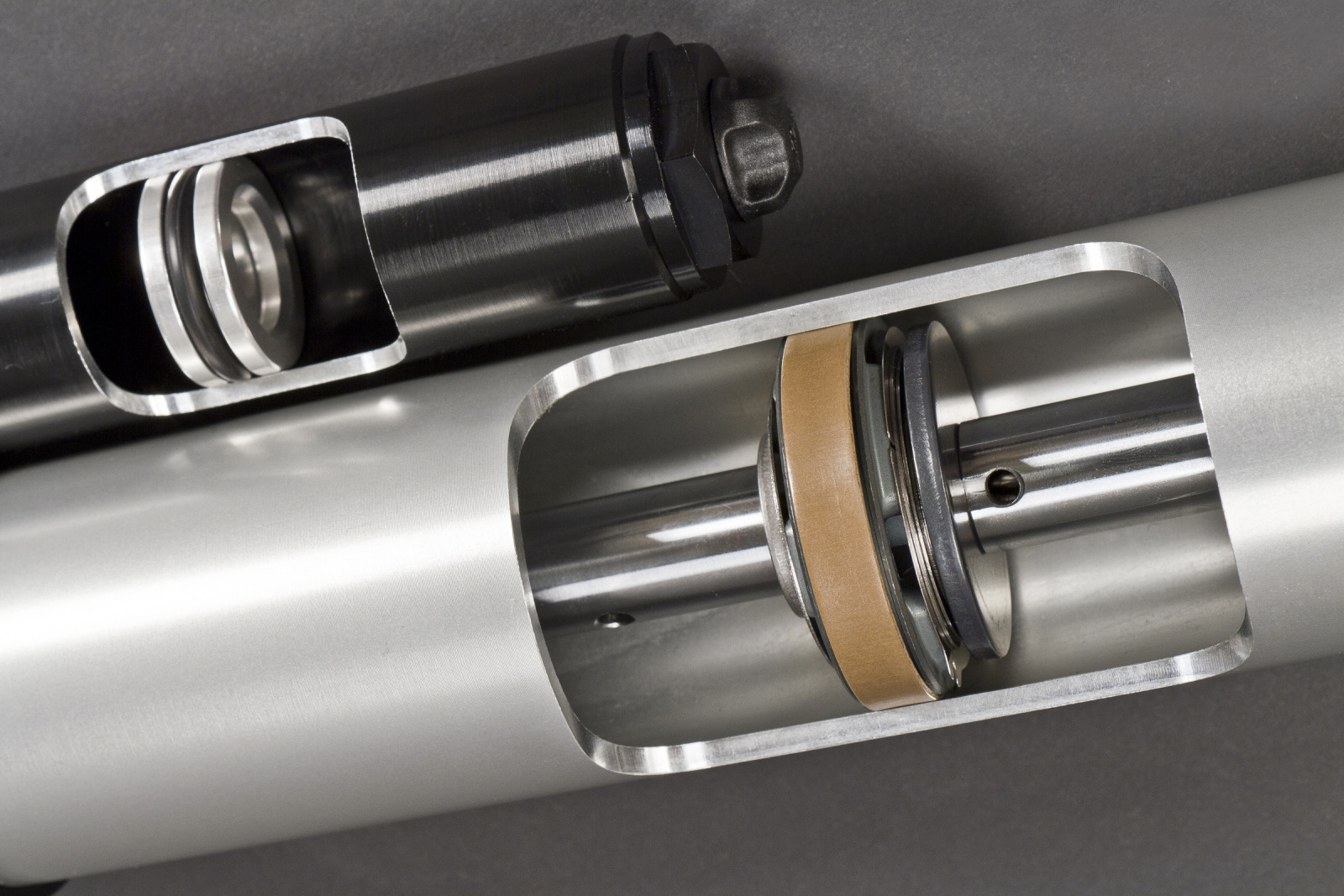
The monotube gas-pressure damper resembles the emulsion damper in that there is only one working space. This, however, is divided into the oil and gas areas by the IFP (Internal Floating Piston), a freely moving second piston. There is no contact between the two, and therefore no emulsion forms. The risk of cavitation still remains, because there are always gases dissolved in the oil, a good 10 percent. That is why the nitrogen filling is put under pressure here too. This pressure is transferred to the oil via the IFP and shifts the cavitation point.
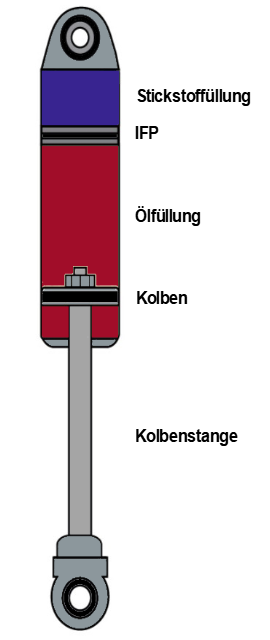
Monotube gas-pressure dampers are more complex in construction than an emulsion damper, but also more capable and more stable in their damping effect. They are more expensive and offer less travel for the same length, because the IFP with the gas volume above the piston takes up space. The fitting position can be chosen freely. There are gas-pressure dampers that have a membrane instead of an IFP. For the same installation space, the piston can have a larger diameter than on twin-tube dampers.
Well-known damper types
FOX Performance Series
The FOX Performance Series dampers have an IFP. They are available for a wide range of vehicles. Because travel is lost through the IFP, but the spring travel for articulation is meant to be kept, adapting the damper mounts is often necessary for these dampers.
Monotube gas-pressure damper with reservoir
This damper is a modified form of the monotube damper. In it, the gas with the IFP is moved out into an external chamber, the reservoir. Damper and reservoir can be connected by a hose or a fixed housing (piggyback). On this type, settings can be adjusted from outside at various points, if the maker has provided for it that way. So with adjustable valves you can set the flow speed of the oil from the working space into the reservoir (compression) or back (rebound), or both.
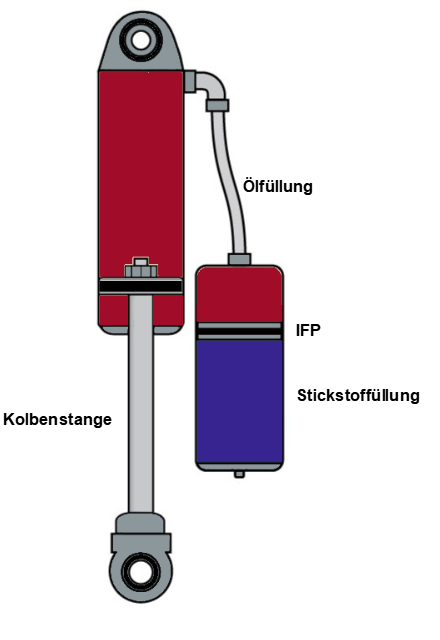
This design has various advantages. The whole working space of the damper is available again, the amount of oil is higher and the reservoir can be placed away at a favourable spot, which makes for better cooling. However, the distance shouldn’t be too great, because otherwise negative effects can arise again from the long hose connection and expansion in the hose. The behaviour can be changed within a certain range without removal, through valve settings from outside. The fitting position can be chosen freely.
The downside is the greater space requirement, because now the reservoir needs room too. Finding the space for it can be a challenge. Heavily loaded dampers also have the disadvantage of temperature-related deformation. It is therefore hard to fasten external mounts, for example for the reservoir, to them.
Well-known damper types
FOX Performance Series
The Performance Series dampers are assigned to the truck/pick-up range. They come as coilover, single damper and single damper with reservoir, in which case they are called Performance Elite Series.
Twin-tube damper with and without reservoir / twin-tube
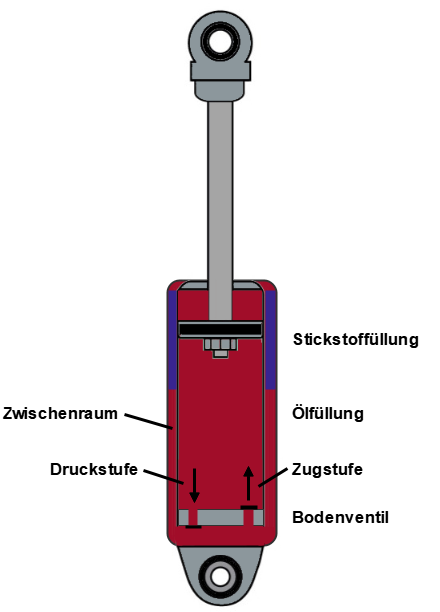
The twin-tube damper is by far the most commonly used type in production vehicles. A good 93 percent of all cars use this principle. On this damper, the compensation space for the displaced oil volume lies between the inner and the outer damper tube. When the piston rod moves in, the oil is directed through a base valve in the working space into the intermediate space, or additionally into a reservoir too.
In the intermediate space is the compensation gas, and it has contact with the oil. At the boundary between oil and gas some emulsion can form, but not as quickly as on the monotube damper. The piston doesn’t come into contact with the emulsion. This design means the fitting position can’t be chosen freely. Often the makers also allow an inclined position within certain limits, usually at most 45°. Beyond that, the gas can get into the working space.
The advantage of this system is that at full travel the damper also fits inside the coil spring (coilover). The disadvantage is the reduced cooling of the oil due to the double-walled design. This disadvantage can be compensated for by the external reservoir.
Well-known damper types
ARB Old Man Emu Nitrocharger Sport
The OME Nitrocharger Sport is a typical damper of this type without a reservoir. It comes from the factory tuned to the OME springs from the same house, the respective vehicle and various load situations.
Koni Heavytrack
This is a twin-tube damper with adjustable rebound and a 70 mm diameter. It is available ready to fit for many well-known off-road vehicle types.
Bypass shock absorber
The bypass damper differs from the systems mentioned so far in one essential thing. Its behaviour also depends on the position of the piston, and not merely on its speed. In the so-called ride zone, the piston speed and its shim setup (see part 4) play little to no role. Towards its ends that changes. There the speed of the piston and its shim setup are the determining factors. This makes it possible to achieve a progressive behaviour depending on the degree of compression. A bypass damper can be designed as a twin-tube damper or, as a monotube damper, have external or internal bypasses.
The diameter, number and position of the bypasses decide how and where the resistance for the piston increases or decreases. Usually the damper is divided into three zones for this. The lower zone, when the damper is almost fully extended, the middle one in which it moves most of the time (ride zone), and the upper one when the damper is almost fully compressed. When the piston reaches the lower or upper zone, there are no more bypasses there and the damping increases sharply. Now the oil can only flow through the piston and its shim setup plays the dominant role. So before full compression or extension, the damping becomes noticeably harder, to catch bottoming out to either side. Most of the time, though, the piston is in the middle zone, where the bypasses are, to allow a softer, more comfortable ride. The bypasses can be laid out so that the shim setup isn’t even activated.
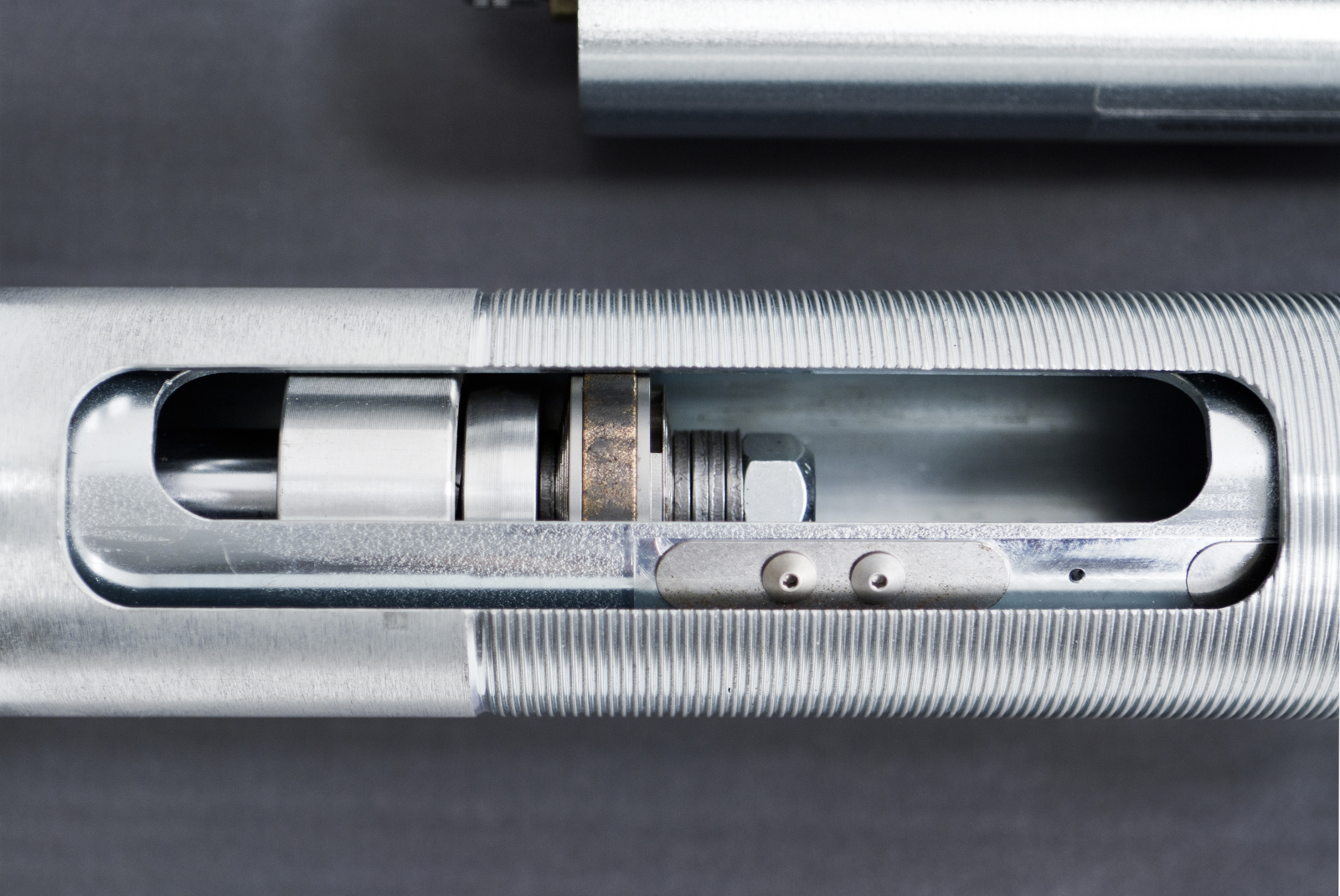
Usually several bypasses are laid out that allow the oil to flow past the piston as the piston rod moves in or out. These bypasses are realised in various ways. On monotube dampers they can be grooves milled into the inside of the working tube. As long as the piston travels over the grooves, oil can escape there and the damping effect is reduced. These grooves have to get smaller slowly towards the end, so the transition is soft and not too abrupt. Once the piston is past the grooves, the oil can only flow through the piston, the resistance increases, the damper gets harder.
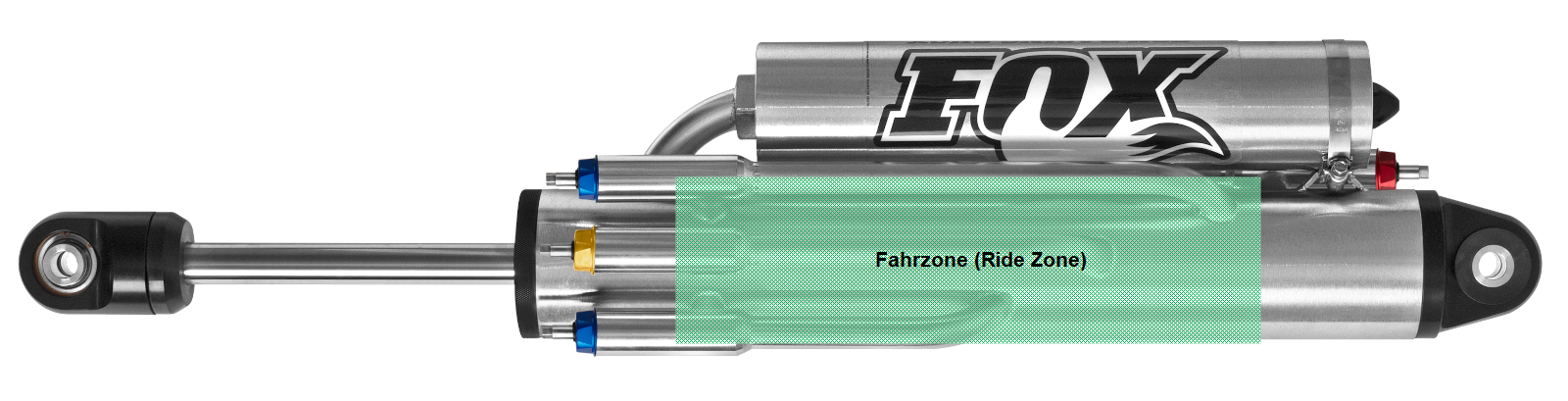
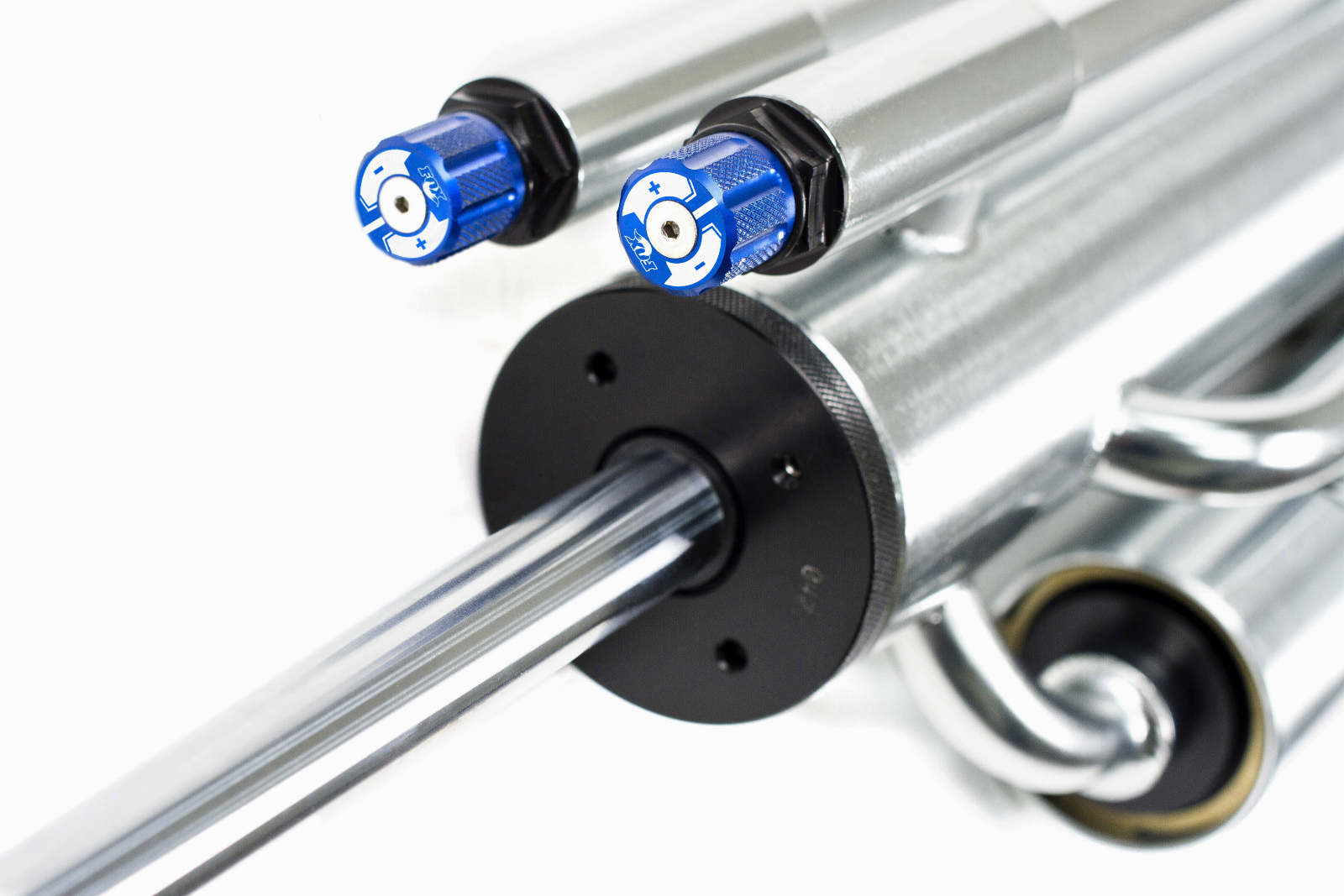
If the bypasses are on the outside in the form of tubes, it looks very futuristic. On each of the bypasses there can also be valves, so you can adjust the shock absorber. Because they are on the outside of the damper, they are very easy to reach. As a coilover these dampers are not suitable.
If the bypass damper is designed as a twin-tube shock absorber, the bypasses are formed by holes in the working tube. They let the oil flow into the space between the outer and inner tube and from there back into the working space behind the piston. Once the piston is past all the openings, it becomes harder in its effect again.
Setting the progression by position is the big advantage of these dampers. That’s why they are often found in competition. On the twin-tube dampers a slight disadvantage comes into play. The outer tube, even if it has good conductivity, insulates the greatest amount of the oil, which is in the inner tube. Only the oil in the intermediate space, and the oil that flows into the reservoir, is cooled by the airflow. In practice, with the usually generously dimensioned dampers, this disadvantage only shows up on long and highly demanding tracks with high impact frequencies (very fast driving).
Well-known damper types
ARB Old Man Emu BP-51
The OME BP-51 is a twin-tube bypass damper with reservoir, available as a stand-alone damper or as a coilover. It is adjustable in rebound and compression.
FOX Factory Race, internal or external bypass
Fox offers a whole range of bypass dampers with either internal or external bypasses. They usually come with a reservoir and various adjustment options, both for rebound and compression and for high and low piston speeds (more on that in the fourth part).
The working principle of a damper in detail
Despite all the different types, the principle of the shock absorber is based on the kinetic energy fed into the damper while driving being turned into heat. On compression, the piston rod with the piston moves into the damper tube, on extension back out again. In doing so, the piston has to move through oil, which brakes the movement. The energy fed into the damper is thus turned into heat through friction. On a BMW X3 prototype at the 2006 Dakar Rally, up to 350 degrees Celsius were measured. I myself was able to measure 70 degrees Celsius on the damper on corrugated tracks.
So the damper can go along with the movements, there are openings, so-called ports, which can be arranged at various points. The oil flows through these when the piston and piston rod move. These include the piston, the walls of the damper tube or valves, which can be fitted at various points. They decide how fast the oil can flow through the piston or past it, and on the bypass damper also when. The more, and the more freely, the oil can flow, the faster the piston rod and piston move and the less energy is dissipated. The damper feels soft and rather comfortable. In the reverse case, when the oil is prevented from flowing through quickly, a higher resistance arises. The damper feels hard, the vehicle less comfortable, but better controllable.
In the piston, the flow is regulated by various bores, by spring-loaded discs or by shims over the bores. Shims are a very common method. They combine spring and closure in one component and allow a very precise, differentiated setting.
The volume compensation always needs a gas
Since the piston rod displaces oil as it dips into the damper tube, there has to be compensation for that volume. In practice this is provided by compressible gas. As the gas, air or nitrogen is used. Better dampers use nitrogen, because it behaves neutrally towards different temperatures and its properties are very stable.
The gas pressure plays a part too. Besides the purpose already mentioned, of preventing foaming and cavitation, by increasing the gas pressure the effective spring rate parallel to the suspension spring can be set. When the gas is compressed on compression, it wants to expand again. That creates a counter-pressure against compression. The higher the gas pressure, the more the damper resists compression and the more it supports extension. That’s why intact gas shock absorbers are always fully extended when removed. Because of the pressure, the gas wants to expand and in doing so pushes the piston rod out of the damper tube.
Adjusting the shock absorbers
In this part the various shock absorbers and the basic working principle were explained. But what do rebound and compression mean? What are shims and how does all of it affect the handling? We go into that in part 4.