
Advertisement: What are the differences between AT and MT tyres, when should you use which, and are MT tyres actually the right choice for winter? We put a few questions to Klaus Faust, an expert on off-road tyres.
Klaus, what exactly is an AT tyre?
Klaus Faust: AT stands for all-terrain, meaning suitable for any terrain. On the road an AT tyre has handling characteristics similar to an ordinary road tyre, but is a little louder as it rolls. Compared with the past, AT tyres today may be driven at up to 210 km/h and in some cases even up to 240 km/h.
An all-terrain tyre is a good compromise for use on roads and off the beaten track. These tyres are more resilient, as they have a coarser tread pattern and so are less prone to damage from stones or scree. AT tyres with the 3PMSF symbol, also known as the snowflake, are now in vogue. These tyres can therefore also be used as all-season tyres. Many drivers no longer want to change their tyres seasonally and so prefer to go for AT tyres with the snowflake.
Drivers of SUVs and motorhomes prefer AT tyres on their vehicles too, ideally with the all-season marking. From my research there are currently at least 23 to 25 SUV AT tyres with the snowflake. There are various manufacturers, of course, but for me the General Grabber AT/3 is one of the best tyres in this segment.
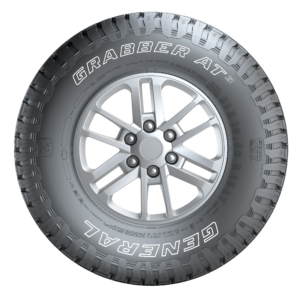 General Grabber AT/3, the off-road tyre for road and light terrain
Which terrain is an AT tyre best suited to?
Klaus Faust: An AT tyre is the perfect all-rounder for road and light terrain. With its chunky tread pattern you’ll cope with unpaved tracks effortlessly. Even sand is no problem (with the air pressure adjusted, of course). Thanks to its puncture-resistant tread you can also travel through light scree or rocky terrain with AT tyres without a care.
Should I run AT tyres at a different pressure than normal road tyres?
Klaus Faust: That depends on the situation, of course. On a normal road you should use the tyre pressure recommended by the vehicle manufacturer and the tyre manufacturer. When you’re off-road it looks different, of course. To get better traction you can let air out of your tyres. That makes sense on sand or mud, for example. But it takes a fair amount of sensitivity. If you let out too much air, the tyre can come off the rim in difficult terrain. You should also definitely bring the tyres back up to a normal level when you drive back onto the road. You also have to bear in mind that you shouldn’t drive at high speeds with lower pressure. The same goes for MT tyres, of course. Although with some MT tyres you can even run up to 50% less pressure than on the road.
Let’s come to MT tyres, what’s the difference between MT and AT tyres?
Klaus Faust: MT stands for mud terrain, meaning “muddy ground”. MT tyres have a much coarser tread pattern, a larger void ratio (see how a tyre works) and look more aggressive. If you compare them with AT tyres, you’ll quickly notice that they’re considerably louder on the road. The speed rating on MT tyres is usually lower than on AT tyres, which means you shouldn’t drive too fast on them.
Current MT tyres should by now carry the POR marking. A tyre only gets the POR marking if it has at least a 35% void ratio and a tread depth of at least 11 mm. These tyres are also only approved up to a maximum of 160 km/h.
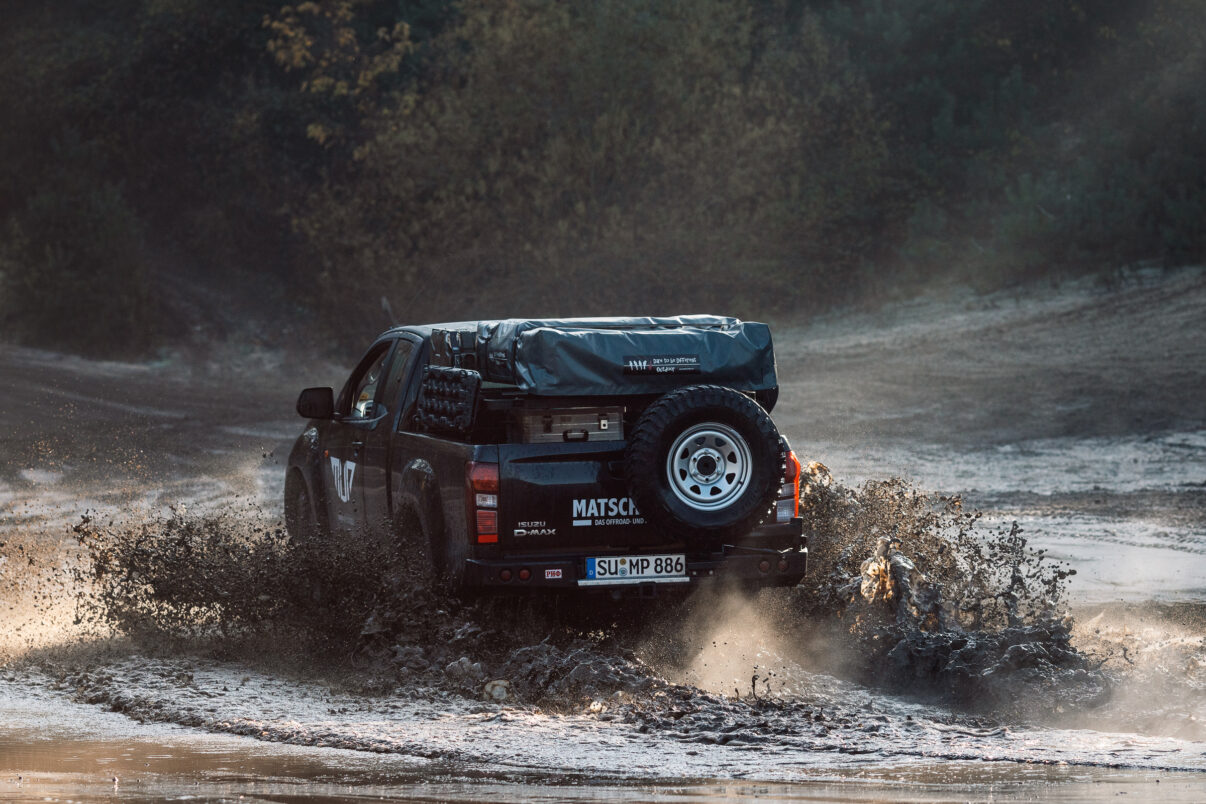
MT tyres are best suited to wet and muddy terrain. Among their properties is good self-cleaning, which means that small stones or mud come loose on their own through the rotation and flexing, giving you more traction. They do, however, also have a higher rolling resistance, which means you use quite a bit more fuel. Caution is also called for with MT tyres on wet roads. You should drive carefully in bends, and you have to bear in mind that your braking distance can lengthen considerably.
If MT tyres drive so well in the mud, then they’re surely great for winter, right?
Klaus Faust: Absolutely not! MT tyres are not suitable for winter. They might still make sense in sticky snow. But on frozen roads they carry a big risk because of the missing sipes. Even if they have an M+S marking (mud and snow), you shouldn’t drive them in winter, because they’d only be allowed as winter tyres with the 3PMSF winter marking.
Which MT tyre would you recommend?
Klaus Faust: I consider the General Grabber X3 a thoroughly excellent MT tyre. It has a novel tread surface and so has extremely good performance on muddy ground, but also good grip on loose surfaces like sand and grit. On top of that it’s exceptionally cut-resistant, so it’s outstandingly suited to extreme terrain with sharp stones.
 General Grabber X3, the MT tyre for tough off-road terrain
Have you got a tip on how to make tyres last longer?
Klaus Faust: As a rule you should rotate the tyres from front to back every 10,000 to 15,000 km. Please don’t forget the spare wheel while you’re at it. The tyres should of course be balanced. In my view you should generally replace the tyres at a tread depth of 4 mm. You shouldn’t drive on such a low tread depth in winter or off-road. And bear in mind that driving in extreme terrain, with lots of sharp stones, makes tyres suffer enormously, so before you put your foot down again on the motorway after the off-road drive, check your tyres for deep cuts and whether they might need replacing.
About Klaus Faust: Klaus Faust has been an expert on off-road tyres for over 40 years and is a brand ambassador for the company General Tire. On top of that he’s been working as an off-road driving instructor and technical trainer for the tyre industry for over 30 years.
» Buy tyres: General Grabber AT3 at ReifenDirekt*
* These are affiliate links. Buying through them doesn’t cost you a cent more, but we get a small commission and go splashing through the next mud puddle with a big grin. That’s how you help keep the magazine free for everyone. Thanks a lot!