
Have you ever wondered where the name Nakatanenga comes from, or why so many bears roam around the shop? And did you know that before the shop for off-road gear, Peter Hochsieder ran guided tours to North Africa, and that the first parts were sold from his parents-in-law’s garage? We look back with him on 30 years of company history: from improvised roof tents in North Africa, through the legendary Heritage grille, to the development of the CargoBear. A conversation about pioneering spirit, a passion for all-wheel drive, and the decision to do things yourself rather than get annoyed by bad solutions.
30 years of Nakatanenga. Wow. Tell us, how did you come up with it?
Originally I trained as a photographer, hands-on, in the classic way. I worked in various areas: portrait photography, advertising photography, later technical photography too. At some point I realised that me and having a boss above me don’t work well together. I was never the type to be an employee.
On top of that came the wanderlust. I was on the road a lot and at some point found that others fancied travelling with me. So I organised a few tours, took people along, and slowly a business idea grew out of that.
Fair enough, but travel doesn’t necessarily have anything to do with the car. So where did the passion for travelling in an off-roader come from?
My great-grandfather Norbert Hochsieder was a painter, photographer and hotel owner in Marienbad. In the 1920s he lived in Algeria for a while and brought back beautiful watercolours from there. As a family we kept travelling in his footsteps, above all to North Africa: Morocco, Tunisia, Algeria.
And all of it in an ancient, rusty VW bus. But I wanted to get to where the bus can’t go any more. That’s how the off-road thing came about. I once went along on an off-road tour, and it completely fascinated me. Sure, you were out on tracks, but there were limits: range, terrain, remoteness. And that’s when the idea came up: with a proper off-roader you can go much further, much deeper in, into the lonelier, more exciting areas.
And which vehicle did you do your first trips in?
Well, not in my very first off-roader, that was a Suzuki LJ 80. That would have been pretty hardcore. I then did the first real tours in a Toyota Land Cruiser BJ 40. With a decent three-litre “fuel to noise converter” in it. Sadly high on emissions and low on power.
The reliability was … let’s say: room for improvement. Toyotas are said to be indestructible, but mine probably had an age problem. Or a care problem from umpteen previous owners. Or both. In any case, the BJ 40 saw the inside of many a North African workshop.
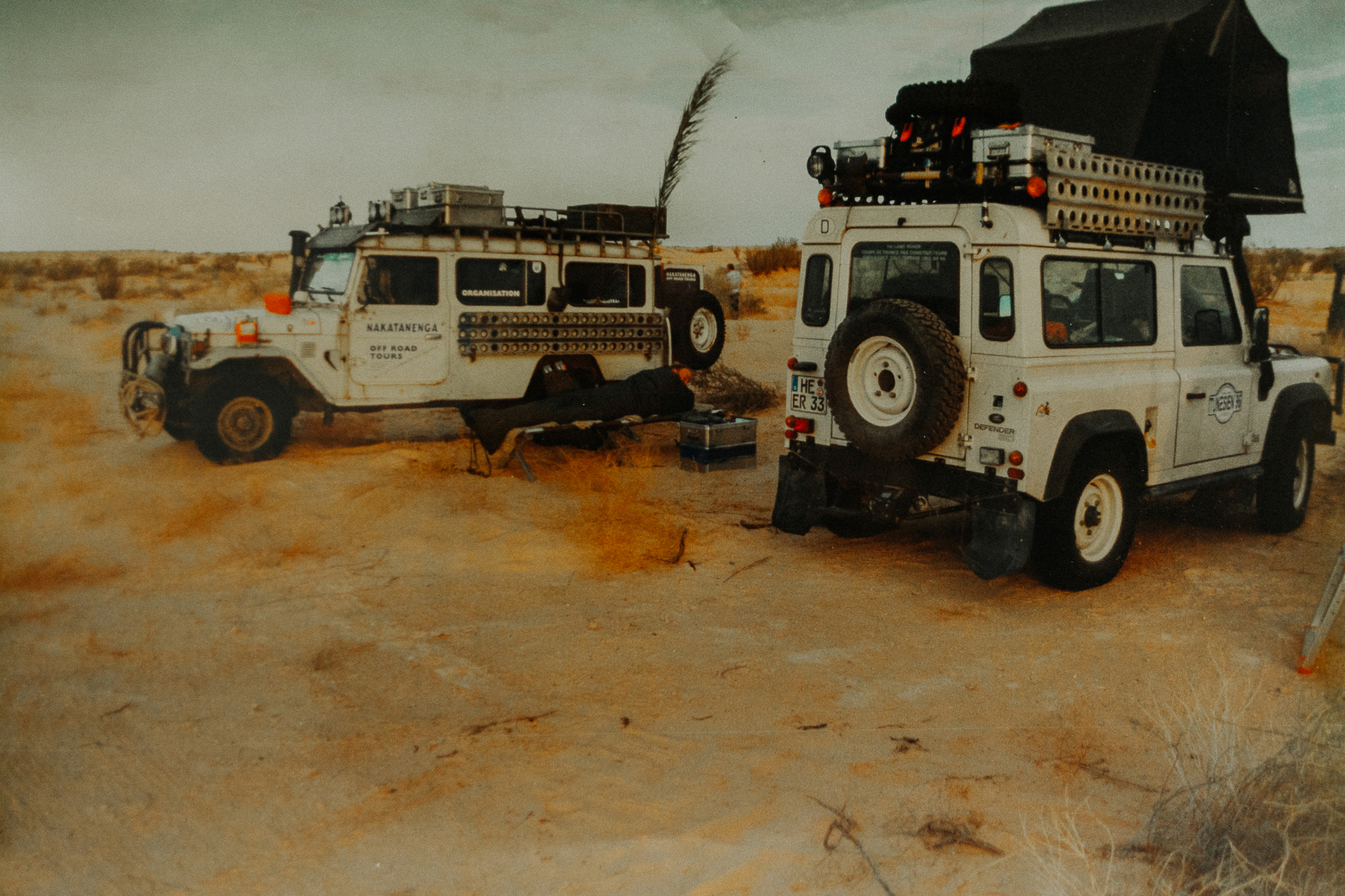
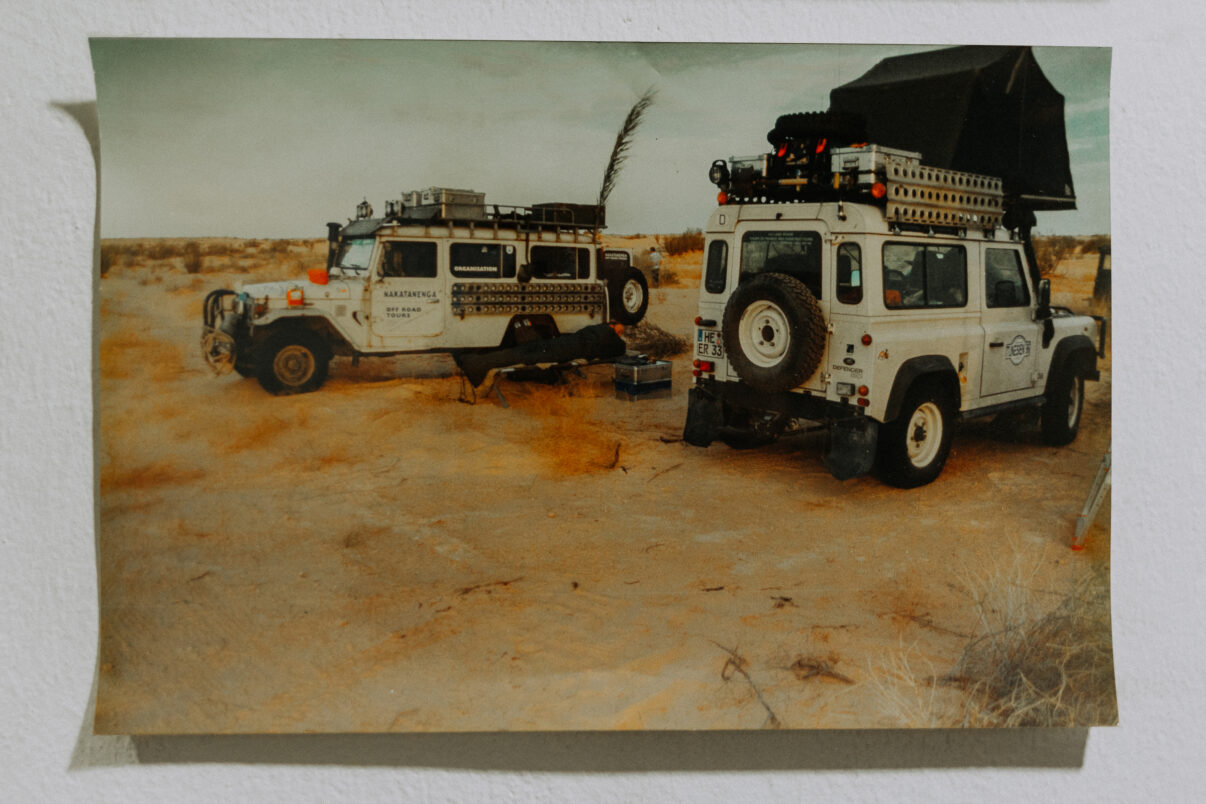
The first tour went to Morocco. Tunisia was quickly added, back then it was a bit like the Switzerland of North Africa. Later came Algeria and Libya too. And at some point the first, let’s call them “customers”, were along on the tours. Friends, mates who came along in their own vehicles. That’s how the idea of offering guided off-road tours developed. Because everyone was pretty thrilled with how I organised and led them.
And did you sleep in the car then?
In the early 90s there were actually already the first roof tents from Autocamp, I had one like that on the Toyota. Yes, so I slept in the roof tent. The comfort, though, was … modest. It was a pretty rudimentary model of the very first generation. At some point it got on my nerves, so I started tinkering with it: sewed a new shell, fitted mosquito nets, all on my mother’s old household sewing machine. Which, by the way, was done for afterwards. My mother didn’t find that funny at the time.
The roof-tent episode was then interrupted by another Toyota, a BJ 45, a lovely old bush taxi, two-door, with a relatively long space in the back. I built a simple conversion into it, for sleeping and carrying things. For a while I was out and about in that, and it was also the first vehicle that, so to speak, “officially” belonged to the company.
I still did the first tours on the side, just like that. But at some point demand was so great that I said: okay, I’ll make a brochure now and register a business. In my actual job I was pretty unhappy at the time, so I took the plunge. At the off-road fair in Munich, the predecessor of the Abenteuer & Allrad, I handed out my first flyers. And it went down well. I could actually make money with it, even if the costing, in hindsight, was … let’s say: bold.
So how did it go on, from the tours to the shop for travel gear?
With the guided tours I always handed out a kit list, with recommendations on what you really need in North Africa: proper tyres, enough fuel, a usable way to sleep, some tools, water, that kind of thing. And then came the questions: “Where do I get a roof rack?” “Which jerrycan can you recommend?” “What tyres do you actually run?”
I was young, needed money, so I started doing deals. With the local tyre dealer, for example: I’ll send you the customers, you invoice through me, so I could earn a little. At the same time I had good contacts with a metalworking shop. I gave them my designs and they welded me roof racks. And they didn’t give up on the third day on the track either. That was the start, all still one-offs, on the side of the actual business.
I’ve heard Nakatanenga started out as a shop in a garage. Is that true?
That’s true. It was actually my then parents-in-law’s double garage, or rather the space in front of it. And yes, not all the neighbours liked it. Now and then there was a bit of grumbling.

Then at some point came a change of vehicle, because with all the kilometres I needed a more reliable car. Actually I wanted to stay with Toyota. But the interest there was rather lukewarm. At Land Rover it was completely different, there I was welcomed with open arms and well supported. That’s how I got my first 130 Land Rover TDI, brand new. That was the mid-90s.
And did you then convert the 130 for your tours?
I actually did the first tour still standard, with the floppy soft top and all the stuff just thrown in the back. The vehicle delivery had been delayed a bit, so off we went without a roof rack, without conversions, on the narrow 7.50 tyres. But it was “only” a Tunisia tour, so it was manageable somehow.
After that came the first conversions. That same year I drove to Billing for the big Land Rover Show. For me it was like an adults’ playground. I walked across the green field with huge eyes and saw everything there is for Land Rover vehicles. First I bought for my own 130, later for customers’ vehicles too. And that’s where I made the first business contacts. That’s how the whole thing with the Land Rover brand really got going at Nakatanenga.
And you don’t travel any more these days? When did the point come where you said: I’m stopping with the tours and focusing entirely on the gear?
That was 2001. By then the tours had developed nicely, the vehicles were being converted ever more professionally. The first prototype of our own grille was already in the works, after a branch in the Czech Republic, out on open ground, had wrecked my radiator and intercooler, I said: there has to be something better.
That’s how our perforated-metal grille came about, today it’s available in six or seven different versions. But as I said, the tours were going great, the vehicles were getting more elaborate, and almost everything was nearly always fully booked.

And then came 9/11. I was out in Algeria with a group at the time. A long-standing customer, a retired teacher, a really calm guy, listened to the news every evening on his world receiver. The next morning he came to me and just said: “Peter, take my radio, go behind the dune, listen to this.”
I did that, and it was clear: something had gone really wrong. At first I thought I’d landed in the synopsis of the new Bruce Willis film. But it was real. And we were in the middle of the desert. In the middle of nowhere, two days in any direction simply nothing. We then worked out alternative ways out, in case the situation in the country turned critical, but in the end, luckily, it wasn’t necessary.
Even so, the impact was enormous. Tours to Muslim-shaped countries were suddenly hard to sell. In the year after that the tours were only sparsely booked, which, mind you, didn’t bother me much. For one thing we’d just had a child. For another, the whole subject of vehicle conversions and builds had by then grown so big that it took up all my time: developing parts, producing, packing, selling, and the online shop was already running by then too.
I then handed over everything to do with the tours pretty quickly and focused fully on what makes Nakatanenga what it is today.
And did you have staff by then?
Yes, there were already the first part-timers, mini-jobbers as they’re called today. One of them is still with us, which I find pretty great. But basically it was still a classic one-man show back then.
Although no longer in the garage, that was history. The company was by then housed in a small place near Neumarkt, in a former cowshed. A real Bavarian classic. But that too soon got too small.
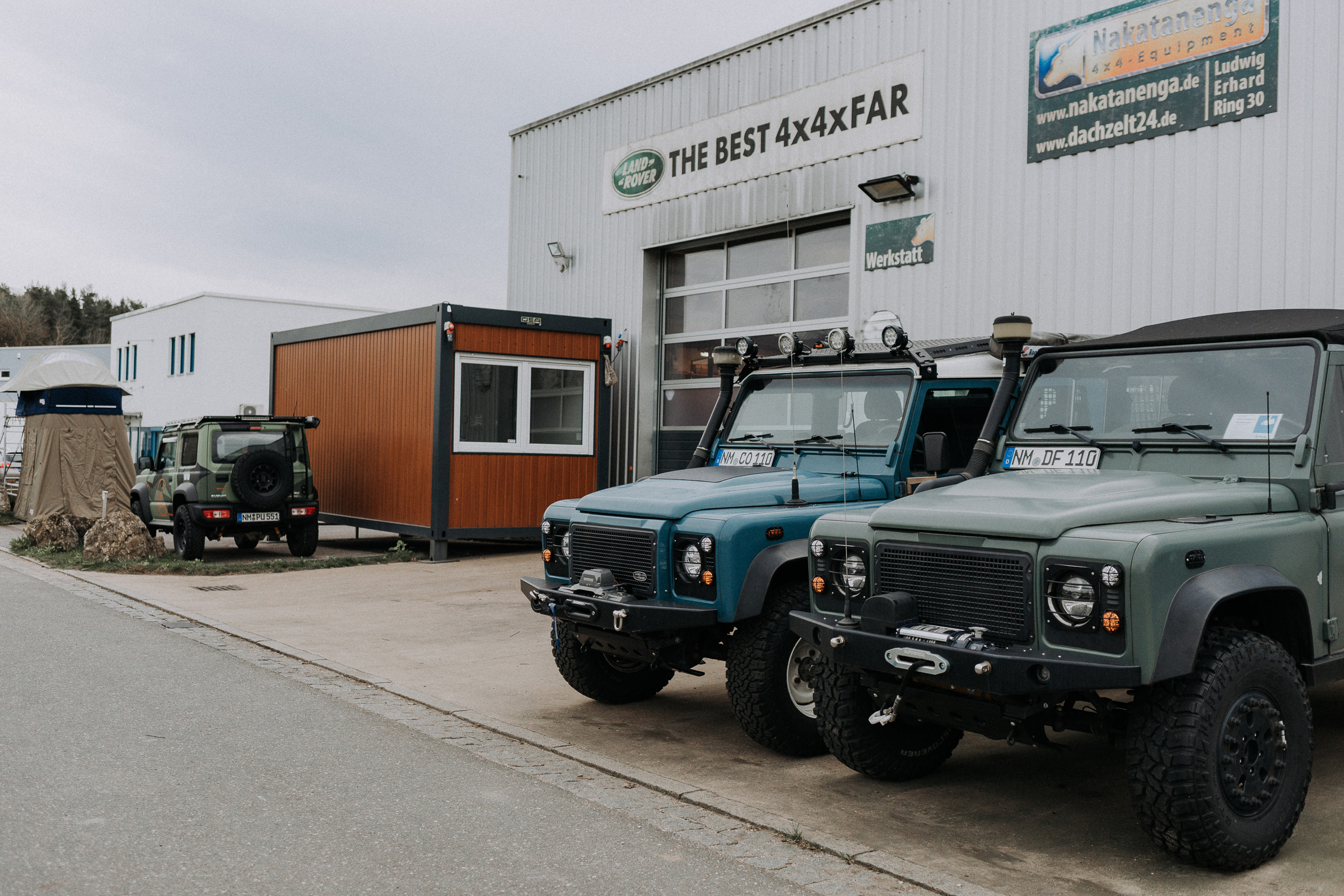
Then we rented our first hall here, as a subtenant of a company that wasn’t doing so well financially. And then it went quickly: first we took over the whole hall, then the office building too, added a hall, another hall, extended the office, added another two halls … and that’s how the thing grew.
And what of course everyone wants to know: where does the name Nakatanenga come from?
That came about, quite honestly, under the influence of a beer or two as well. I was sitting in the pub with a good friend, a linguist who studied old languages. And we were spinning ideas.
Nakatanenga, or some similar form of it, apparently comes from Old Sumerian. The Sumerians, that is, the ancient land between two rivers, today’s Iran and Iraq, invented, among other things, the wheel. First the two-wheeled, then the four-wheeled ox cart. And there was apparently a word that sounded a bit like “Nakatanenga”, which stood for this four-wheeled cart with draught animals. Nobody knows exactly whether it meant “horse with four wheels” or “ox with four wheels”. The language isn’t spoken any more, after all, and the record is rather thin.
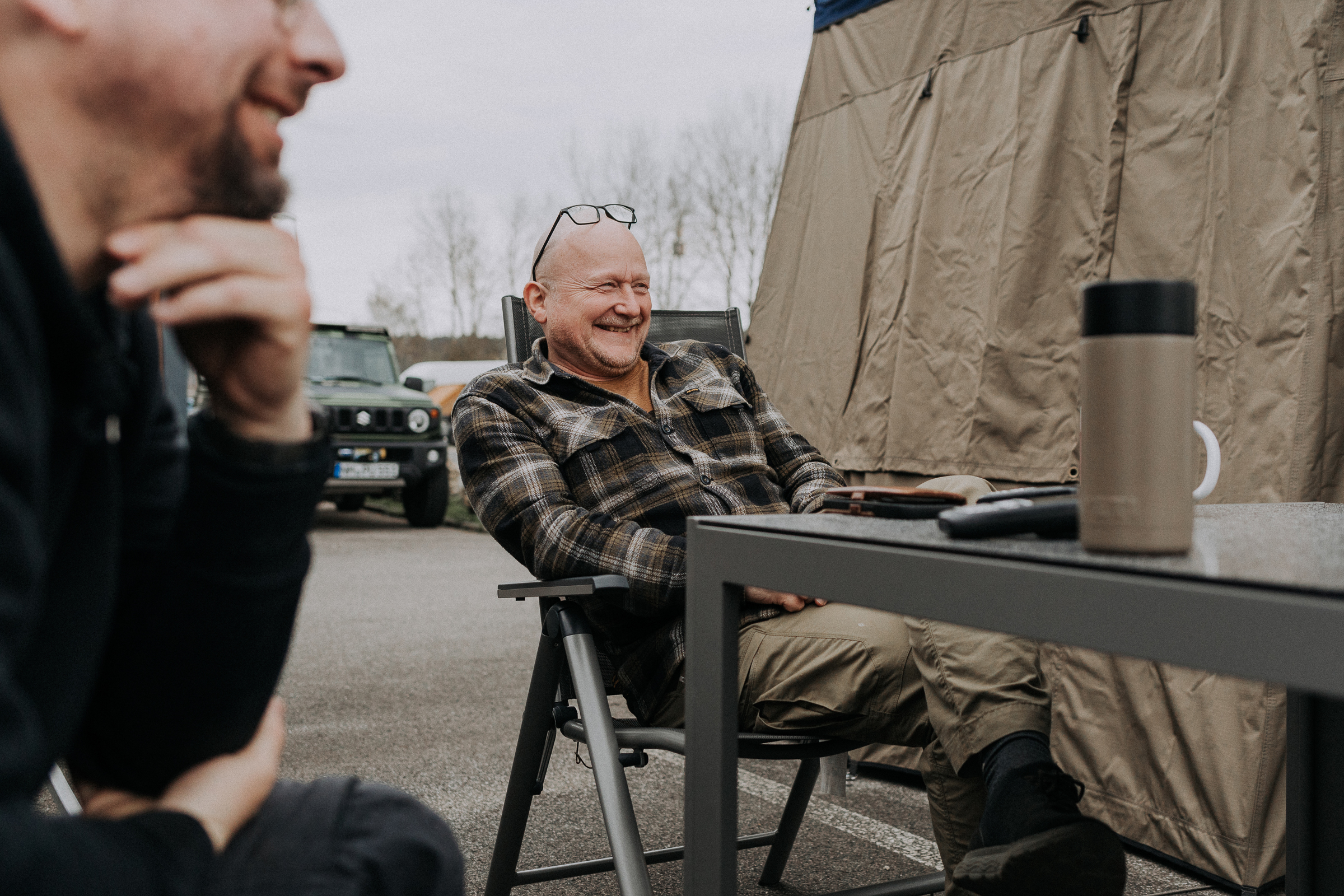
But I wanted a name that sticks. One that makes you ask: what’s that supposed to mean, anyway? Something that makes you curious. Back then print advertising was still the medium of choice, and I wanted people not to simply scroll, er, leaf past a name like that.
And when did the bear come along as the logo?
The bear? That’s another one of those typical stories. It came along relatively early. You see, I’m a big fan of stuffed bears, especially teddy bears from the 60s. One of them, a garish green fairground bear, was my constant companion. He was along on every tour, long before Nakatanenga even existed. Simply as a mascot.
And when we then needed a logo for the company, it was meant to be something that radiates strength, endurance, off-road capability and the ability to survive. Something that fits what we do. And the bear was the obvious choice, also because I simply like bears. I think that was around the year 2000.
You’ve brought quite a lot of innovations to market. I’d almost call you the Gyro Gearloose of the off-road scene. What are your favourite developments, and what was more of a misfire?
For me it was always important that you can make things at a sensible value for money. But sure, there were also projects that got out of hand, for example a few roof-tent designs that in the end were simply too elaborate and therefore too expensive.
On the other hand there are absolute highlights. Our Heritage grille, for example. That’s my personal favourite item. The basic idea didn’t take much brainpower, but a lot of development work on the tooling. We didn’t just want to stamp it, but emboss it, so that out of an aluminium sheet only a millimetre thin, something is created that’s extremely stiff, has a great feel and looks really good too.

The result is something to be proud of. The Heritage grille is in use today on “Land Rover” fans’, restorers’ and tuners’ vehicles all over the world. And that does make me proud: to know that the thing is out there in the world, hanging on so many vehicles. And still coming from us.
But there are also products like the heater box or the battery box, where I remember you were pretty early with Nakatanenga.
Yes, but quite honestly: not right at the front. Sometimes you see an idea and think: it’s actually good, but the execution isn’t convincing yet. And then you think about how to do it better.
I didn’t invent the heater box, for example. But our version was the benchmark for many years, in terms of performance, battery capacity, volume and overall size. By now there are a few that come close. But we’re still pretty well placed there.
The CargoBear roof rack is by now one of the centrepieces of the Nakatanenga range. Would you tell us a bit about it?
Roof rack systems are always a topic, you can carry a relatively large amount of material with them relatively quickly, but you have to know what you’re doing. Our first contacts with aluminium roof racks came via the company Brakha from South Africa, which no longer exists today. We’d got to know them at a fair once. My 130 had just been converted to a station wagon at the time, in-house, one of the few conversions of that era, and Brakha put a rack on it for me.
The racks from South Africa were good, but just not quite designed for our conditions. Winter, salt, they didn’t cope so well with that. Who’d have thought. Even so, we imported container-loads straight away, the things sold well.
The material aluminium fascinated me. If you know what you’re doing, you can build very light, very sturdy solutions with a bit of brainpower and good manufacturing technique. So we started developing our own racks. The first ones still came from production in the former cowshed, were completely welded, still without the name “CargoBear”. They were produced partly in Germany, partly in the Czech Republic, where the craftsmanship was really top, even if the transport problems were big. Sometimes a whole truck full of dented racks would arrive. But well, you solve that somehow. That, though, was a bolted version which was quite good, but apparently didn’t go down so well visually. Then we dropped it again for the time being.
By that time we already had contact with Front Runner and within a short time became one of the biggest Front Runner dealers in Europe. But at some point the trade with Front Runner got more difficult, they switched to direct sales, and that no longer suited us. So we said we want something of our own. Something flatter. Something more rugged. Something more modern. And that’s where the idea of the CargoBear was born.
The basic idea was a flat platform. We had help from outside there, someone had a few exciting ideas that we took up and developed further in-house. The result was the CargoBear. I was convinced from the start. The fact that the rack is flat especially was important to many. A lot of customers didn’t buy a roof rack because the car then no longer fitted into the garage or under the carport. And taking it off? With the Defender in particular, anyone who’s ever taken one of those things off and put it back on again knows you don’t just do that for a weekend trip.
Sure, at the start there were minimal production problems, because the system is built very tightly and precisely. But once that was running, the CargoBear took off like a rocket. We certainly nicked a few market shares there, which didn’t please everyone.
The big advantage of the CargoBear is its versatility: you have countless mounting options for airline fittings or screw systems. At the same time the platform can be walked on right across, so you don’t have to balance from cross member to cross member. At first we had chequer plate, later then stamped anti-slip studs, lanced openings, lighter, grippier, better.
The CargoBear is extremely modular. You can run it with one or two cross bars, with many bars for heavy luggage, or as a complete platform, with or without panels, with end profiles front and rear. And everywhere you have screw points, you can configure it exactly as you need it.
What I find especially interesting about Nakatanenga, and what also clearly sets you apart from others, is how much you do in-house. In the past, for example, a large part of the final assembly of the roof tents was with you, then came the metalwork, the sewing room … Tell us how it all comes together.
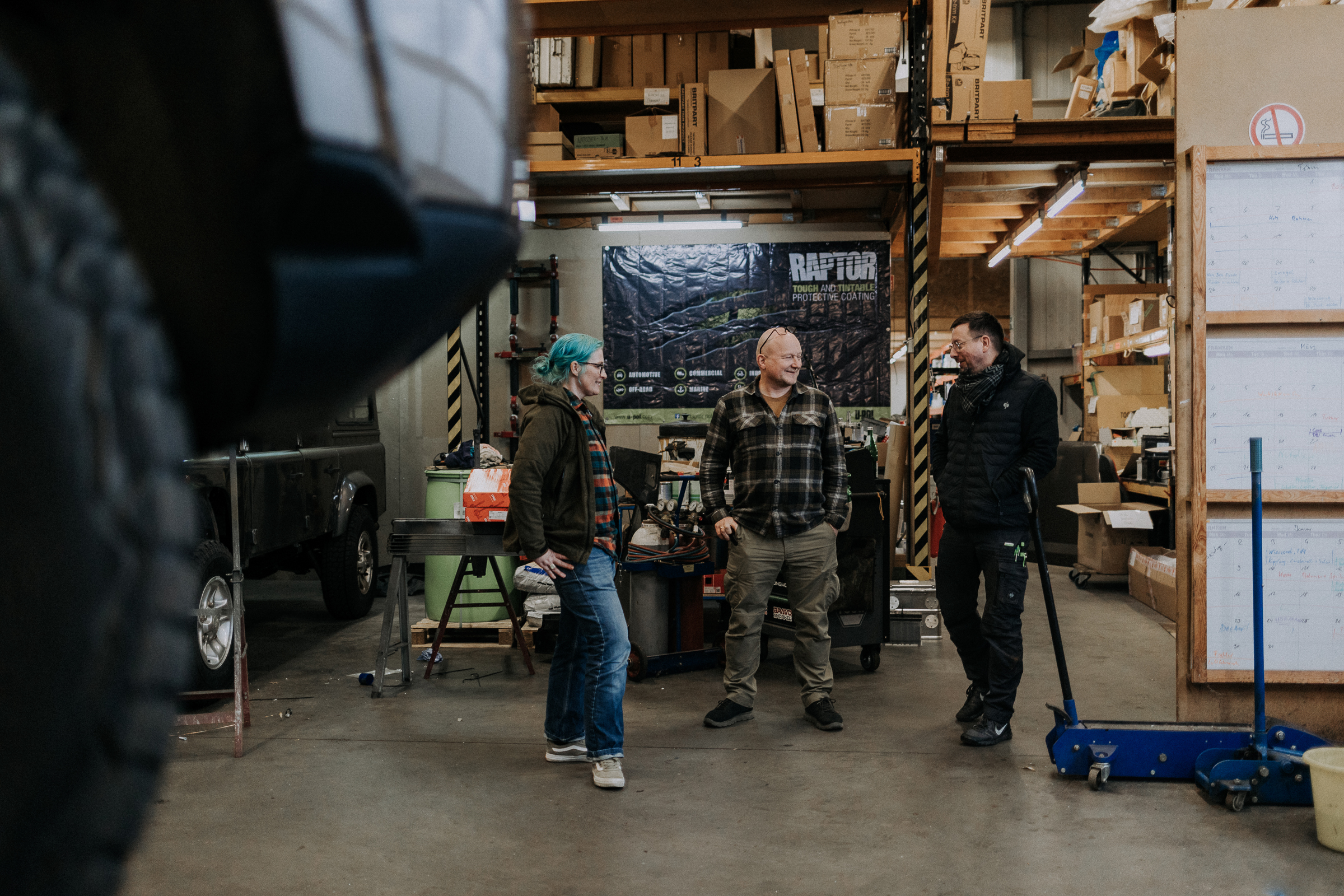
The roof tents are still made in-house, and yes, we have pretty much all the trades in-house. From the design team to prototype manufacturing in every direction. We work with metal, we have really skilled metalworkers there who build things out of sheet that other people could at best manage out of modelling clay. Then there’s a joinery, and also a tailoring shop, which has by now been spun off but still sits in our building.
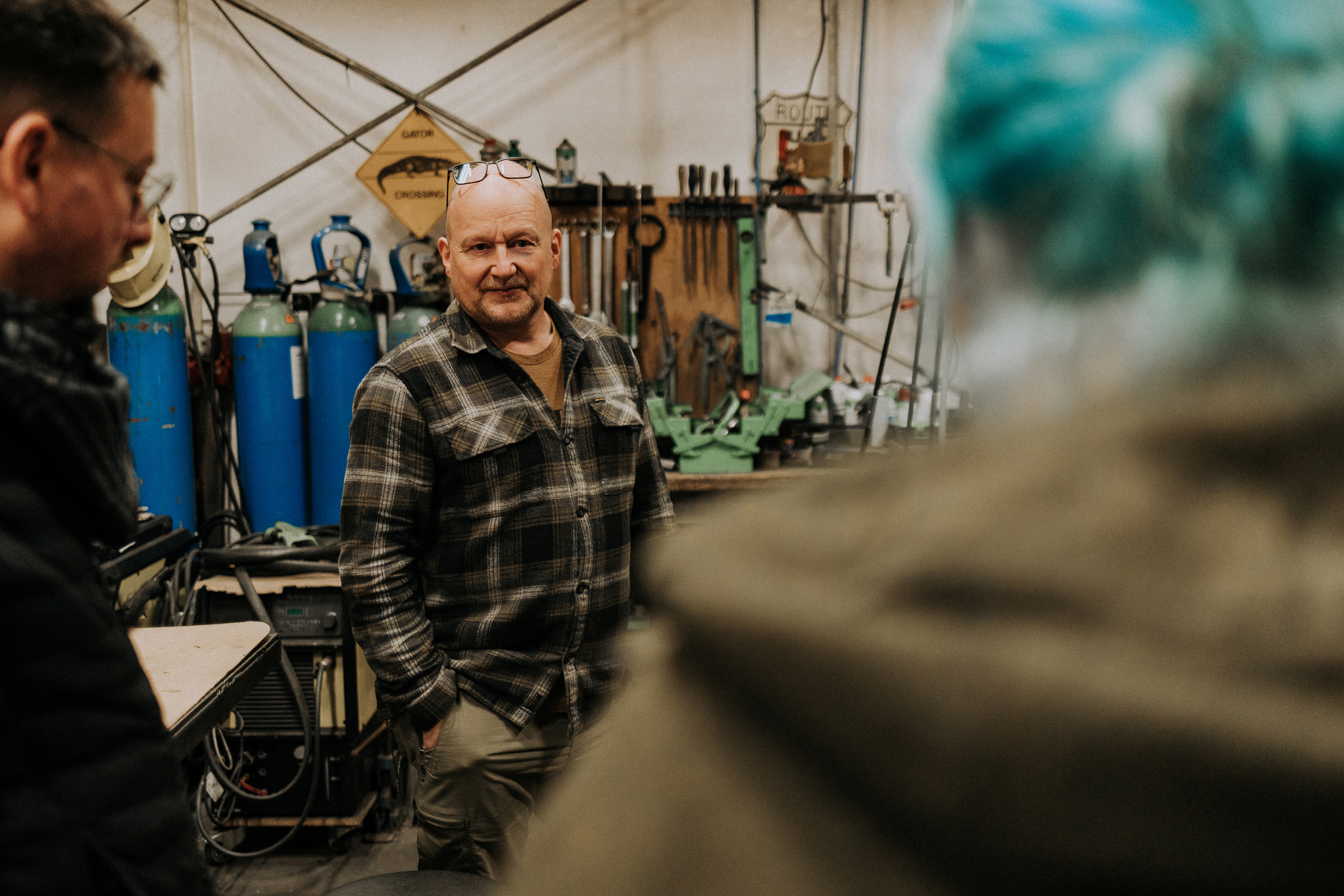
We have people here from very different trades with the most varied skills. We can laser, turn, mill, not for large-scale production, but for samples, prototypes, small runs or special builds that’s perfectly enough. We also 3D-print or cut parts now and then, depending on the project. If customers want an existing item adapted, we do that directly here on site.
The big runs we then have made under contract, but even that mostly happens in the orbit of Berg near Neumarkt. Let’s say: within 50 to 100 kilometres is where the bulk of our manufacturing happens.
Sure, a few components also come from elsewhere in Europe, very occasionally from outside Europe too. Most things are then finished off here in our warehouse.
And all the textile things, those are made in-house, aren’t they? The tool rolls, for example?
Yes, the tool rolls are actually sewn in-house. But when it comes to larger quantities, several hundred pieces, then we don’t do that here any more. That simply wouldn’t be economical.
For cases like that we work with contract sewing shops and textile firms that simply do it better and faster than us. But what’s important to me there: as you can see from our labels, it’s all Made in Europe. We don’t have things sewn somewhere in Asia under questionable conditions. That matters to me personally a great deal, that we keep the value creation in Europe as far as is possible.
The off-road scene is developing strongly towards van life right now, Sprinters, VW buses, panel vans. At Nakatanenga I haven’t seen so much of that so far. Will there be more in future?
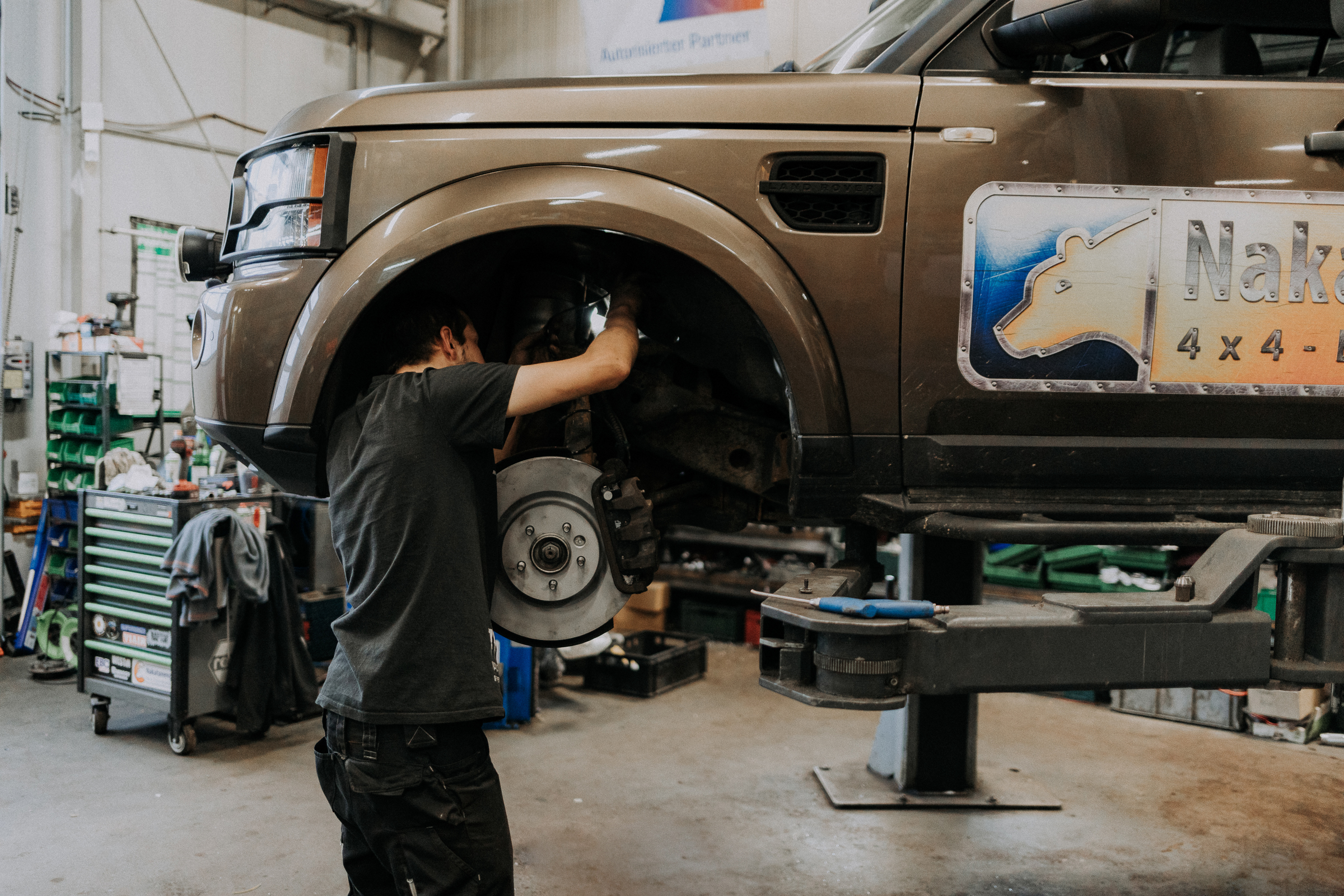
At the moment we still have very, very much to do in the classic off-road segment. We also have our own workshop where we do conversions. There we have waiting times of two to three months for a workshop appointment. Unfortunately, finding skilled staff isn’t easy these days: many car mechanics can only plug in the diagnostic connector and swap parts. Really working on old vehicles, only a few can still do that.
Actually, a few years ago we did build our own Peugeot Boxer, with all-wheel drive of course and a really lovely wooden interior. Alex from the team designed and built it. But the project then fell asleep again, simply because we were, and are, more than fully occupied in the off-road area.
Of course: if the market keeps developing in that direction, we’re open to it. Sticking with things has always been our way. So something could well come of it, but it doesn’t have to. We’re watching it.
And yes, of course there are already many other providers throwing themselves fully into the van life topic. But if the spark of an idea comes to us, or someone approaches us specifically and says: “Haven’t you got, can’t you do?”, then something could well come of it. We have the skills.
We already manufacture today for this or that well-known firm or for brands you’d recognise, in some cases even branded products. We’re well networked, know the requirements in the off-road world very precisely, and those differ markedly from the normal car or outdoor sector. We know what quality the market demands, and we have the contacts and capacity to work as a partner for others too.
Photos: Doreen Kühr