
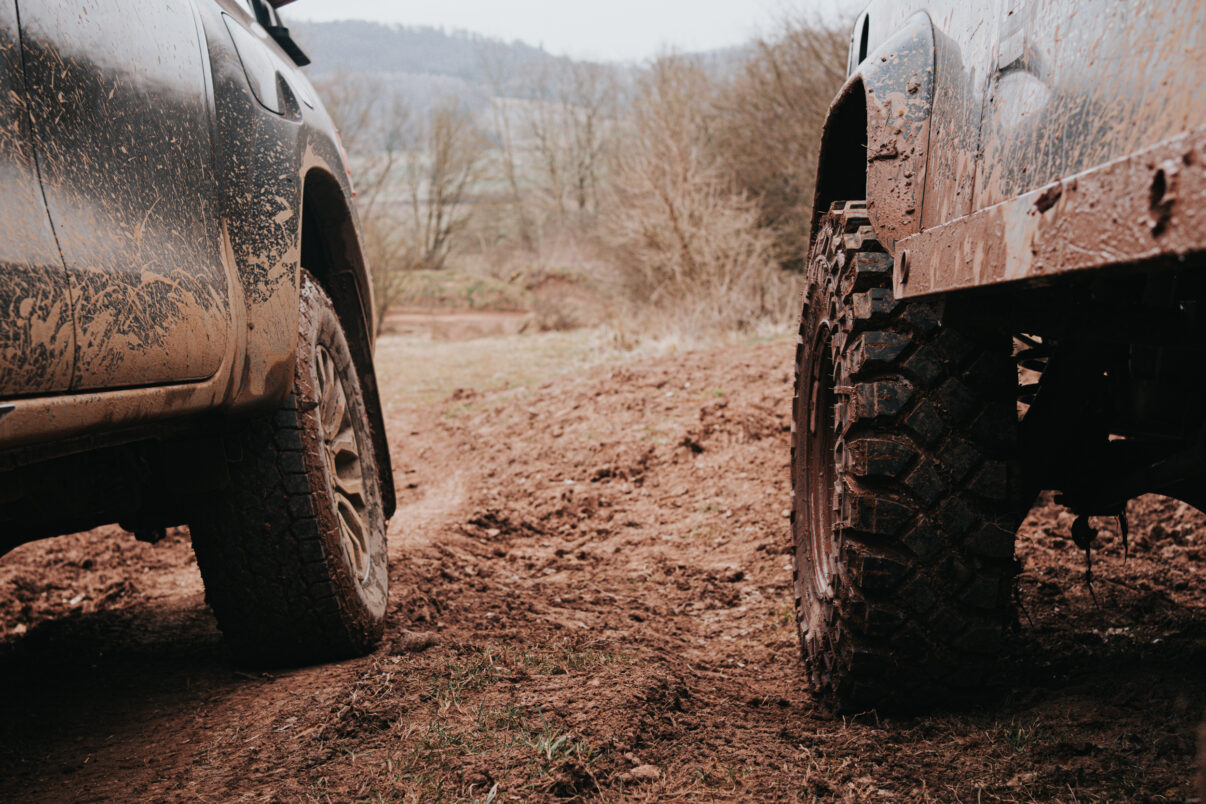

The tyre is the only connection between the car and the road. It has some essential jobs: grip, safety and comfort. On top come durability and, often enough, it is supposed to look good too. Off-road it also has to do all this under harder conditions. Quite a lot to ask of one tyre, and after reading this you will surely look at them differently.
Tyres have to keep us safely on the road or the trail for tens of thousands of kilometres. They are meant to grip reliably in rain and snow and get us up and down the hill without sliding. They should look good too. A tyre has a great many demands placed on it. But who actually knows exactly how they even work?
The Kamm circle
Different forces act on a tyre from different directions. The ones that matter for us here are the circumferential force under acceleration or braking and the lateral forces under steering. All of these forces have to be transferred to the road through the tyre contact patch, ideally at all times. In motorsport they say that before you even think about power gains or suspension, you have to understand how the tyre works and run the right tyres. Tyres get extreme attention there. From the type to temperature and air pressure to the rubber compound, every parameter is set and checked meticulously. Since there is no universal tyre that does everything perfectly, that last point in particular means a lot of effort and cost, because in racing a special tyre is chosen for every track and every kind of weather.
For the everyday driver it can of course be less of an effort, clearly. The same goes for the average off-road driver. But choosing the right tyre is still essential and should match how you use the vehicle. Once you have chosen a tyre, you should also know where its weaknesses are, so you can allow for them when driving. A well-known example is MT tyres, which work well in dirt and mud but often do very badly on wet cobbles, in rain and in snow. These are the things you should be aware of.
To understand the envelope within which every tyre works, the Kamm circle helps. As long as the tyre is not sliding or locked, its rules apply.
What grip is based on
Grip, the adhesion of a tyre, is determined by the wheel load and the coefficient of friction µ. The wheel load is the weight bearing down on the tyre. That includes the vehicle weight, but also the dynamic loads that constantly change with the driving situation. The second factor is the coefficient of friction. It is determined by the tyre material and the surface it runs on.
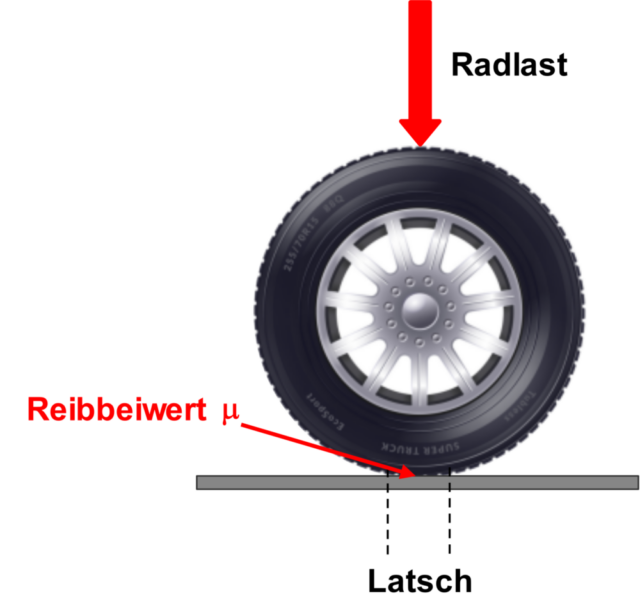
The tyre has grip and holds to the road as long as the circumferential and lateral forces do not exceed the wheel load multiplied by the coefficient of friction. That is exactly what you can read off the Kamm circle. As long as the tyre stays inside the circle, it provides grip. If it sits a long way to the side on the y-axis, for example (hard steering input), it can only transfer a little circumferential force through acceleration before it is out of the circle, that is, it loses grip. When it has to transfer high circumferential forces, things do not go so well with the lateral forces.
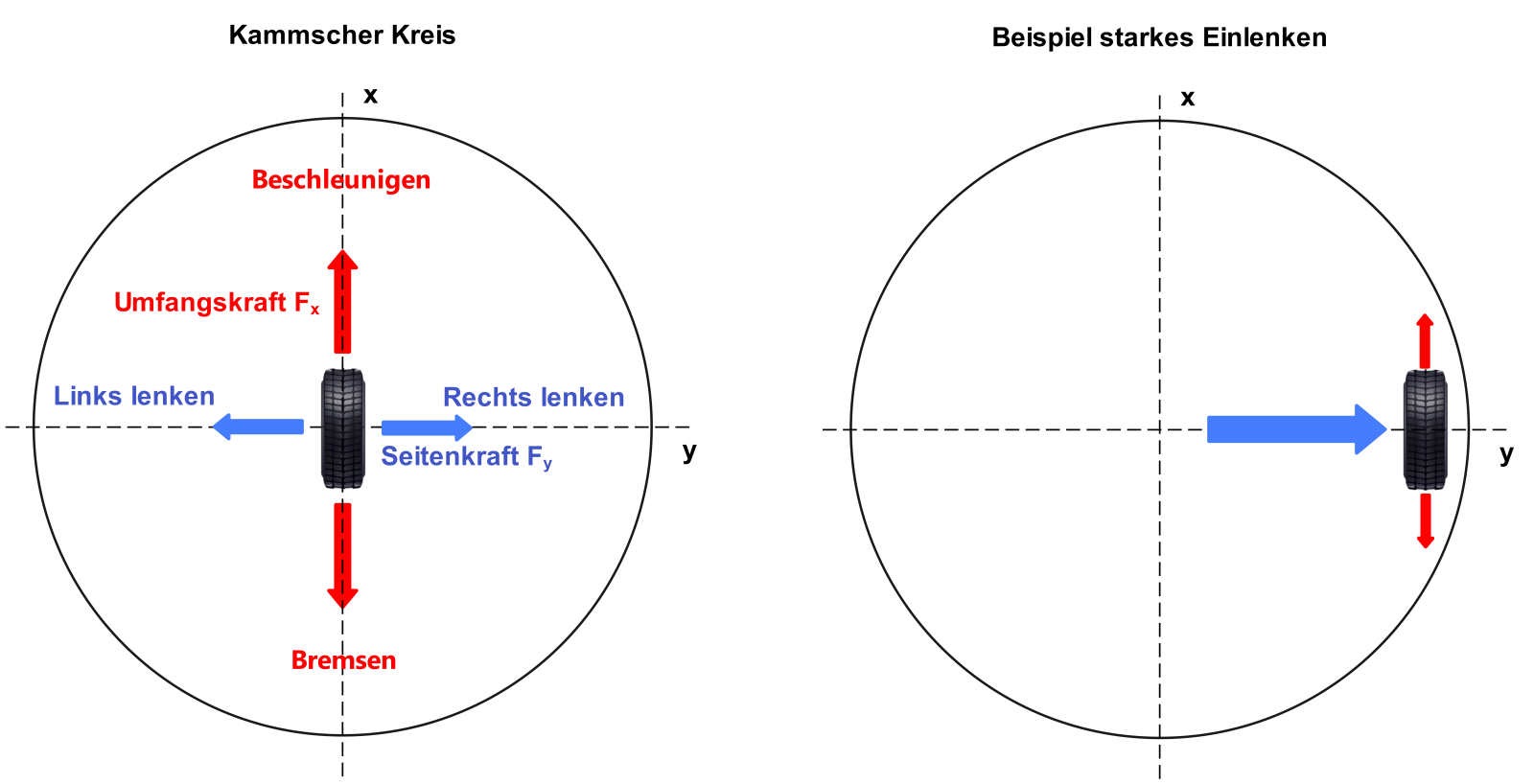
To transfer force, the tyre uses three mechanisms. The dominant one is adhesion, which only comes fully into play on dry tarmac. It then makes up a good two thirds of the grip. The second strong mechanism is deformation (interlocking), responsible for one third of the grip. On a wet road, on loose ground like sand, scree, mud and so on, this mechanism does almost all the work. The third mechanism, which we can ignore here, is wear resistance.
Tyres grip through adhesion
With adhesion, the tyre and the surface form a sticky bond. This happens at the molecular level and is constantly renewed and released. The Van der Waals forces are at work here.
Good adhesion needs a rough, dry, dust-free road surface. The adhesion forces are proportional to the contact area. The contact area is formed by the contact patch and the surface structure of the road. Further factors are temperature, the material and the pressure, meaning the current wheel load. The more pressure bears down on the tyre and the softer its tread, the more contact area it can build, because the rubber presses into the smallest, finest structures of the tarmac.
Another decisive factor for adhesion is sliding. At first that sounds like a contradiction, but that is how it works.
Good grip only comes through slip
Slip is essential for adhesion. Slip can be described, in simple terms, as slipping through. In technical terms: slip is the difference in speed between two friction partners.
On a tyre, the slip arises between the contact patch and the road. Slip means that one side tends towards a difference in speed. Under acceleration the tyre turns faster than the vehicle travels. Under braking it is the other way round. In both cases shear forces arise in the material, which contribute to the tyre warming up.
First comes pseudo-slip, especially with treaded tyres. As the car accelerates, picture a tread lug touching down on the road, bending first and so already creating a slip that arises within the material itself. After that the tread lug slides over the surface, the real slip arises. It is like setting a brush down lightly and pushing it a little. At first all the bristles bend over, the brush does move, but the bristles are still standing in the same spot. Only when you push the brush further do the bristles rub across the surface.
The newer the tread and the softer the rubber compound, the more pseudo-slip the tyre has.
As a result the tyre turns faster than it rolls over the road. The elastic rubber creates shear forces in the material. The material closer to the rim has already turned further than the material on the road. This deforms the contact patch and creates a contact area ahead of the tyre under acceleration and behind the tyre when rolling and braking. This extra contact area is part of the rolling resistance.
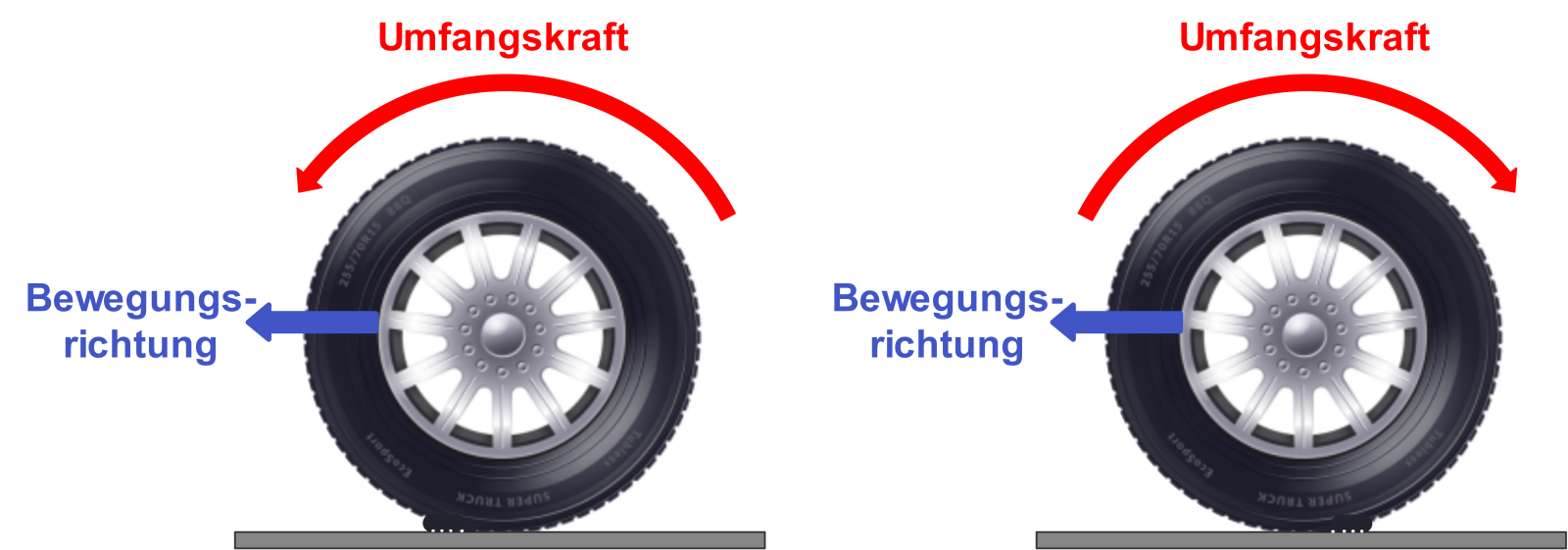
Tyre slip diagram
If the slip is too great, the grip drops off again. This behaviour is described by the slip curve, which is determined for every type of tyre. It differs considerably depending on the road and the tyre’s condition (temperature, dry, wet, snow, ice, and so on).
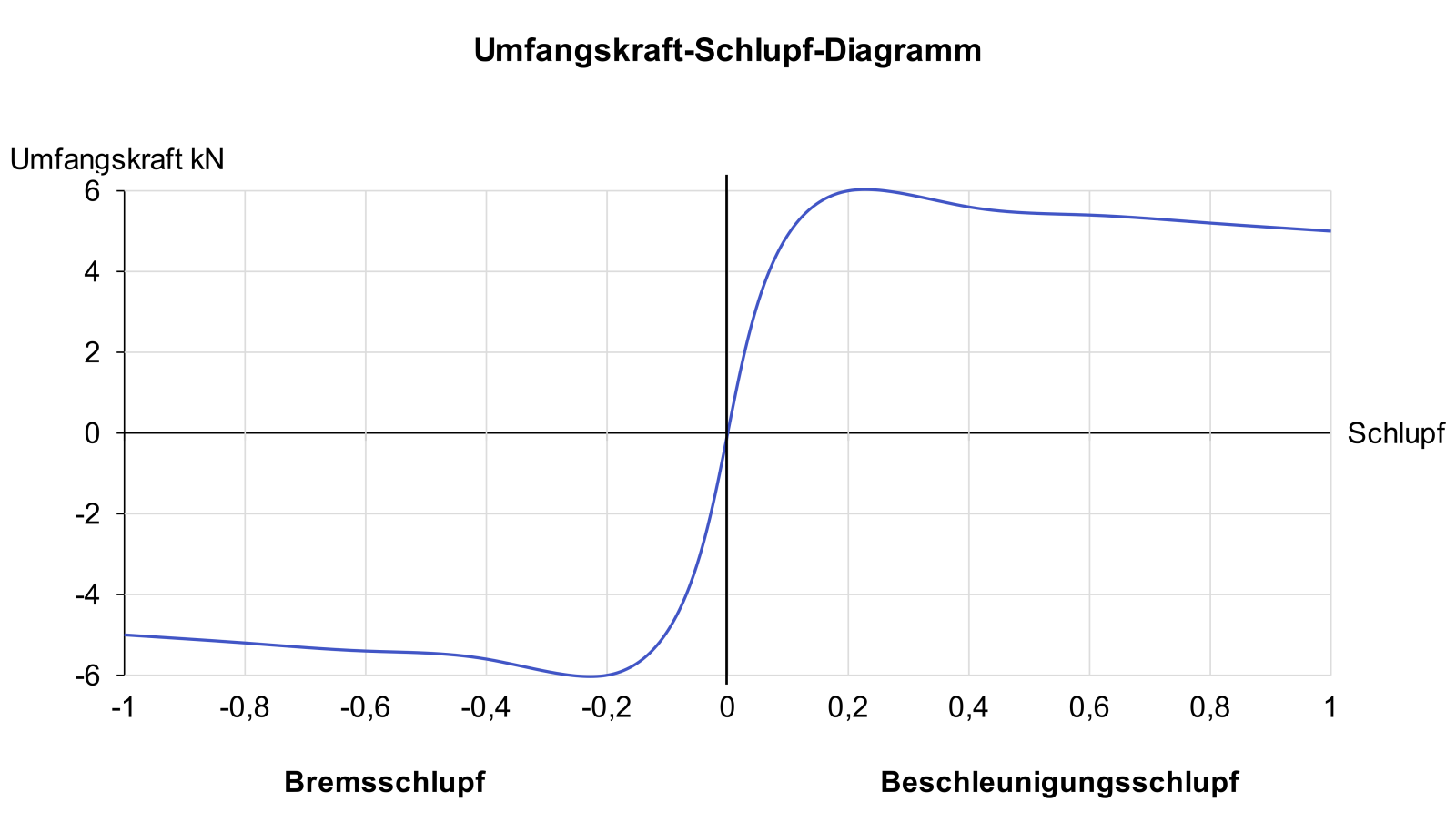
The diagram shows a tyre running in a straight line. You can see that it can only transfer higher forces once there is slip, and that as the slip grows, this ability falls away again.
The normal range of slip is between 5% and 15%. ABS systems try to keep the wheels in a range of 8% to 10%. At the other end of the scale is 100% slip. This state arises when the wheel locks or when it spins and turns at least twice as fast as the vehicle is travelling.
The same applies to the lateral forces under steering. They can only be transferred when the tyre has a little slip, that is, slides across the tarmac. The deviation between the direction the steered tyre is supposed to roll in and the direction it actually rolls in, sliding included, is called the slip angle. In the diagram below you can see that here too slip provides more transferable lateral force. As with a pre-tensioned spring, restoring forces arise here as well, which want to straighten the steering wheel again.
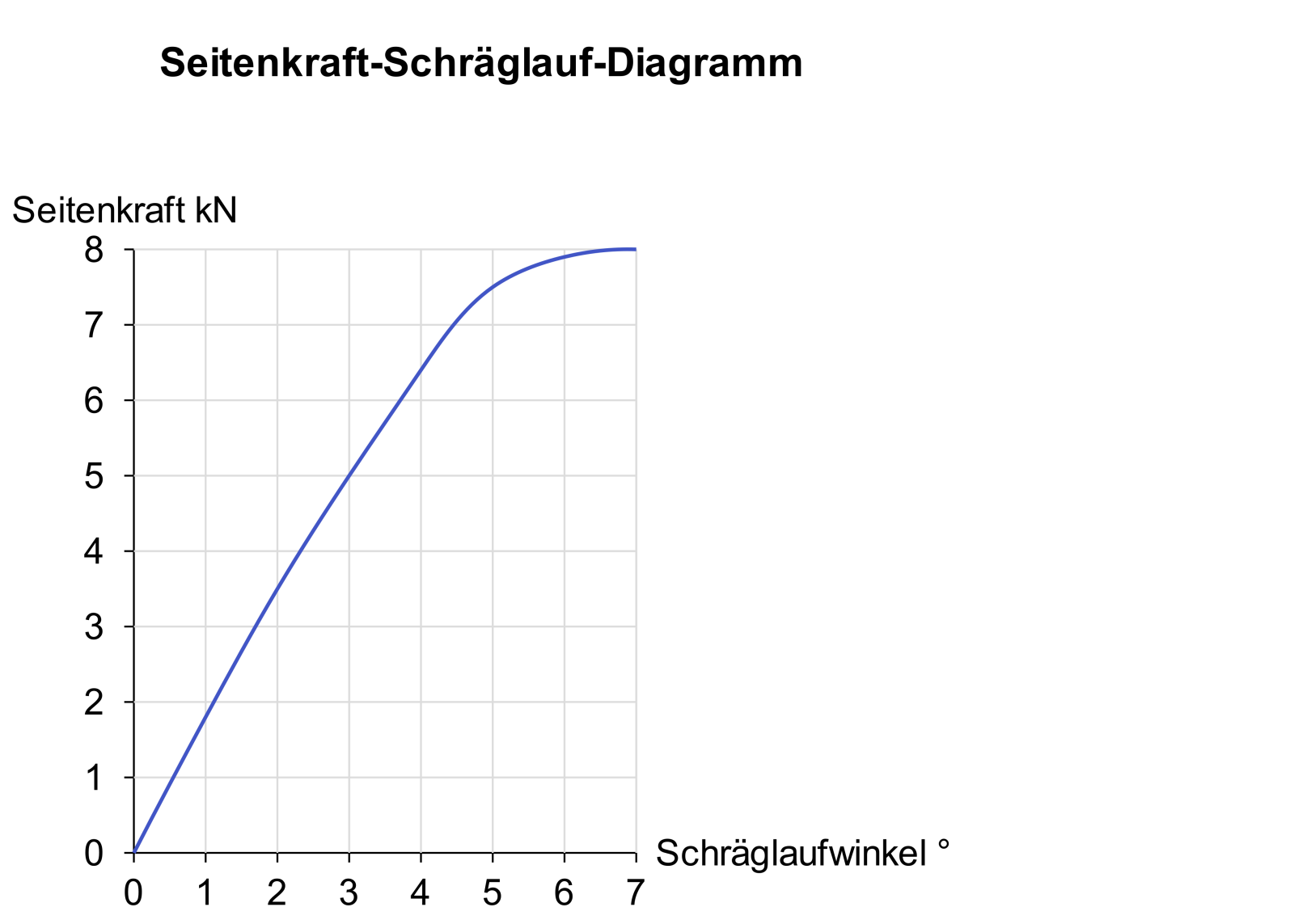
The ability to transfer lateral force falls off when the slip grows beyond its optimal range. That is why front-wheel-drive vehicles tend to understeer. The car does not follow the steered tyres exactly and slides a little towards the outside of the bend, because the driven front wheels also have to transfer circumferential forces. Rear-wheel-drive vehicles tend to oversteer, because the steered wheels do not have to transfer circumferential forces, so the slip does not rise and they therefore do not lose lateral grip.
Off-road, on loose gravel, dust and in mud, adhesion no longer plays any role at all. Here it is mainly deformation and interlocking that come into play.
Deformation
The second important factor for good grip is deformation, also called interlocking. Deformation is what most people probably mean by grip on a tyre. With deformation, the tyre’s rubber wraps around the bumps in the surface. The tread helps with this, because it lets the tread blocks deform more easily. So they can interlock with the surface better than if the rubber were just one flat surface, as on slicks (treadless racing tyres). On tarmac the small peaks of the road surface, the microroughness, bore a good 0.5 to 1.5 millimetres into the rubber. After all, several hundred newtons per square centimetre bear down on the contact area.
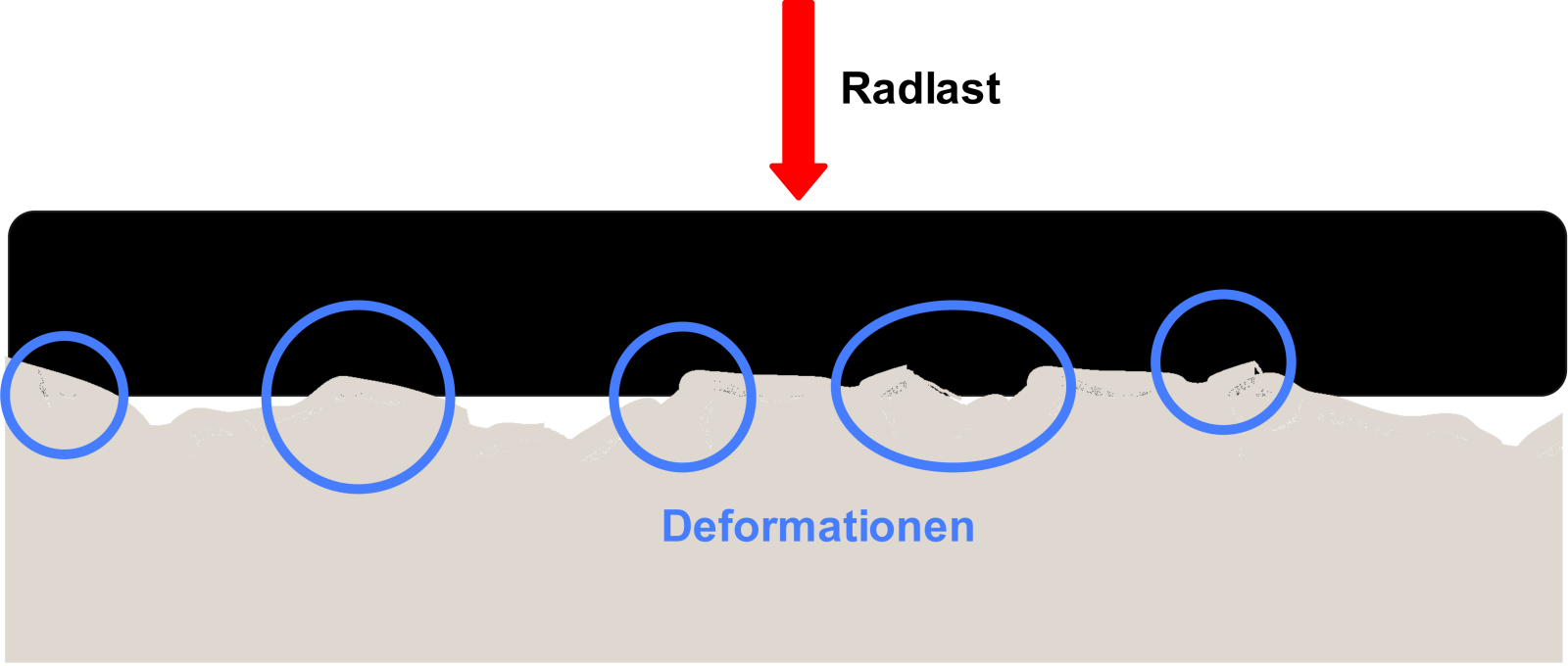
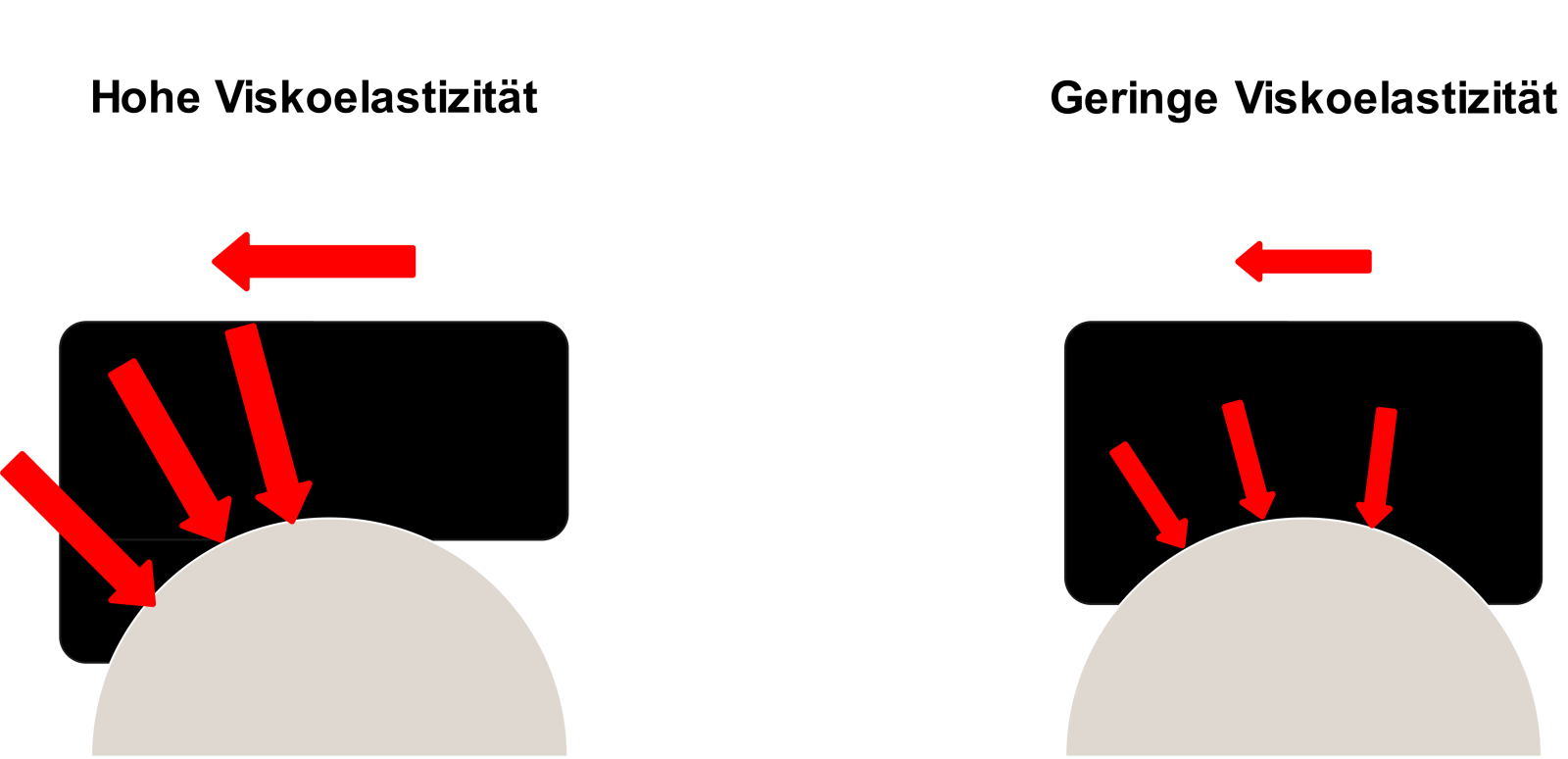
As it rolls off these tarmac peaks, the tyre then presses against the trailing face of the bumps, and grip arises. The higher the wheel load, the deeper the bumps push into the tyre. Here the hysteresis effect comes into play, offered by the viscoelastic material of the rubber. The rubber adapts to the road structure, but only returns to its original shape with a delay. The effect is that a tyre with higher viscoelasticity returns to its shape much later. As a result it has more contact with the side of the microroughness it is rolling off, and all the pressure has to rest on this side, which increases the grip in the direction of rotation.
Anyone who likes watching motor racing may have noticed that drivers take a different line on a wet track than on a dry surface, and that they switch from treadless slicks to treaded tyres. This is easy to explain. When the road surface is wet, deformation has to do the job on its own. Adhesion lives on as much rubbing surface as possible (slip). These conditions no longer exist in the wet, and slicks cannot displace enough water, they aquaplane.
While the tarmac of the racing line, polished smooth by heavy use, gives slicks an excellent bonding partner, it lacks the roughness that deformation needs to work well enough. So the driver, on his treaded tyres, moves over to less-used, rougher parts of the track.
Grip on a wet road
As described under adhesion, it only works on a dry tarmac surface. In the wet, then, only deformation and interlocking are left. Unless the water disappears some other way, the tyre works its way through the water in three stages.
First the hydrodynamic processes take effect. As the tyre rolls, the water is pushed to the side and forwards. When this mechanism no longer works, aquaplaning sets in. In other words, the tyre floats up, glides on the layer of water and can no longer break through it to find grip.
The second stage is channelling the water away through the tread grooves. These form proper channels that carry the water off to the side, and water remaining in the grooves is flung out as the tyre rolls. To picture the scale: at a good 80 km/h and with 3 millimetres of water on the road, a normal tyre takes up around 10 litres per second in its tread alone.
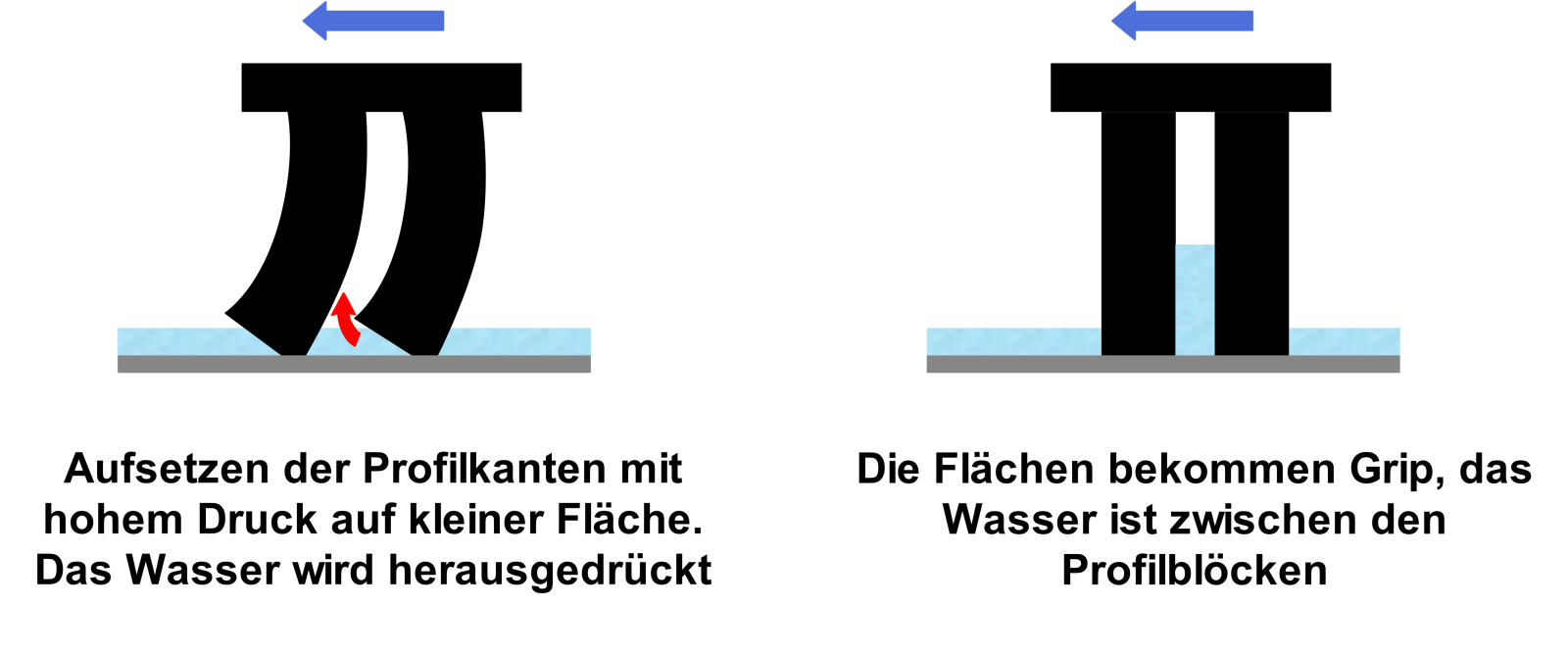
Finally the rest of the water is broken through and the tyre regains contact with the road. For that you need as many tread edges as possible, which stand at an angle like a wedge as the tyre rolls. They cut through the water until they touch down with their full surface. Now it is important that even the last of the water can get away. The tread grooves help here again, and on a winter tyre the sipes. The remaining water can sit there until it is flung off.
Grip on snow and ice
Winter tyres have lots of tread grooves and sipes. The reason is that this way as many tread blocks as possible first cut into the snow with their edges, then touch down across their full surface and so make contact with the ground. Unlike summer tyres, which tend to have harder rubber compounds, winter tyres have a softer compound that lets the tread blocks bend and angle more easily. The principle is the same as in the wet. The angled tread edges act like a wedge and can cut through the snow more easily. At these many edges, pressure peaks arise that help the interlocking with the road surface.
In snow another effect comes in. The snow lying in the tread grooves and sipes adds sliding friction based on cohesion forces. These are the forces that hold a material together, in this case the snow.
Tyres off-road
When we are out off-road in the 4×4, we are dealing with far more slip, which does not add to grip but to slipping through. This way the tyre “shovels” its way through loose ground with its coarse tread blocks, until it meets firm ground and can build grip again there through deformation and interlocking.
Now it also becomes clear why you often get stuck in mud. If the shovelling never stops, because the tyre does not meet enough firm ground, while at the same time the resistance to movement grows as it sinks further into the mud, you make no more progress. The tyre cannot brace anywhere and put its circumferential force to use for propulsion. Then the vehicle can sink deeper and deeper, because the shovelling effect carries more and more material out from under the tyre.
The coarse tread of off-road tyres
When we talk about off-road tyres, we usually mean AT or MT tyres. The AT tyre is usually described as 50% road-capable and 50% off-road-capable. It is meant to offer the best compromise between road and off-road use. It does neither as well as tyres optimised for the particular purpose. Even so, it is the best choice if you drive a lot of road but also off-road.
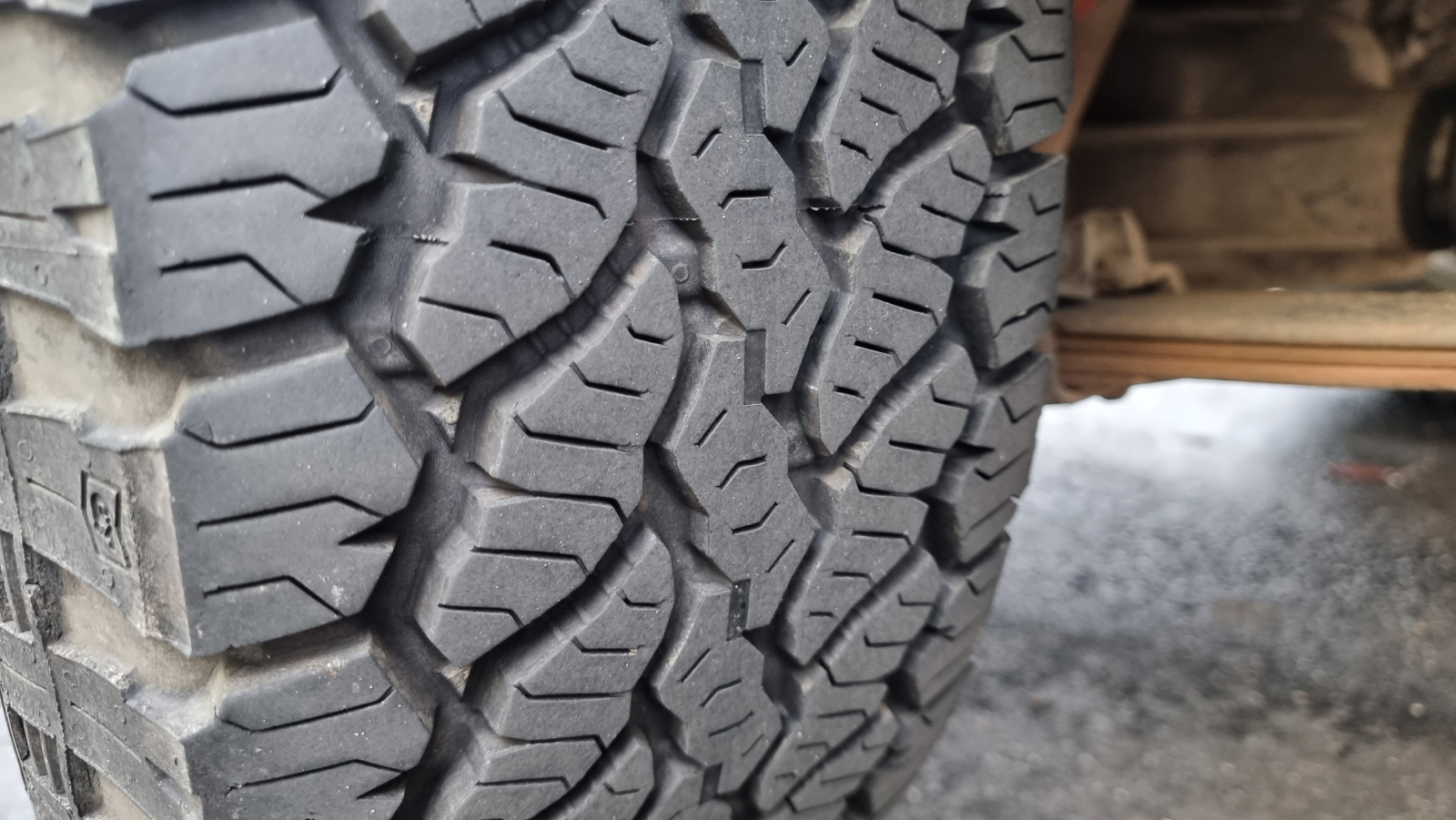
Its tread has more positive area (tread blocks) than an MT tyre. It has more surface for adhesion and more tread edges for interlocking and wet grip. The individual tread blocks are also broken up by further grooves. Some AT tyres even have winter sipes, like the Pirelli Scorpion AT Plus for example. That has also earned it the legally required winter tyre symbol 3PMSF (three-peak mountain with snowflake, 3 Peak Mountain Snow Flake).
The following pictures show the General Grabber AT2 (left) and AT3 (right). Both also have the 3PMSF symbol and, compared with normal tyres, relatively coarse sipes. You can clearly see that the AT3 has more positive tread than the AT2.
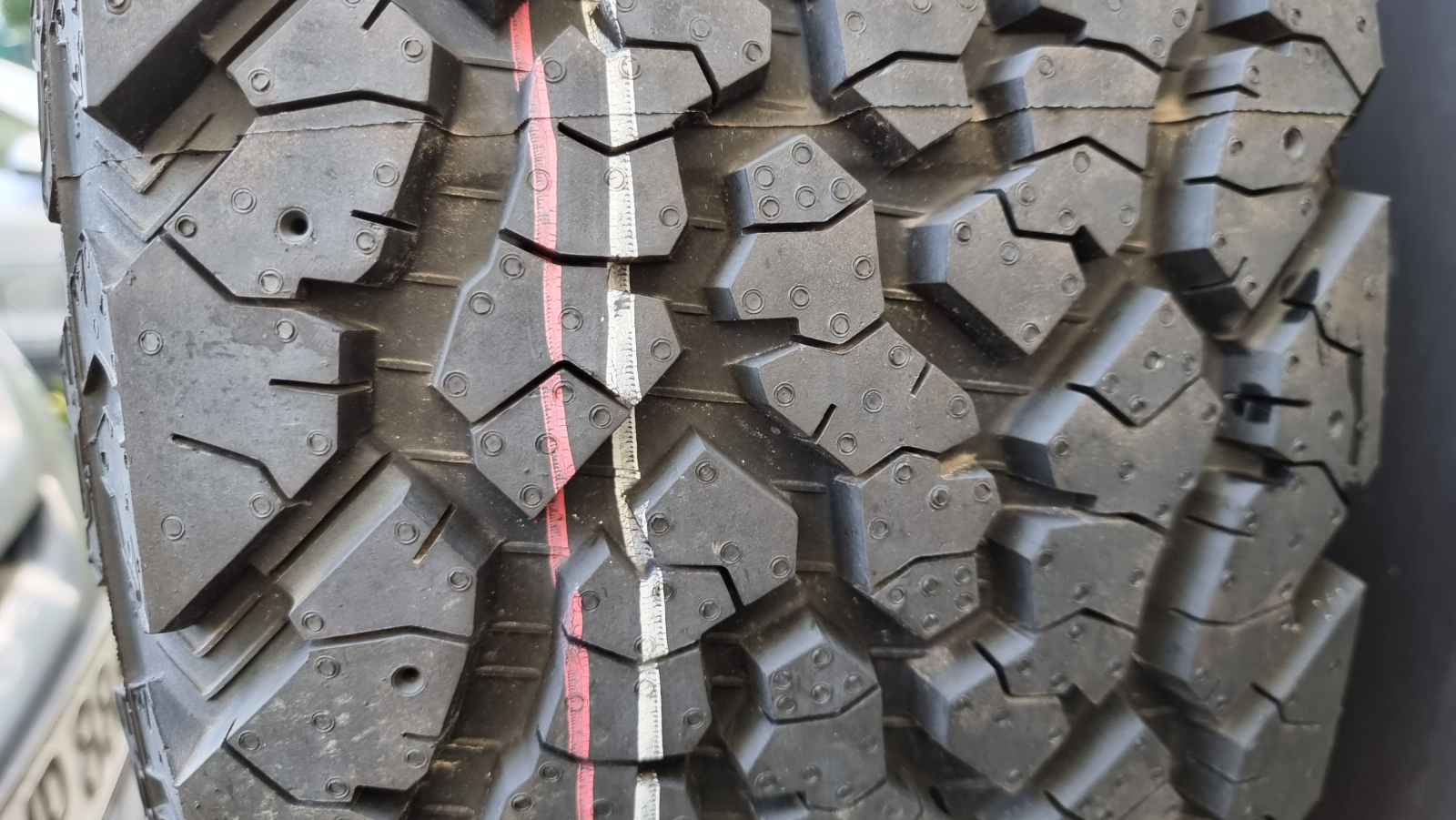
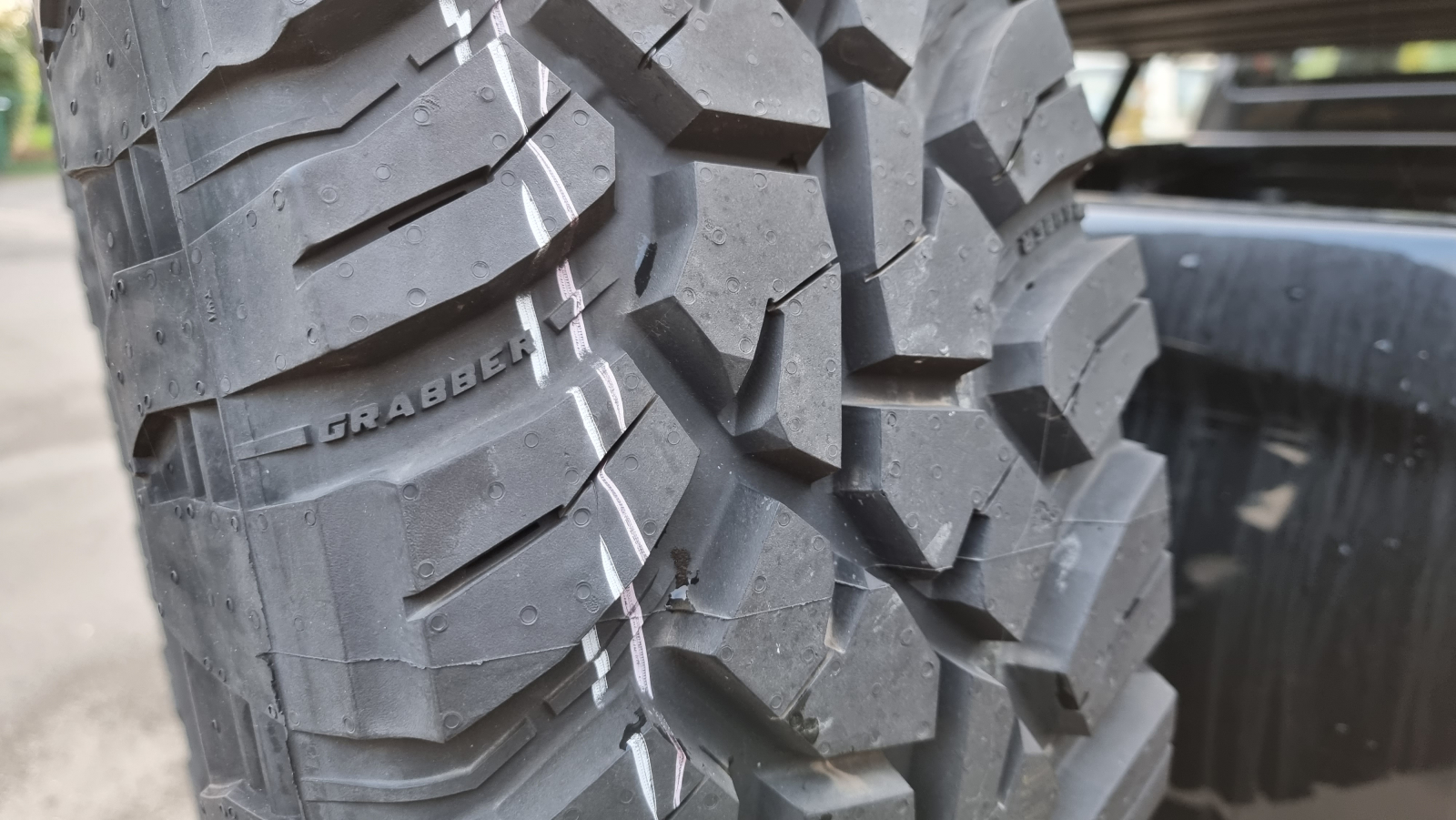
MT tyres have their focus off-road. You can feel that when driving on the road too. They have a large share of negative tread, the gaps between the coarser tread blocks. That helps with “shovelling” off-road and offers better interlocking on coarse, loose ground. Dirt that clogs the tread finds less to hold onto and can be shaken off more easily by centrifugal force and flexing.
Its small positive tread area and the often missing sipes make good grip through adhesion and interlocking on tarmac harder. In rain, slush and ice they quickly start to slide, because they lack a higher number of tread edges for interlocking and for cutting through the water. The large negative share of the tread does leave plenty of room for water, but when it comes to the individual tread block making contact right down to the surface, the channels to take up the remaining water are missing.
On the General Grabber MT X3 you can clearly see that the much fewer but larger tread blocks push up the negative share.
Improving grip off-road
The simplest and most effective measure to improve traction, or grip, off-road is to reduce the tyre pressure. While on the road the correct pressure is crucial, at the low speeds usual off-road it can be lowered considerably.
Lowering it changes the contact patch. It gets longer and the tyre sits on more surface. On the one hand this spreads the weight better, because it can rest on a larger area. That helps in desert sand, for example, where it stops you breaking through the harder top crust so quickly and getting stuck in the softer sand below. On the other hand, on mud and loose ground the interlocking options increase, and the driving force can spread over more surface too.
With less pressure the tyre flexes more. Flexing is the term for the deformation of the tread. On meeting the ground the tyre compresses, then returns to shape as it rolls off. This movement of the tread helps to clear mud and dirt from the tread. On the next turn a clear tread is ready again.
But this deformation also generates heat in the material. That is why you must only drive slowly with reduced pressure. If you forget to raise the pressure again on tarmac, the tyre can get so hot that it tears apart. The sidewalls of good off-road tyres are so tough that heavy deformation does the material no harm, as long as they do not get too hot from fast driving.
They also stay safely on the rim when you steer. On sharp downhill bends especially, the kind that often come up in sand dunes for example, the lateral load can pop the tyre off the rim if the pressure is too low. Good tyres resist this.
Tyre damage patterns
In the next article, on wheel alignment, we look at the various wear patterns of tyres and what they tell you. This topic fits better with wheel alignment, because that, with the exception of the wrong tyre pressure, is responsible for this wear.