


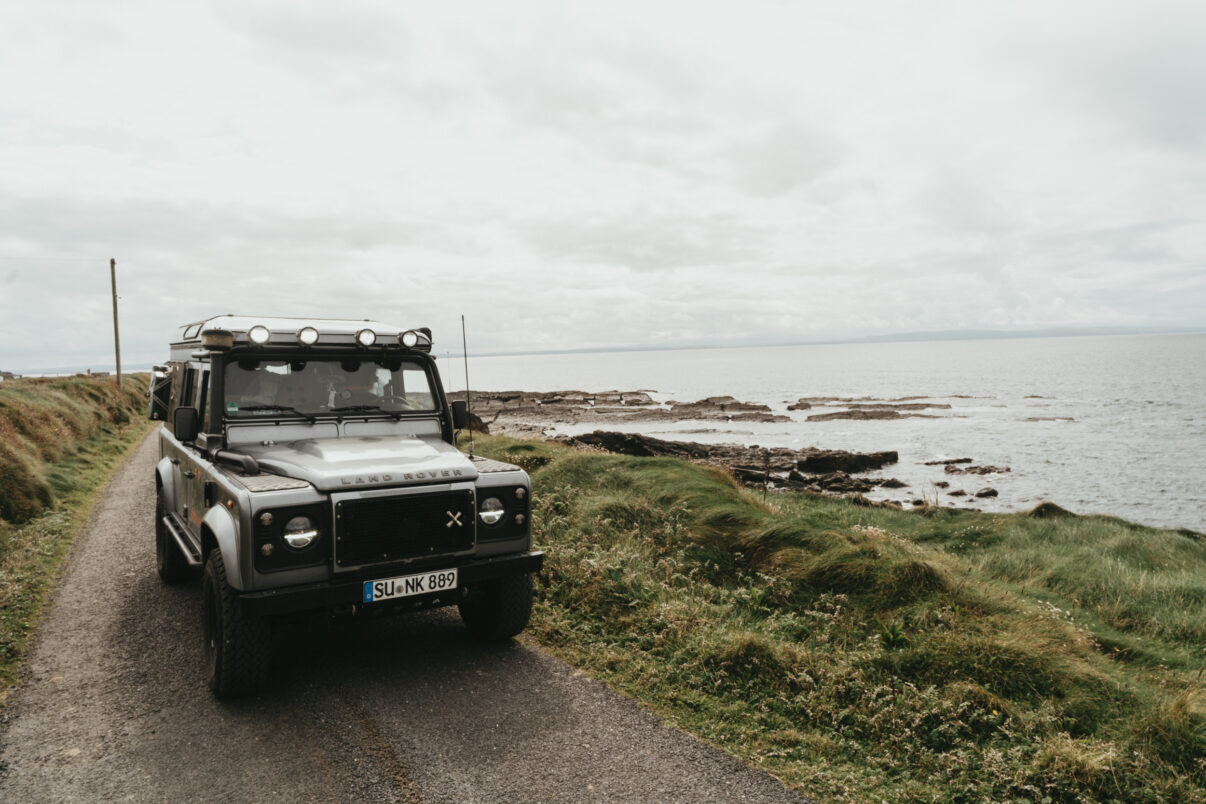

It doesn’t always have to be about tracks and mud. A leisurely trip in the off-roader over tarmac can be fun too and hold some great experiences. We really wanted to go to Ireland once more. No sooner said than done. Last year we set out to drive the Wild Atlantic Way in full… and only got halfway. So this year we’re tackling the second part. This piece is about the first part of the trip.
Ireland: rugged, cool and beautiful in any case. And hospitable, as we were lucky enough to experience again. Again? Yes, we’d already been to Ireland in 2015 with some friends from my Landyfriends forum. A forum member and friend lives there, whom we visited. So we knew what (lovely things) awaited us.
This time we set off on our own, so Nik, me and our golden retriever Guinness. The plan is quite simply put: to drive the Wild Atlantic Way (WAW) in full and into every corner. Spoiler alert! That’s actually easy, you don’t even need maps or a sat nav, because the WAW is superbly signposted. Just follow it either south to north or the other way round. The signs show exactly that too. Our tip: take the route from south to north, because the other way round you’ll be moving against all the coach and motorhome tourism in season.
Where the Wild Atlantic Way begins
Officially the WAW begins or ends on the R600 just before Kinsale, depending on which side you come from. That’s where you find the first sign with the typical WAW symbol, which we’ll follow from now on.
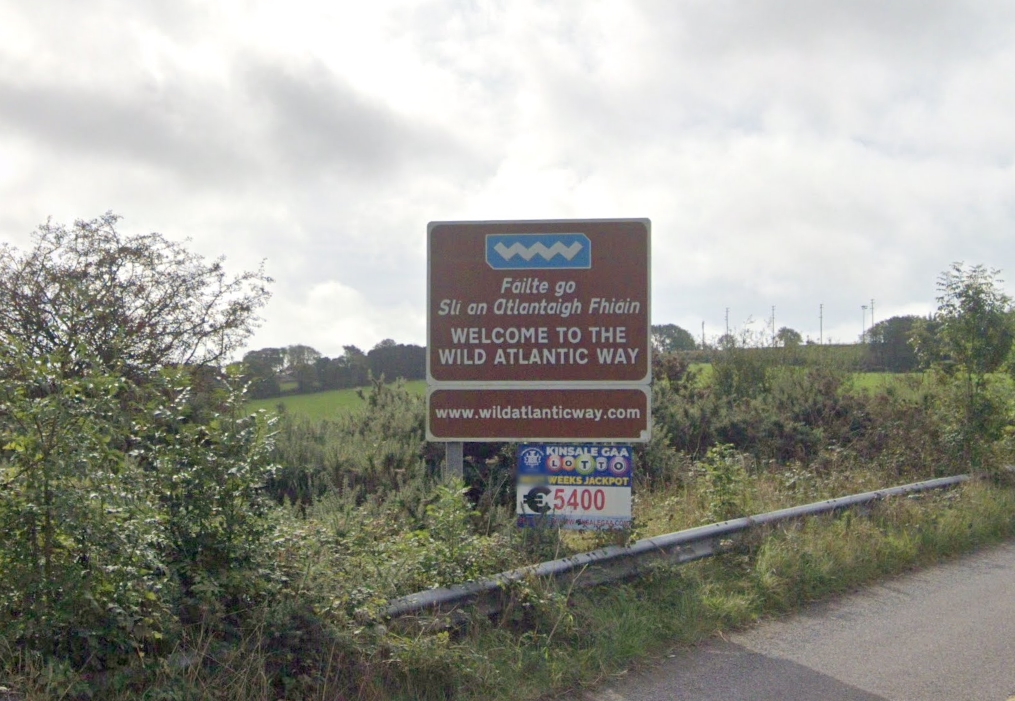
From here we now follow the WAW signs with the letter „(N)“ heading north. Sights are signposted too. Often these are dead ends leading to the attractions, and from there it’s back onto the Wild Atlantic Way.
The Port Lairge and Tintern Abbey
But even before the Wild Atlantic Way we visit a small attraction, the wreck of the steamship Port Lairge. At low tide it’s easy to reach, and the broken hull allows glimpses inside, at least into the engine room. A little above there’s a car park, and from there it’s just a good 150 metres to the wreck.
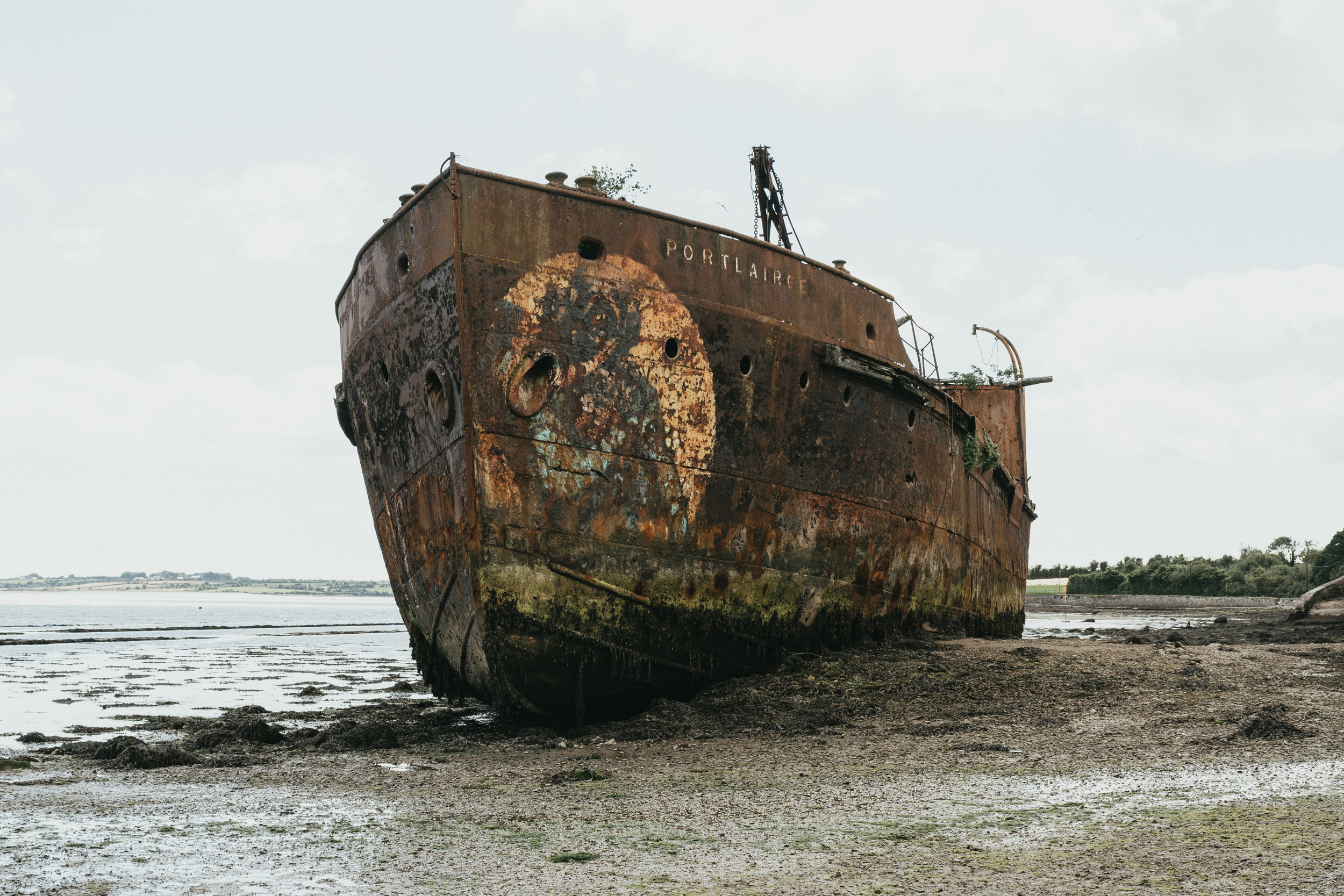

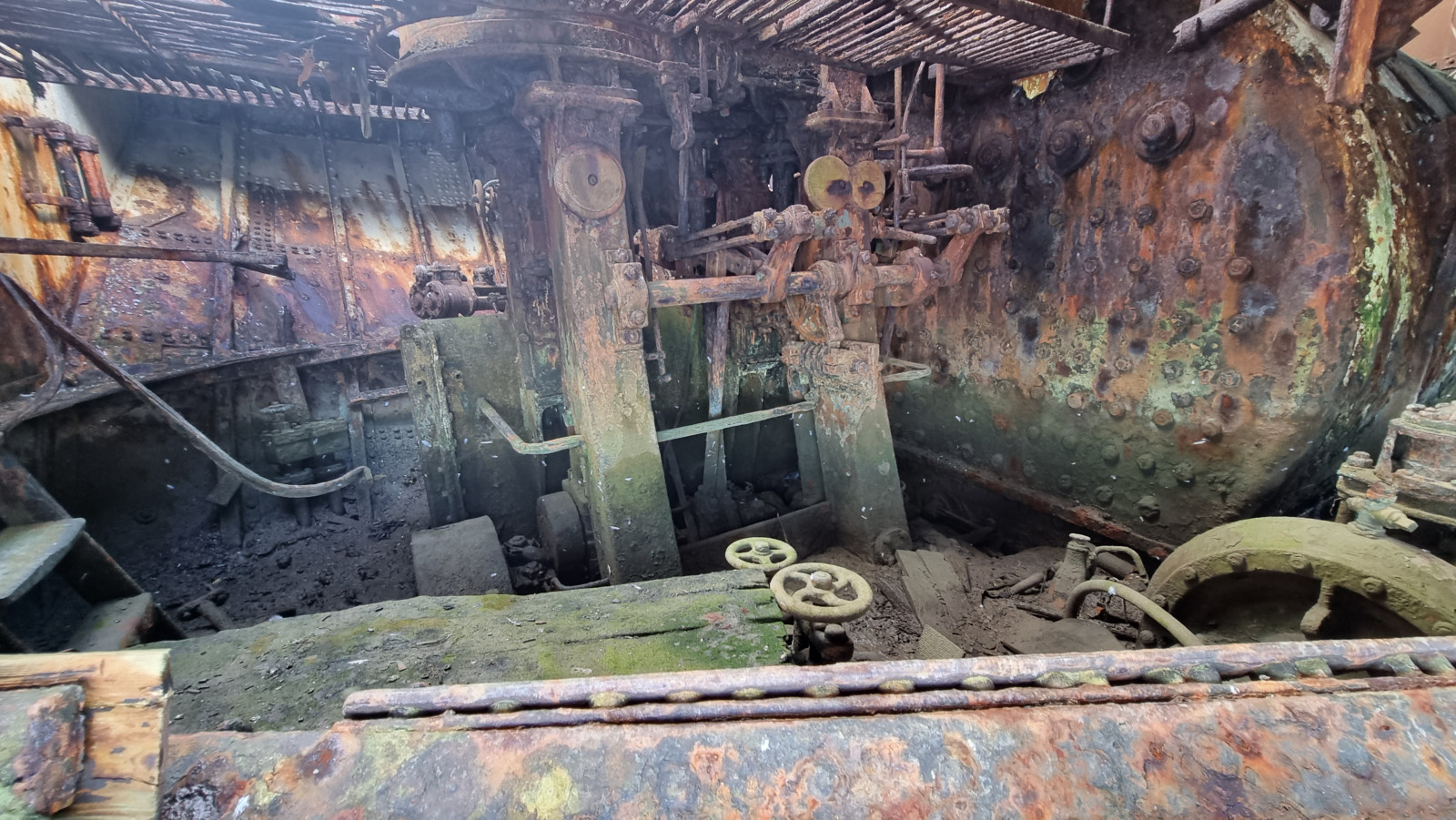 Der Maschinenraum der Port Lairge.
Not far from the shipwreck lies the former Tintern Abbey. Yes, we were puzzled at first too, because in 2016 a breakdown forced us to spend a night in front of Tintern Abbey. Only that was in Wales. When we ask, we’re told that these two Cistercian abbeys really do belong together. Visitors can walk freely around the grounds. There’s also a very old cemetery with a chapel. It’s a strange feeling to see these ancient graves, with the simple stone tablets that have lain here for hundreds of years.
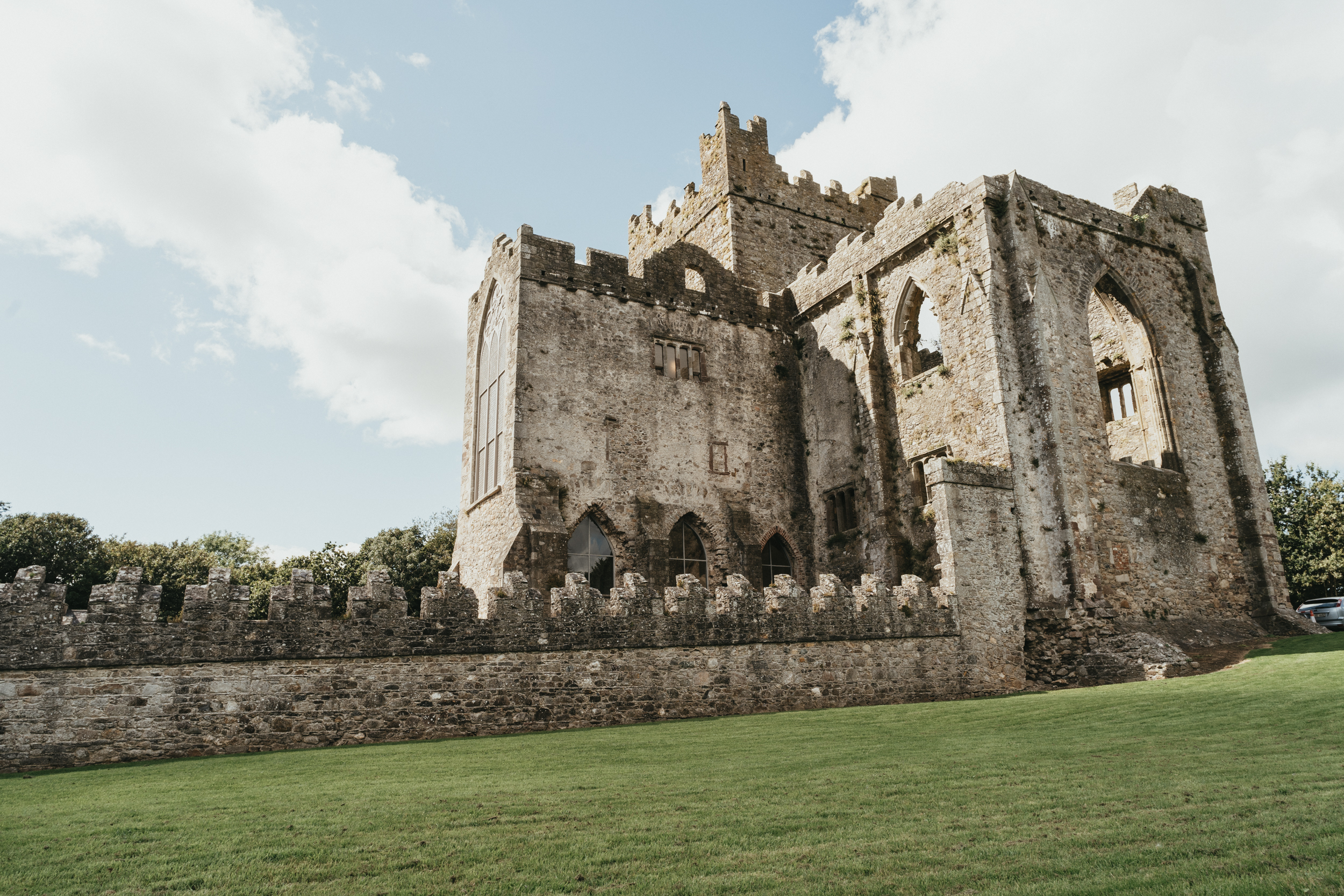
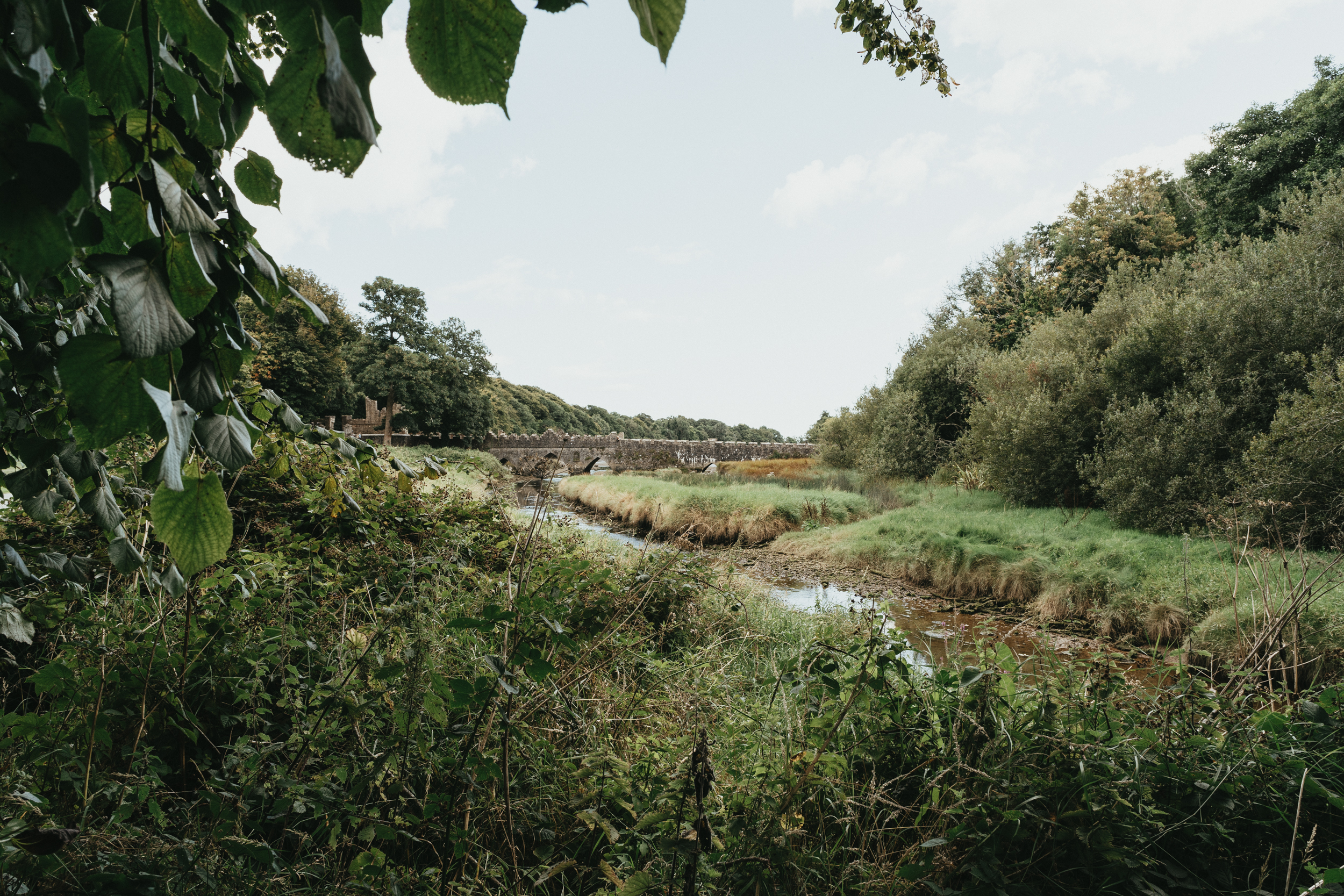 Garten von Tintern Abbey
Lusitania Museum
That suits me. As someone interested in submarine history, this is a place I want to visit. The day before I’d already looked at the „Memorial Trail & Garden in Honour of Those Lost at Sea“ in Kilmore Quay, which commemorates all the victims of the sea up to the present day. Here it’s about the drama of the Lusitania, sunk by a German U-boat in the First World War.
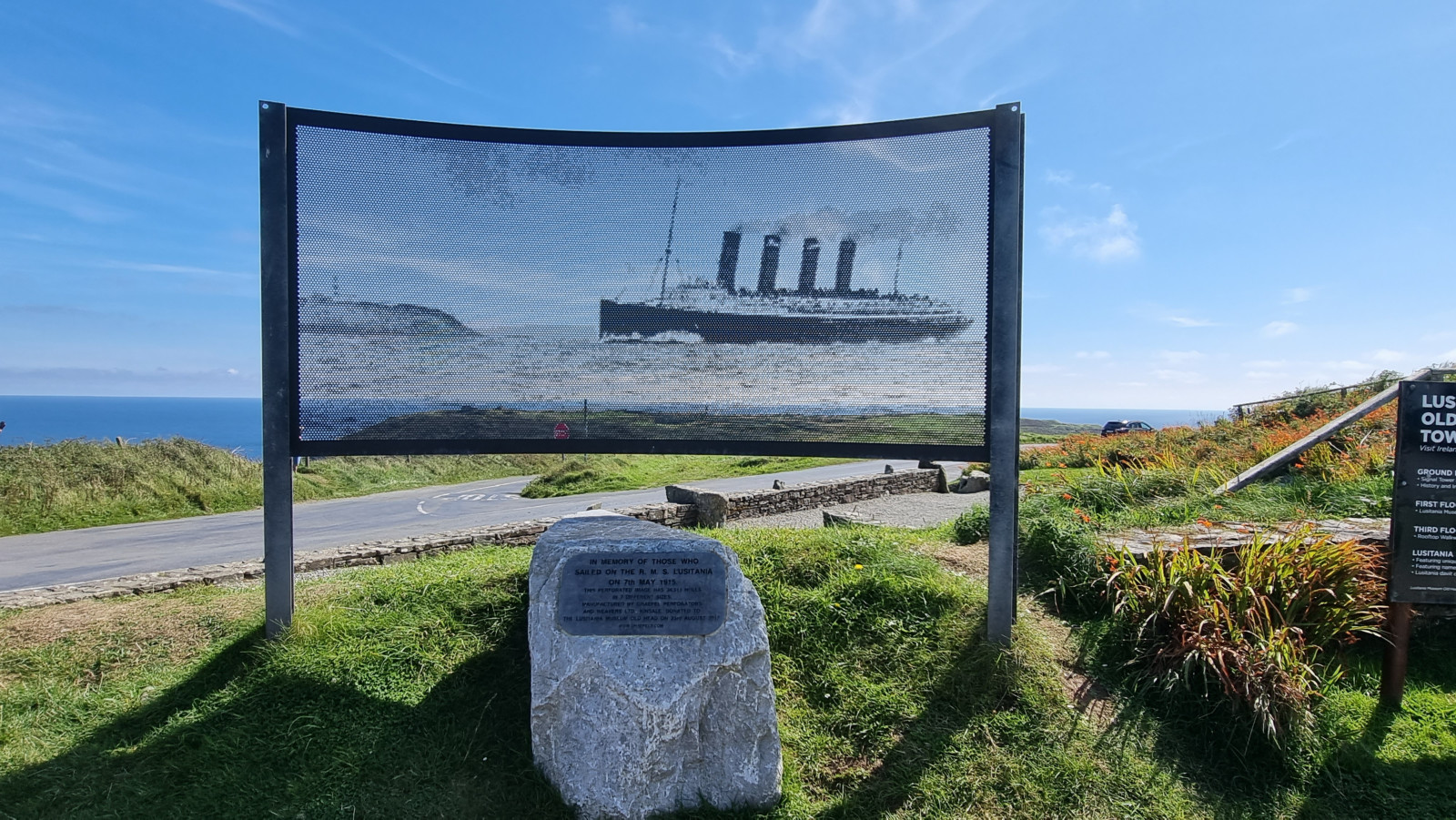
It’s a nicely laid-out site with a small museum in a 200-year-old signal tower that was originally meant to warn of a French attack. Next to the museum lies the Memorial Garden with a davit from the Lusitania and a wave-like bronze band bearing all 1,915 names of those affected, and whether they survived the torpedoing or died.
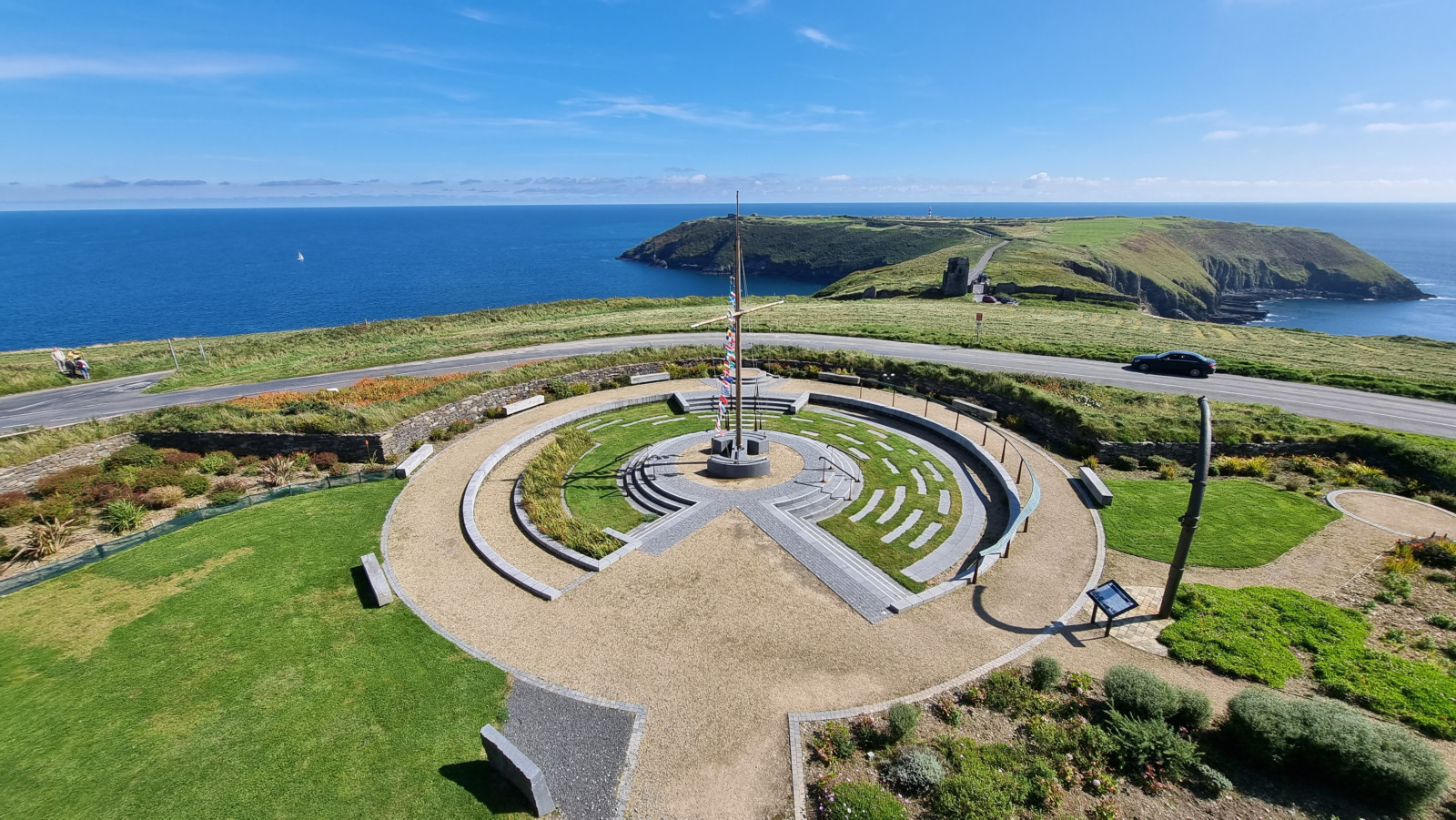
If you like the view out to sea, after the museum visit you can take a walk to the remains of the Irish De Courcey Castle and on to the old Old Head of Kinsale lighthouse. For that you have to cross a golf course, quite spectacularly located there. This is one of the most important lighthouses in the south of Ireland: Old Head of Kinsale Lighthouse,
Rituals need keeping up
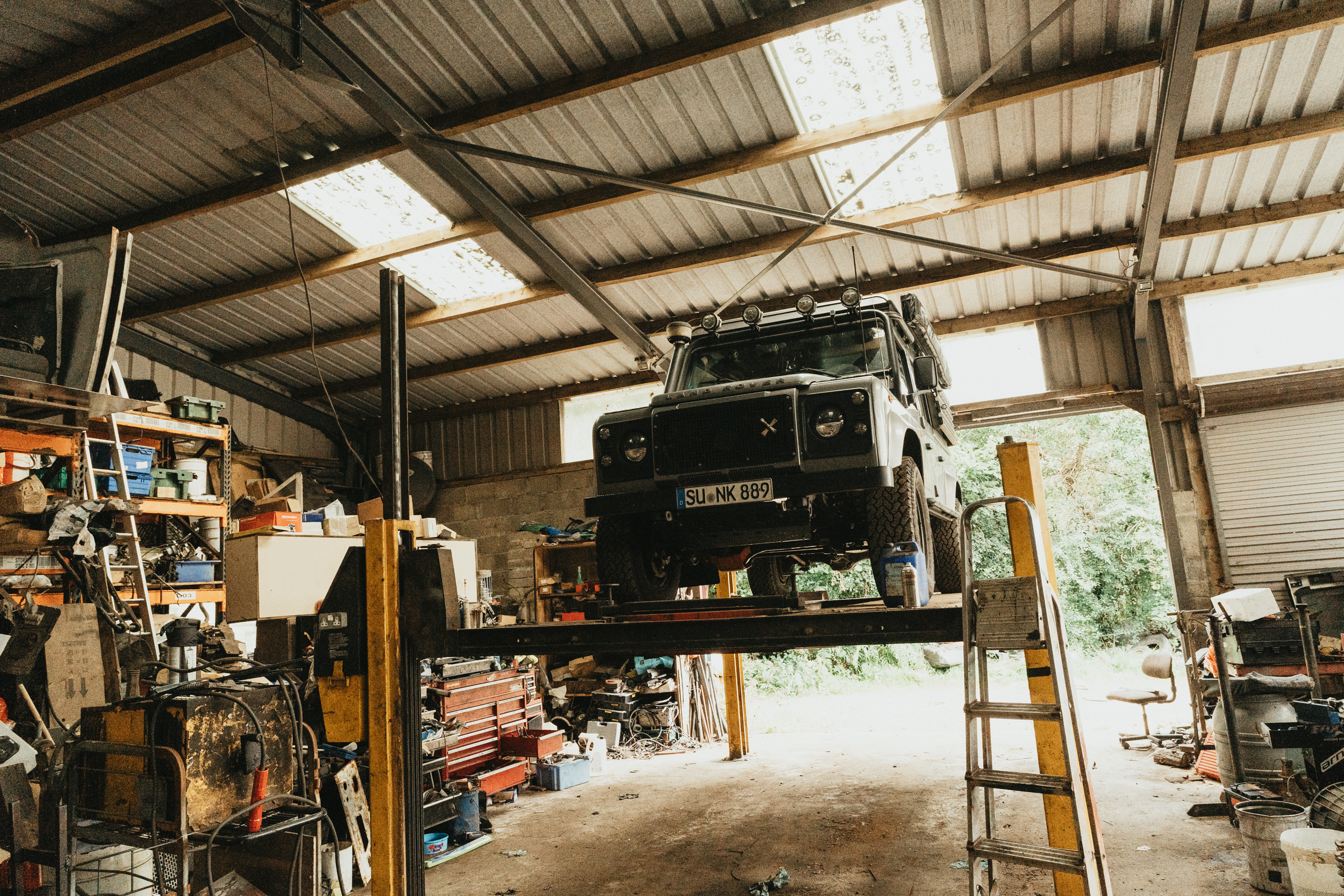
We love our Land Rover Defender. Most of the time, anyway. But sometimes it gives us a headache. So it does again now. A grinding noise sets in, and its cause is found fairly quickly too. A universal joint on the propshaft is pretty much done for. After numerous phone calls to nearby Land Rover main dealers, none of whom has a free slot or simply can’t be bothered with us, we get a tip. There’s apparently a mechanic who somehow keeps all the Defenders around here running. We get his phone number and actually reach him. „No problem“ he says, we should come over. He sends us Google coordinates and adds straight away that we shouldn’t be surprised, he lives a bit out of the way. Ok… what’s waiting for us there?
We’ve no choice. We have to get this fixed, even if it means we’ll vanish forever into the Irish woods. We take the risk and set off. The address and the name are deliberately not given here, because that wasn’t wanted. In any case, the drive there already turns out to be a test. In bad weather probably only Land Rovers would make it to the property.
We’re greeted right away by numerous parked, part-dismantled Land Rovers and vehicles of other makes. You could describe this place as a big, colourful parts store with a central workshop shed. Every corner and nook is crammed with vehicles and vehicle parts. Engines, gearboxes, roofs, chassis, wheels, seats, windows, doors, simply everything, and much of it taken apart into individual pieces. They say that 70% of all Land Rovers ever built are still running; the remaining 30% are probably here.

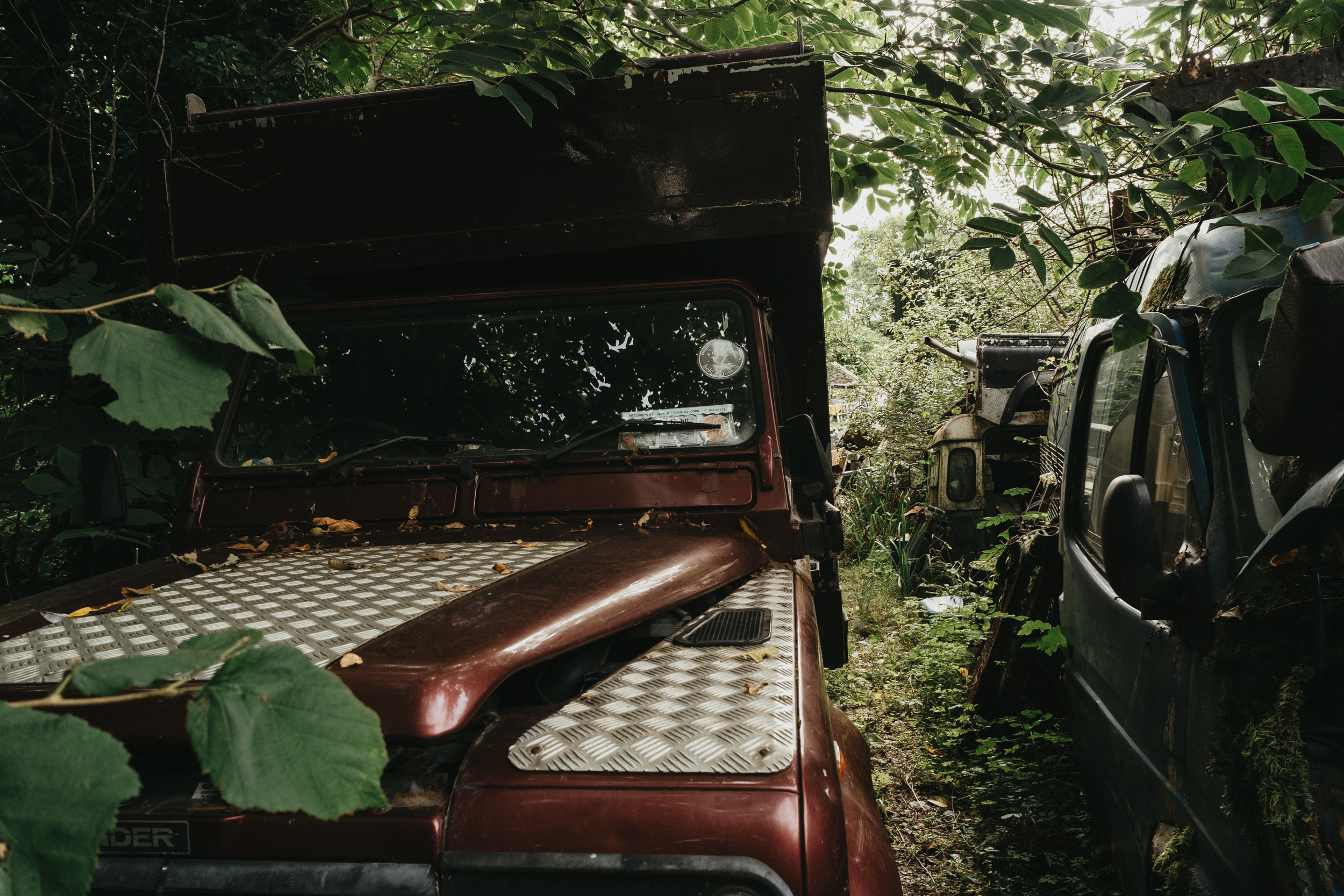
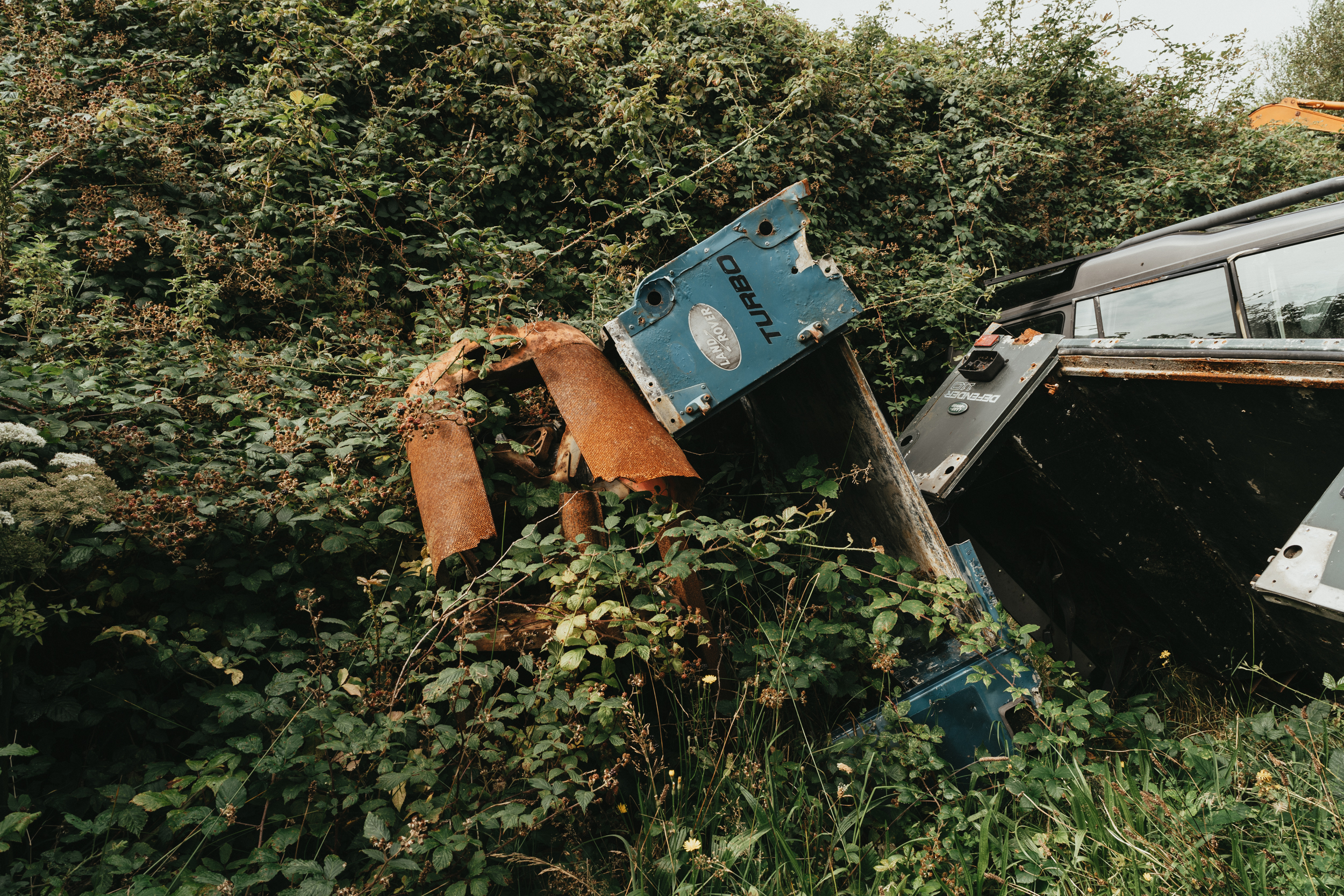

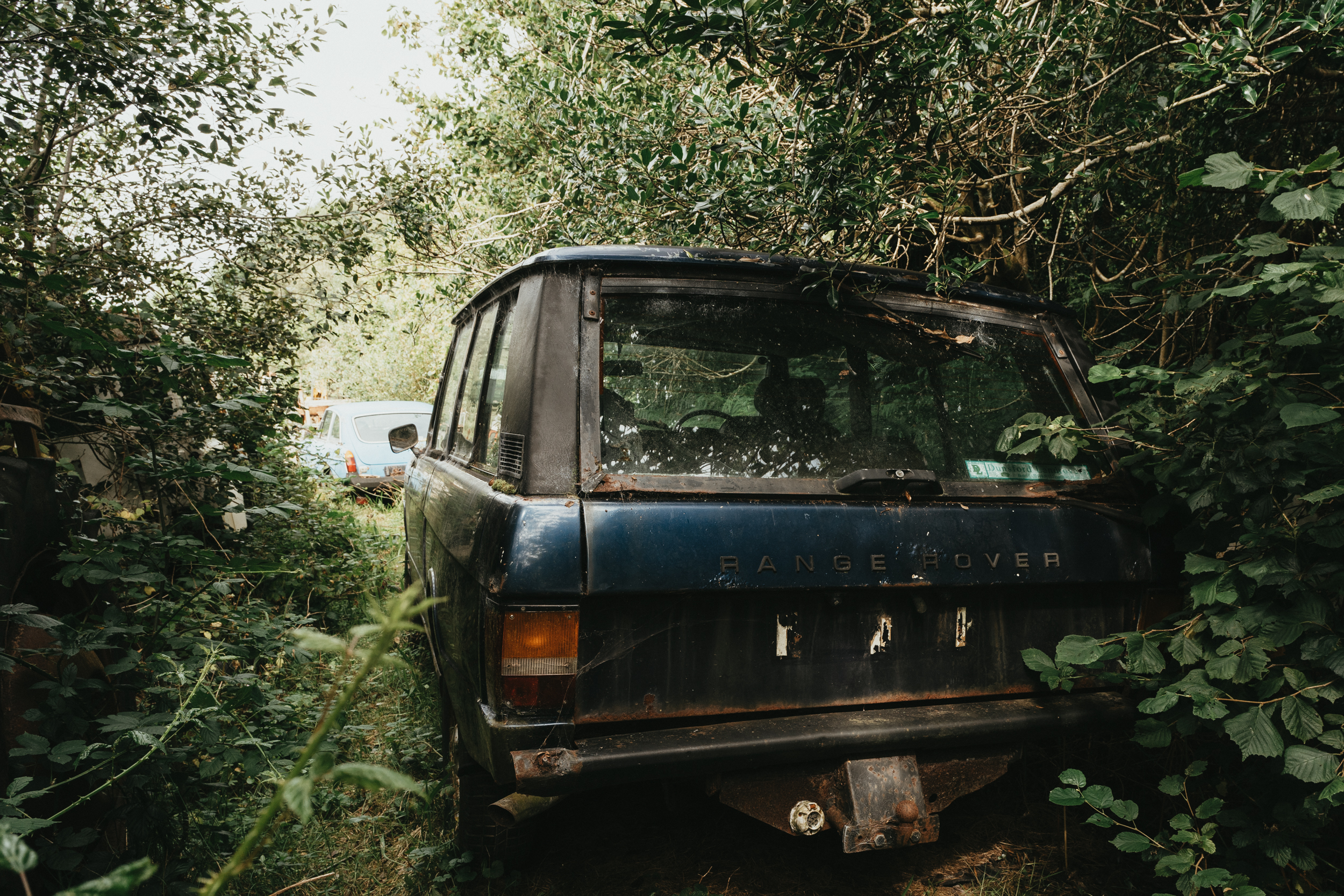

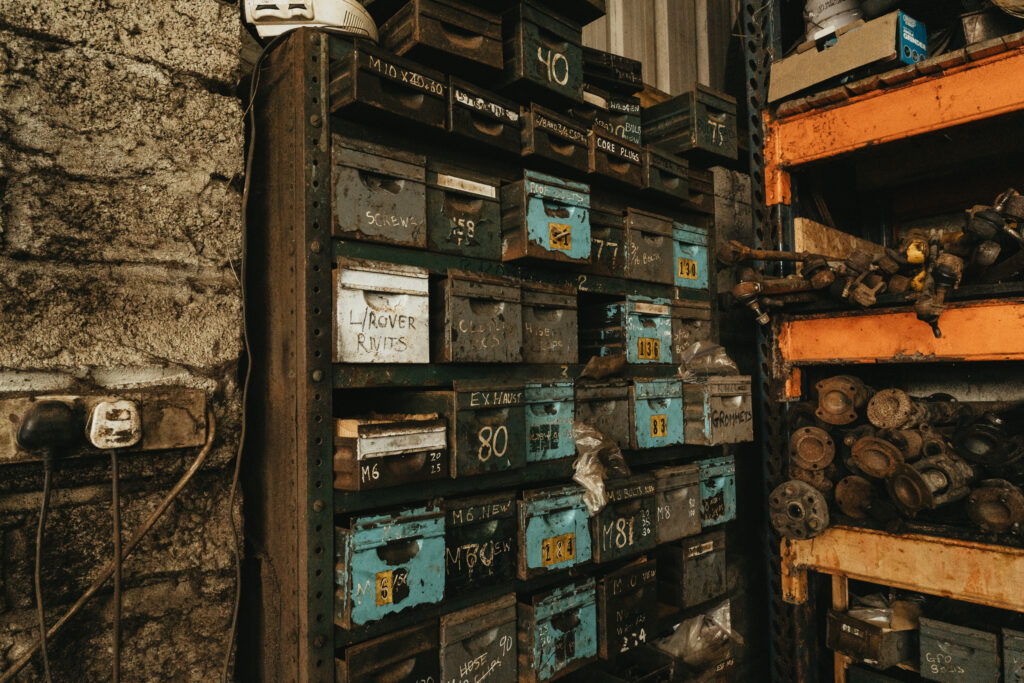
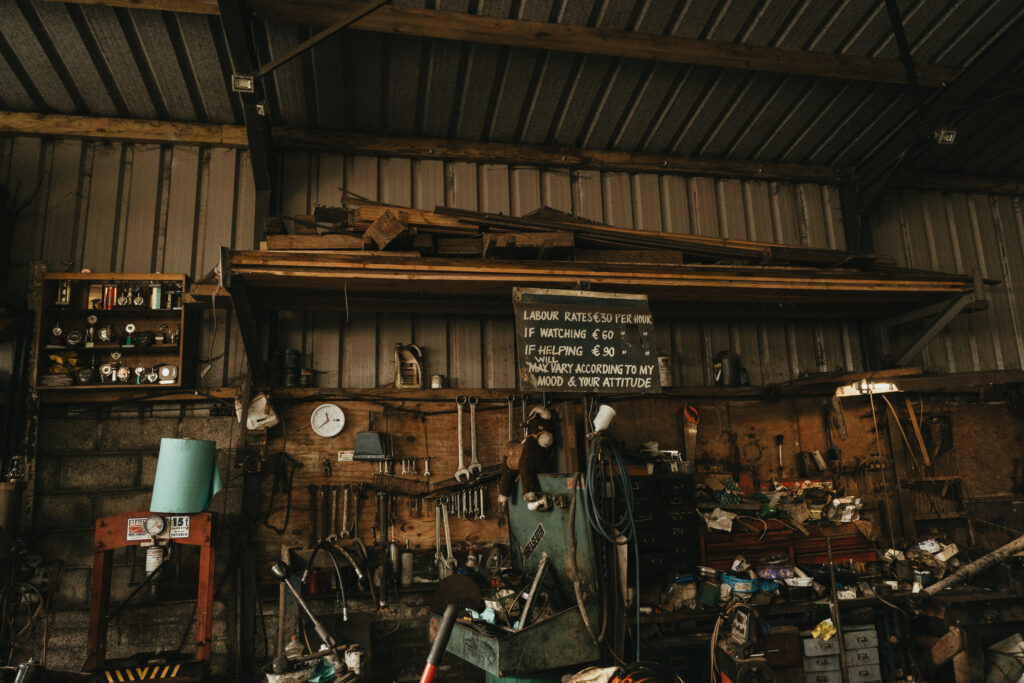
In the workshop shed there’s basically only one free spot, the ramp. We’re greeted cheerfully and warmly. The good man gets straight to work. I can see at once that he does this routinely. He’s a real petrolhead. I learn that he raced Minis and Rovers. Numerous trophies back that up. In a good hour he’s done with everything. We now have an HD universal joint, he’s checked a few more things and blown out an axle breather. He sends us on our way at an absolutely fair price.
Strange folk at the Drombeg stone circle
Maybe it has to be that, at a cult site like the Drombeg stone circle, you’ll come across strange folk. This rather small cult site from the megalithic culture is surely the most visited place of its kind in Ireland. In this very well-preserved site, with 17 stones arranged in a diameter of about 9 metres, one of which lies flat as an altar, a man was moving about and doing extensive „stretching exercises“. His companion waited outside the stone circle. Nik would have liked to take a photo of the circle without any strangers in it, but even after 20 minutes of complete „freedom of movement“ and a polite request, the gentleman would not be diverted from his ritual movements and carried on making a spectacle of himself. A shame for us, hopefully good for him. Then at least it would have done one of us some good.

In any case we end our visit and move on. For the night Nik has tracked down the somewhat unusual eco-camping and glamping site next to Goleen harbour. Building work is going on at the campsite just now. It doesn’t offer many proper pitches at the moment, but we get one on the gravelled car park. Not the highlight, but ok. The site itself wants to offer an especially ecological glamping experience. You can hire large canvas tents, particularly eco cabins or 360-degree dome tents. In the middle of the landscape there’s also a bathtub whose water can be heated with logs and fire. Sadly we’re too late for this pleasure, and the weather worsens into heavy showers. We simply stay in our pop-top roof and snuggle down cosily.
For the right mood you need fog
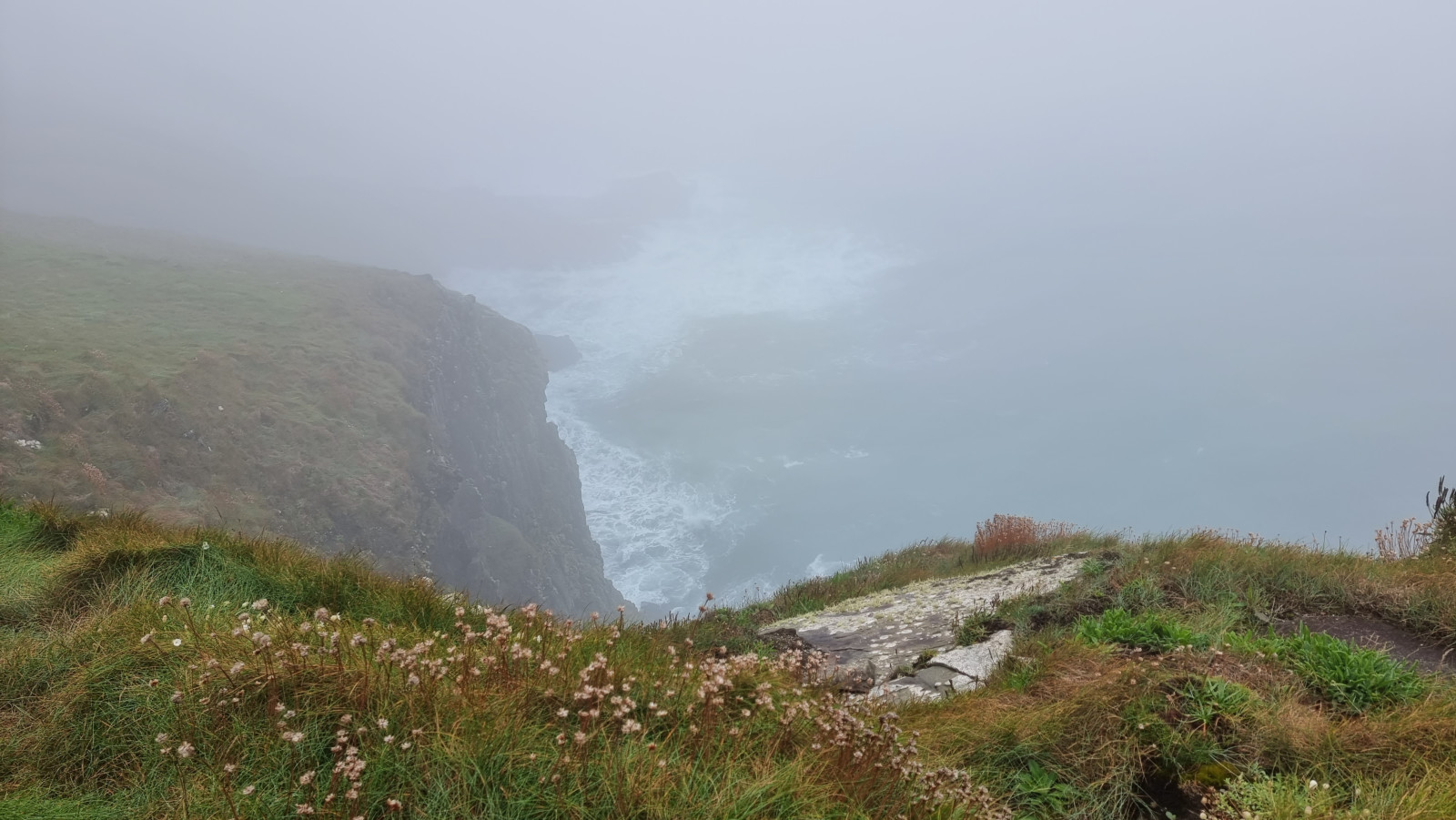
Fog, we hadn’t had that yet, but it somehow belongs to Ireland, doesn’t it? At least if you plan to visit Mizen Head. We’re at the far end of the first peninsula. There are a few interesting installations there. We almost turned back when we arrived at the visitor centre, because we’re basically the only ones here. But then we notice that it is open after all and we can carry on.
Fastnet lighthouse
We want to reach the Mizen Head Signal Station, which is accessed via a spectacular bridge. It’s hazy, foggy, wet and cold. That fits this little patch of earth really well. On the way you find the outline of the Fastnet lighthouse, which stands a good 15 kilometres further south-east on Fastnet Rock, the southernmost point of Ireland. In the visitor centre and the Signal Station there are detailed descriptions of its construction.

The tower is built from 2,047 stacked granite blocks, shaped and laid on one another so that they hold by themselves. Apparently to this day. The tower was assembled several times to test the construction, until each stone, weighing 1 to 3 tonnes, was taken out to Fastnet island on a steamship built specially for the purpose, to be put together there. The total weight today is 4,400 tonnes. In 1985 the tower survived a heavy 48-metre-high tidal wave and storms of up to 191 km/h, most recently in 2017.
Mizen Head Bridge
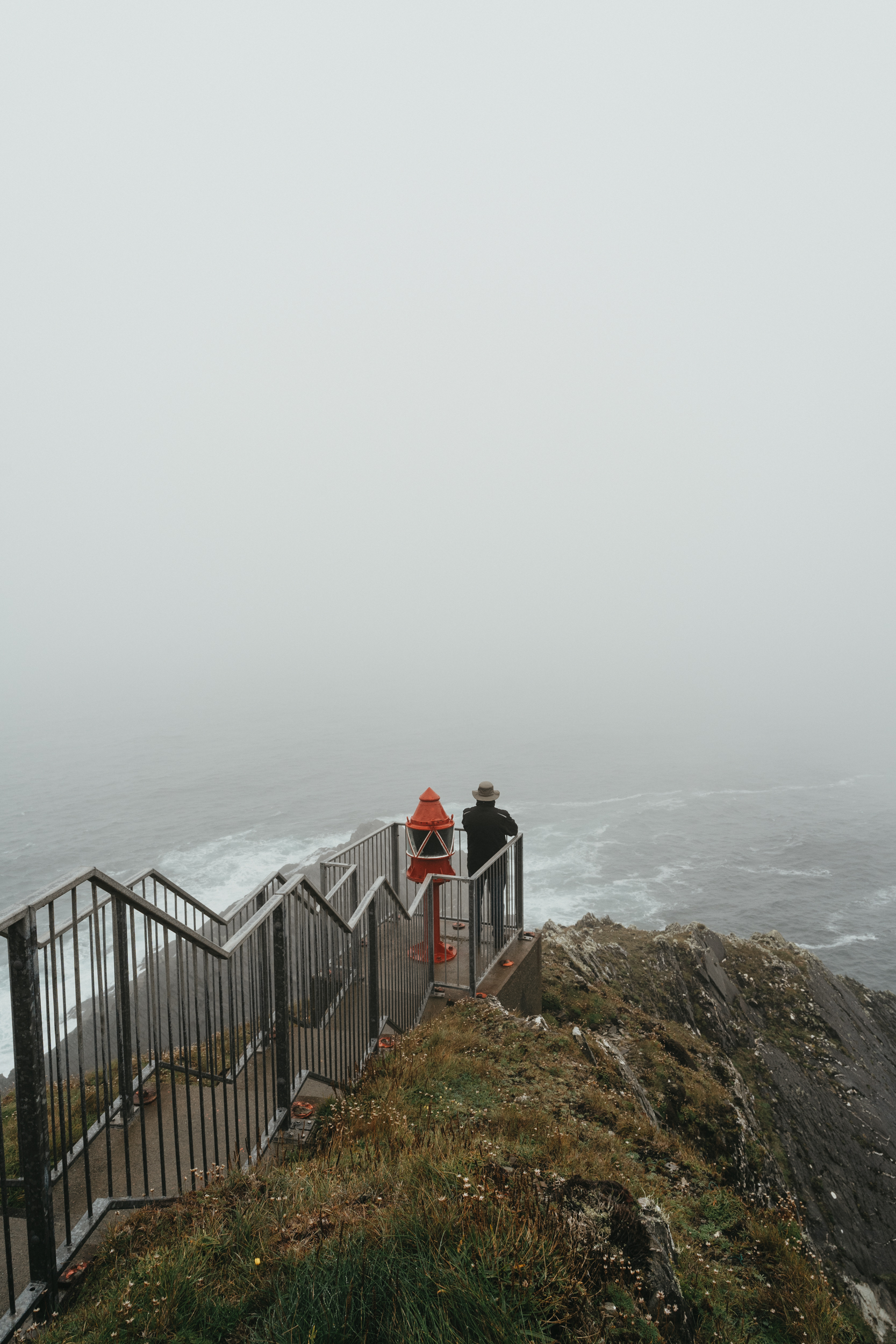
The surely most spectacular part, though, is the Mizen Head bridge. To be precise, the second bridge, because the one we’re about to cross was built over the first bridge. At a good 46 metres up, it allows the crossing from the mainland to the small rocky island and the signal station.
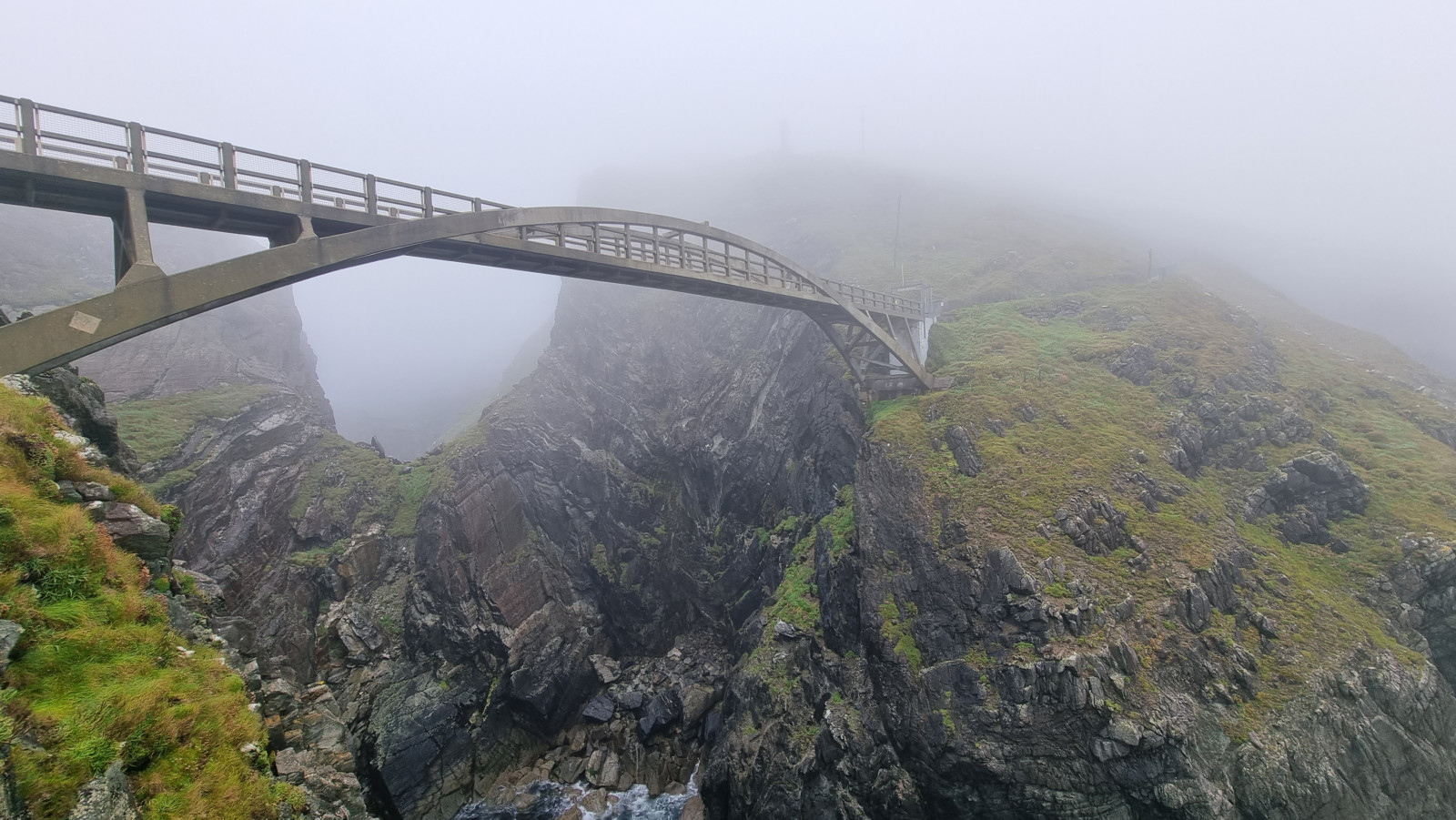
The first bridge was used, so to speak, as a platform to build the second, and then torn down. Just ask the nice gentleman in the signal station, he knows all about it. Interesting pictures and descriptions can be found here too: Mizen Head Footbridge. What’s special about the first bridge is that it was one of the earliest structures made of reinforced concrete. Bridges were usually built of steel, but this one wasn’t, and it lasted a good 100 years under the local conditions. In 2005 it was declared unsafe, and the present structure was then built over it, financed by donations.
Mizen Head Signal Station
The bridge leads to Mizen Head Signal Station, which is no longer in operation today. How fitting that the former fog-signal station now stands in the fog. The elaborate, almost self-sufficient installation is very interesting. Living quarters and machine rooms can be viewed, everything is in good condition and a knowledgeable person keeps watch and explains.
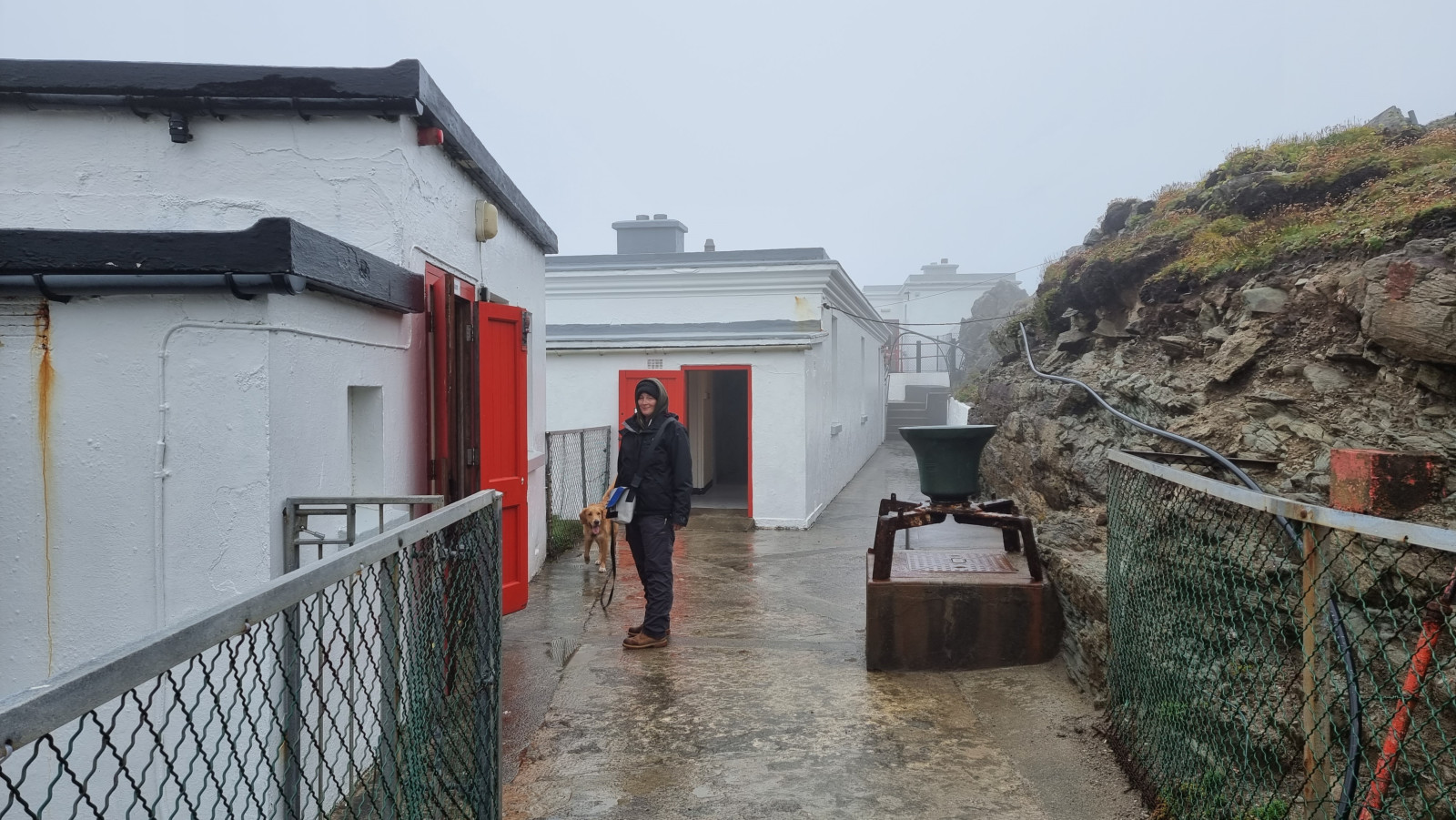
The station is worth a visit, especially when there’s fog. The rough, jagged rock faces that rise steeply from the sea, with the spray breaking against them, hint at the conditions under which ships were warned of being dashed to pieces here.

Dunlough Castle, or Three Castle Head
The sporty side shouldn’t come up short on this trip either. Although the weather hasn’t got any better, we want to hike to Three Castle Head. From the car park, where we follow the request and pay the owner a small fee, we set off. Over typically Irish green pastures, in the middle of sheep, we walk and try to make out the path. It’s only a small trodden trail, and a few times we have to cross smaller streams. In dry weather, if that even exists here, surely no problem.
After a good 30 minutes we come down a narrow path. We’re not sure whether we’ve arrived, as a few walls seem to shimmer through the fog. Then the fog briefly tears open and we’re standing in front of Dunlough Castle, which reaches from a deep gorge by the sea up to Dun Lough lake. There’s said to even be a ghost here, a white lady. But despite the mystical weather we see no ghost.
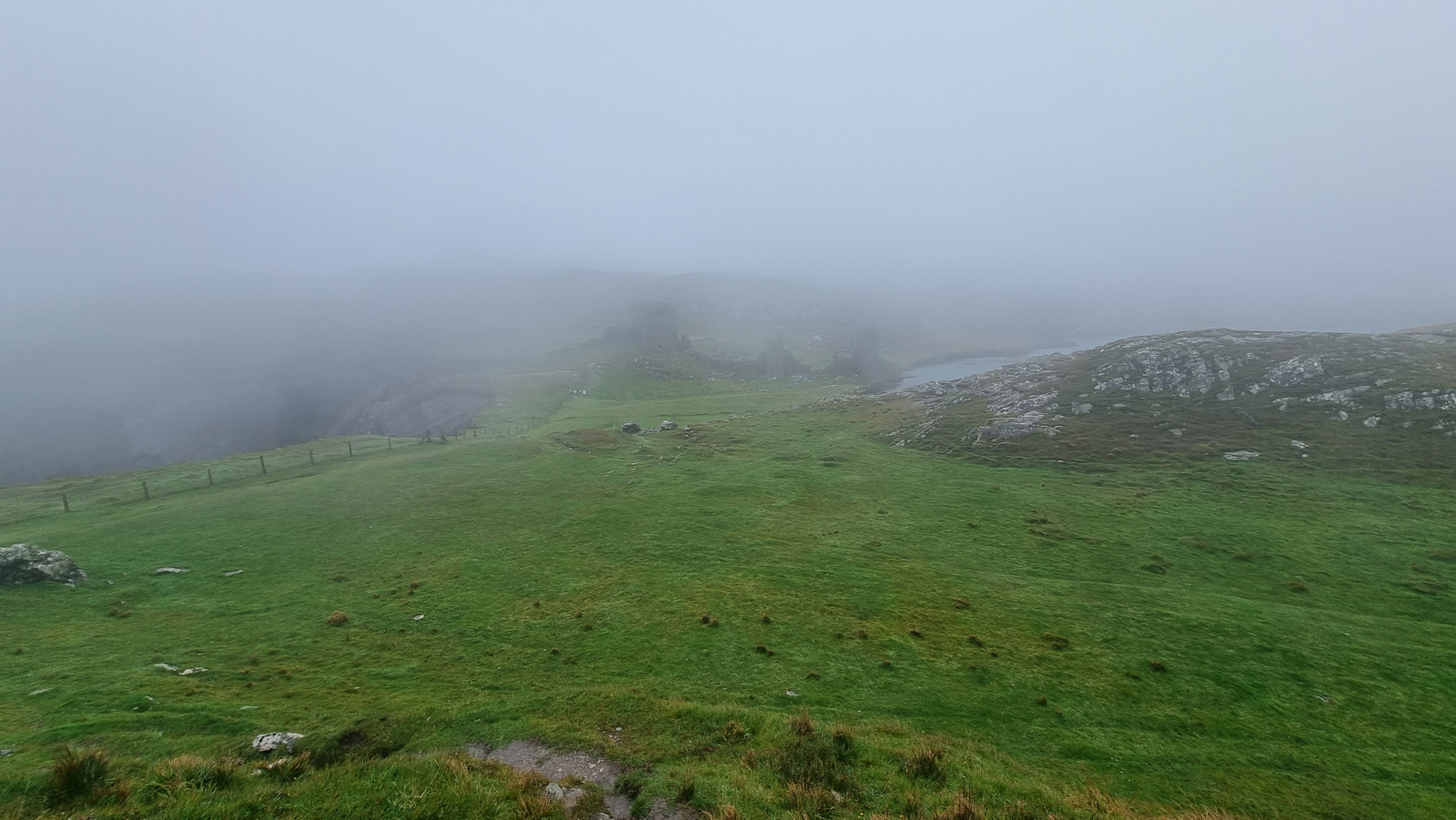
The fog, though, only tore open to make way for rain. From now on it hammers down on us. Do we turn back? No, we’re here now and want to see it all. So we carry on and switch to the other side of the crumbling Norman structure. We can look up into the towers from below, taken over these days by birds, even single wooden planks are still there.
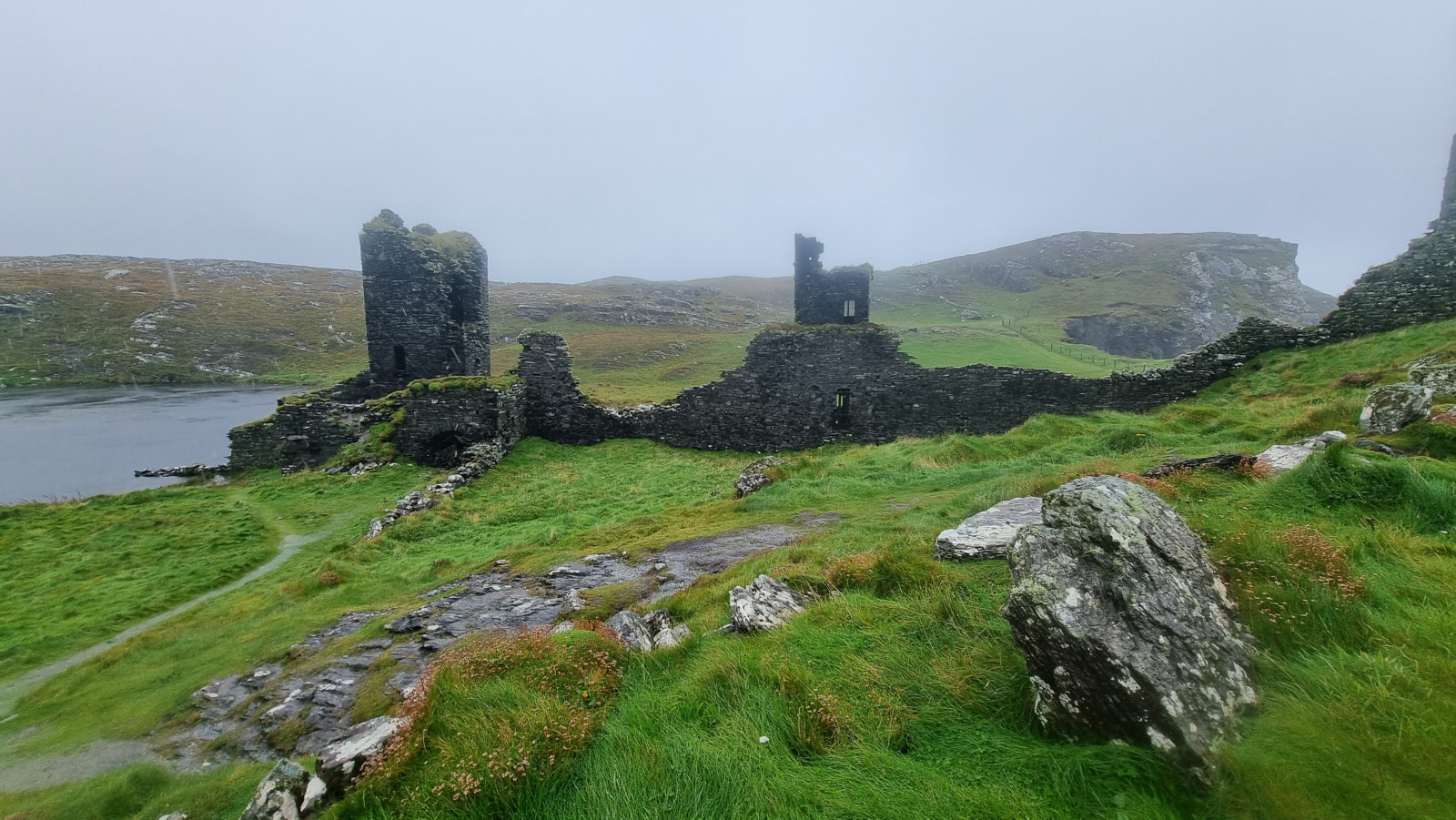
Who on earth wanted to live so remotely, and what was guarded, protected here? Donagh O’Mahony, who had the structure built in 1207, will no longer be able to tell us. Wikipedia says the O’Mahony clan settled here behind the crumbling walls. Two insurmountable obstacles for the time, which together with the protective walls and towers sealed off the rest of the small peninsula.
By now we’re completely soaked and we set off back. Jeans and no high-tech functional wear, that comes back to bite you. But the Tilley hat does its job. Soaked through, we climb into the car and head for the next campsite.
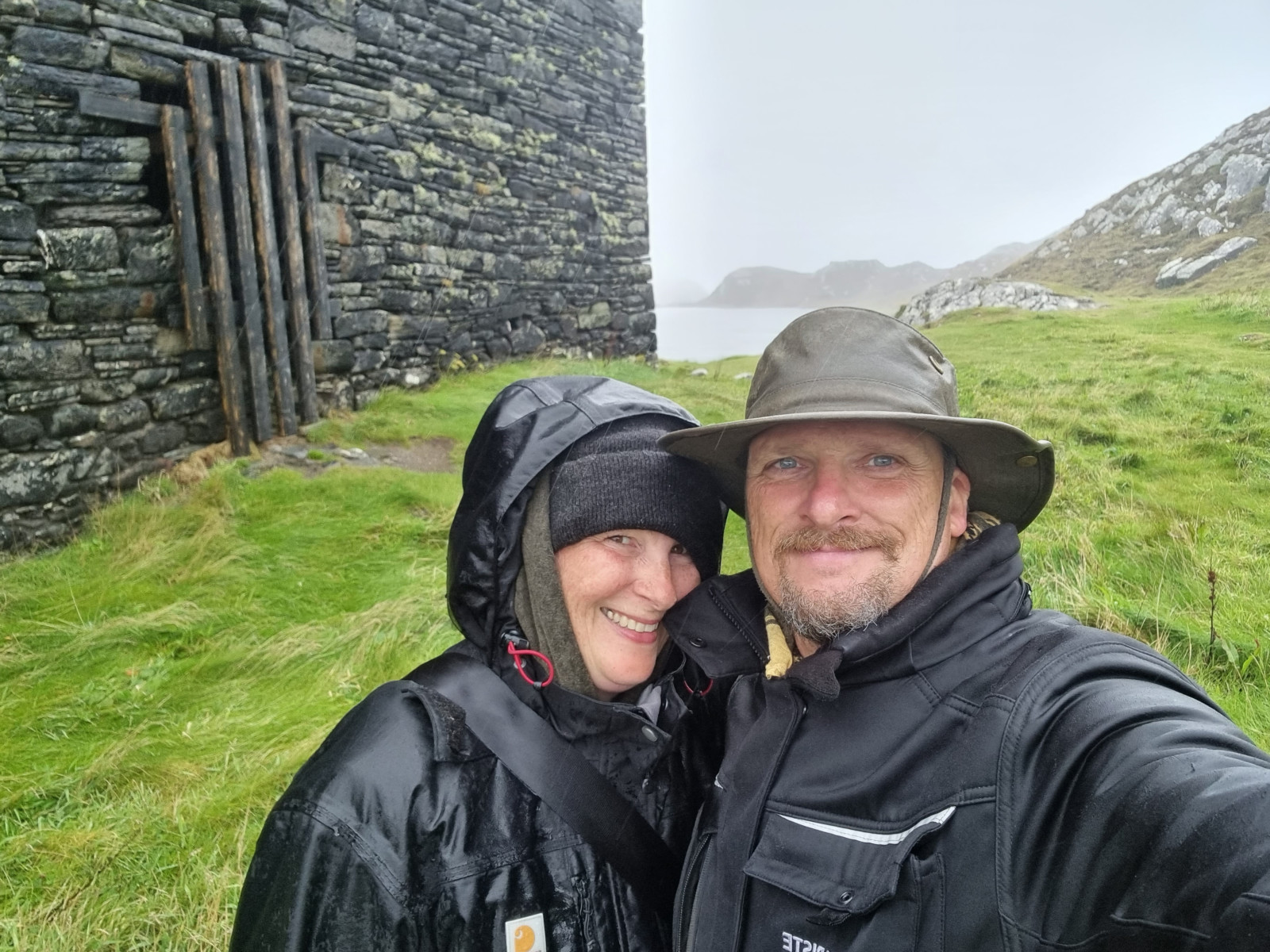
Sheep’s Head
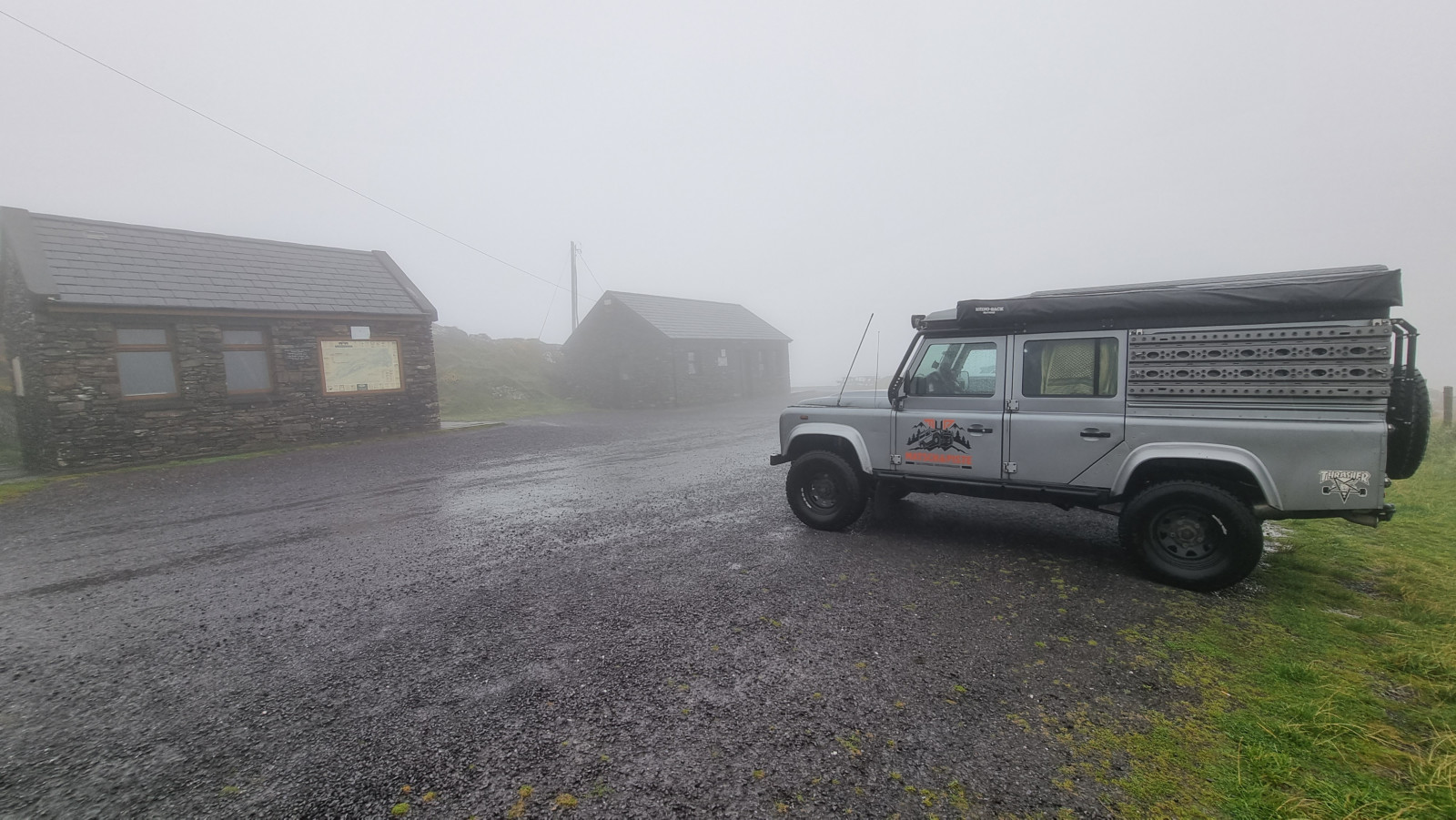
We drive on, strictly to our plan of taking in every metre of the Wild Atlantic Way. That brings us to Sheep’s Head at the end of the second peninsula. By car we only get as far as Coomacullen, and there’s nothing to see there. At least today, because everything is again wrapped in damp haze. From here it’s only on foot. The paths are part of the 88-kilometre Sheep’s Head Way, a popular hiking trail. So anyone who feels compelled to walk it, be my guest…
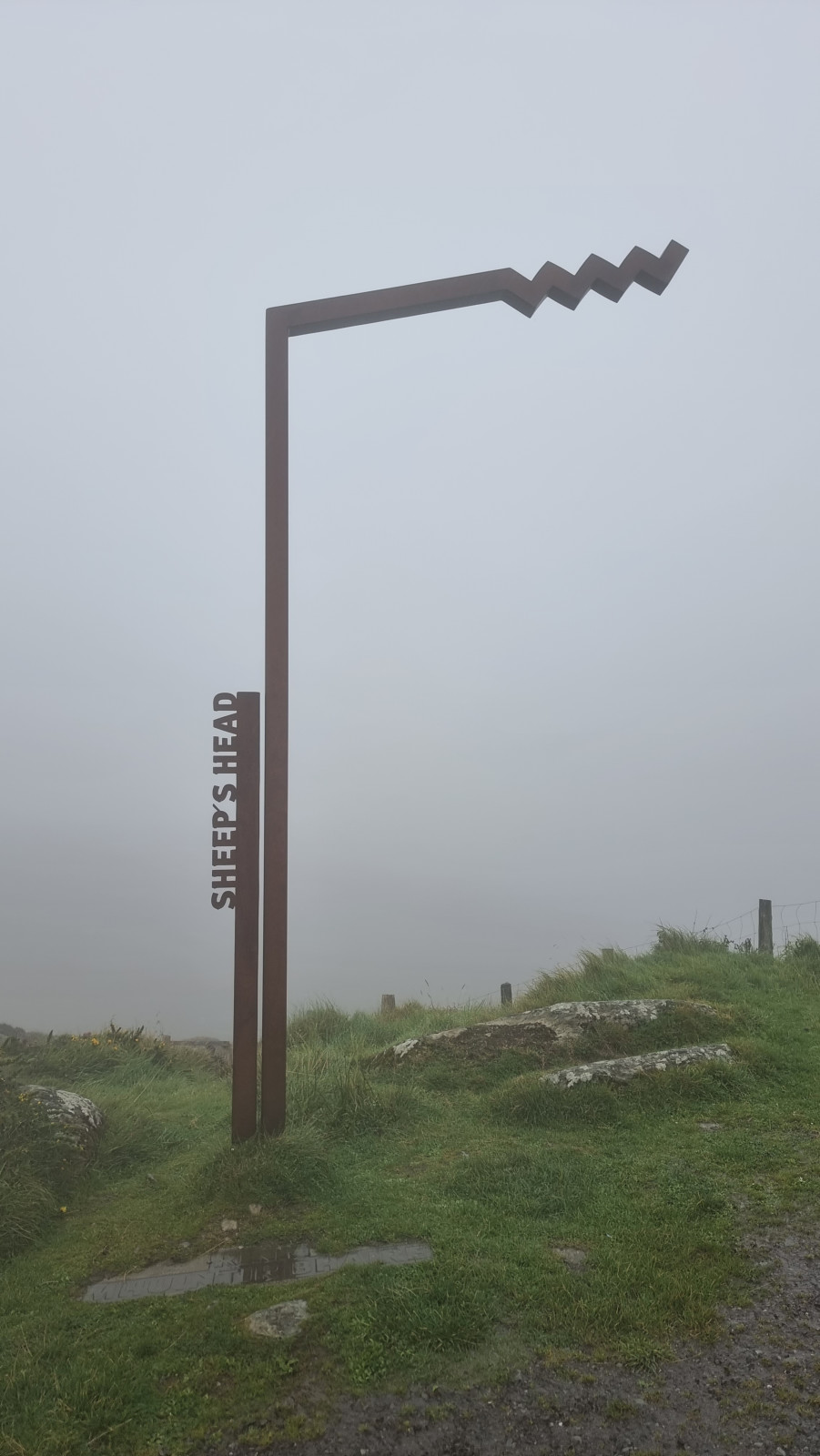
Here too, as at all the sights along the Wild Atlantic Way, stands a post with the WAW logo. Always a sure sign that you’re still on the right path.
The charm of Ireland on a few square metres
Already on the way to Sheep’s Head we’d noticed this little shop in Kilcrohane. Now, on the way back, we want to take a look at J.F. O’Mahoney’s got-everything shop. This ur-Irish name alone makes you curious. Hang on! O’Mahoney? Perhaps a descendant of the builders of Three Castle Head?
This enterprising man offers everything, at any rate. It’s a filling station, but also a small supermarket, kiosk, café with an attached second-hand bookshop and restaurant. Rustic, cosy and quirky. The ceiling is plastered with records and other things, not a square centimetre in the shop is free. Everywhere stands and hangs something you need, or don’t, which is probably why it’s been hanging there forever. In the middle of it fridges, shelves, a counter and a coffee machine.
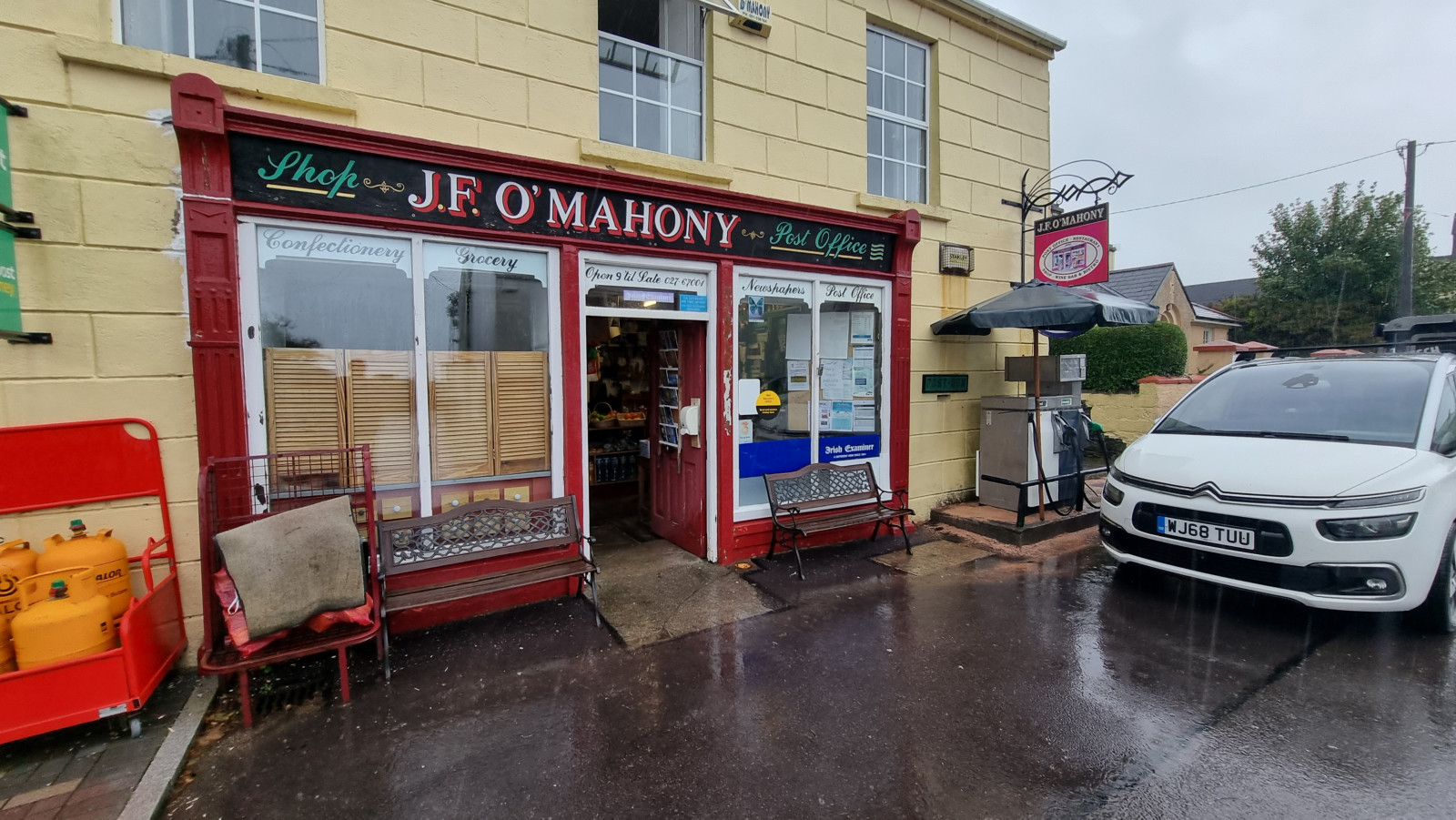
For want of Guinness beer in the shop, the friendly owner immediately offers me his private stock. I’m reluctant to rob him of his supplies, but he won’t let up either. So we settle on three cans for me and three for him. I gratefully buy them off him and we quickly sign a petition against EU bureaucracy, which is increasingly getting to him. A shame, really; such quirky and lovely places really must be preserved.
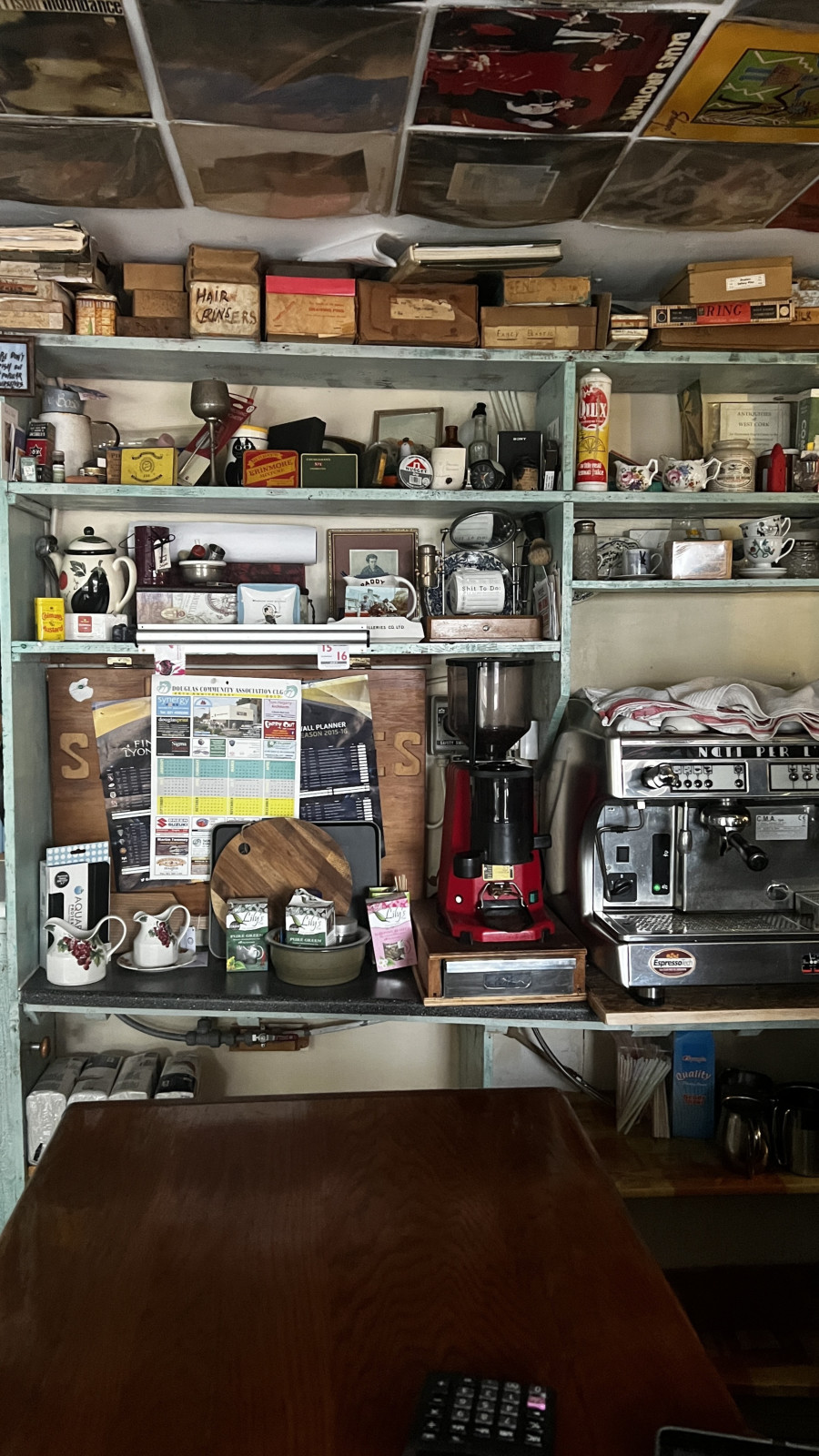
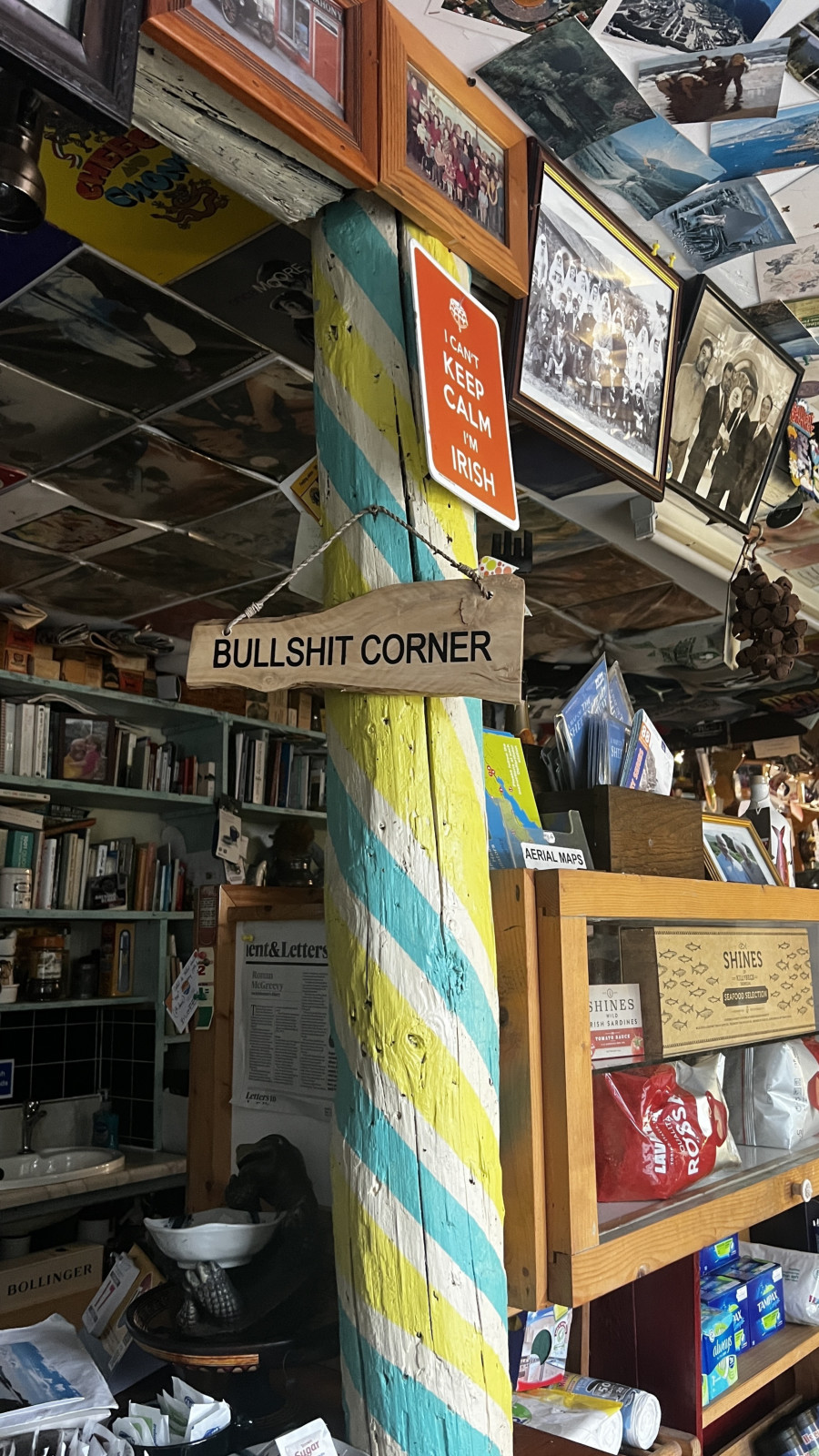
We cover a few more kilometres and for this night book onto the Glengarriff Caravan & Camping Park. It’s not the campsite of our dreams, but it’s fine. In the evening we go to the bar in the events building on the grounds for something to eat: fish and chips. Then we enjoy a beer or two and once again go to sleep in the rain.
A must: an Irish breakfast
When we open our eyes the next morning, the weather is still very poor. Perfect! That way we don’t even get the idea of making our own breakfast. We’d rather have it served to us in Glengarriff. At the Sugarloaf Cafe we strike lucky. In the best of moods, the owner greets us warmly, already busily frying this and that in the kitchen.

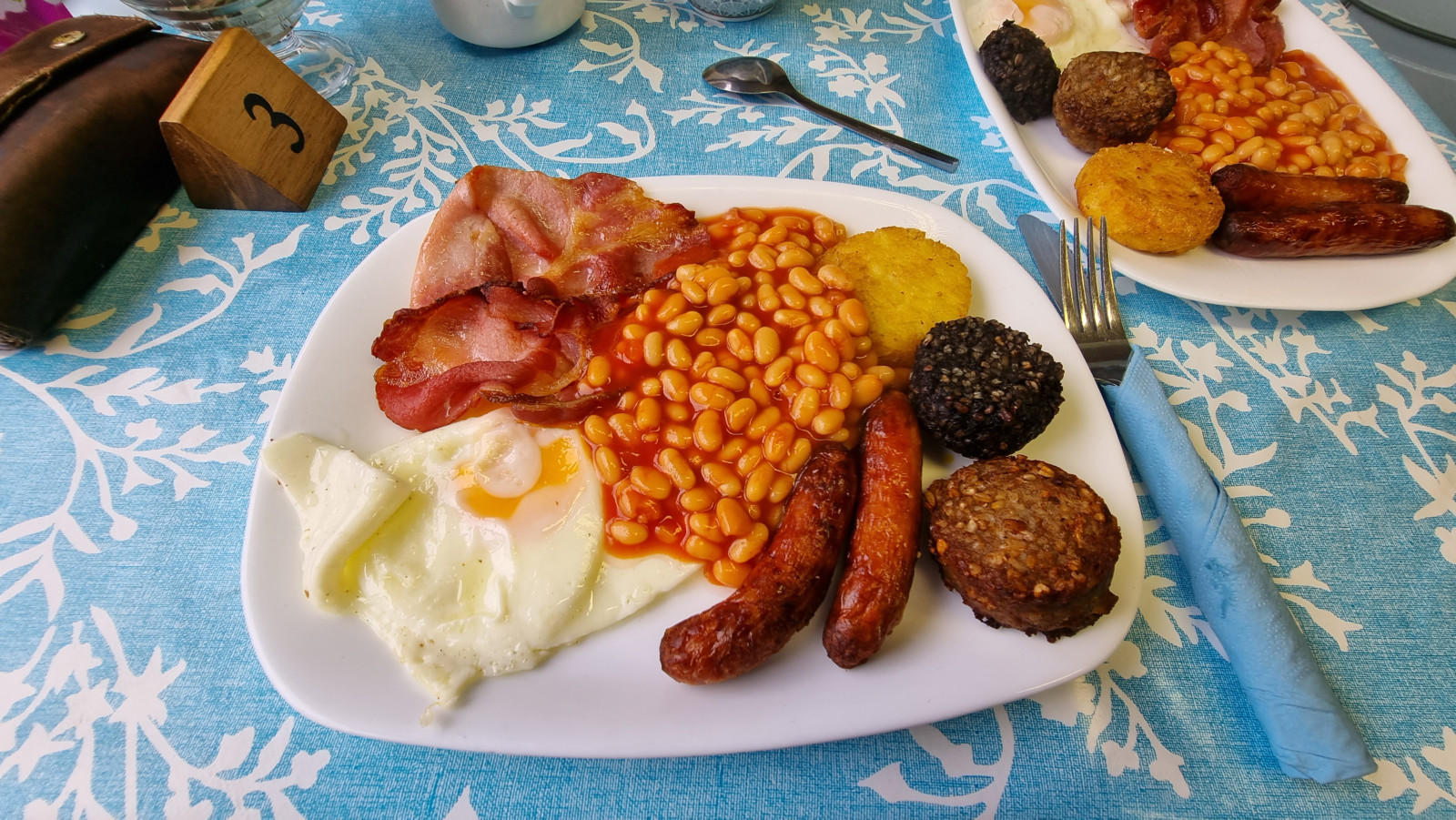
We feel at ease straight away and order an Irish breakfast. It’s both hearty and sweet. Bacon, black pudding, sausages and fried egg, with mushrooms, toast and butter and a pot of coffee. That’s how a day is allowed to start, and here we have a perfect one.
The Man Machine
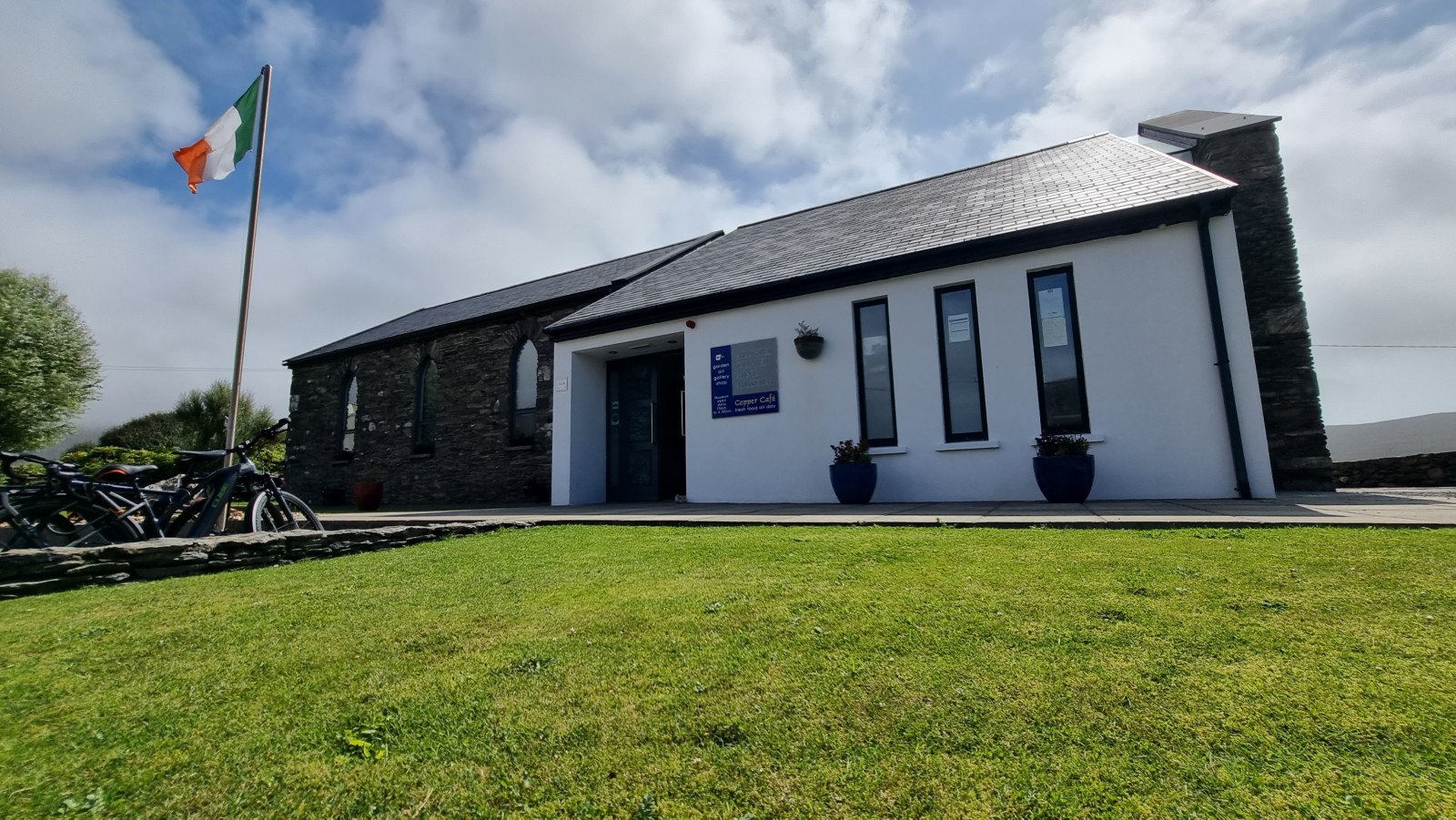
Nik has already tracked down the next destination. She really wants to visit the Allihies copper mine. In Allihies an old church has been converted into a museum with a café. First we go into the museum and read up on the copper mining that broke over this region from 1812 and changed everything. The museum is small but very well done. Afterwards we refuel in the café.
Across the whole region the mine works began, and engine houses with steam engines sprang up, which for a good 50 years mainly pumped out the groundwater. From 1860 there came a new development, the „Man Machine“. It was meant to boost productivity considerably. The „Man Machine“ was nothing other than a forerunner of the escalator. It let the workers get to their workplace underground and back again much faster and without tiring. That left more time and puff for the backbreaking work in the tunnels.
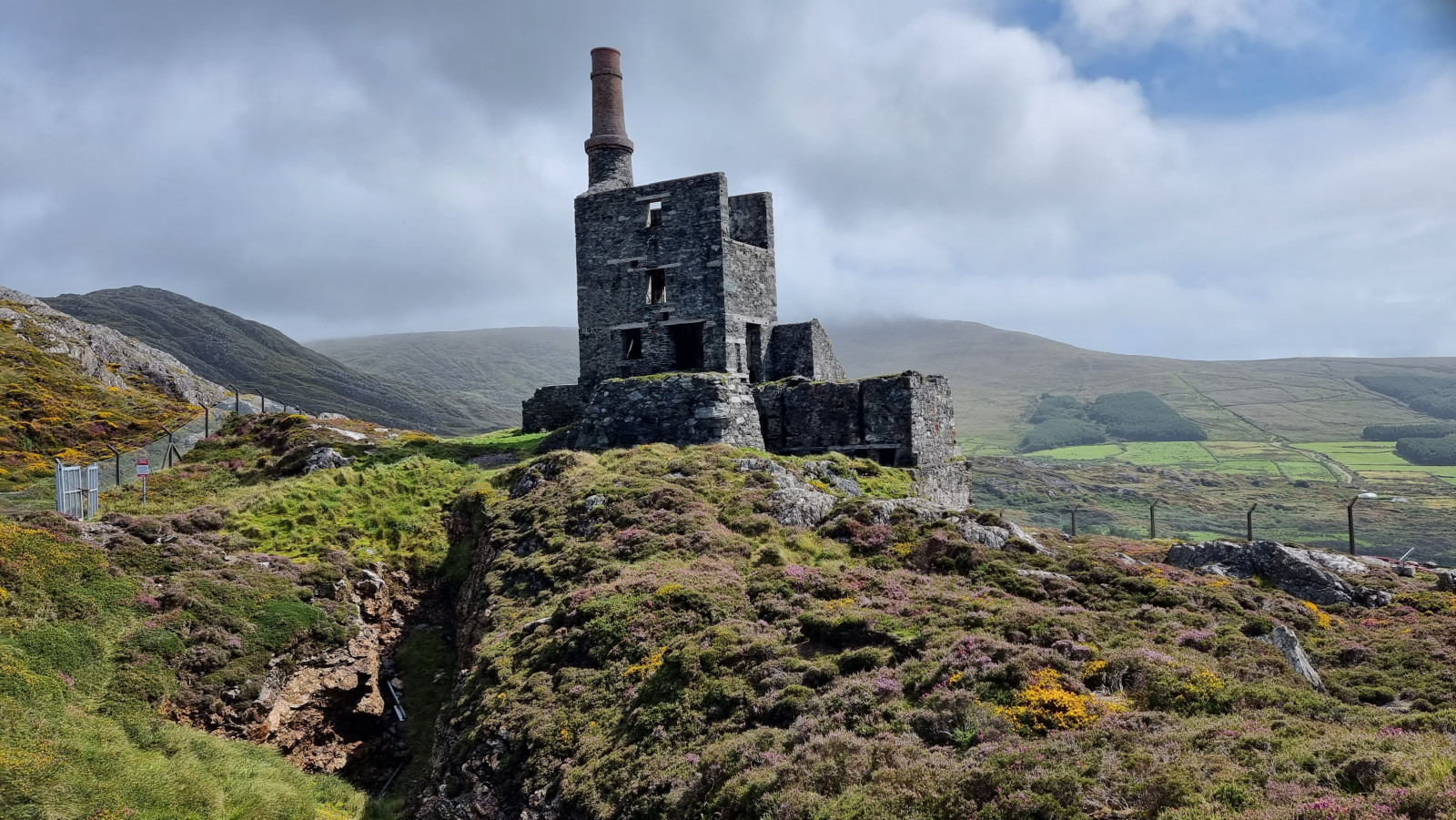
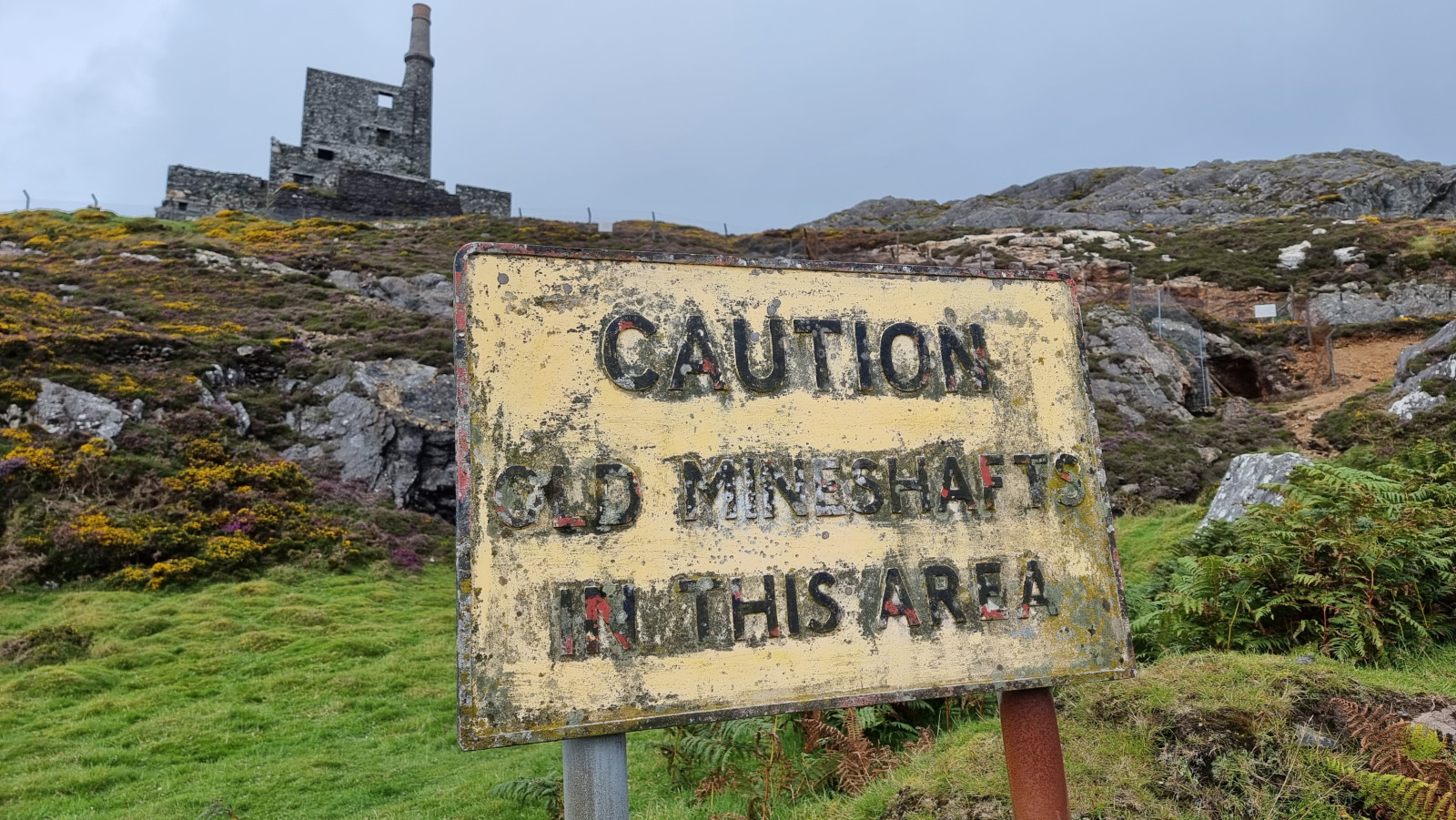
The engine house still stands there today and is among the last in the whole world. We park the car a little below and hike up, only to find that we could have driven all the way up there too. Closer access to the ruin is forbidden, as the whole ground is fragile. Everywhere there are large and small holes with water running through them. At some point all of this will probably collapse.
A bit of off-road
Up there we see that the path continues and decide to drive the Copper Mine Trail (Old Copper Road), which gives us a little off-road experience over gravel tracks. We’re rewarded with wonderful views over the landscape and the sea, until at the fork near Gort we come back onto tarmac.
 Ein bisschen Piste muss schon sein. Oberhalb von Allihies.
Derreen Garden
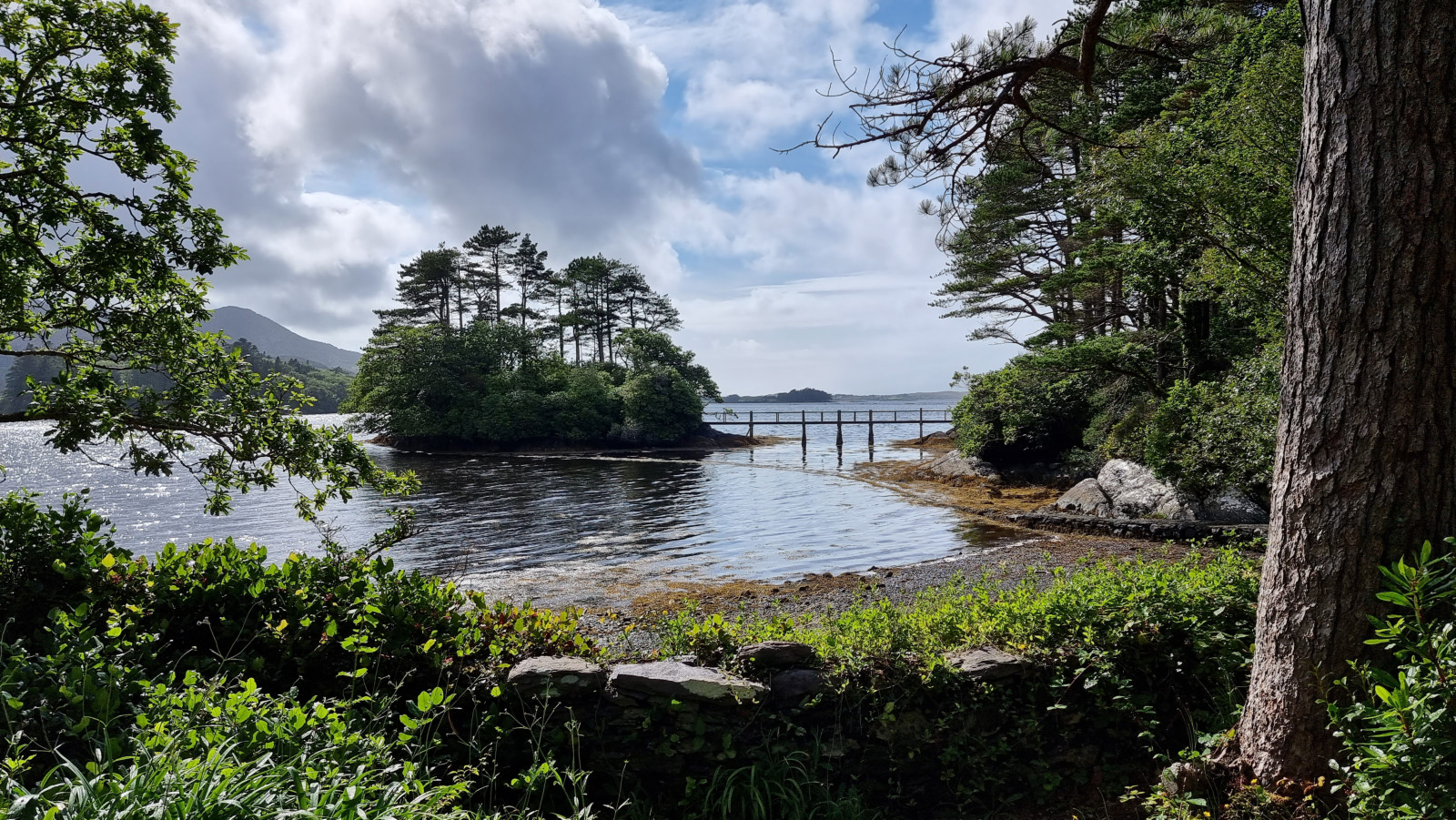
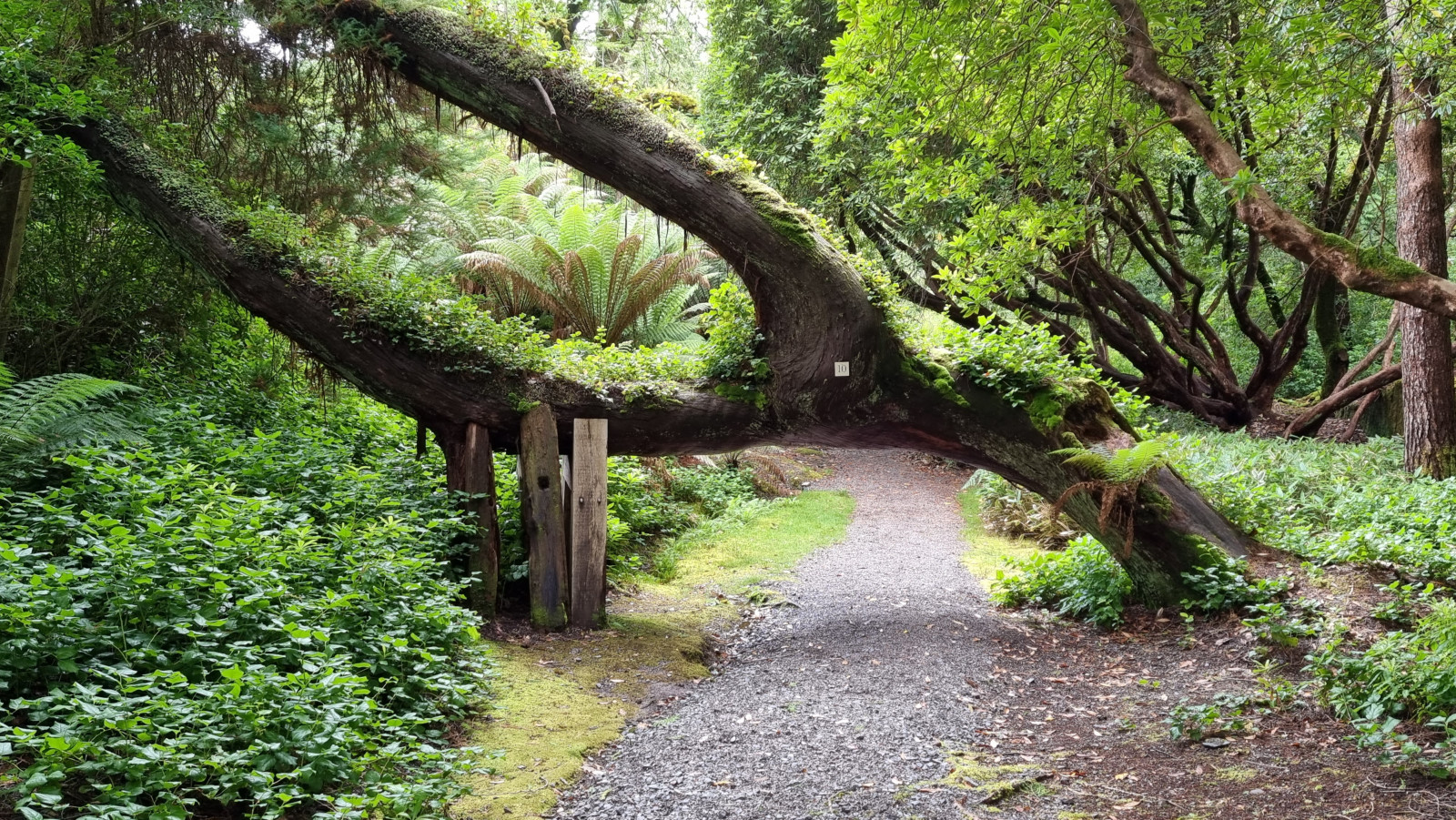
We roll on along the Wild Atlantic Way towards Derreen Garden. We park and enter this 243,000 m2 site. Small paths wind through this enchanted arboretum, laid out from 1863, which is home to exotic trees and metre-high tree ferns. Anyone with time can walk all 12 kilometres of paths; we limit ourselves to a part of them. Again and again we come upon small hidden, romantic corners that invite you to linger, while the gaze keeps sliding over the water, into which the sun is slowly sinking.




Kenmare
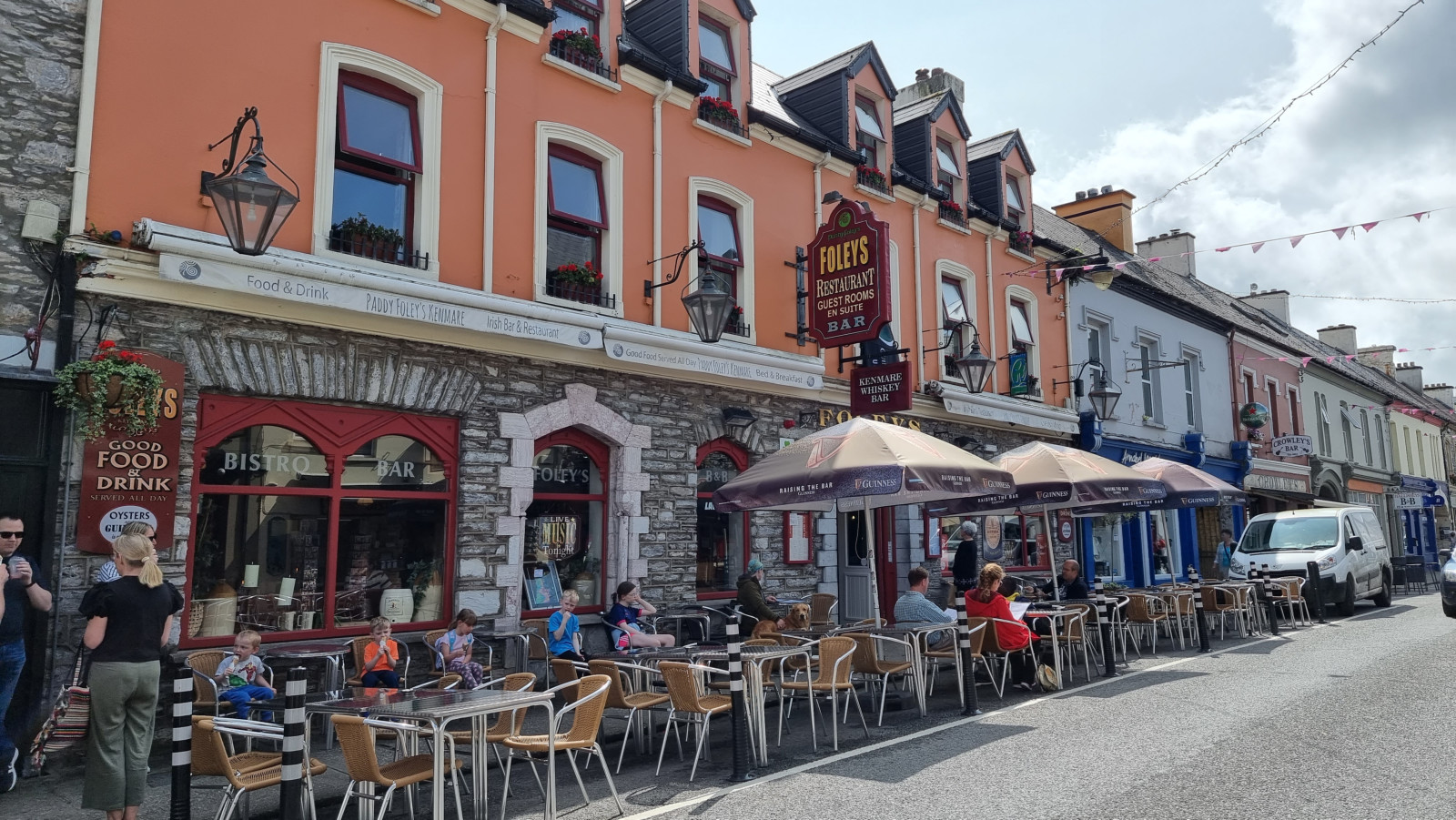
We come through the little town of Kenmare. A colourful bustle around us, everywhere the typical tightly packed colourful little houses with their hand-painted signs or walls. Shop after shop, pub next to pub, and a hubbub without it seeming hectic. We come to the conclusion that this is the right place to get a little taste of an Irish small town. We park the car and set off with Guinness. First port of call is a small restaurant, Foleys. Once again I order fish and chips. After all, you have to be able to compare. These are good, at any rate. The tables are set up on the pavement and the parking strip. Unthinkable in Germany. Here it bothers no one, and closely packed the people go their way between the tables. With a bit of mutual consideration it all works.

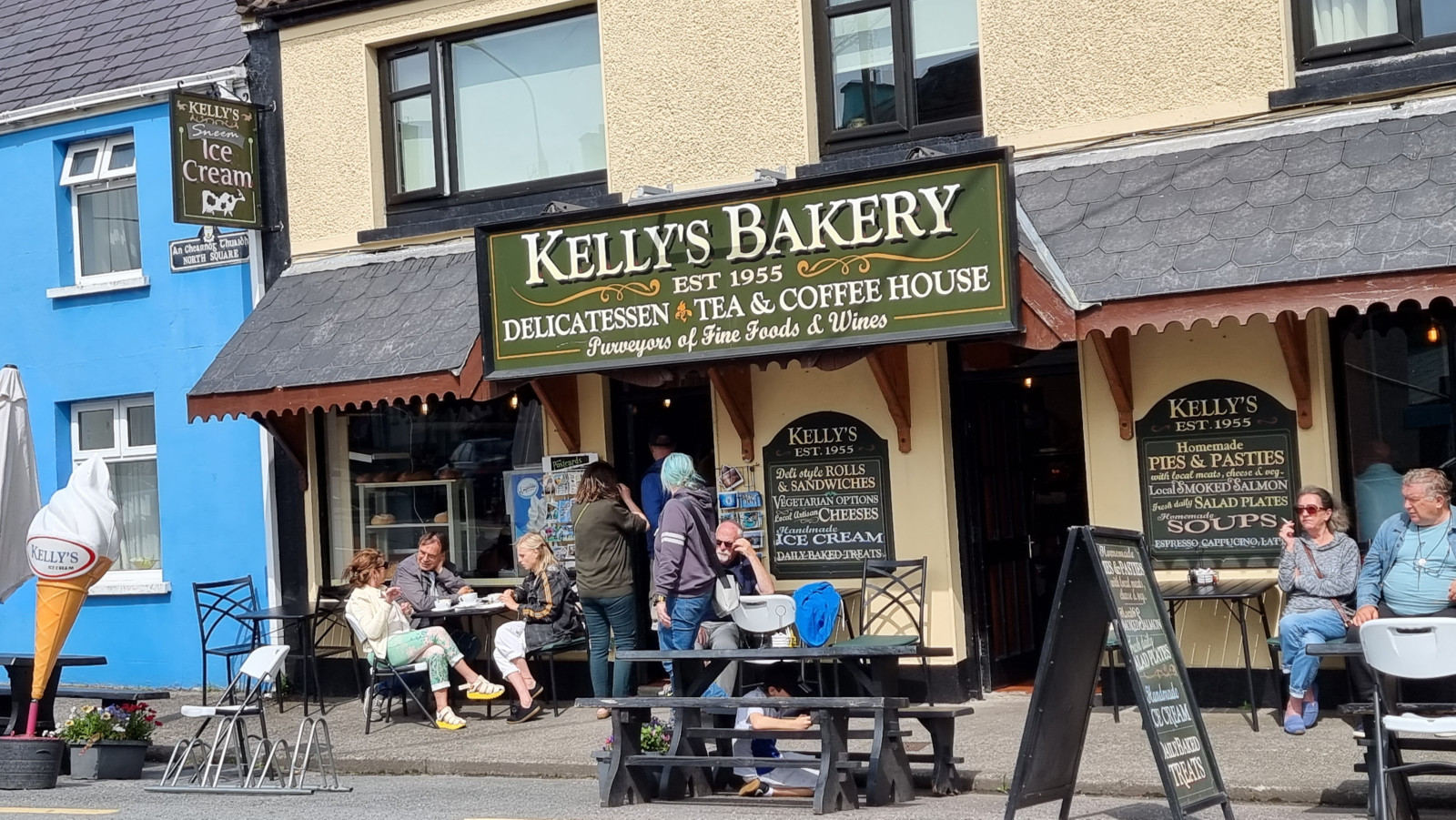
Next we come through Sneem. This is where Kelly’s Bakery is! Of course we want to go there. Nik got this tip from a book. If you pass by, stop, go in and buy something, as it’s said to be very tasty. Yes, we can confirm that, it was worth it. A queue of people outside the door bears witness to that too.
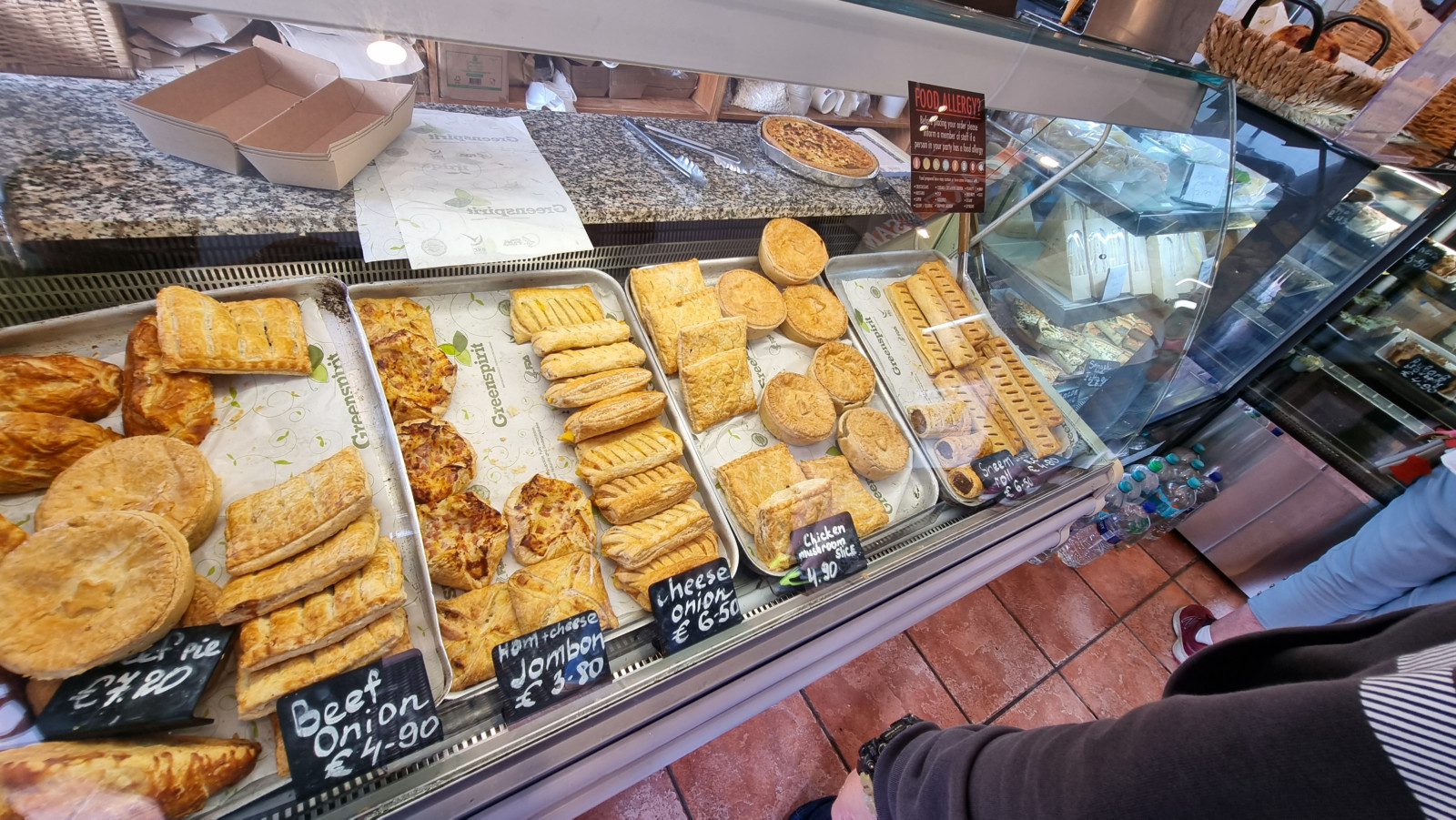
We buy a few delicious pasties, they come in numerous varieties. Let’s not even get started on all the sweet things. We stock up for supper and maybe tomorrow’s lunch too.
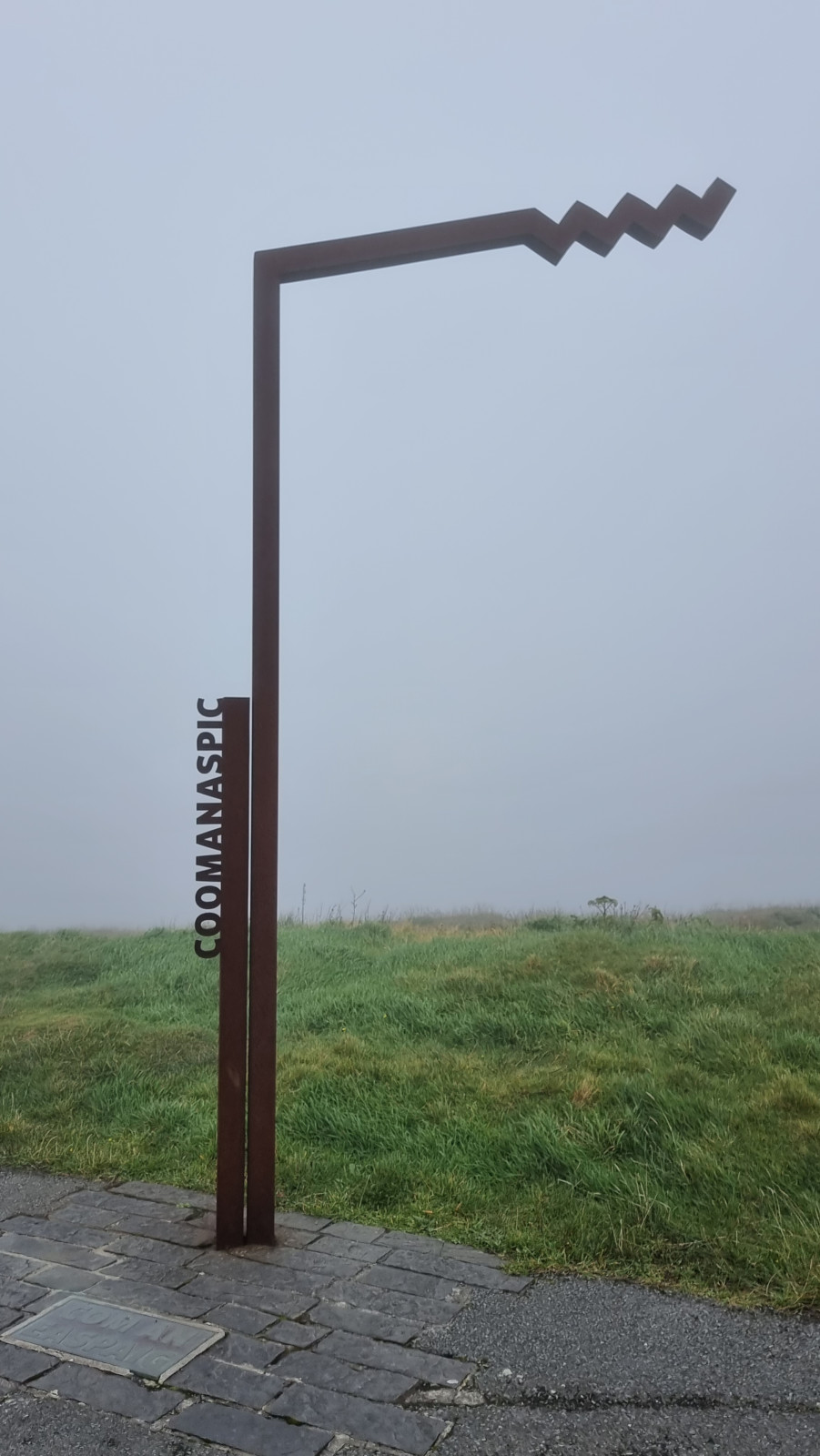
On our way we pass Coomanaspic. There should really be a lovely view of Dingle Bay here, but we’re in Ireland. So the land once again wraps itself protectively in fog, so that no one can peek at anything. But we were there, at least.
Kerry Cliffs
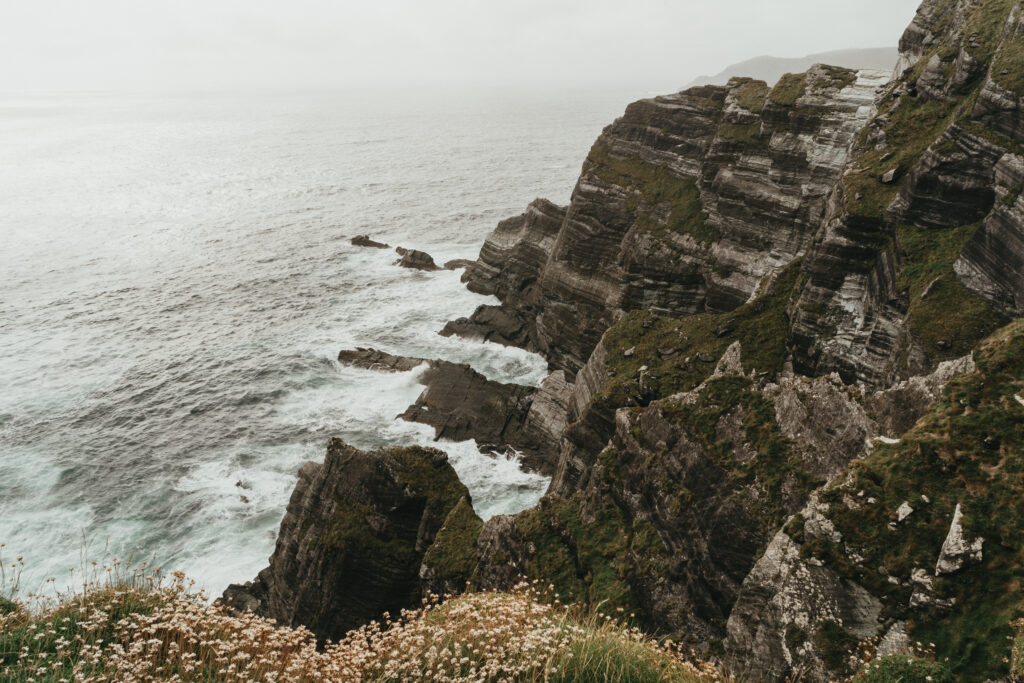
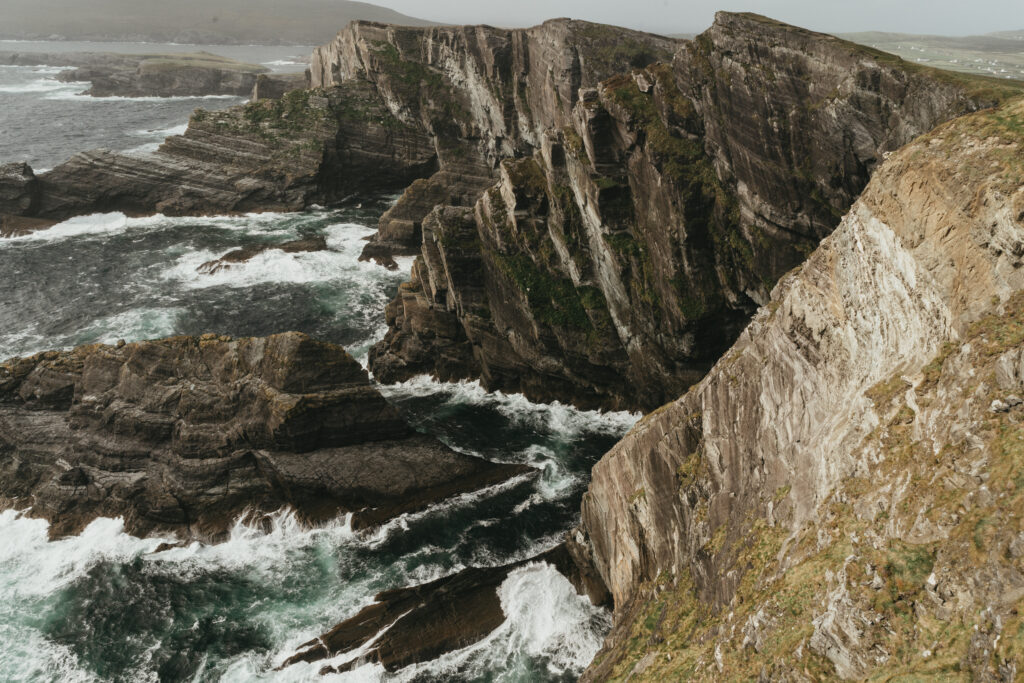
Just a little further we come to the Kerry Cliffs. What? Nobody knows them? Everyone knows the Cliffs of Moher, and it’s touristy there to match, but I find the Kerry Cliffs almost more beautiful. Of course there are tourists here too and we have to pay an entrance fee, but it pays off, as we’ll find out. From 300 metres above the Atlantic, the Kerry Cliffs open up a spectacular view of the steep cliffs, against which the sea breaks ceaselessly with a loud roar.
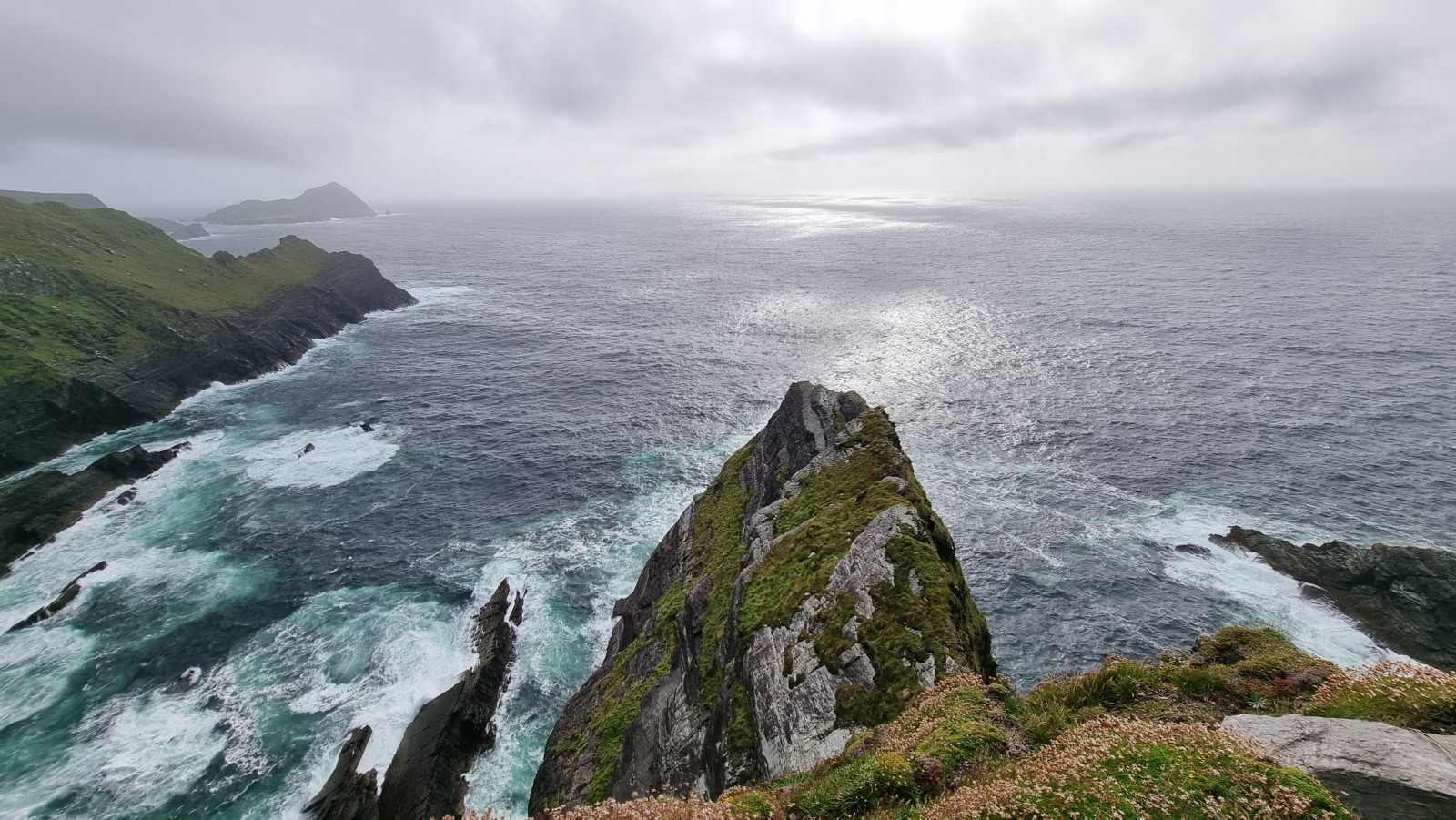
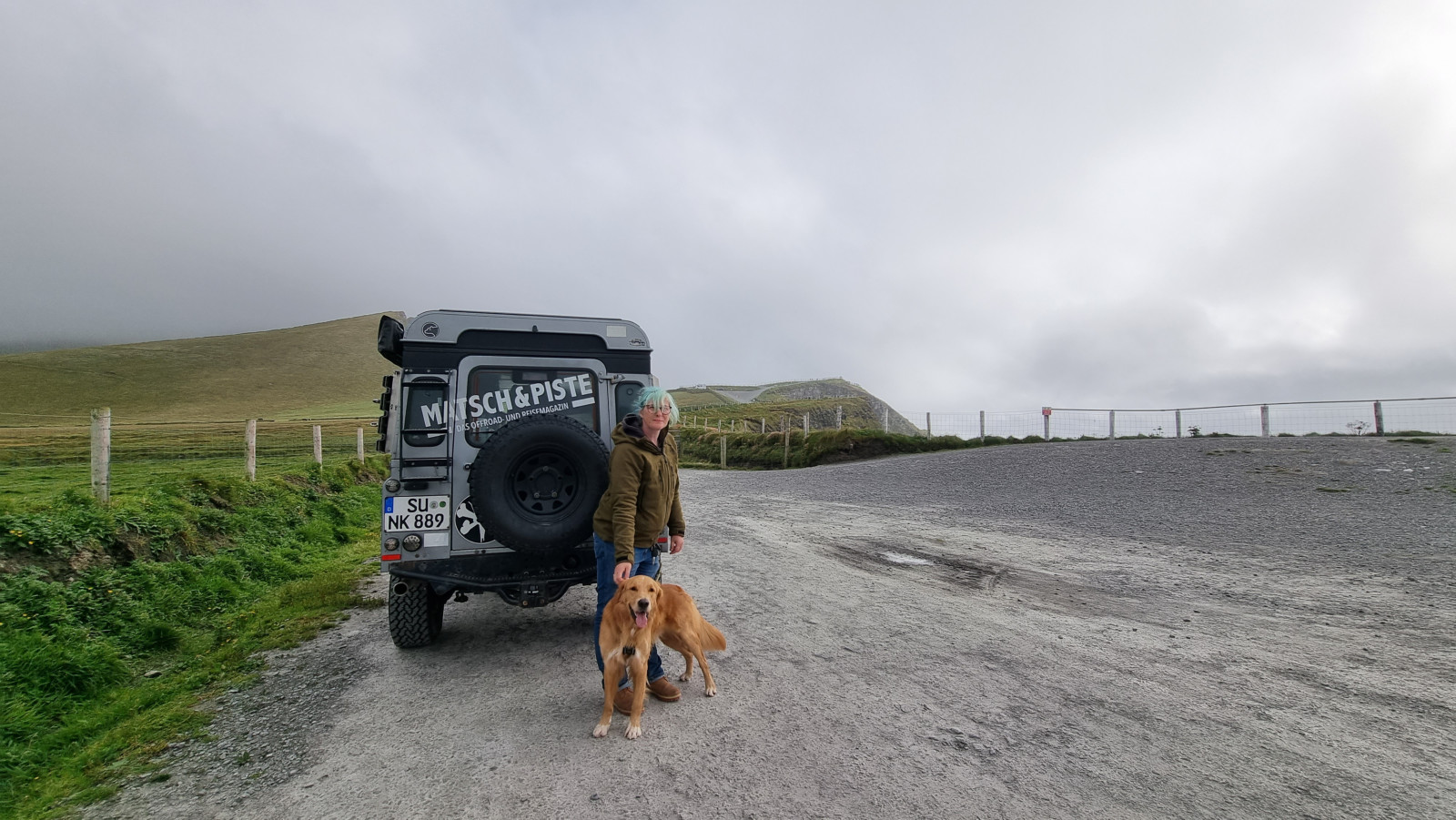
A sign at a small picnic area up there catches our eye, saying that camping on the meadow is currently not allowed. Currently? So otherwise it would be allowed? We go back to the ticket booth and ask. Lo and behold, you can camp here, just not on the meadow. For 20 euros we can drive through the barrier, against the departing stream of visitors, and look for a quiet spot right by the cliffs. We don’t need telling twice. Ten minutes later we’ve found our spot. It stays windy, but with that view it doesn’t matter.
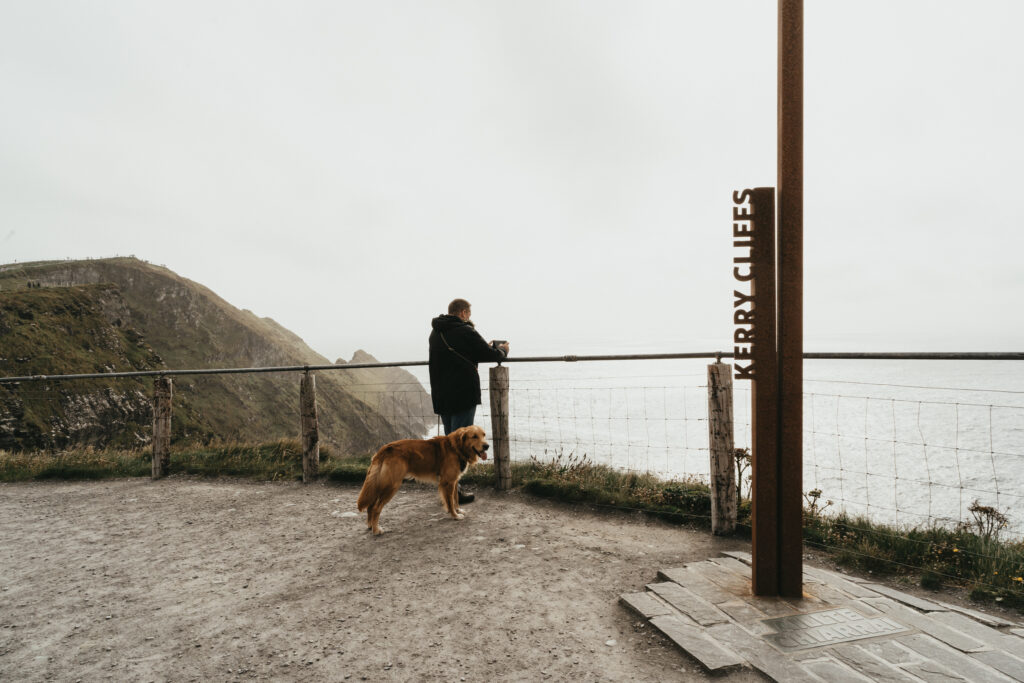
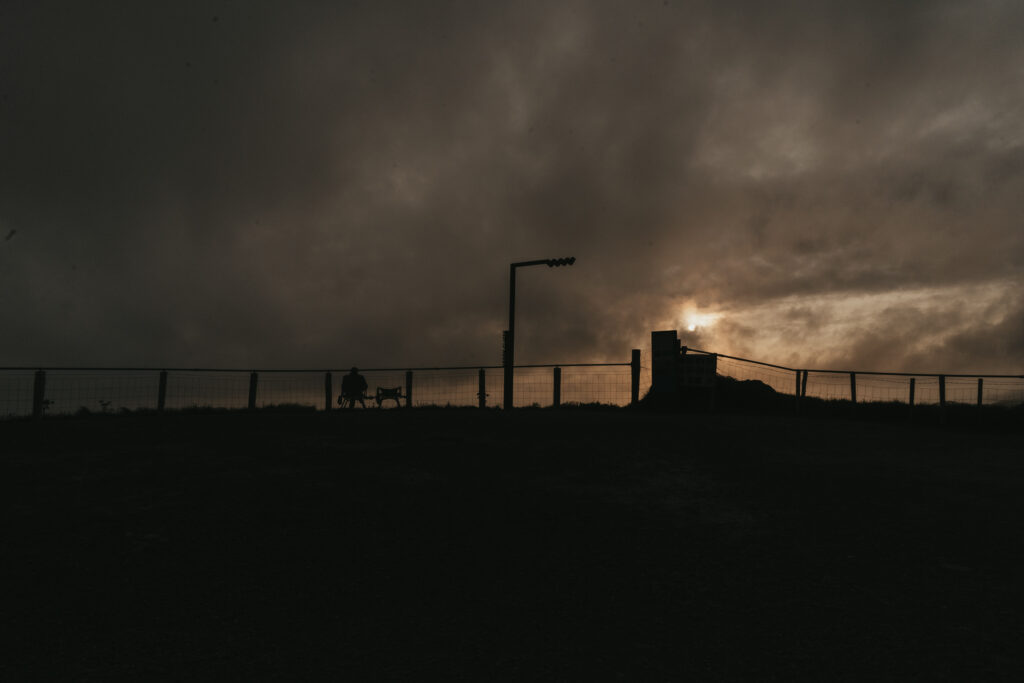
Shortly after 6pm we’re alone up there. We get our chairs out and settle down with wool blankets and a tasty whiskey right by the fence, because we’re facing west, and that, as everyone knows, is where the sun sets. The wind drives the spray up to us, a slightly salty taste forms in the mouth. A unique and interesting mix with the whiskey. What a great evening.
On to Dingle
Via Valentia Island and a short ferry crossing we carry on to Dingle. We’d already been here in 2015, so we knew Inch Beach. My plan was to drive the car far out onto the beach there and then give Guinness a little present: as a water baby he loves to run free and hurl himself into the waves. Inch Beach is flat, wide and big enough, and so ideal.
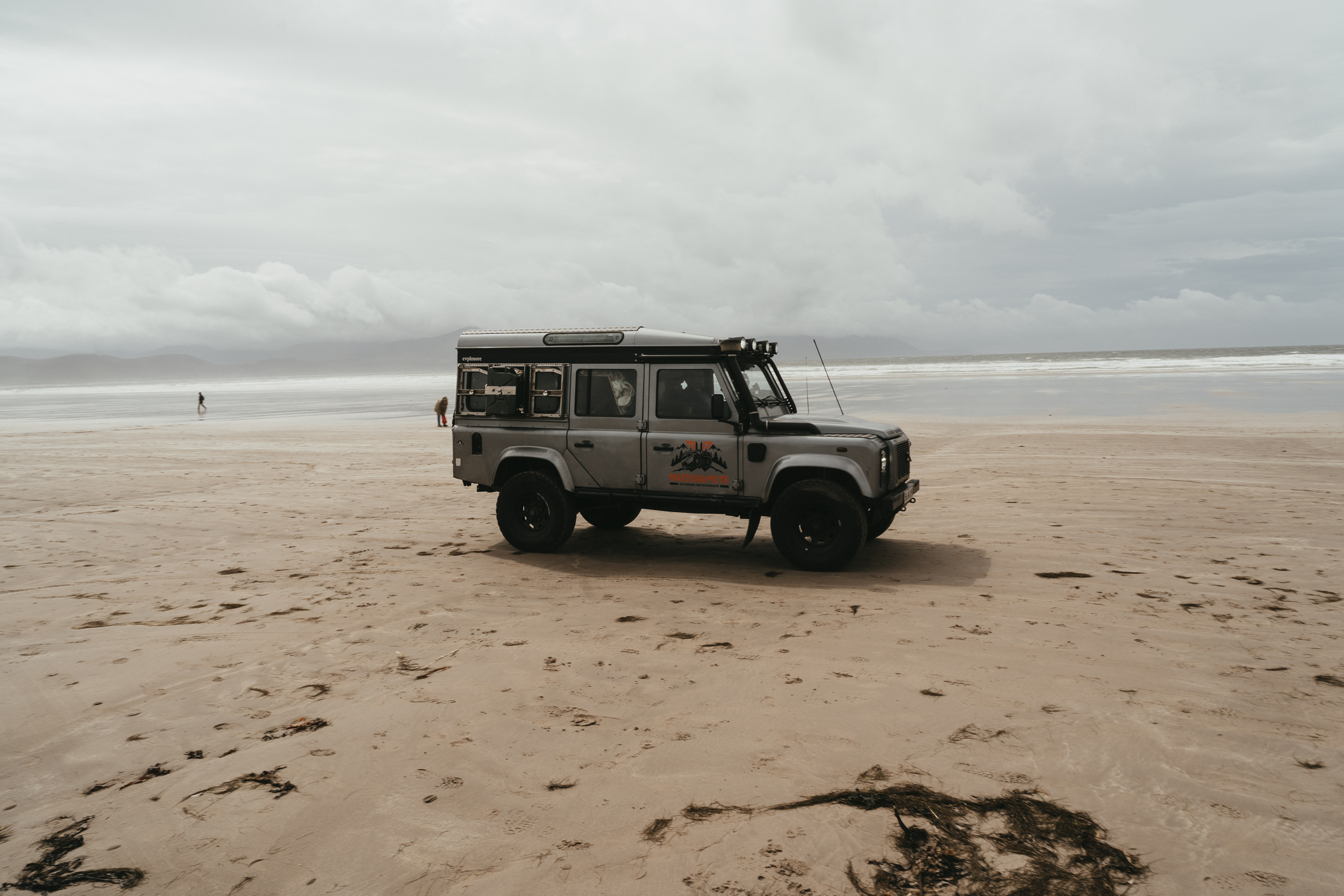
So off we go, shoes off, shorts on and away! Guinness simply can’t be stopped! I have to keep an eye on him so he doesn’t overdo it, because right now all he knows is running and swimming. We have great fun and it’s a real joy to watch him at it. After a while I end the game and we go back to the car to have a little something. That was a good thing, Guinness reckons too.


Dingle pub and hardware store
In Dingle we have a fixed goal. Foxy John’s is headed „Bar & Hardware“. Put simply, that’s a hardware and DIY shop with a pub. A brilliant idea, really, to bring the two together. We enter the shop with Guinness in tow. On the left is the counter for the beer, on the right for spades, ropes and rat poison. But there too men sit with their glasses and have a chat.

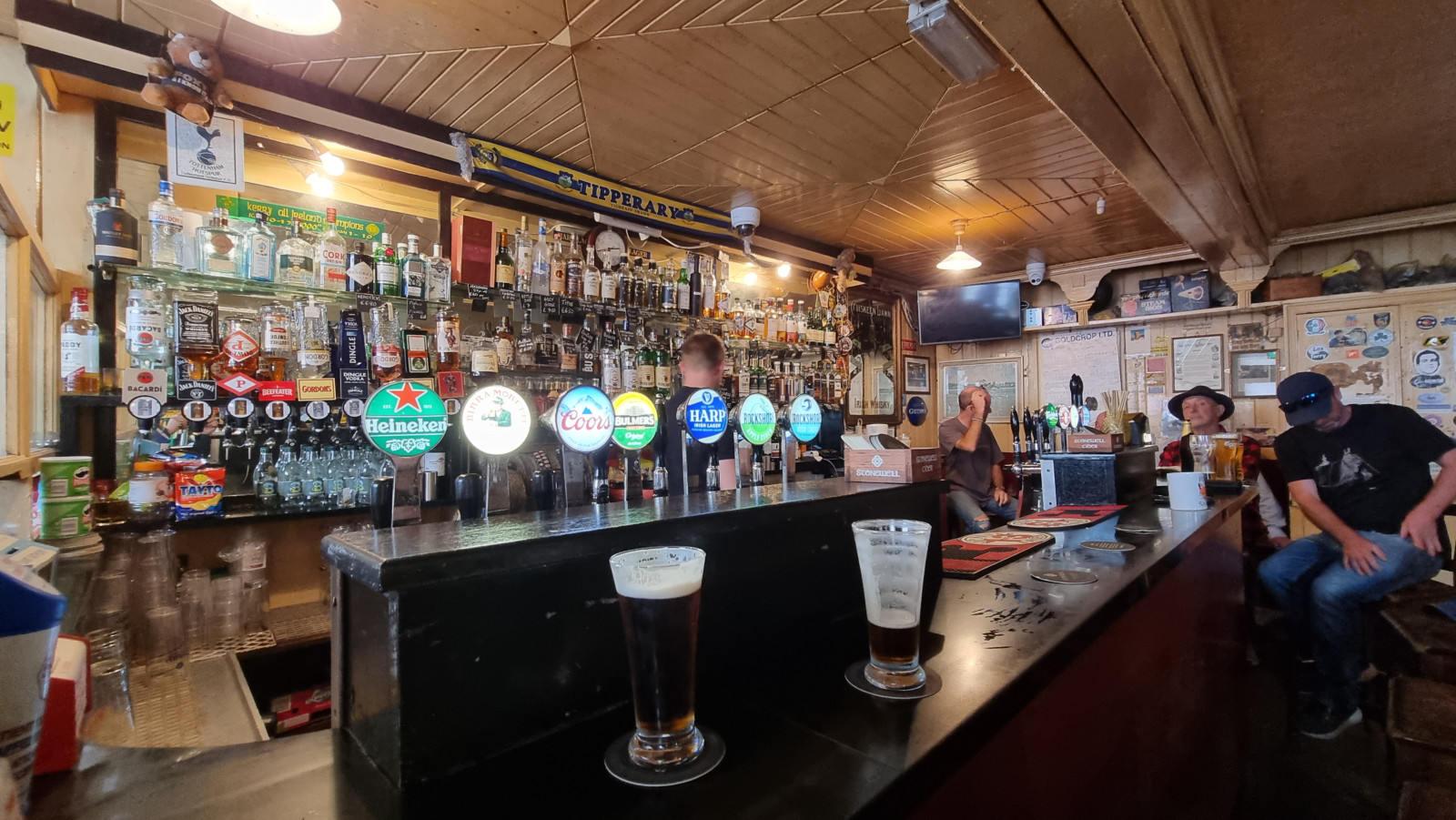
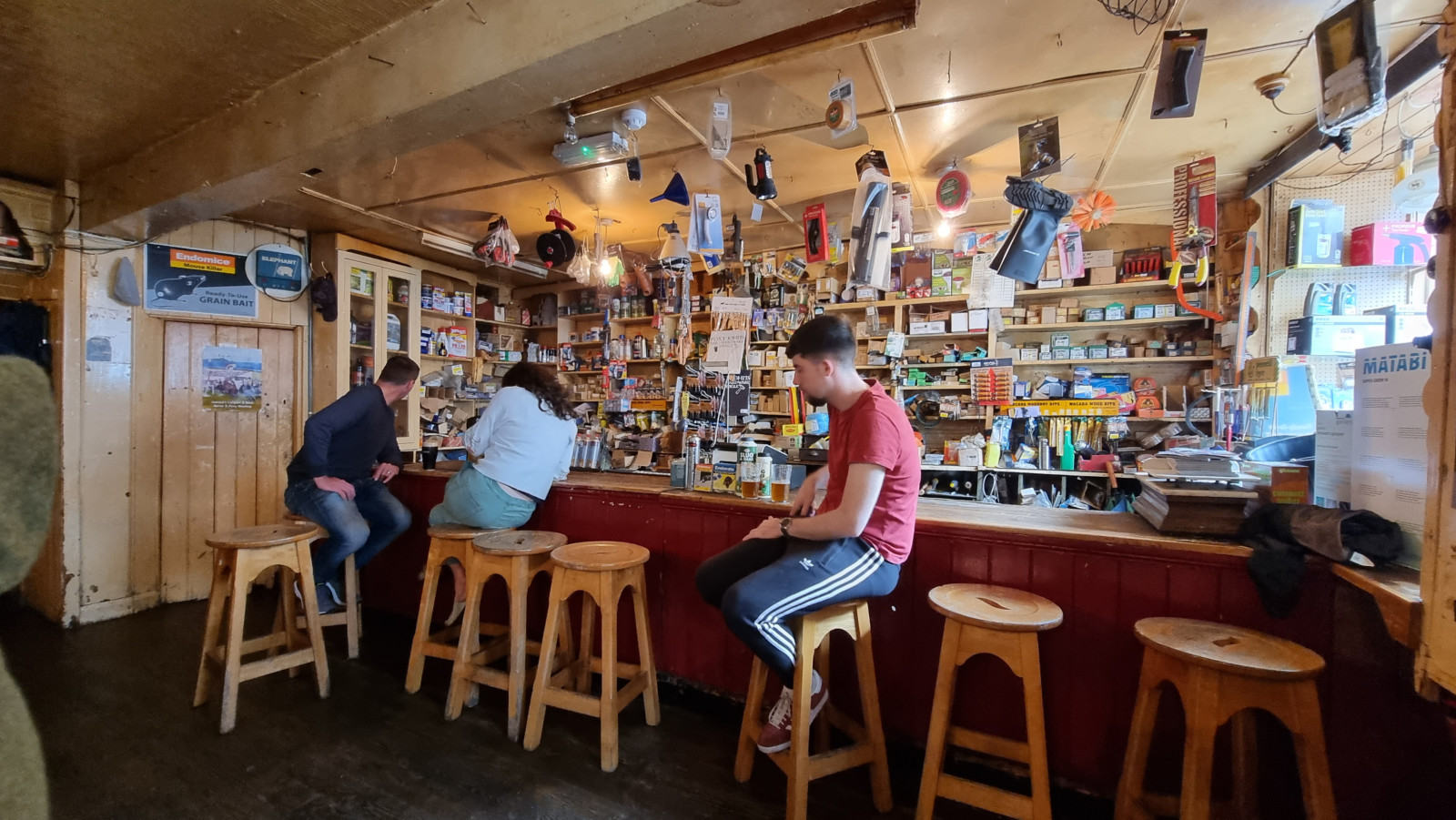
The owner sits with his dog on a bench at the end of the counter, his son pulls beer and immediately asks where we’re from. Another man says he’ll have to fetch his dog now too, since there are already two here. Yet another comes in with a dog, and the central aisle is full of paws, a funny situation. We have fun and nice conversations for a few beers, then we have to move on. We say goodbye to the friendly round, there are still a few kilometres to knock off.
To the Connor Pass
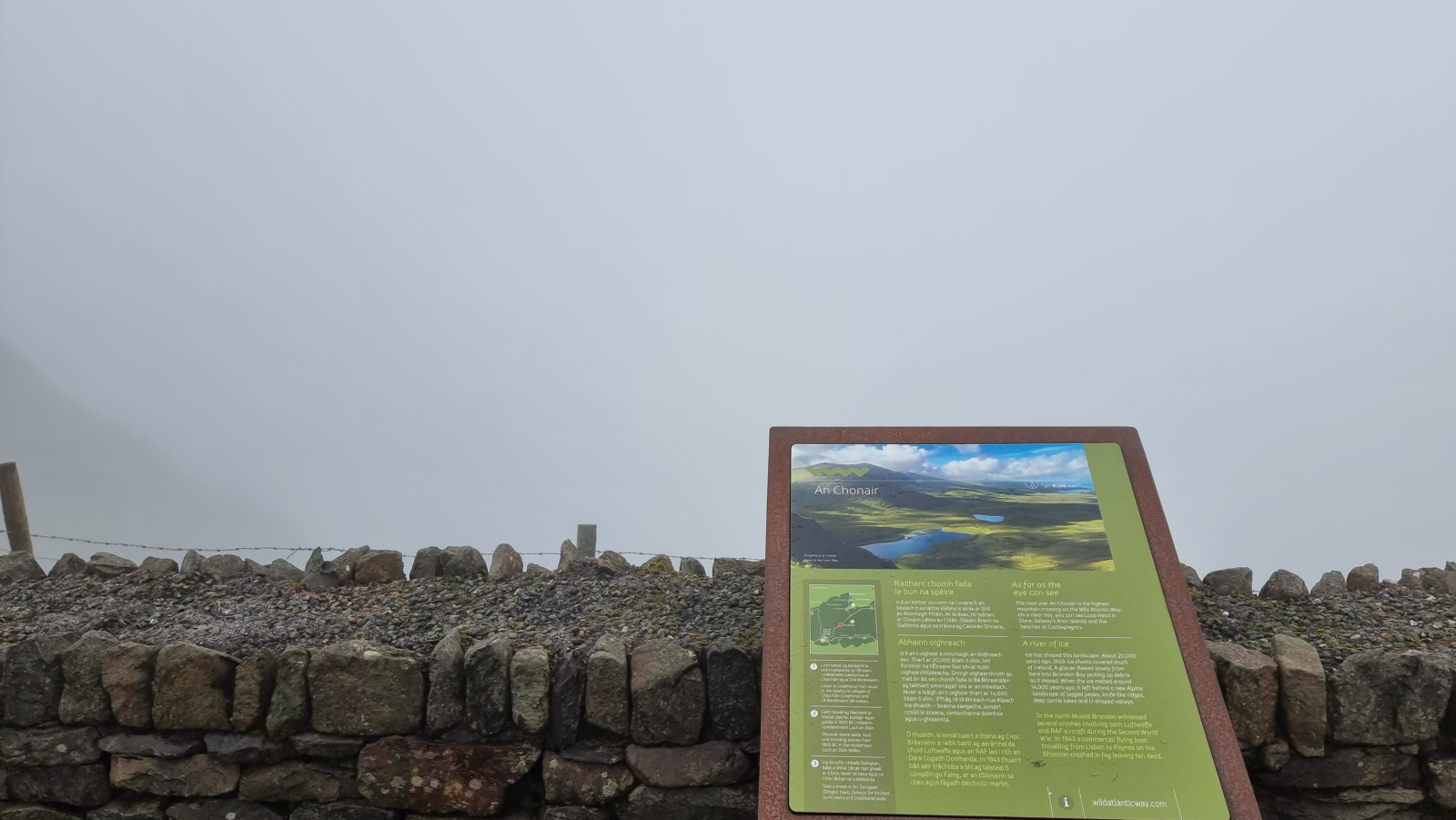
We drive around the peninsula, the road leads us back to Dingle. From there we take the route to the Connor Pass, which we also know from 2015. Back then we’d started an off-road tour from here that wasn’t easy, but at least took place in the best weather. What can I say? You might guess it: this time everything lies in the thickest fog. The information board hints at what we’re missing. But the pass isn’t the only attraction; the Connor Pass Road is worth driving too. One of Ireland’s most beautiful roads.


Carrigaholt Castle
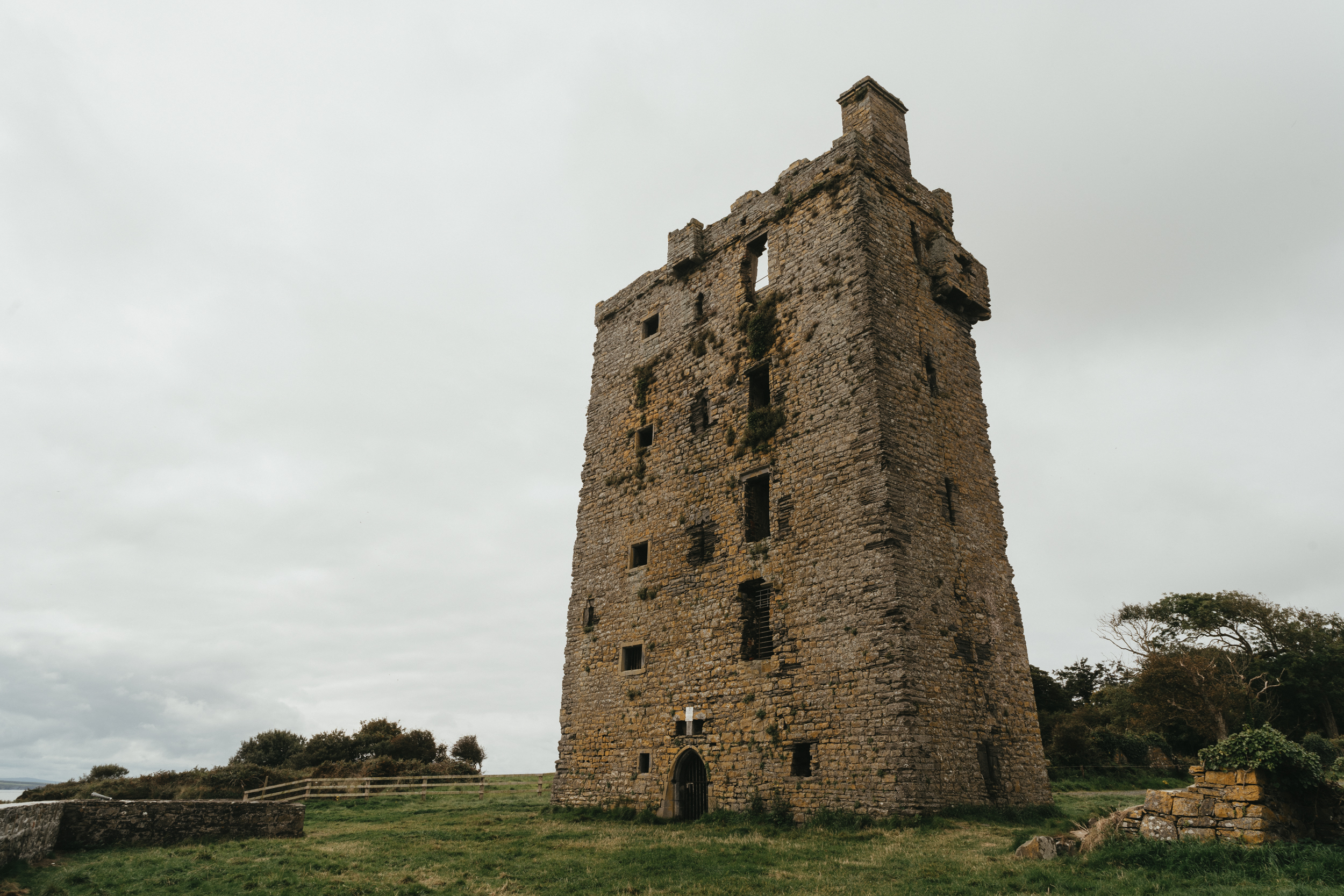
We manage a few kilometres north and cross the Shannon by ferry at Tarbert. We briefly take a look at Carrigaholt Castle and drive on to the Loop Head lighthouse. We’d already visited it in 2015, so we don’t walk around the whole site again. At the back there’s a large rock inhabited by many birds, and you have a clear view over the sea.
 Carrigaholt Castle
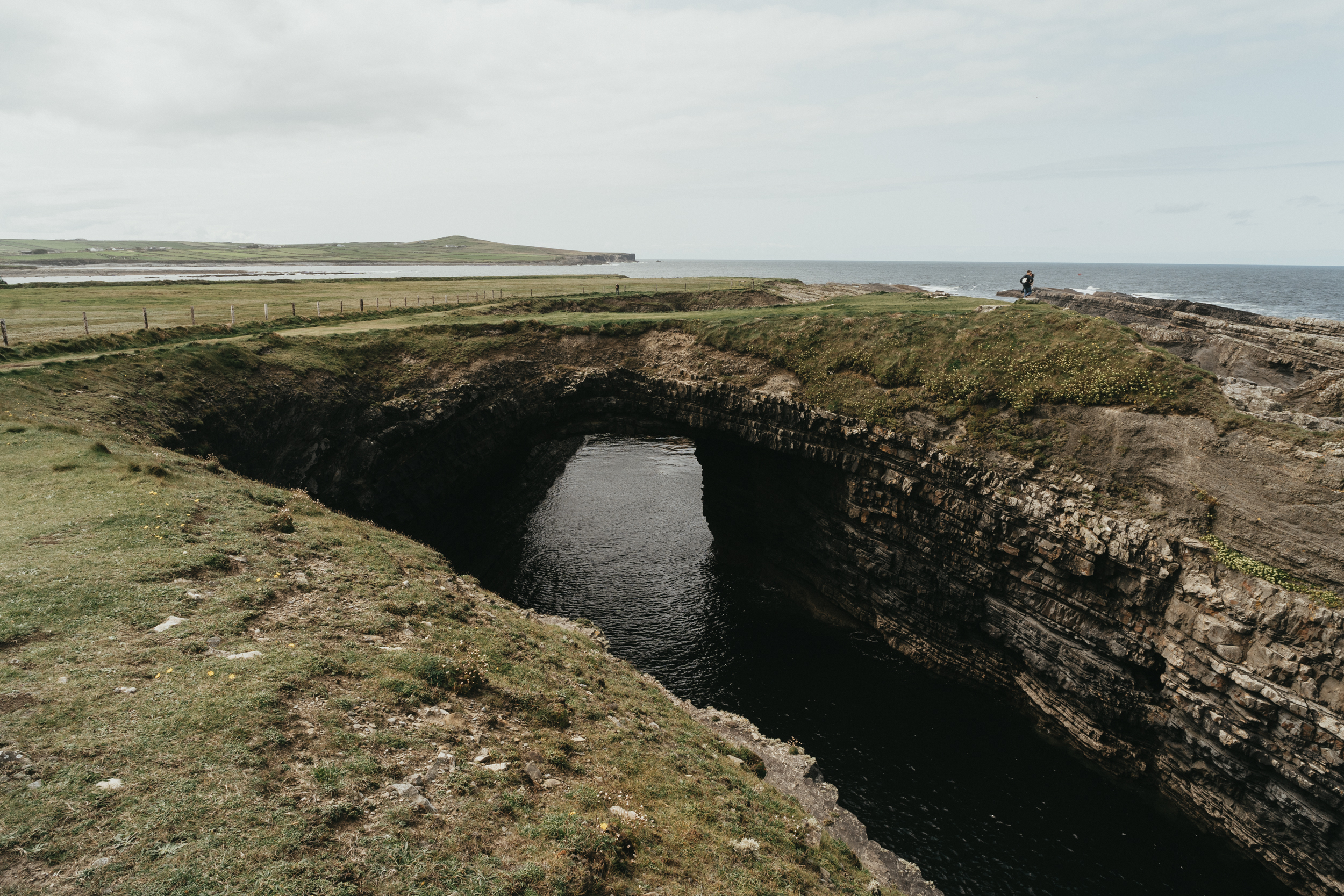
We don’t stay long and drive on to another well-known attraction, the Bridges of Ross. These are natural stone bridges formed over many thousands of years by the sea’s surf. Some have already collapsed, but one bridge still stands. From here you can take a little walk along this rocky coast, and perhaps a small picnic suggests itself.
 Bridges of Ross
We come through Kilkee and discover a lovely beach. Here the water is very shallow, so it reaches far into the bay. Ideal for a bit more romping about with Guinness. After he’s let off steam, we carry on to the Burren.
Into the Burren
This karst landscape is world-famous; it consists of rectangular fields of stone over an area of about 250 km2. Many small paths lead through it, and the Burren can be walked through well too. We head for the Burren Perfumery. This little perfumery with a shop is like a colourful, fertile gem in the stone landscape. Beside the shop there’s also a small café that looks very inviting. Sadly it’s already closed.
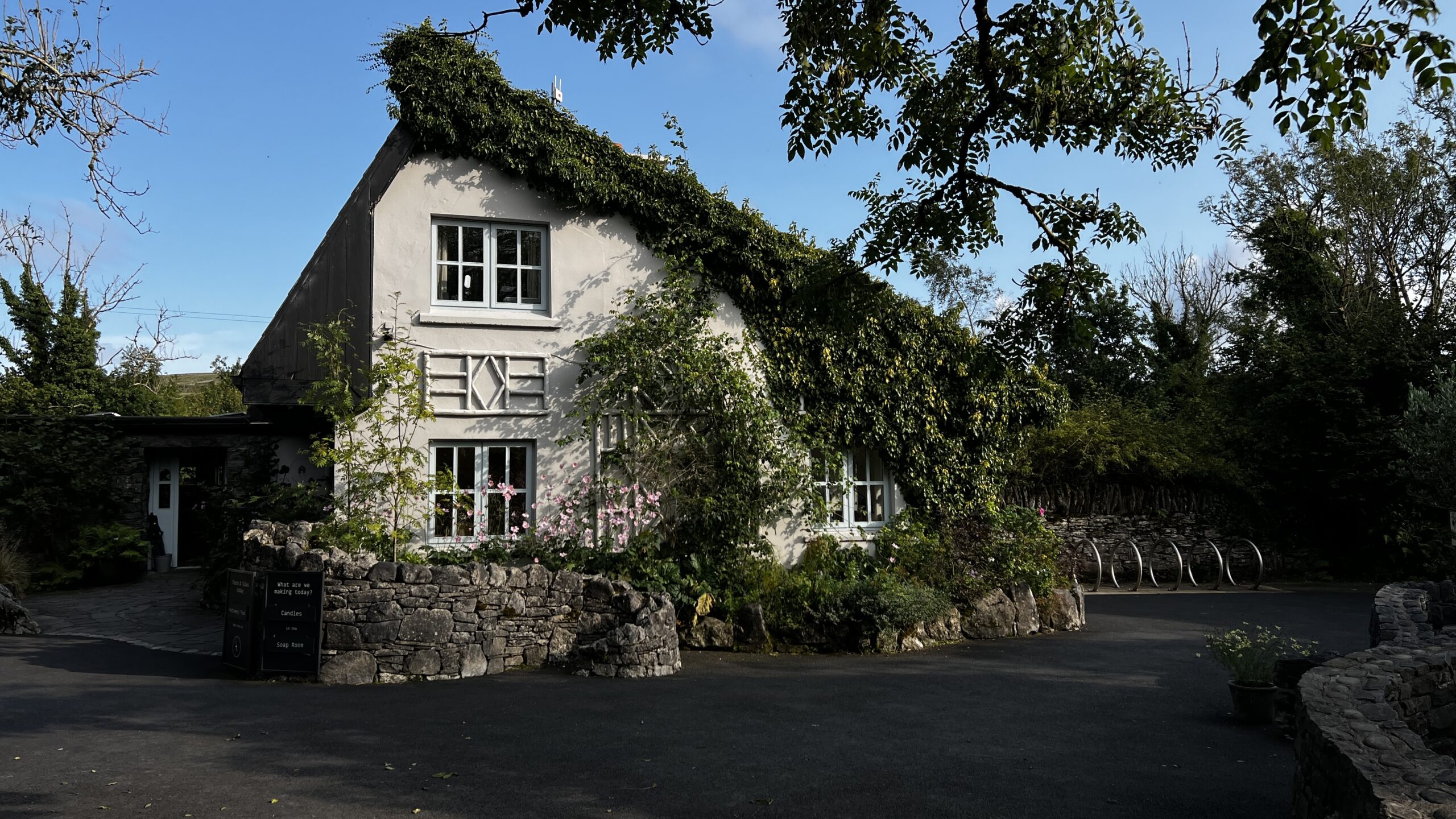 Burren Perfumery
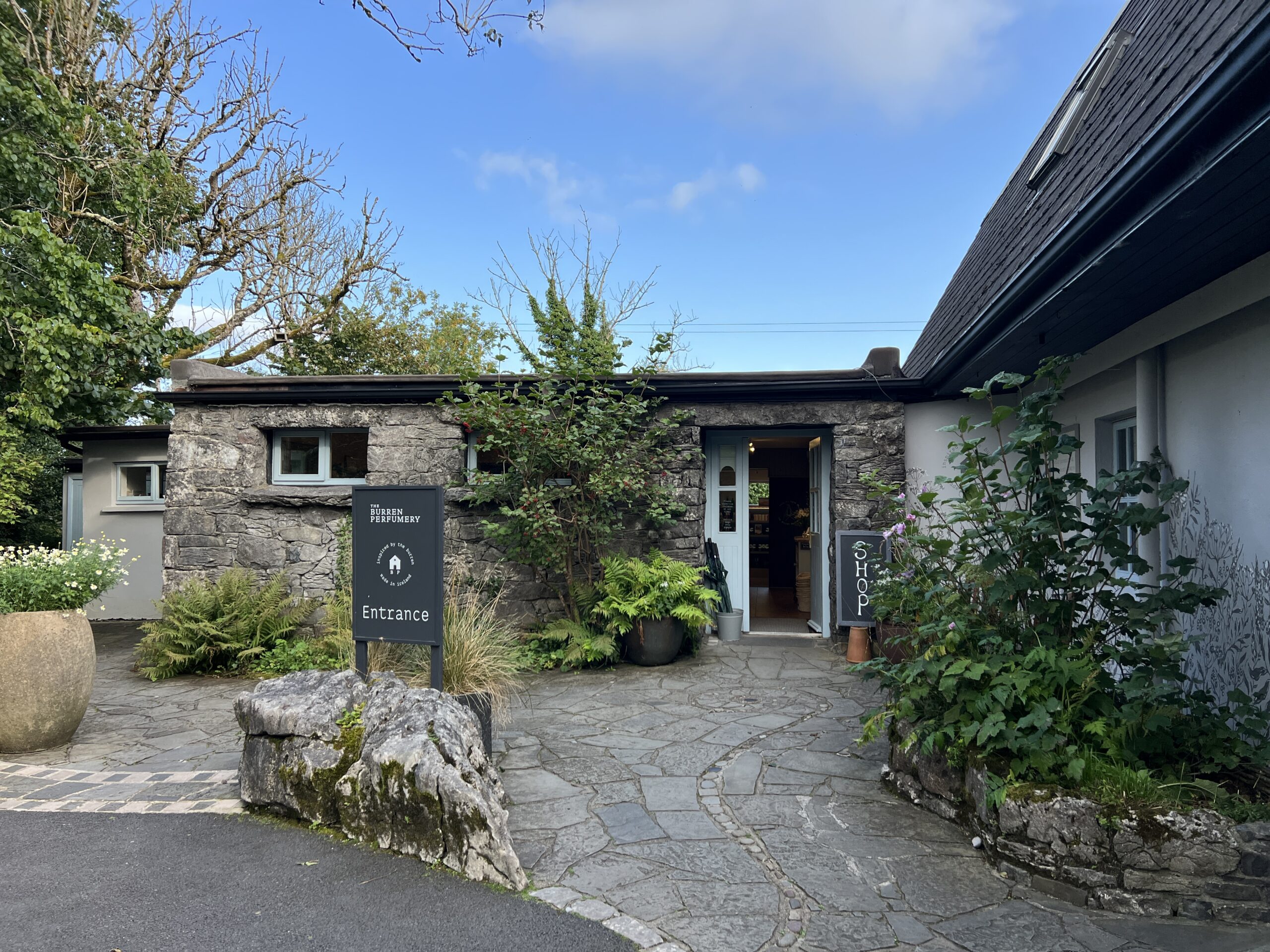 Burren Perfumery
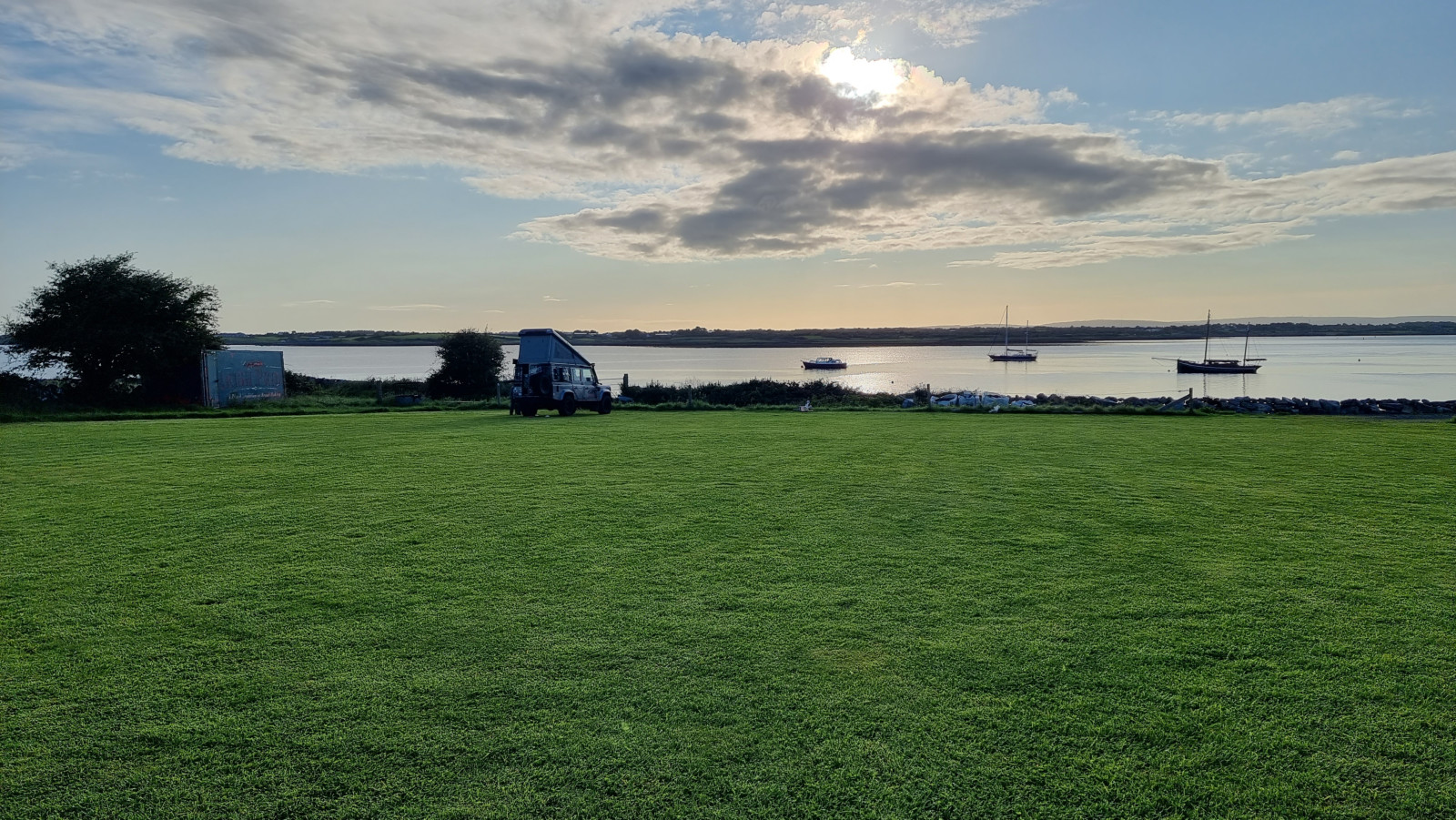
For us it’s now on to the last overnight stop. A campsite in the Burren won’t let us onto its ground; the rain has softened everything and we’d only ruin the meadow. We find a spot on a private meadow, where the house owner lets us stay. One last barbecue and a play in the water with the dog. Tomorrow it’s back towards home. We mark the point where we left the Wild Atlantic Way. This year we’re returning to drive the rest.

More information on Ireland’s Wild Atlantic Way
Of course there’s also a website covering the whole Wild Atlantic Way. Here you’ll find a lot of information, it’s worth a look: The Wild Atlantic Way.

The second part of our trip is this way: Wild Atlantic Way, Part 2.