



Power is an often-cited figure when vehicles are compared. Torque comes up frequently too. What’s the one, what’s the other, how do they relate, and why do they form curves when the trace is shown? We explain it for you in detail.
Torque
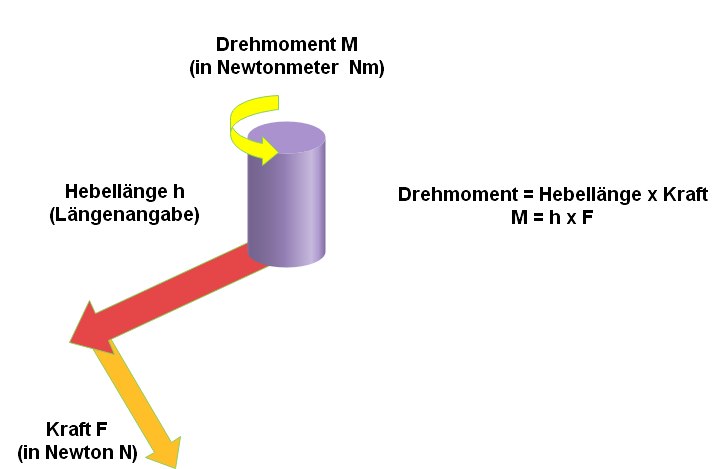
Torque (newton metres, Nm) is a force that acts on a radius, or in a rotation on a centre point. It results from the product of the applied force and the lever length over which it acts on this point. No movement has to be present for a torque to act.
To change the torque, the force or the lever length, or both, has to be changed. On the combustion engine this is achieved through the design of the combustion and the design of the crankshaft and conrods. Behind the engine, the gearboxes (manual or automatic, transfer case, differentials) then change the torque further. The gears in the gearbox are nothing other than levers of different lengths.
Power
Power (P) is a figure for work done in a certain span of time. It’s given in watts (W). James Watt was the best-known inventor of the steam engine. On vehicles the power is in the kilowatt range (kW). The older figure is metric horsepower (PS). One PS corresponds to the force needed to lift 75 kg one metre in one second. This value was set by James Watt at 735 W. When he wanted to describe the power of his steam engine, it was helpful to have a comparative measure familiar to people: the working force a horse can deliver continuously. So we have the conversion factor of 0.736 between PS and kW. One PS corresponds to 0.736 kW.
In other words, power says how often a force is delivered over a certain period. Important here is that, unlike torque, time (t) plays a role.
The relationship of power to torque
Strictly speaking, power (P) = torque (Nm) x speed (v). In the automotive field, though, power is associated with the engine speed (n). If you convert the formula to engine speed, you get for the power (kW) in relation to the speed: P = Nm x n / 9549. For the conversion to PS, P = Nm x n / 5252.
But what does that mean in practice now, in relation to the behaviour of the vehicle? That’s often not so clear. Torque says how strong the engine is, what load it can move. Power says how fast it can do it. That explains why with sports cars the kW/PS are more in the foreground and with off-road or commercial vehicles the torque. But they’re not independent of each other.
A high torque shows itself when pulling loads or heavily laden vehicles, which may also be moving uphill. An engine with enough torque won’t slow much and will pull the load steadily, maybe even still accelerate. On 4x4s, good torque means slopes can be handled with ease. It also means larger wheel diameters (= bigger lever) have no noticeable effect and the vehicle still pulls strongly. Usually you can also work at lower revs, which often brings advantages off-road. Why that is, is explained further below.
Power shows itself through speed, because power is work in relation to time. Speed is distance in relation to time. Lots of power allows lots of distance per time. With torque the dimension of time doesn’t appear at all.
A good example was our Isuzu D-Max. When we fitted it with larger tyres, we could clearly feel it on the motorway going uphill. It lost speed and fell back noticeably. From 140 km/h sometimes to 100 km/h. We had to change down. Normally it should drive faster with larger tyres, as one revolution covers more distance thanks to the larger circumference. But if the torque is too low and the load too high, the work delivered per time, that is the power, drops too. The vehicle gets slower on the hill.
More power would have made it faster in top speed on the flat, more torque would have stopped the speed collapsing on the hill.

Why the highest torque comes before the maximum power
If you look at the trace of torque and power of engines, or read through the vehicle figures, you notice that the highest torque always comes before the point of highest power. Both are always given with the corresponding engine speed. Take our Toyota Hilux GR Sport as a typical example. There you find the figures:
Torque: 420 Nm / 1,200 rpm-1
Power: 150 kW / 3,400 rpm-1
For understanding, let’s look at the formula for power again more closely: power (P) = torque (Nm) x speed (n) / 9549.
The reason is that the power is the product of the torque and the speed. Have a look at the graph below for that.
As long as both (speed and torque) rise (white area), the power rises in any case. From point A the torque now drops slightly. But as long as one of the two values, in this case the speed, still rises enough (green and blue area), the other value, the torque, can already drop. The power as the product of the two other values still gets larger.
From point B the torque now drops sharply (red area). Here the power maximum, point C, lies. The power can’t grow any more, as the torque drops too sharply. A turning point is reached and the power gets smaller again. By the way, on most graphs the curves cross. That’s because the two y-axes for torque and speed don’t show the same scale. In our graph both curves are at the same scale and so don’t cross.

Why torque drops above a certain engine speed
The reason for this is the cylinder charge with air. That’s anything but linear. Besides factors like the volume of the cylinder, that is the displacement, the size of the valve openings, the diameter of the air paths and so on, the speed of the piston is the deciding factor.
The faster the piston shoots down on the intake stroke, the more air is filled into the cylinder. Under the same conditions of course, like the opening degree of the throttle. So let’s look at a situation where no parameters change any more except the piston speed: the accelerator is fully pressed, the throttle wide open.
Although the maximum amount of air could now flow in, the full power isn’t there yet, it builds up first. And that’s the reason, the open throttle and the valve sizes only offer the potential for the maximum air to flow in. But that alone doesn’t make it do so yet. Only with the rising amount of fuel does the combustion get stronger and the piston speed rise, and with it the amount of air in the cylinder. That then sets the power spiral in motion. More fuel follows, as there’s more air, the piston gets faster, which again means more air and so on.
This could keep going, but at some point the whole intake path and finally the valve sizes become the limiting factor. The air the piston demands despite its speed can no longer flow in. The combustion loses force (point A in the graph above), the torque drops again and no longer rises despite rising speed.
This applies just as much to forced-induction engines, whether an exhaust turbocharger or a supercharger. Because their output is, in the first case, dependent on the energy and volume flow of the exhaust, which are also determined by the cylinder charge, and in the second case on the engine speed. They both increase torque and power, but change nothing about the basic shape of the curves.