



Every coin has two sides? Where there’s light, there’s shadow too. You know these sayings, and in relation to dual-battery systems and a smart alternator, it’s true. This article is about the problems a smart alternator can cause when charging two or more batteries.
Modern vehicles from emissions class Euro 5, and in any case 6 or 6+, have so-called “smart alternators”. Anyone wondering what concern that is of us off-roaders, well, at least the new pick-ups, vans and panel vans, or rather transporters, have alternators like this. Or rather, they have to have them in order to get the CO2 emissions under control. These alternators are a measure to reduce emissions. Whereas a few years ago motorhome and body builders were still supplied with vehicles without alternators like these, today’s emissions limits allow that ever more rarely.
In such vehicles, the central control unit (ECU) takes over the control of the alternator. When the battery is charged normally, the voltage is, as usual, roughly between 13.8 and 14.4 V. This voltage level and the current demanded by the consumers create an electromagnetic resistance at the alternator’s pulley that the engine has to overcome. If the battery charge is sufficient, the ECU lowers the produced voltage. When the voltage is lowered, the resistance reduces, and the engine consequently uses less fuel.
That’s exactly what happens with smart alternators, which should actually be called smartly controlled alternators. If the ECU determines that charging isn’t necessary right now, the voltage is regulated down. A typical value is 12.5 volts, but below that too.
The consequence is that, with a dual-battery system, various older systems fail. Dual-battery systems often couple and charge, from the simple relay through to the B2B charger (battery-to-battery charger), depending on whether the voltage is above 13 volts. The individual switch-on and switch-off voltages for the chargers vary slightly. But all have in common that this is how they recognise whether the engine is running or not. If the voltage falls below their switching voltage, they disconnect the batteries and no longer charge.
Relays drop out entirely in that case, since they can’t react intelligently to the voltage level. They could in theory be connected to ignition-positive (terminal 15), but then a different dilemma arises that’s even worse. The starter would then also draw its current via the relay during its starting process, which the relay often doesn’t survive.
By the way, the problem also occurs when the auxiliary battery is connected without much technology, that is, without isolation or charging technology. Because when the alternator regulates down, then it doesn’t charge, one way or another.

Recuperation
If the car has a recuperation brake in which the alternator is used for braking, further imponderable factors come into play for the dual-battery system. When the braking effect is desired, the ECU switches the alternator in and regulates the voltage up. The control therefore always keeps the state of charge of the starter battery at about 80%. That’s necessary in order to be able to store the energy released when braking in the battery. Only then does the recuperation work.
In that case you shouldn’t be surprised if a battery monitor probably never shows a full battery. By the way, batteries are rarely charged to 100% by driving alone. That’s why the manufacturers of battery monitors like to display an almost fully charged battery as 100% charged, which is also accurate enough. That saves many customer calls to the service hotline asking why their battery never gets full.
The right charger is necessary
If your vehicle has a smart alternator or recuperation and a dual-battery system, you have to make sure that the charging system is prepared for it. The manufacturers solve the problem in different ways.
With the ignition as the signal
Most charging systems monitor the onboard voltage and switch on automatically when a certain value is exceeded and off again when it’s undershot. In addition they have an optional line that, when connected, bypasses this automatic function. This is mostly connected to terminal 15. Those are all connections that carry current when the ignition is on. With that, the charger switches on independently of the voltage increase by the alternator, so it doesn’t wait for the running engine. An automatic switch-off is still provided, which in case of doubt ends the charging and the connection between the batteries. This voltage is then mostly below 12.5 volts, so they work safely with smart alternators.
Examples of this variant would be the Sterling Power B2B chargers of the ProCharge series: Sterling B2B charger.

© Sterling Power
Querying the generator voltage and the ignition
Other charging systems, especially when they’re made specially for Euro 6 vehicles, monitor the voltage and the ignition. Only when the voltage falls below a certain level, for example 13 V, and the ignition is off, is the charging, or rather the connection between the batteries, interrupted too. This solution has a drawback, however. The battery coupling stays active if the voltage, e.g. through another charging source, stays above the switching level. That may not be wanted.
Systems that stubbornly query the ignition (on or off) have the advantage there. When the car is parked, the connection is interrupted, so a simple on or off, level queries are not needed. But here too there’s a drawback. If the ignition is on without the engine running, charge can be taken from the starter battery into the auxiliary battery. You should be aware of that if you’ve chosen this variant, and only switch on the ignition when the engine is also started, or at least switch the ignition on and off deliberately.
Via parameterisation
The third variant offers the greatest flexibility. Here several parameters can be set for the detection. These include the minimum voltage of the alternator. If this is undershot, the engine is considered switched off and the charging is interrupted. Secondly, a time span for which this value may nonetheless be undershot. If the alternator is currently working with reduced voltage and, for example, the engine speed is increased during acceleration, the alternator voltage can briefly drop below the minimum value until it’s regulated back. As long as the time parameter isn’t exceeded, the charging of the auxiliary battery isn’t yet ended and the two batteries aren’t disconnected.
As an example, the Orion-TR SMART device series from Victron may be mentioned here: Orion-TR SMART at Amazon.
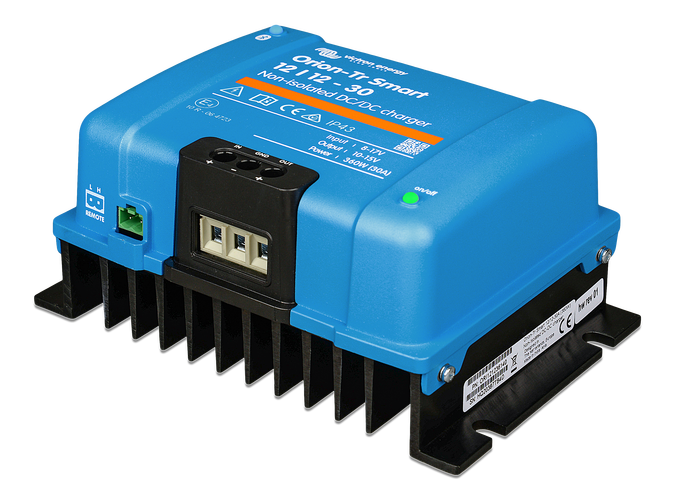
© Photo: Victron Energy
Programming out the SMART function
Not infrequently, the smart function can be switched off. To do this, workshops with an appropriate device can switch off the function in the vehicle’s control unit. It’s questionable whether that’s legal in every case, since it worsens the emissions behaviour. With vehicles that meet the emissions standards even with the smart control switched off, switching off this function is no problem.