


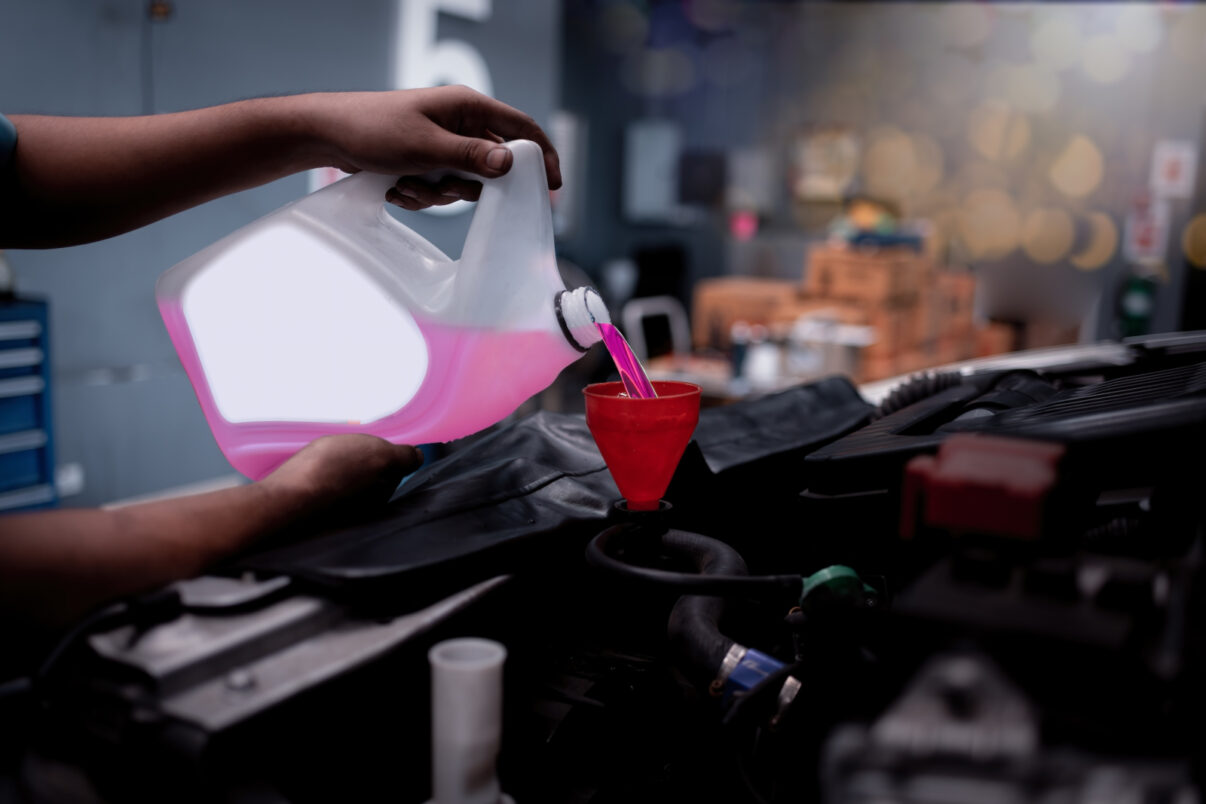

The name might be to blame for the fact that most people attribute only this one property to coolant antifreeze. Yet the additive to the water in the cooling system has many jobs. But beware, it’s not irrelevant what and how much of it is filled in. Our guide on this subject explains everything you need to know.
The properties of coolant antifreeze
Engine antifreeze is made from one of three types of glycol, because they mix completely with water: monoethylene glycol, monopropylene glycol or diethylene glycol. All three have different properties. Most commonly, monoethylene glycol (MEG) is found. The usual key points for a cooling system with MEG are a fluid temperature during engine operation of about 120°C at about 1.4 bar pressure.
A number of additives are mixed into the antifreeze that protect against corrosion through protective films and the alkaline base setting, keep seals and rubbers supple, and prevent foaming and cavitation. That may sound trivial, but it isn’t. Coolant is also nothing you should neglect, as will become clear.
Frost protection
The primary job is frost protection, which is hardly a surprise. The frost protection is achieved via the glycols. Undiluted, MEG would freeze at -11°C; mixed with water, this point drops further. At the usual ratio of 50:50, the cloud point is at -37°C and the pour point at -47°C. The following table shows how MEG behaves with regard to frost protection according to the mixing ratio with water:
| MEG % share in the mixture | Cloud point in °C | Pour point in °C |
|---|---|---|
| 0 | 0 | 0 |
| 5 | -2 | -2.5 |
| 10 | -4 | -5 |
| 15 | -6.5 | -8.5 |
| 20 | -9.5 | -12 |
| 30 | -17 | -20.5 |
| 40 | -27 | -32 |
| 50 | -37 | -47 |
Source: Handbuch Verbrennungsmotor: Grundlagen, Komponenten, Systeme, Perspektiven – Richard van Basshuysen and Fred Schäfer

Why glycol lowers the freezing point
When the temperatures drop, the movement of the water molecules slows down. If it’s cold enough, they begin to join together into lattices. The molecules attract each other and there’s increasingly a lack of movement energy to counteract the attraction. They then form hexagonal crystal structures: ice.
Through the addition of the glycols, pure ice crystals can no longer form, the glycols have to be incorporated. These structures are more complex and can only form at even lower temperatures. The freezing point is lowered.
Corrosion protection
Besides frost protection, corrosion protection is the main job of the antifreeze. The coolant and the surfaces of the engine that come into contact with the coolant interact chemically with each other. The water in the cooling system and even the MEG itself are causes of corrosion. Monoethylene glycol oxidises and in doing so highly aggressive carboxylic acids arise that attack the various metals. Traces of the metals can be dissolved out into the coolant and deposit at other places, starting further corrosion there.
To make matters worse, aggressive substances originating from combustion are introduced into the cooling circuit, and so salts and acids accumulate in the cooling system. The oxygen in the water also oxidises with iron components; rust can form, which also causes mechanical problems. They deposit on the mechanical seals of the water pump and destroy them over time.
The balancing of the additives, which make up about 7% of the antifreeze and are meant to prevent corrosion, is very important and not at all simple. Inhibitors that suppress corrosion on one metal can cause corrosion on another. They have to be precisely balanced in their concentration.
The manufacturer therefore specifies specifications the antifreeze should meet, because they know best which materials were used in the engine and which additives protect them best.
To counteract the corrosion-promoting acidic substances, the antifreeze is basic, or alkaline, with a pH value of 8. This value decreases over time, however, and the effect against acids wanes. The coolant itself becomes ever more acidic and aggressive towards the metals. That’s why the coolant change is also to be carried out according to the required intervals. Brown coolant is a good indicator that a change is necessary.
Raising the boiling point
At the boiling point of a liquid, it transitions to the gaseous state. That’s absolutely undesirable. At 1 bar air pressure, the boiling point of water is 100°C. Undiluted antifreeze boils at about 160°C. If you mix both, the boiling point of the mixture rises to over 100°C. With MEG and a mixing ratio of 50:50 it’s at 109°C. So the effect isn’t that great.
That’s why there’s a second and far more important measure to prevent the coolant from evaporating. You know it from the pressure cooker. Because the cooling circuit is designed as a closed system from which the pressure can’t escape, the boiling point rises further. Usual values lie between 120°C and 140°C.
That’s why you should also never open the cap of your cooling system when the engine is at operating temperature. Partly because you can injure yourself, and partly because the pressure escapes. Then the water in the system can immediately start to boil.
Vehicles sold in climate zones where it’s either always very hot or very cold get adapted cooling systems, e.g. the radiator may have a different dimension and the thermostat may open or close at different temperatures. That way it’s ensured that the permitted mixing ratios of water and antifreeze work in the respective regions.
The ratio has to be right
An engine should not be cooled with water alone, and it must not be operated with coolant antifreeze alone. Only in the right ratio of both does the system work that’s designed for exactly that. During engine development, the coolant antifreeze and its properties in relation to engine cooling and heat dissipation are taken into account, because coolant antifreeze reduces the heat dissipation. In the 50:50 mixing ratio by about 50%!
If you were to drive with water only, the heat dissipation would therefore be far too good, so that the engine would barely reach operating temperature. In addition, all the protective properties mentioned above are then missing. That’s only something for emergency operation.
Conversely, if you were to run only antifreeze in the cooling system, that would freeze at about -11°C to -13.5°C and the heat wouldn’t be dissipated sufficiently. Your engine freezes or overheats, depending.
Only in a certain range of the mixing ratio does the frost protection as well as the engine cooling work. This ratio usually lies between 60:40 and 30:70 water to antifreeze. The latter is considered the maximum of antifreeze and should not be exceeded.
Why do only both liquids work together?
The cause of this is the specific heat capacity of the liquids. Water has a capacity of 4.19 kJ per kilogram. In other words, 1 kg of water has to be supplied with 4.19 kJ of energy to make its temperature rise by 1°C. It can absorb a lot of heat and therefore cools well. MEG is at 2.3 kJ. The two mixed then give the required absorption capacity that keeps the engine at the right operating temperature.
It has to be noted that the dynamic viscosity of the mixture is roughly a factor of 250 greater than that of water. In other words, the mixture cools worse than pure water, and it’s also harder to pump. That in turn requires a higher throughput from the water pump, by at least 15% compared with pure water.
Now it also becomes understandable that, when towing a trailer uphill, higher engine speeds should be driven. But that’s not the only reason; there are further reasons for it to be found in other areas of the engine. Keywords for that would be piston-crown cooling and oil pressure, but those are other subjects.
Topping up or increasing the antifreeze, using antifreeze correctly
Ready-to-use mixture or rather concentrate? Which of the two should you choose? That depends entirely on what you want to achieve. If it’s about topping up the fluid level in the cooling system again, you can take a ready-to-use mixture. There, water and antifreeze are already mixed in the stated ratio. Even if the ratio differs a bit from the one in your vehicle, nothing happens when topping up now and again. Especially if you don’t drive into the limit range where it gets too cold.
You can also take a concentrate, but then it has to be mixed with water. Ideally in the same ratio as when filling the cooling system.
In principle, distilled water is always to be recommended! Normal tap water should not be used if possible, and only when it doesn’t exceed 20 German degrees of water hardness. Chlorine and sulphates in the tap water can have negative consequences. The ideal water values for coolant are:
- Water hardness: 5 to 9 German degrees of hardness
- pH value at 20°C: 7 to 8
- Chloride ion content: max. 40 mg/l
- Sum of chlorides + sulphates: max. 80 mg/l
Source: Handbuch Verbrennungsmotor: Grundlagen, Komponenten, Systeme, Perspektiven – Richard van Basshuysen and Fred Schäfer
Increasing the antifreeze
If you want to increase the antifreeze, you have to take concentrate and fill it in undiluted. That it’s not far-fetched that you’d have to do this, you can read here: Winter camping in Scandinavia with a Defender and Burow – experiences and tips.
You can do a small calculation to work out the approximate amount. But since the exact state of your cooling system will never be 100% known, you should always measure with a refractometer. Even if you’ve only topped up. The calculation can help you, though, not to fill in too much concentrate, because as described above, that can have very negative consequences.
The starting point for this example is the usual filling in a 50:50 ratio (= 1:1) with 10 litres of coolant in the system using Liqui Moly KFS12+. That gives frost protection down to -40°C. So you have 5 litres of water and 5 litres of antifreeze in the system. If, according to the frost-protection table, you want to reach a ratio of 2:1 for protection down to -68°, you have to end up, rounded to clean figures, with 6.6 litres of antifreeze and 3.4 litres of water in the system.
You only need to calculate one part of the filling; the other then results automatically. Calculate the share of the antifreeze:
10 litres in a 2:1 ratio = antifreeze share / (antifreeze share + water share) x total amount.
2/(2+1) x 10 = 6.6
So there have to be 6.6 litres of antifreeze and 3.4 litres of water in the system in the end. Since you only top up antifreeze (concentrate), but drain off water and antifreeze, a second calculation has to be made. The amount of water has to be 3.4 litres. So you have to take out 1.6 litres of water from 5 litres of water. Since the ratio is still 1:1, you have to drain off double the amount of fluid, that is 3.2 litres, because in one litre of drained coolant only half is water. Now you’ve set the maximum water share. Now you only have to top up with antifreeze back to 10 litres, that is by 3.2 litres. With that you’ve set the ratio of 2:1.
Mixing antifreeze
It’s always best if you have the correct antifreeze with you straight away. But if that’s not the case and you nonetheless have to top up, it can happen that you have to fall back on a different product. In that case, people often refer to the colour, red may be topped up with red and blue with blue. You should be very careful with that, because there are no regulations in this regard. Every manufacturer can use whatever colour they want.
The most important thing you need to know for mixing is that there are two large families and two large standards of antifreeze. That would be the one largely driven by VW and the one from BASF under the brand name Glysantin. VW designated its products with G11, G12, G12+, G12++ up to G13, BASF with G30, G40, G48, G05, G33 and G34. With BASF Glysantin there’s normally a reference to the VW designation.
| BASF Glysantin | VW |
|---|---|
| G48 | G11 |
| G30 | G12+ |
| G40 | G12++ |
| GG40 | G13 |
| G65 | G12evo |
The two large variants that don’t get along, form strong acids and can clump when mixed are the silicate-containing, older antifreezes and the ones without silicates. Silicates are used for corrosion protection in aluminium engines, since they deposit as a thin protective layer on the surfaces. Typical representatives of this type are G11/G48 antifreeze. These silicates are quickly used up, which is why the coolant antifreeze has to be changed at shorter intervals. That would already be the first important point you should know, which variant is prescribed for your engine?
Then, especially driven by VW, new organic corrosion-protection additives were used. These types were now called G12 and are not mixable with G11/G48. The next step was G12+ and G30, which are mixable with silicate-containing products. But only these! The following generations are again not mixable. Next came G12++/G40, which brought further improvements, like increased corrosion protection and raising the boiling point to 135°C. Current antifreezes carry the designation G13/GG40.
BASF does refer to the matching VW designations, but advises against mixing its own product with foreign products. With products to the VW standard it looks the same. That may be meant to keep customers with their own brand, but if you mix it, that happens at your own risk.
If your engine requires a coolant based on monopropylene glycol, you must not use a monoethylene glycol product. BASF Glysantin is then out; it’s based on monoethylene glycol.
Conclusion
It’s as so often, in the maintenance schedule, besides the change of various fluids, the coolant is also on the programme. And just as often it’s overlooked. We hope the article could show that the coolant too should be changed regularly, especially with the silicate-based variants.
On a trip, too, the rule again is, preparation is everything. If you carry the right antifreeze, you’re on the safe side. A look at the data sheets shows something reassuring. You’re well protected for central European weather conditions and there’s no need for action.
What everyone should check again and again, though, is the coolant level and the concentration, that is, the antifreeze level. That’s best done with the universal refractometer. Especially when you’ve repeatedly topped up with water. Correctly, you of course always top up with a mixture. Mix yourself a few litres in a container once, then you can use it again and again.
But if a situation arises in which the cooling system has to be refilled, then it’s better you have the right product and something to measure with you. A hose only has to have burst or another leak occurred. If enough coolant has been lost, just topping up with water is no longer enough.