


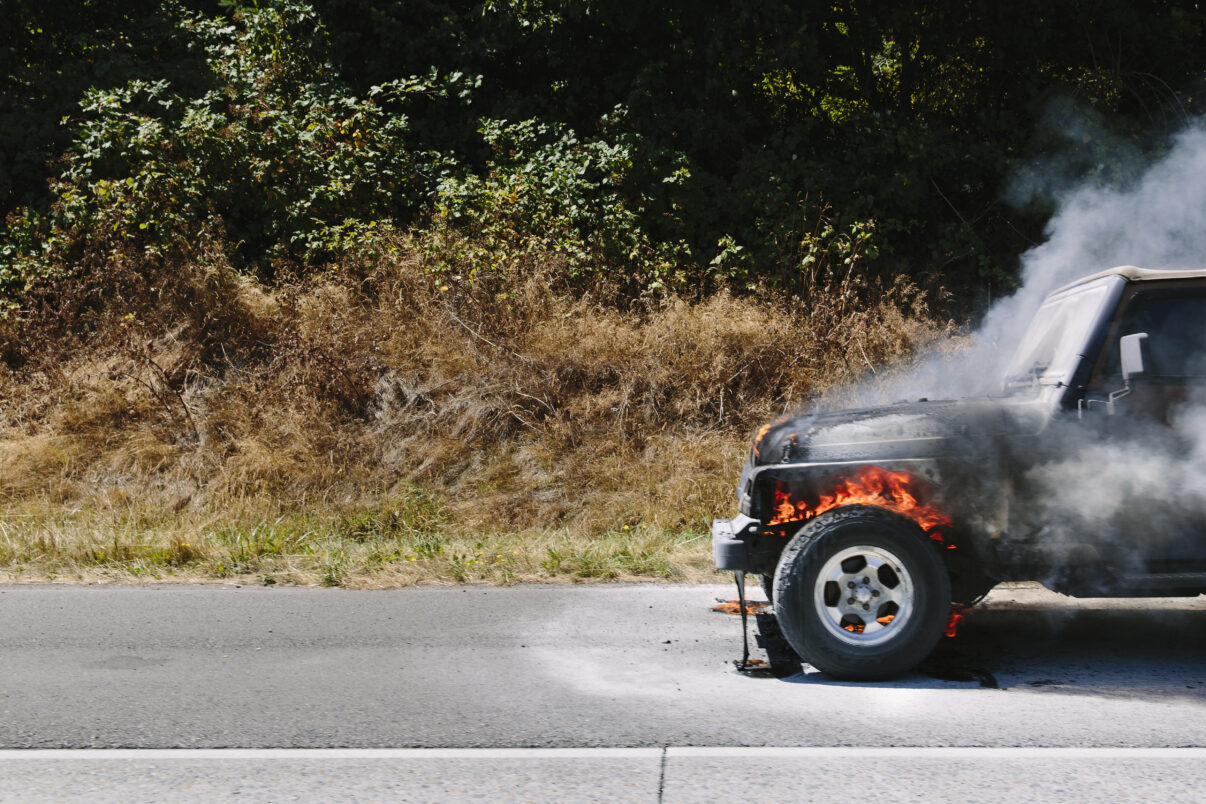

What was it like when, thousands of years ago, people saw fire for the first time? Were they afraid of the flickering flames of the fire, or did they immediately recognise the use in it? Without a doubt, fire changed life, and ever since, a fire has exercised a certain fascination on us humans. Be it as a source of warmth, a cooking place or as a gathering place for cosy togetherness and the forging of plans and exchanging of news. If a fire unleashes its destructive force, then we speak of a blaze. This is to be prevented, and if it does happen, to put it out and prevent further damage. That’s what this article is to be about, fire protection and firefighting while travelling.
For that we first have to understand what happens with such a fire, why it can arise, which preventive measures can prevent it, which extinguishing agents there are, in order ultimately to be able to put out an incipient fire. We’ll also go into dangers in what follows.
What actually happens with a fire or blaze?
So before we go deeper into the subject of fire protection and firefighting while travelling, we should first understand what happens with a fire or blaze. The burning process is nothing other than an oxidation. A chemical reaction of a combustible substance with oxygen, in which energy is released in the form of heat. So for a fire to come about, we first need three essential things. These are combustible material, oxygen and an ignition source. Let’s look at that more closely.
The material prerequisites for a fire are still relatively easy to grasp. For a fire, a substance that is combustible is needed. Such a substance can come in various forms. Solid substances, liquid substances or gaseous substances for example. Here we can easily imagine things from the off-roader’s everyday life. The wood at the campfire for example as a solid substance, although this still shows a peculiarity in the combustion process that we’ll go into later. Or the operating materials in liquid or gaseous form. The combustible substances are divided into so-called fire classes. You’ve surely read these on a fire extinguisher at some point. But what’s actually behind it?
Combustible substances as the basic prerequisite for combustion
Fire class A
Fire class A covers the burning of solid fuels, e.g. the already mentioned wood at the campfire or plastics in the vehicle. These solid substances burn as a rule with embers. An exception here is, for example, as already briefly mentioned, the wood that burns at our warming campfire. Because in doing so, gases first arise that then burn.
Fire class B
Fire class B contains the burning of liquid fuels, e.g. the fuel in the tank of your vehicle or paints in the hobby workshop. Here too it isn’t the actual liquid substance that burns; rather it first has to evaporate and in doing so the substance forms a combustible mixture with the ambient air. Here the ambient temperature of course plays a very important role, because you’ve surely heard at some point that petrol gases off much earlier than diesel. Liquid fuels burn with a flame.
Fire class C
Fire class C categorises the fires with gases, e.g. the propane or butane gas that many of you use for cooking outdoors. These too burn with a flame.
Fire class D
Then there’s also fire class D, namely for the metal fires. Of these too we have a whole lot on the vehicle. You’ve perhaps seen a very bright flame in a vehicle fire? That could have been the combustion of aluminium or magnesium. Metals are solid substances, so why aren’t they assigned to class A? Well, because they can show special properties during combustion and can thus have consequences for the correct extinguishing – which we’ll come to later. Metals often burn with extreme heat and so when extinguishing with water or water-containing extinguishing agent it can get very dangerous. Through the enormous heat, the extinguishing water can be split into its chemical components and these immediately react with each other again. It comes to the so-called oxyhydrogen reaction. Metals burn with a flame.
Fire class F
Last but not least, fire class F. This also describes fires with very special hazard potential, namely the burning of cooking fats and the like. Fire class F was created because of the enormous risk of such fires and peculiarities during extinguishing. People extinguish fire intuitively with water and exactly that can get very dangerous here. You’ve surely heard of the fat explosion at some point. More on that later too.
Let’s remember with the fire classes whether they burn with flame or embers, because that will become important for the later extinguishing process.
To ignite a fire, ignition energy is needed
For a fire or blaze to come about, a sufficient ignition temperature is needed. Depending on the level of the temperature, the ignition process takes varying lengths of time. Once the substance is burning, a certain energy has to be released so that the fire keeps burning by itself and doesn’t simply go out again. You know that from the campfire too. These dependencies, by the way, also explain why there are substances that can’t simply be ignited by a small flame. We can make use of that, for example in the area of the construction of buildings.
You probably still remember the experiment with the sugar in physics class. If you tried back then to light the sugar cube with a small flame, it only caramelised. If ash was now added, it suddenly burns after all. The ash fulfils the role of a catalyst. You know that one from the car too and there too, chemically-physically speaking, it does nothing other. Through substances in the catalyst, a further chemical reaction is set in motion and the pollutants are converted into other substances. An ignition source can be internal or external; some substances can even ignite themselves through a chemical reaction.
The fire of course also needs oxygen
A fire is a chemical reaction of a combustible substance with oxygen, we noted at the beginning. So oxygen is also needed for it to burn. We find oxygen omnipresent in our ambient air. This contains about 21% oxygen. Depending on the amount of the oxygen present, the combustible substances burn better or worse. If the oxygen supply to your campfire is poor, because you’ve perhaps lit a pit fire, this doesn’t burn particularly well either. If wind comes up, the flames suddenly flicker quite nicely. A stove with a well-built chimney perhaps works better there too.
These three prerequisites are often represented in simplified form in the so-called fire triangle
This is only a simplified representation that already disregards the mentioned intensity of the ignition source and possible catalysts. A further important prerequisite isn’t named here either. Namely the right mixing ratio of combustible substance and oxygen. So let’s look at that too.

The combustible substance and the oxygen have to be in the right mixing ratio for a combustion process to come about. Let’s again take the lighting of the campfire as an example. If you first light some tinder, then that’s much easier than if you straight away try to light a thick log. That’s because the surface of the tinder is larger compared with its mass and therefore more contact surface with the oxygen is available. The more favourable this ratio is, the more easily an ignition is possible. You’ve surely heard of the term dust explosion at some point, e.g. with a silo full of sawdust. That’s about exactly the matter described here. The many small bits of sawdust are very easy to ignite.
Causes of fire
Fire protection and firefighting while travelling of course also includes giving thought to the causes. If we look at statistical surveys, then electricity, human misconduct and arson are named as by far the most frequent causes of fire. Right at the back of the statistics rank causes such as lightning strikes and spontaneous combustion. That’s bad news and also good news. Because the better we know the causes of fire, the more we can act against them. And at the points of electricity and human misconduct, really good headway can now be made through preventive measures.
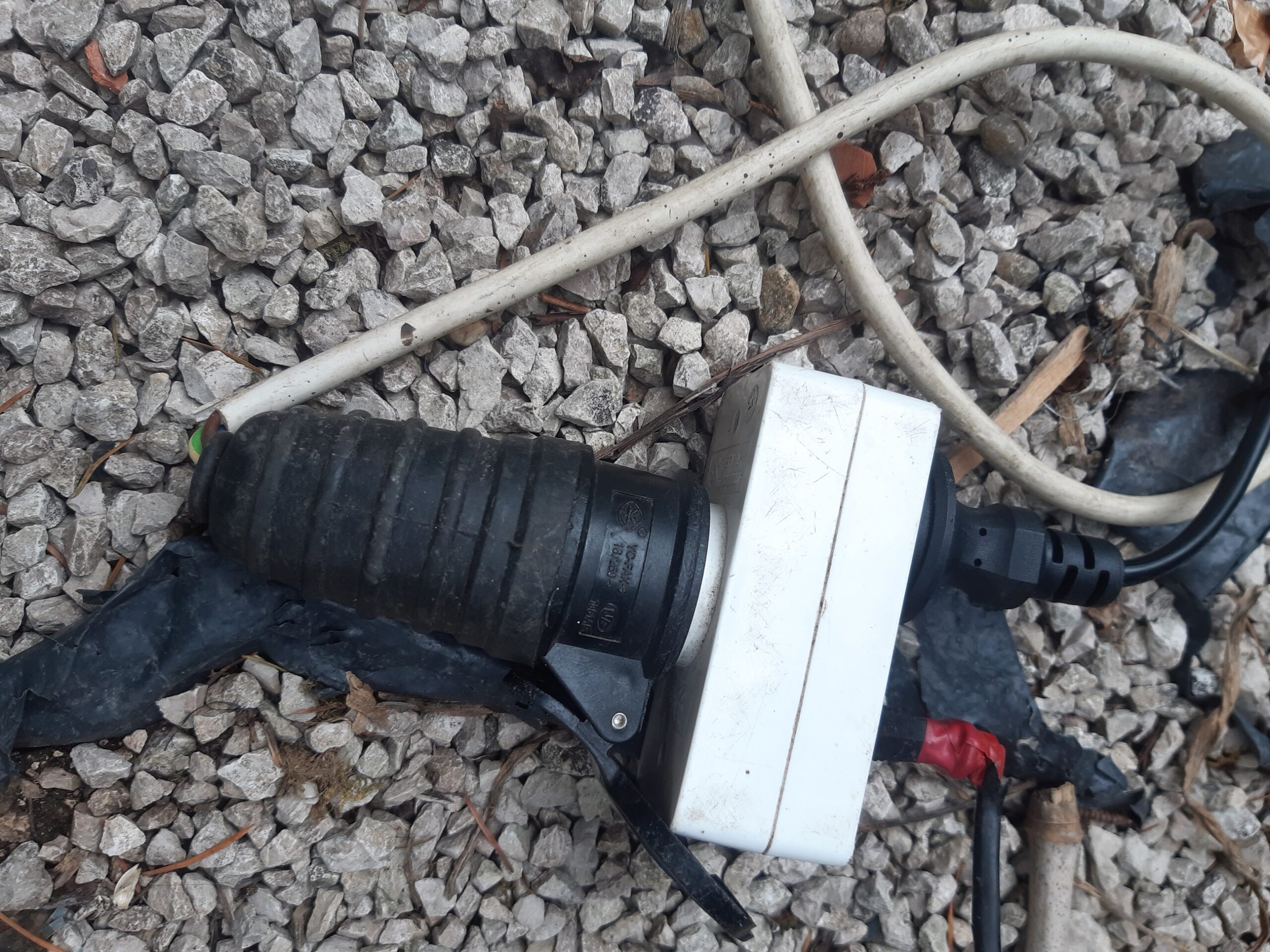
Vehicle fires as such are relatively rare, but in the off-road travel sector too we’re dealing with a lot of situations from which fires could arise and which are easy to prevent. We’ll deal with that in the next part on the subject of fire protection and firefighting while travelling.
Extinguishing agents, their effect and what for what
Now we already know a whole lot about what happens with fires and how they arise. Only how do we extinguish the fire if it does happen? Let’s remember again the prerequisites and the fire classes. At the prerequisites for a fire, we can also start to extinguish. We can consequently withdraw the oxygen from the fire and thus smother it. We could also lower the combustion temperature and bring the fire to extinction. A further possibility would be to withdraw the fuel from the fire, to starve it, or even to change the mixing ratio somewhat.
Which extinguishing agents are there and what are they used for
You’ve surely seen or heard of the common extinguishing agents at some point. Water, foam, powder and carbon dioxide as extinguishing agents. All the named have advantages and disadvantages, are more or less well suited to certain fires, or even harbour dangers when used! Let’s look at a few advantages and disadvantages as well as dangers of various extinguishing agents by way of example.
Water as an extinguishing agent
Advantages
- Everyday, almost unlimited, cheaply available and easy to deliver
- Intuitive even for the layperson
- Non-toxic
- Very effective with fires of class A
Disadvantages
- Extinguishing damage through water damage, endangerment of the structural integrity of a burning object through the enormous weight
- Water freezes at 0 degrees Celsius
- Washing-out of pollutants into the environment possible during the extinguishing process
- People reach for water intuitively to extinguish fire, that can be dangerous
- Enormous expansion of the water vapour when heated
- Water as an extinguishing agent is ineffective with liquids that float on the water or with gases that stream out under high pressure.
Further dangers
- Fat explosion: When used in fire class F there’s the danger of a fat explosion. If such fires are attempted to be extinguished with water, e.g. in a frying pan in the kitchen, then the extinguishing water sinks below the burning fat, is strongly heated, multiplies its volume and flings the fat upwards. This can then ignite massively above the ignition source, an enormous jet of flame arises.
- Oxyhydrogen reaction: For example when used in fire class D, owing to the high combustion temperatures it can come to the chemical splitting of the water and renewed reaction. With other fires too, such as the fire of batteries, it can come to great heat and thus a splitting of the water, oxygen is released and the fire is further fuelled.
- Increase in volume: As already mentioned, water multiplies its volume when its state changes to gaseous by up to a factor of about 1,700, i.e. from one litre of water, 1,700 litres of water vapour can arise. This can become very dangerous. An example from practice, which unfortunately keeps happening, is the attempt to extinguish a chimney fire with water. Owing to the increase in volume during the evaporation of the extinguishing water, the chimney literally bursts apart. The water vapour can also lead to dangerous scalds during the extinguishing attempt.
- Conductivity: when extinguishing electrical installations it can come to electrical accidents.
Foam as an extinguishing agent
Advantages
- Works well with fires of class B and is also suitable for solids of class A
- Less water damage
- Can be produced quickly (by the fire brigade) and also matched to the fire
- Possibility of preventive application, flooding of spaces (e.g. warehouses and runways)
Disadvantages
- More expensive than water
- Possible environmental impacts
- Stocking harder than with water, not always available
- Possibly not frost-safe
Dangers
- Like water, the foam is electrically conductive, this can lead to electrical accidents
- Oxyhydrogen reaction with metal fires of class D, see water
- The foam can conceal obstacles and thus lead to accidents
Powder as an extinguishing agent
Advantages
- Non-toxic
- Various extinguishing powders available for different fires, there’s even metal-fire powder
Disadvantages
- Enormous extinguishing damage possible through finest powder, which penetrates into every crevice and acts corrosively (salts)
- Danger of obscured vision through the powder cloud
- Powder can trigger a coughing irritation, possible health damage when taking in larger amounts
Dangers
- Extinguishing foams can be destroyed by extinguishing powder
Carbon dioxide as an extinguishing agent
Advantages
- Residue-free application as an extinguishing agent
- Good to stock
Disadvantages
- Little or no effect in the open, since the extinguishing agent quickly disperses and remaining heat can quickly reignite the fire
Dangers
- Splitting of the CO2 possible with metal fires and thus fuelling of the fire through the released oxygen
- Danger to life, as a respiratory poison
Further extinguishing agents
There are of course a few more properties of the extinguishing agents as well as further extinguishing agents, but these are partly very special or rather relevant for the fire brigade. So there’s, for example, also water with various additives as an extinguishing agent in special situations. At this point let’s also mention the relatively novel fire extinguishers against lithium fires. In everyday life and also in ever more off-road travel vehicles, lithium batteries find application. The extinguishing results with the fire extinguishers specially designed for this are partly quite good, although we should always think of the dangers of such a fire, for example through flying parts when the battery bursts.
The following table gives you another overview of various extinguishing agents. One principle we should remember: fires that burn with embers are basically cooled down, flames are smothered.
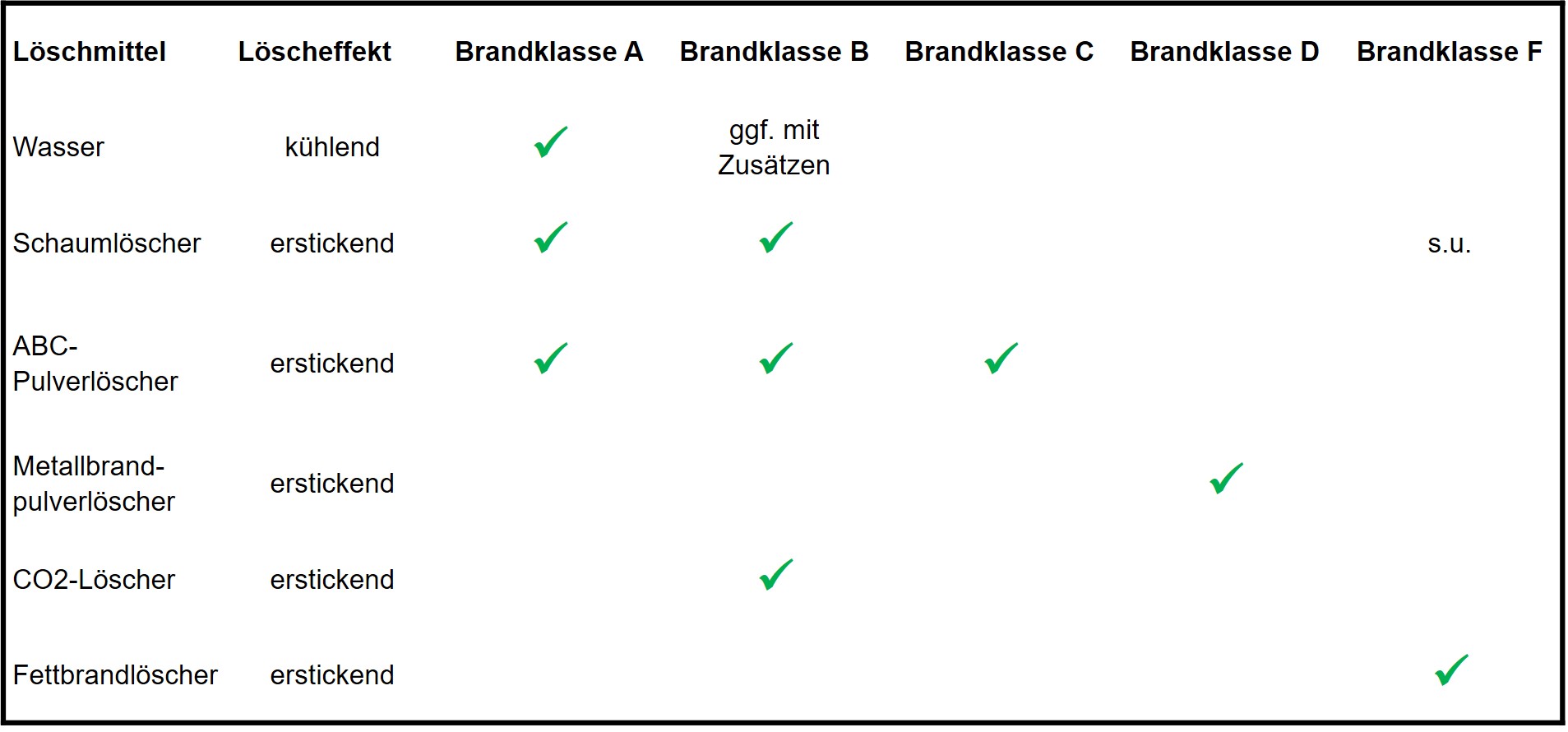
With permanently installed extinguishing systems, for example in buildings, of course other considerations come into play and the extinguishing agent is matched to the object and its contents (e.g. warehouse). So with IT systems, carbon dioxide is frequently used as an extinguishing agent.
Extinguishing agents and fire extinguishers
As an extinguishing agent, various possibilities come into consideration. In businesses there are frequently stationary or even fully automatic extinguishing systems, mobile extinguishing agents and much more. For us, who are out and about with the off-roader – and here it’s ultimately about fire protection and firefighting while travelling – it will mostly be the fire extinguisher. Let’s look at this a little more closely.
Fire extinguishers exist for various fire classes, which we’ve already got to know, with various extinguishing agents, in different sizes and modes of operation. So let’s summarise again briefly. Fire extinguishers of fire class A are suitable for solid substances that are ember-forming, extinguishers of fire class B for liquid or liquefying substances, fire extinguishers of fire class C for gaseous substances, extinguishers of fire class D are used with metal fires, and the special fat-fire extinguishers of class F with fires of oils and cooking fats from the “gastronomic” sector. By the way, fire class E hasn’t existed for years; instead you may find a warning notice regarding the extinguishing of electrical systems on the fire extinguisher.
The Technical Rules for Workplaces (ASR) do apply to workplaces, the name says it already, but let’s nonetheless take a brief look at the ASR 2.2, which regulates the measures against fires. Here we find a whole lot on the subject of fire extinguishers, which is also useful for application in the private sphere.
The extinguishing capacity
For example, on the extinguishing capacity of an extinguisher. This is determined by extinguishing a standardised test object (woodpile and liquids) per fire class (A, B) and is indicated by a number-letter combination on a fire extinguisher. With the fat-fire extinguishers, by the way, the number quite simply indicates the volume in litres of an amount of cooking oil to be extinguished in a container. Depending on the fire hazard and area of the workplace, a certain amount of extinguishing-agent units is required. That’s also a good orientation for the dimensioning in the private sphere.
For an area up to 100 square metres, the rule prescribes for example 9 extinguishing-agent units in a normal hazard situation. What does that mean? A household-standard foam extinguisher with 10 kg extinguishing-agent content frequently has a specification of 34A, 144B, that is an extinguishing capacity of 34 in fire class A and 144 in class B. An extinguishing capacity of 34 in class A then in turn corresponds to 10 extinguishing-agent units (LE), 144 B corresponds to 9 LEs. So that this extinguisher in our example would, in terms of extinguishing performance, be sufficient with normal hazard for the basic equipment. The BG Nahrungsmittel und Gastgewerbe (the food and catering trade association) has provided a practical calculator on the internet for the calculation.
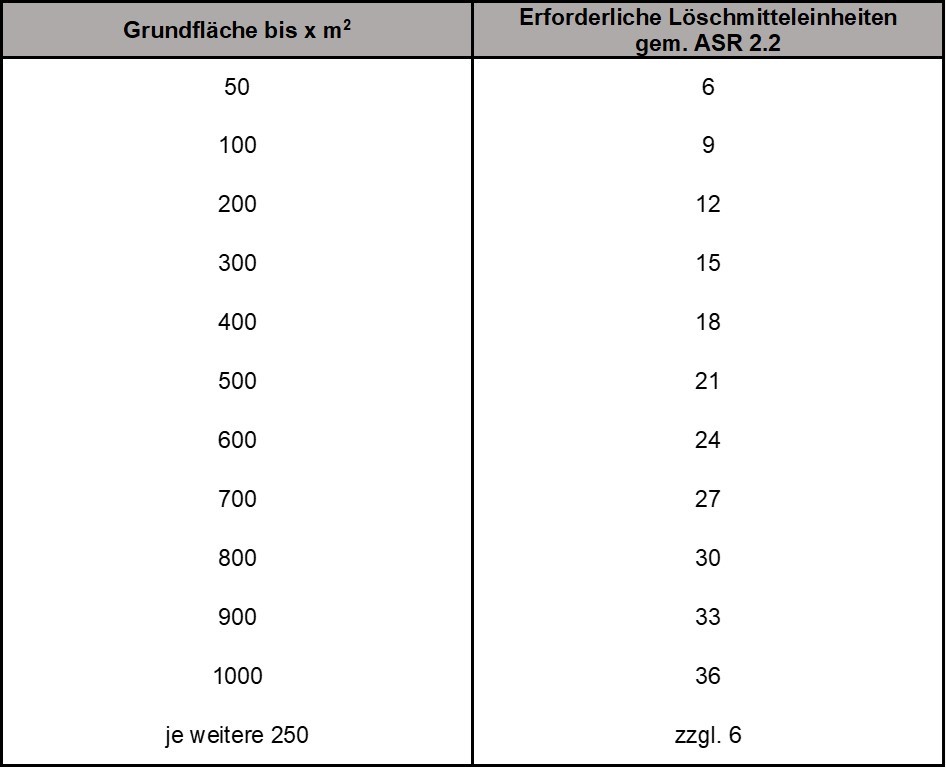
Counted in the sense of the ASR 2.2 are as a rule fire extinguishers from an extinguishing capacity of 6 LEs. But under certain conditions, several extinguishers with lower extinguishing-agent performance can also be kept on hand, which in sum are then sufficient. This for example to simplify the operation through weight reduction. That can be an important consideration in travel vehicles too.


Fire extinguishers must, in order to count as such, have a test and approval according to DIN EN 3; the extinguishing sprays partly fail at this.
In the mode of operation of the fire extinguishers we distinguish two variants
The constant-pressure extinguisher and the cartridge-operated extinguisher. With the constant-pressure extinguisher it’s the case – the name already reveals it to us – that this is permanently under pressure. You can often recognise these by a small control pressure gauge. Many of the car fire extinguishers with one or two kilograms of extinguishing agent are constant-pressure extinguishers. These are frequently cheaper to buy, in maintenance – if they are maintainable at all – significantly more (time-)consuming and thus more cost-intensive.
A cartridge-operated extinguisher contains extinguishing agent and propellant, or rather pressure agent, separately. The propellant is contained in a small cartridge in the extinguisher, as a rule as CO2. When used, a brief additional work step is required, namely the activation. In doing so, frequently a button is pressed and thereby the sealing foil of the propellant cartridge is pierced – sometimes a lever is pressed or similar. Then the propellant flows into the extinguisher and puts the extinguishing agent under pressure.
It’s frequently said that this additional work step costs valuable time. But let’s be honest, this is probably not even a second. The mode of operation is as a rule well marked on the extinguishers, please make yourself familiar with it. Cartridge-operated extinguishers are somewhat more expensive to buy, but simpler in maintenance, because here only the pressure cartridge and the contents have to be checked, both easy to dismantle, but no pressure released and refilled. The latter not infrequently leads (with cheap) constant-pressure extinguishers to them no longer being properly sealed afterwards.
Through the fact that the cartridge-operated extinguisher isn’t permanently under pressure, the wear is possibly lower and a creeping pressure loss unlikely, therefore higher operational reliability. The sudden pressurisation in the event of activation has a further advantage, for example with the powder extinguisher. Because here the extinguishing agent is well loosened up by it.
Carbon dioxide extinguishers are of course always constant-pressure extinguishers.
Fire protection and firefighting while travelling – choice of the extinguishing agent in the travel vehicle
With vehicle fires we frequently have two problems with which we’re confronted when choosing the extinguishing agent. The corrosive effect of the powder with consequently great extinguishing damage, and water and foam are not (always) frost-safe. There are meanwhile also frost-safe foam extinguishers. If we now take everything into consideration, then a (frost-safe) foam extinguisher appears as the best choice for the vehicle. Customary in the passenger-car sector are 1 or 2 kg extinguishers, whereby, owing to the already very short extinguishing time of these small extinguishers, a 2 kg extinguisher is to be preferred. One or two of those also find a good place in an off-road vehicle. Especially with larger vehicles, larger extinguishers can also be used, plus a special fat-fire extinguisher for the onboard kitchen. It’s best to have yourself advised for your respective situation in the specialist trade.
The fire extinguisher should be stowed well within reach. Here too a look at the ASR 2.2 helps. According to it, fire extinguishers in workplaces are to be kept on hand so that they are reachable within 20 metres from every point – that should be very well possible in the travel vehicle. As a practicable mounting height, a height of about 80 to 120 cm from the floor has proven itself. But here too you should make sure that the extinguishers are really well and quickly reachable and you don’t first have to open any closed flaps or similar, or even have to clear away equipment in front of the extinguisher, or have to get from the cab into the interior conversion and the like.
Stowing and marking of extinguishing agents in the travel vehicle
The clearly visible marking is also a good idea, so that if necessary third parties or travel companions who don’t know your vehicle so well can easily find the extinguisher. For the marking, stickers of the – also internationally understandable – symbols are suitable, as regulated in the ASR 1.3.
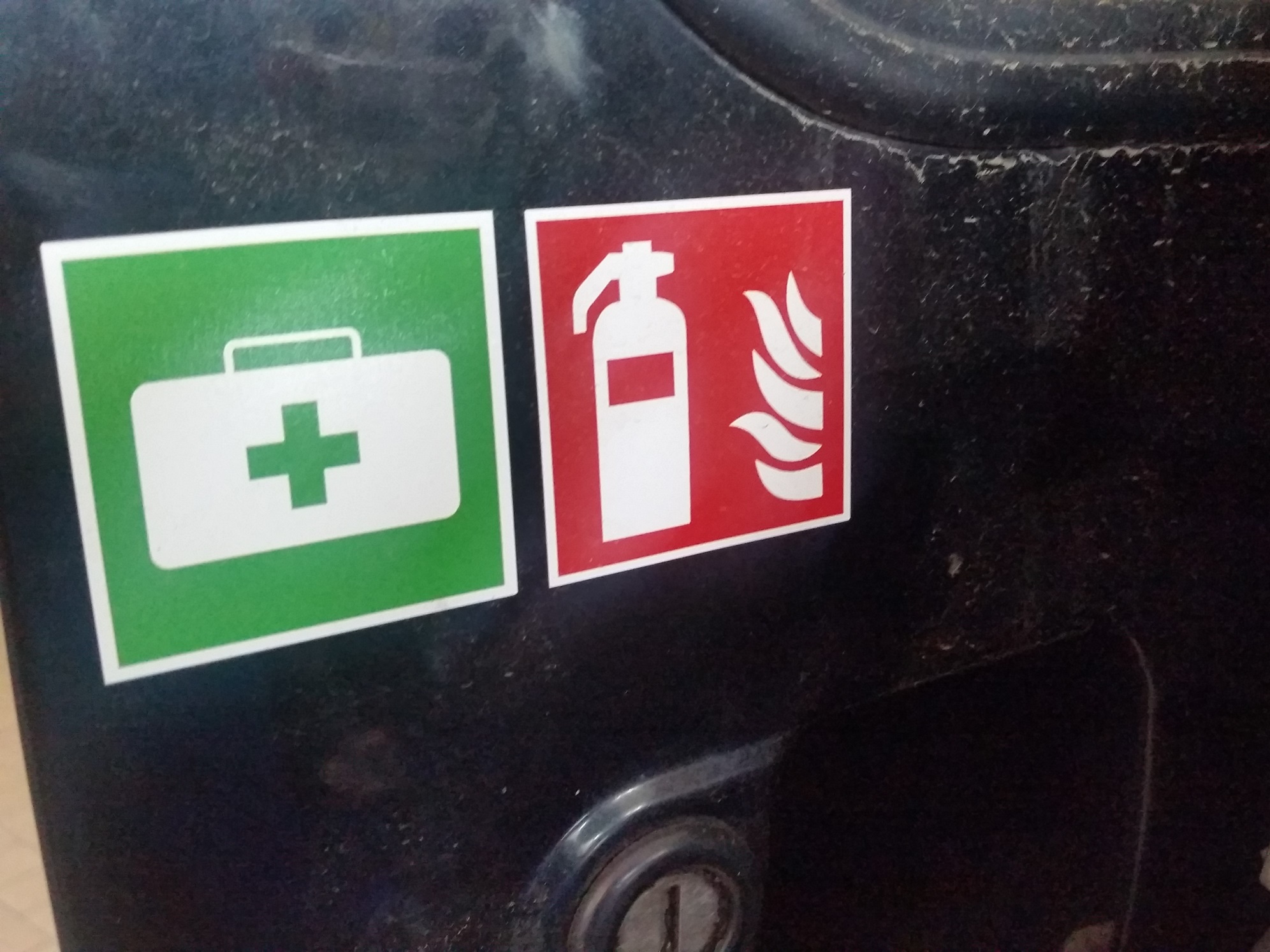
At the same time, fire extinguishers, like all equipment items, should be fastened track-proof, because such an extinguisher can easily become a danger in the event of an accident or a tipping in the terrain, if it lies loose in the vehicle.
Carrying obligations when travelling in other countries
Please check – as with other safety equipment, e.g. high-vis vests and warning triangle, or the carrying of medication – before travelling to other countries which regulations there are there regarding fire extinguishers. Frequently there’s a carrying obligation in the vehicle. For example in the Baltic states, Poland, Romania, Greece and Turkey there’s a carrying obligation.
The fire blanket, a sensible addition?
When we’re dealing with fires that can be extinguished by smothering, a fire blanket can be used. These blankets are as a rule made from glass fibre and there are them in various sizes. The fire blankets are frequently packed in a small bag that you can fasten to a wall. If it’s to be used, you mostly pull on two small straps and thus take out the fire blanket. The blanket mostly has two small pockets, on one corner each. These are intended for reaching into and self-protection.

It’s frequently mentioned that the fire blanket is good for putting out burning people, e.g. in a fire event in a flat. This can, however – implemented incorrectly – lead to serious injuries. If the affected person is wrapped in the blanket, the head has to remain free and exactly there lies the problem. At the neck there isn’t sufficient coverage and then the flames, in pursuit of the oxygen, beat out of the top of the blanket and cause severe and most severe burns in the facial area. How it’s done better, more on that later.
With a fat fire, the fire blanket can help to smother it, but there too it appears safer – while observing one’s own safety – to put a matching lid on the pot or pan or, better, to use a fat-fire extinguisher straight away. Effective self-protection is difficult with the fire blanket.
Further aids
For the rescue of people from the danger area, there are in businesses and facilities frequently further aids that, depending on the personal situation, could also come into application in the private sphere. Therefore let’s also briefly mention here carrying sheets, carrying chairs, escape hoods and escape filters as evacuation aids. Rescue sheets, or rather tarpaulins, can be folded together very compactly and also be stowed well in a travel vehicle.
Dangers with fires
Before we now finally go to the extinguishing of a fire, a few more important words on dangers that fires cause.
First of all, of course, the thermal hazard comes to mind, that is the possibility of burns or scalds. But the hazards through smoke and respiratory poisons are not to be underestimated either, here there can be danger to life! If you find someone, or have signs of breathlessness, unusual breathing sounds or chest pains yourself, then dial the emergency number and give first aid. This includes the upper-body raised position, the opening of constricting clothing, fresh-air supply and breathing calmly together. Look after the affected person, ensure heat retention, e.g. with the rescue blanket from the first-aid kit, initiate further first-aid measures if necessary and stay with them until rescue forces take over. Likewise very dangerous are the mechanical hazards with a fire, this for example through flying or falling parts.
Here too it helps to look once more into an area that at first glance has nothing to do with off-road driving and travel, but helps with understanding what it’s even about. Namely into the state building regulations. Here, regarding fires, essential things are named about how buildings have to be constituted. These are that the arising of fires is prevented, that with fires the spread of fire and smoke is prevented, that the rescue of people and animals is made possible and that effective extinguishing work is possible. So it’s about prevention, about minimising damage, rescuing living beings and extinguishing work. We should always keep that in mind with fires too. Quite concrete behaviour in the event of fire is documented in the fire protection regulations that you know from businesses, for example. Here there are three parts, A, B and C. Part A is aimed at all people in the building and must therefore be clearly visibly displayed.
A small fire extinguisher on board too can make the difference with incipient fires, but think of the dangers of a fire. Therefore please only undertake extinguishing attempts with incipient fires and only when you trust yourself to do it and it’s safe. Human lives come first. Observe self-protection and protection of others!
How to extinguish
Important is of course the early alerting of the fire brigade, the dialling of the emergency number. If you trust yourself to extinguish an incipient fire and people and animals are safe, then there are a few essential things to observe when handling the fire extinguisher.
In the open, observe the wind direction and attack the fire with the wind direction. Also watch out for possible oxygen supply that suddenly occurs when you would, for example, open (too quickly) a bonnet, hatch, door or storage flap. This has enormous hazard potential for the person extinguishing. Keep enough distance and give bursts of spray onto the burning material. Bear in mind too that such fire extinguishers only extinguish for a few seconds, so you have to proceed with it in a very targeted and safe way. Check again and again whether the fire is really extinguished. Re-extinguish if necessary. Extinguish surface fires e.g. on the ground from front to back, drip fires (e.g. leakage at a pipe) from top to bottom. Here it can be important that the leakage is shut off, which, however, also has dangers. So, in case of doubt, better leave it to the professionals. If you have several extinguishers available and several people can extinguish the fire, then use the extinguishing agents simultaneously.
Once the fire is extinguished, check afterwards whether the fire is really out, stay with it a while longer. Of course, once-used fire extinguishers don’t go back to their original place, but into maintenance.
So once by way of example using the vehicle fire:
- Stop, get an overview, secure the vehicle and secure the danger spot as the situation requires.
- Rescue passengers from the danger. The priority lies on rescuing people, not on material values like the vehicle. Observe self-protection and protection of others!
- Notify rescue forces and call for help.
- Take out the fire extinguisher, if necessary pull the safety pin/split pin and charge it, and attempt the extinguishing attack with targeted bursts of spray. In doing so, observe the wind direction and extinguish with the wind direction. Be especially careful when the fire is, for example, in the engine compartment. Don’t open the bonnet abruptly, but unlatch it and first try to extinguish through the gap without immediately supplying a lot of oxygen (we recall once more the prerequisites for a fire). Continue extinguishing and check.
As a fire protection officer and instructor in this area, the author is of course aware that the correct extinguishing of a fire is hard to convey in theory and the procedure is very situation-dependent. Here, as so often, practice helps. In businesses there’s for this the training of fire-protection helpers, which you can of course also do privately with various providers and thereby acquire useful knowledge. Sometimes volunteer fire brigades also offer a corresponding instruction and practice for those interested.
Burning people pose – as already mentioned – a particular danger
They frequently run around uncontrolled and thereby endanger others. Ideally a helper can bring them to the ground and then extinguish them in a targeted way with a fire extinguisher. For this, first extinguish the body trunk, arms and legs, only if necessary the head and in doing so please don’t spray into the face.
If it does happen: first aid for burns
Should it, despite all caution, come to burns or scalds after all, first aid is to be given and if necessary the rescue service notified.
The dangerousness for the affected person depends on the size and severity of the burns, that is how much area of the skin and at what depth is affected. With infants and children, even supposedly smaller burns can be life-threatening. If you determine a possible danger to vital functions, or even just very strong pains, then dial the emergency number if this appears necessary to you.
While observing self-protection and protection of others, you as a first aider should primarily concern yourself with combating the pain and the shock. Through burns too the affected person can suffer a shock through fluid loss.
Remove still-damp clothing with scalds immediately, leave burnt-on clothing in place. Cool burnt or scalded spots with cool tap water (not ice-cold) until pain relief sets in and the affected person finds it pleasant, as well as showing no signs of cold or signs in the direction of hypothermia. Important here too is one’s own heat retention, e.g. with a rescue blanket, even if it sounds paradoxical. Especially when cooling large thermal injuries as well as when cooling these with infants and children, great caution is advised, so that it doesn’t come to hypothermia.
Burn wounds should afterwards be covered as germ-free as possible. For this, a loosely laid-over dressing cloth or cling film is suitable. Exert no pressure, don’t wrap around. See to medical care. If necessary, depending on the severity of the injury and effects, further first-aid measures are required. Check the consciousness and breathing of the affected person again and again, ensure their own heat retention and give comfort until the takeover by the rescue forces. Here too, in such an article, only important measures can be gone into briefly, which can be different depending on the situation. Better you attend a first-aid course and refresh your knowledge in this vital area regularly.
Prevention and insurance questions
The best is of course if it doesn’t come to a fire event at all. We’ve already gone into a few points on prevention further above in this article. We want to illuminate this more closely in a follow-up article.
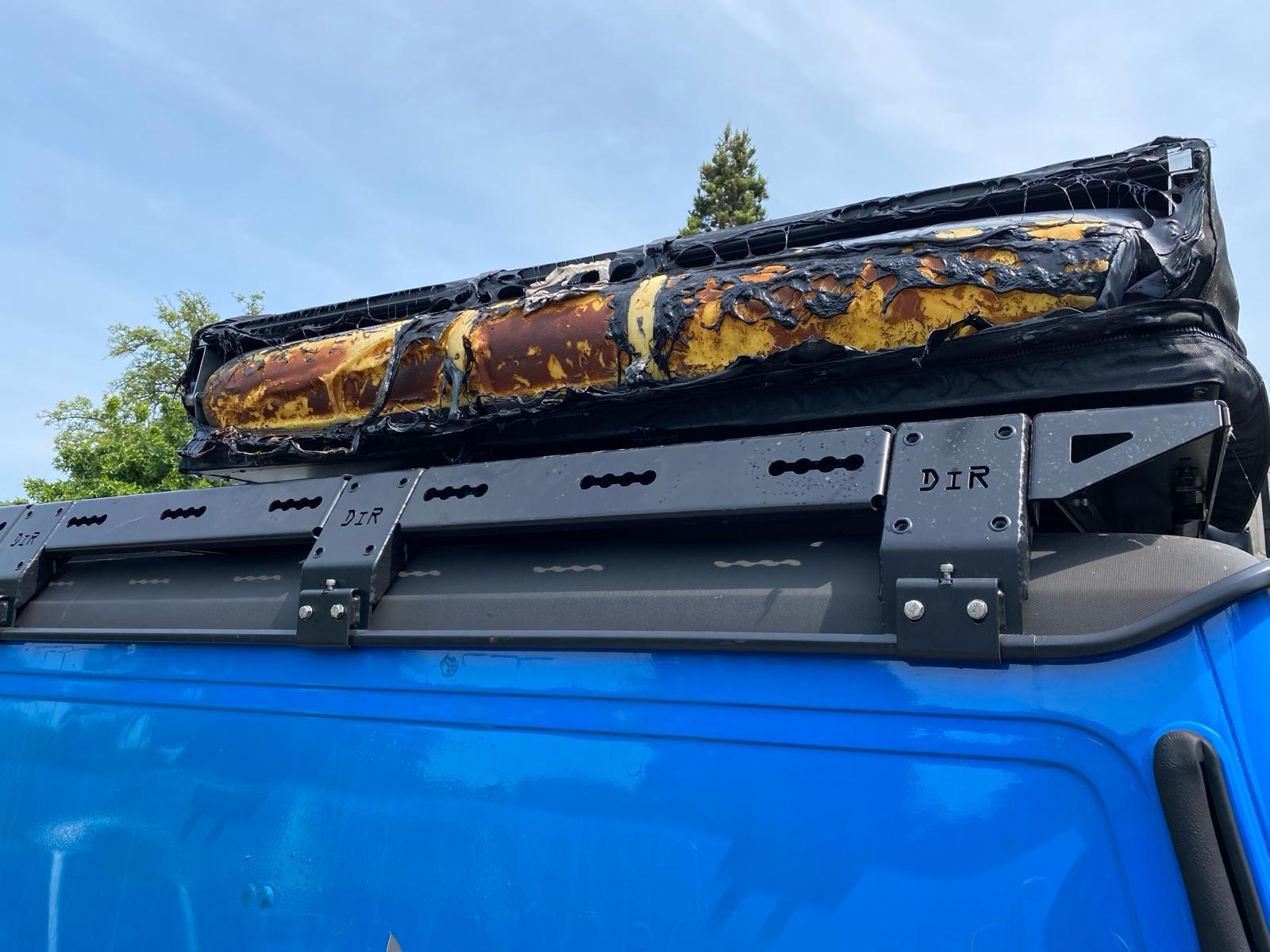
And if, despite all preventive measures and combating of an incipient fire, it does come to damage to the travel vehicle, the insurance could come into play. Here numerous questions then arise. What even counts as a vehicle fire? What is insured in the event of a fire? How is it with the inventory, for example the expensive recovery equipment or the roof tent? Does the insurance also cover extinguishing and consequential costs? Are fire damages to further objects and vehicles, for example in a fire in a hobby or vehicle hall, insured?
We want to pursue these questions too in a further article on the subject of fire protection and firefighting while travelling.
© Photos in the text: Yjan van Dijk, Björn Eldracher