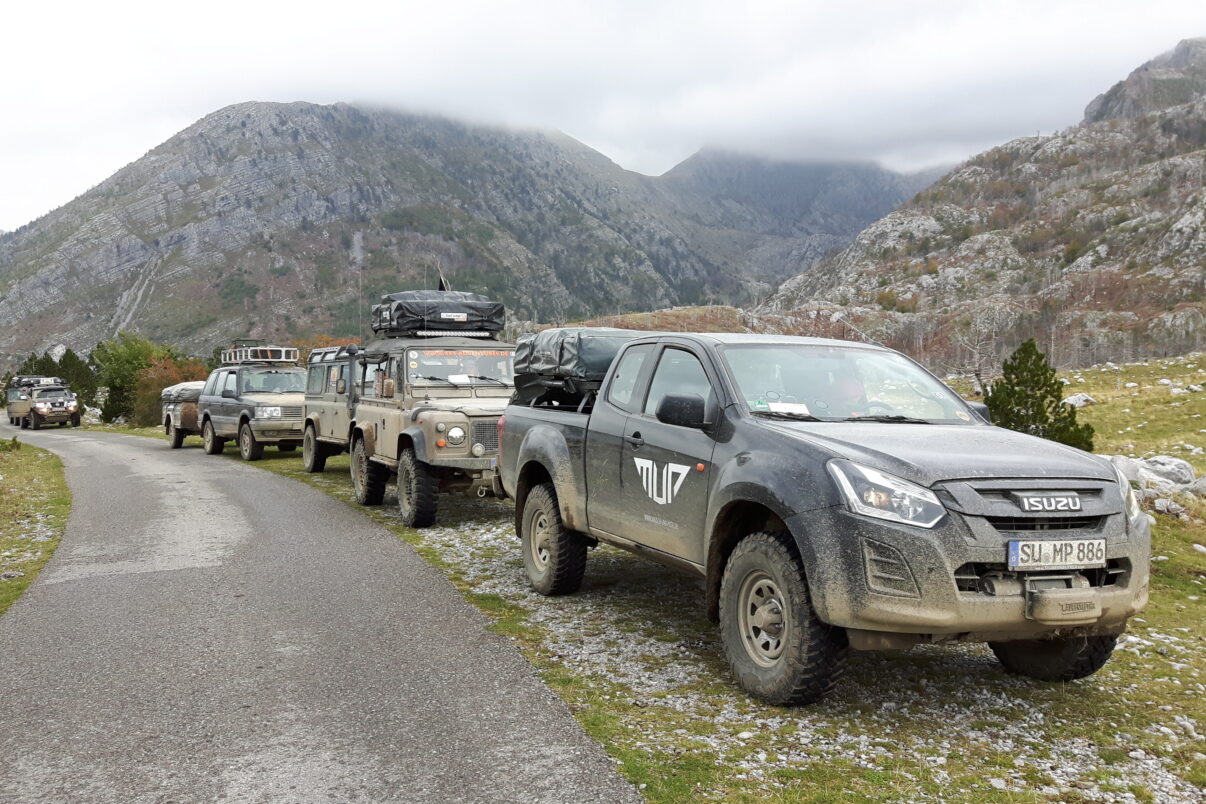

There are many reasons for driving off-road in a group. We give you tips so the tour becomes a pleasure.
Some of you are out more often in a group with several vehicles. There are good reasons for that. Some seek the company and the chat on the road or in the evening round the campfire, others look for travel buddies to tackle difficult stretches of a trip together.
There are many pros and cons to travelling or driving off-road in a group
Company and the feeling of being out with like-minded people are more of the soft factors. But that’s often a reason for driving off-road in a group. You can swap stories at the break and share what you’ve experienced. The group also gives safety, in recovery, bush repairs or difficult off-road sections.
The downsides are just as obvious. It can, especially on difficult off-road sections, take a very long time until all the vehicles in a group are winched up the steep slope, and even on easy stretches the average speed of a convoy is simply lower than that of single vehicles. So you have to plan for more time. It can also be a challenge for a (large) group to find an overnight spot where all the vehicles fit. Often it’s harder as a group to make contact with the locals. Solo travellers usually have the advantage there, as the threshold for offering invitations is understandably higher with a closed, large group.
What to watch for when choosing your travel partners
The days when travel partners were sought through ads in the relevant travel magazines are more or less over. Today many off-road travellers use forums, travel meets, associations, communities and clubs to make contacts in the scene. Another option is organised group trips.
Shared interests are an advantage, so the tour stays a good memory for everyone involved and the daily get-along works. This often starts with simple things like photography. Maybe you have someone in the group who likes to stop every few hundred metres for a few nice photos, or even needs time for the right composition. Others in the group care more about the driving. The result is that both characters end up annoyed. Further factors you should best clear up beforehand at a pre-meet are travel style, tolerated difficulty levels, experience and the like.
A certain homogeneity in the group when it comes to the vehicles can matter too. It can get annoying over time if one person in the group, say, has to make a fuel stop every 300 km while other vehicles in the group have very long range. You should discuss all this before the trip and make clear arrangements. Identical vehicles within a group also have advantages for the possible travel speed, and you can split spare parts, recovery gear and tools across the vehicles in a weight-friendly way.
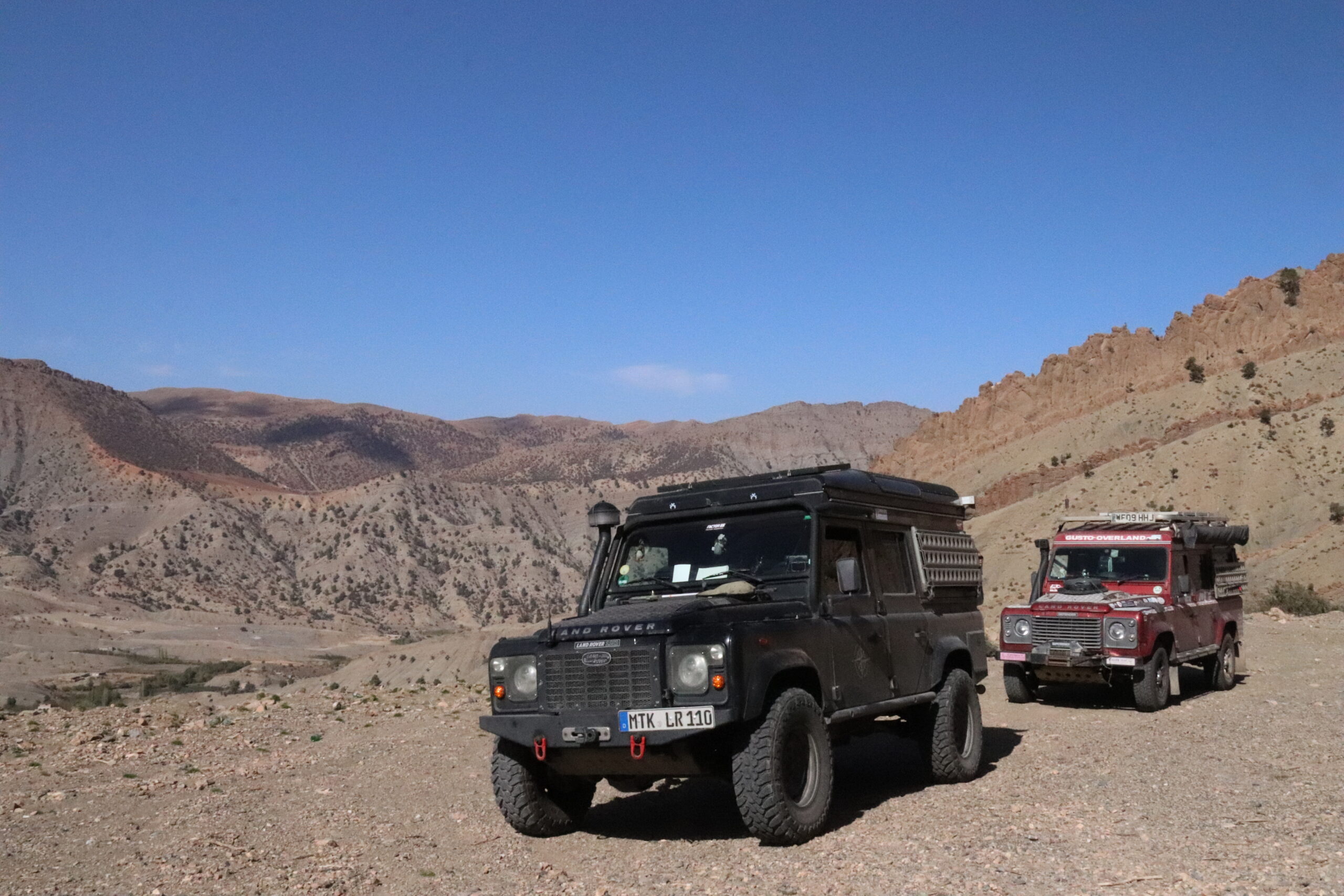
In the end only the tour itself will show whether the group gels, and of course a group can be a pure marriage of convenience, just to tackle difficult sections, with the points above fading into the background.
All this has a lot to do with group dynamics and less with the actual off-road driving in a group, so here we only want to give a few things to think about. So let’s get to driving off-road in a group.
Before the group off-road driving starts
It’s a good idea to make yourself familiar with where the safety-relevant kit is stowed in the other vehicles in the group. That includes, for example, first-aid kits, the medical box, (emergency) medication, fire extinguishers, recovery gear and the like. Talk beforehand about whether someone in the group has knowledge that’s useful in emergencies, and make clear arrangements for the case that hopefully never happens, like who takes on what in an emergency. We’ll come to communication tips for emergencies later in the article.
It also makes sense for fellow travellers to know about any pre-existing conditions, medication and emergency medication. Because in case of doubt it’s the fellow travellers who can save lives. For this it’s a good idea, usually on longer trips, to fill out a so-called medical sheet for each traveller, so that in an emergency fellow travellers can pass the important information to rescuers and doctors.
How to keep the group together and make sure no one gets lost
Professional vehicle convoys, in the military or with aid organisations for example, have clear rules, and that’s how we should handle group off-road driving too. Because then it gets easier and more relaxed for everyone involved. Now, we of course don’t have the corresponding markings like the flags (red, green, yellow and blue) and aren’t allowed to use them, of course. But we can do many things in a similar way. Let’s look at it in detail.
Clear communication has a key role in group off-road driving
Off-road driving in a group needs clear communication. This should start before the group sets off. That includes, of course, sorting out the question of which vehicle drives in which position. More on that later. You also have to set out in advance how you communicate in the group.
Almost all of us have a smartphone today, and they’re now part of everyday life. But we can only advise against the mobile phone for this purpose. Here you only reach one vehicle from the group at a time, the communication is far too slow for sudden obstacles or a looming breakdown, for example, and a group chat isn’t practical. There’s also the matter of reliability, or dependence on infrastructure. There’s the famous dead spot, and where you’re out off-road there isn’t always phone signal, or you don’t have a SIM card or other systems while on tour abroad. Ordinary smartphones aren’t very rugged either. Not a good thing for group off-road driving.
So radio in the individual vehicles of the group is very useful, and various radio applications are possible in principle.
Communicating by radio
Various radio applications are possible for this, each with its pros and cons. The classic among off-roaders and off-road travellers in Europe is surely still CB radio. Here you have a large choice of different sets, both base sets and handheld radios, for guiding, for example. The usable channels are around 27 MHz, that is in the 11m band. The power is a maximum of 4 watts on the FM and AM modulation types, and 12 watts on SSB. With CB radio you can achieve acceptable range, the entry requirements are low, as it’s so-called licence-free radio, and this radio application is free of registration and fees.
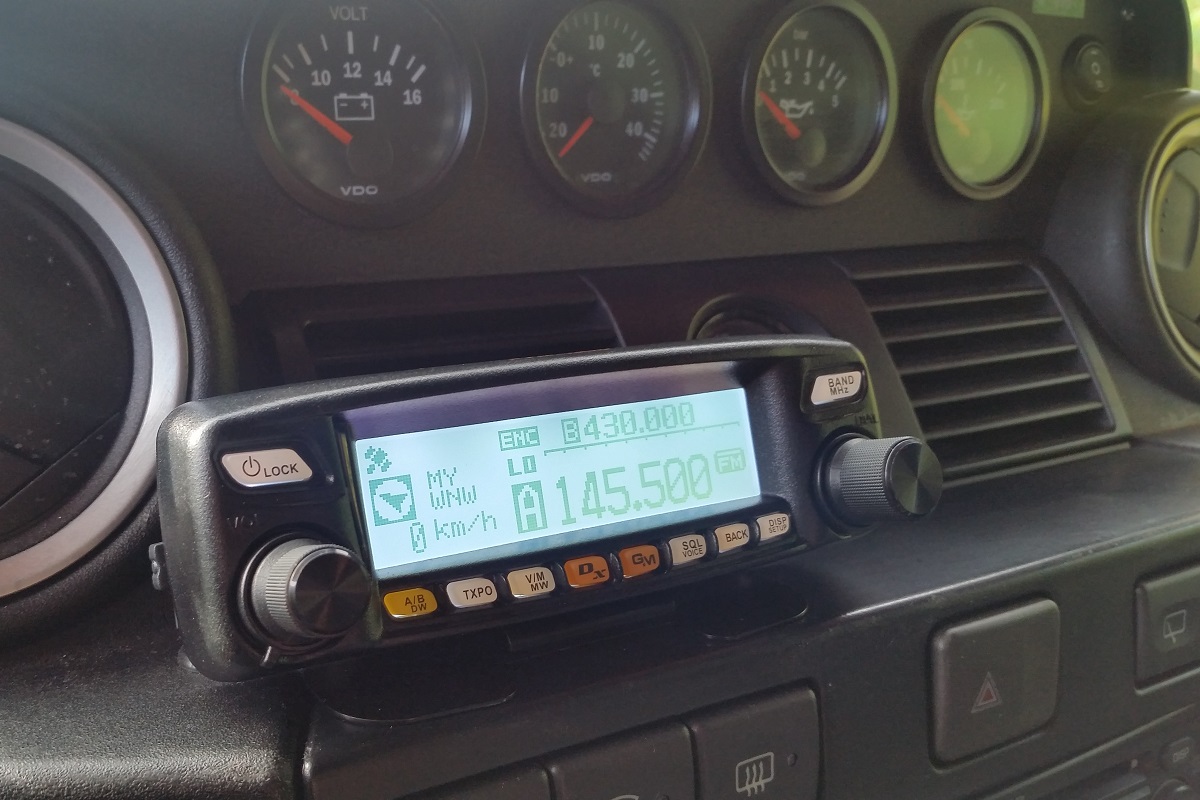
PMR446 radio is also a licence-free application that can be run without extra cost and without a licence. As PMR446 devices, only handheld radios are allowed. By design, PMR446 devices may only have a transmit power of 0.5 watts. The available channels are at 446 MHz, hence the name, that is in the 70cm band. In dense building, twisty terrain or even dense foliage, the range can be very short. A clear disadvantage in a group.
Another radio application is the amateur radio service, colloquially also called ham radio. Despite its broad spectrum of usable frequencies, high power and varied options, it’s still not widespread among 4×4 drivers in Europe. This may be down to the entry hurdles. The application requires an amateur radio licence and authorisation to take part in the amateur radio service. That comes with considerable study and exam effort and cost.
Besides these there are further radio applications, which tend to lead a niche existence, though.
CB radio and PMR446 will be your choice for group off-road driving
Whichever radio application you choose, you have to set out before you set off on which channel or frequency you talk within the group.

Practical tip: In the individual travel countries there can be different rules on radio use. In Germany, for example, there’s the so-called “microphone ban” under paragraph 23 of the road traffic regulations, which we’ve reported on several times. Please find out beforehand about the rules in force in your travel country.
That information in brief. If you’re interested in the topic of radio in the 4×4 in detail, then have a look at the Big 4×4 on radio here on Matsch&Piste.
But communication by radio isn’t the only thing that matters
If you come to a turn-off within your group, you wait there until the following vehicle is visible, and so that its driver can see where it goes on. If the gap gets too big, this should be reported to the lead vehicle, so its driver can, for example, take the speed off the group and the following vehicles can close up again. Take your bearings from the speed of the vehicle behind you too, and look in the mirrors regularly.
Just as important as good communication within your group is communication with others. That includes signalling to oncoming vehicles, making room to let them pass and so on. Part of good etiquette in group off-road driving is that you don’t take up unnecessarily much room with your group and hold others up. At breaks, watch for space-saving parking of the vehicles so others still have room. Park vehicles so further vehicles can pass safely and let faster vehicles overtake your group. It’s also a nice and helpful gesture to signal to oncoming vehicles how many vehicles are still coming, or to show which is the last vehicle.
Practical tip: If something does go wrong despite everything and you actually lose a vehicle from the group, then set out before the tour where you meet again for this case. That can be a rest spot or a campsite in the end, but also a striking landmark.
One more tip. Garmin, by the way, has various devices with a so-called team-tracking function. With the inReach technology you can swap messages between vehicles in a group and follow the real-time positions of the individual members. Surely interesting for people who drive a lot in groups.
Roles and positions in group off-road driving
First the group needs a lead vehicle
At the start, set out who leads the convoy. You need a person in charge. That’s best someone from the group who knows the route and is also able to lead a group like this. This person drives in a vehicle at the head of the group, takes care of navigation and organises communication, guides vehicles into stopping places, informs about the state of the route. Before setting off, this person should also do a short briefing on the tour with the group. This can contain general information on the day or the tour, the weather, special points on the route like the difficulty level and the like. Just everything that’s useful to know before setting off.
It’s important that all this lies in one hand. That’s comparable to situations like recovering a vehicle or guiding, where everyone listens to one command so no chaos arises. For proper guiding with hand signals you’ll find many useful tips here.
Practical tip: It’s a big help if the person leading the group is the passenger in the lead vehicle, because then they can focus fully on their role. Because this is a demanding, responsible job.
The vehicle at the back of the group has an important role too
Namely a so-called Tail End Charlie. This term comes from the military and describes the rear gunner in a bomber. They defend the aircraft to the rear. And that’s exactly what the last vehicle, or its crew, takes care of in the group. They watch that no one gets lost at the back of the group, or warn of faster vehicles closing up, and so allow safe passing.
Everyone else in your group should of course enjoy the drive, but also think along and, if something seems odd to you, for example with the choice of route, if stops or fuel stops become necessary, if you spot hazards and the like, communicate this early. Everyone is responsible for themselves and others. Communicate to the lead vehicle too if the speed is too high for you, because you’re still an off-road beginner for example, no false shyness, because it should be safe for everyone involved. Within the group there’s of course no overtaking.
Further tips for relaxed driving in a group
Keep enough distance to the vehicle in front within the group. This can be especially relevant in dusty regions. For one thing, you have little or no view through the kicked-up dust if you drive too close, which provokes accidents, and for another you don’t want the dust of the vehicle in front in your air filter or your vehicle. Kicked-up stones can also cause damage to your vehicle.
On tricky off-road sections, enough distance to the vehicle in front takes on further meaning. If you drive too close, several vehicles can get stuck at once in a mud section or similar. That makes a recovery unnecessarily harder. On uphill drives it could also happen that the vehicle in front of you slides back, leading to an accident. So always keep enough distance.
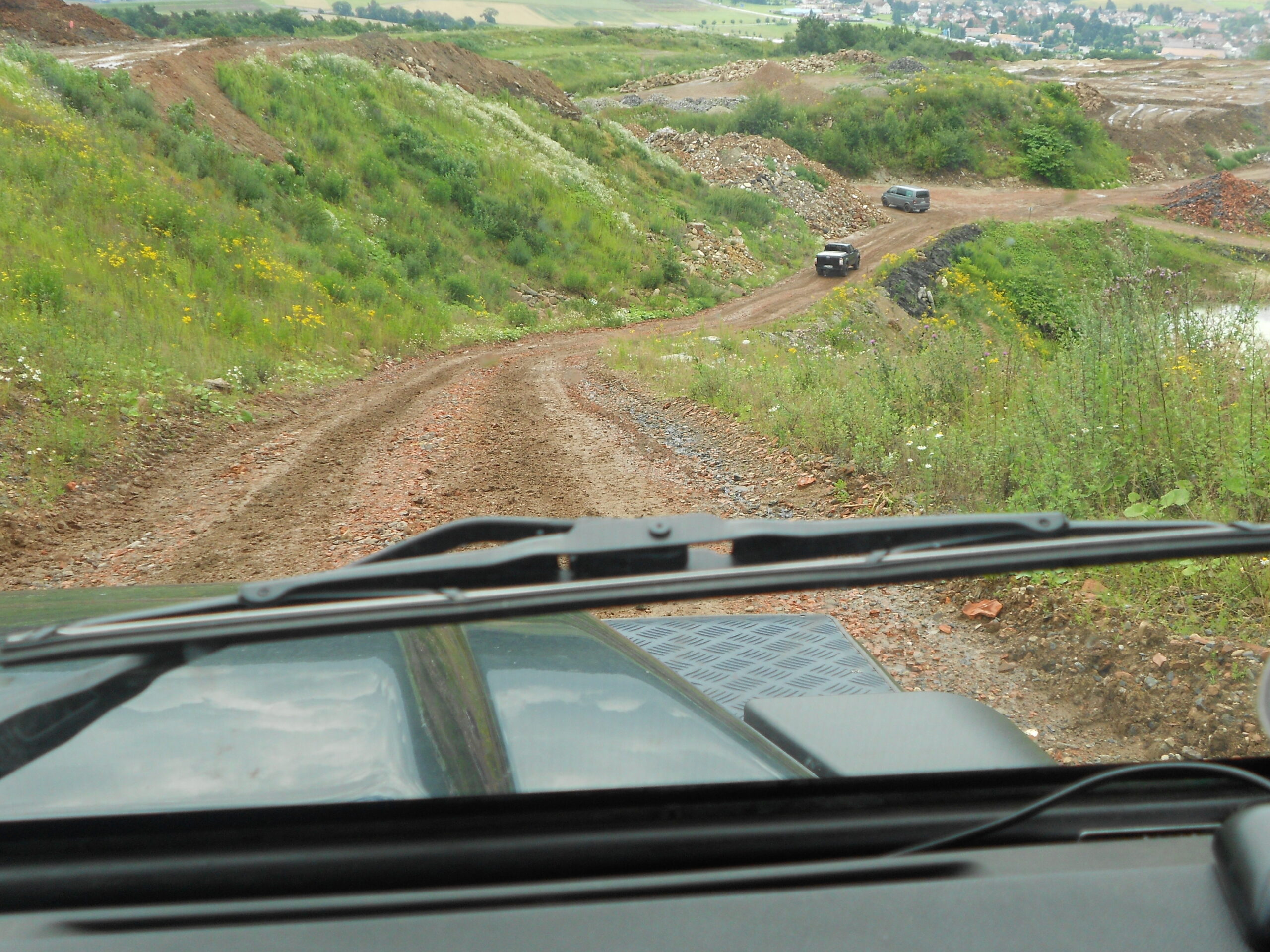
Within a larger group of vehicles, though, a concertina effect often happens, that is, those at the back of the group have to drive faster than those at the front. Everyone, not just the lead vehicle, should bear this in mind and try to drive evenly and, where possible, not let irregular gaps form that tear the group apart and then have to be closed by the following vehicles faster. All this only brings unrest into the group and is, on top of that, more tiring to drive. Through moderate pulling away, accelerating and slowing, the concertina effect can be reduced a bit.
This is how you can put group off-road driving into practice
Andreas has a lot of experience with group off-road driving. After all, he’s organised quite a few tours with the Landyfriends, with up to 40 vehicles. So here come a few more useful pointers and practical tips from him.
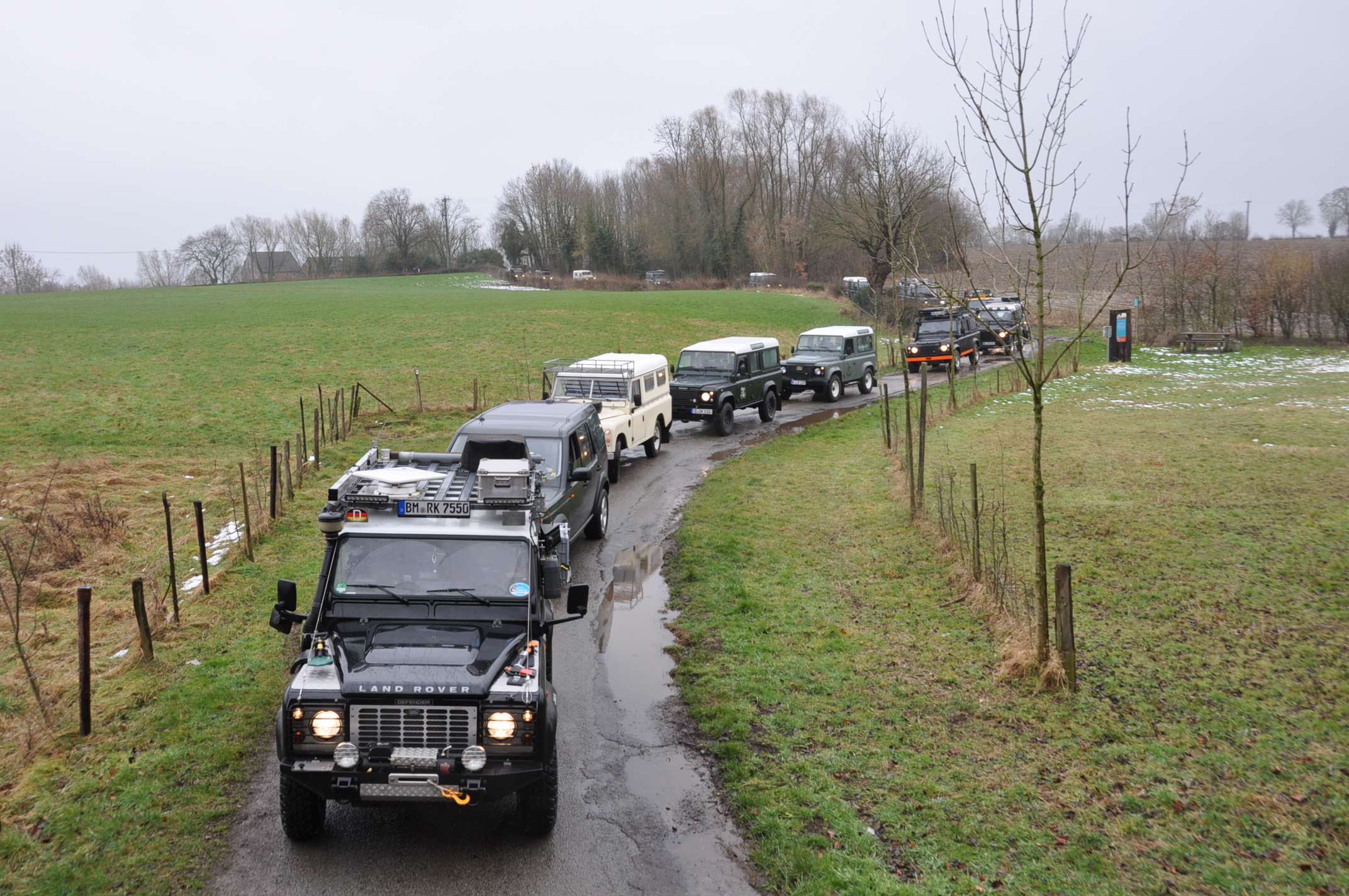
It’s proven good for the lead vehicle and the last vehicle to always be in contact. The lead vehicle passes important information to the group. Especially when it’s hard to see, for example on narrow paths with many bends or crests, or dunes.
If your group is too big, so the radio distance isn’t enough, a vehicle in the middle becomes a relay station. If that isn’t enough either, then it’s best to split the group into smaller groups, each with a lead vehicle and Tail End Charlie. Each group forms a self-contained unit. That way you make sure everyone in the group has received the message. If it reached the last vehicle, then you can assume everyone in between got it too. If it didn’t reach there, the relay vehicle in the middle takes care of it. Vehicles with these jobs should, as mentioned, have passengers, so the driver can focus on driving the vehicle safely.
Examples of sensible communication
The group is heading towards a turn-off in the woods.
Lead vehicle: “Right at the fork.”
Last vehicle repeats: “Right at the fork.”
The group has to reckon with oncoming traffic on a narrow stretch. A large truck comes the other way.
Lead vehicle: “Oncoming traffic, truck.”
Last vehicle repeats: “Oncoming traffic, truck.”
At the back of the group, a vehicle stops for an unknown reason.
Last vehicle: “Tail end stopping, four vehicles halted at the abandoned petrol station. Will report when the cause is clear.”
Lead vehicle: “Confirmed! We’ll find the next possible stop and wait.”
The group is out in the desert among dunes.
The radio range may be short and visual contact keeps breaking. In the end a vehicle gets stuck, the front vehicles of the group drive on.
Here it’s important that everyone in the group tries to keep visual and radio contact. If visual contact is lost, ask over the radio whether the group is following. If not, pass it forward at once and stop, so there’s a radio relay between the front and the rear group to pass things on. Otherwise the group can be pulled too far apart. Without experience, finding each other again can become a challenge, especially as the stress level likes to rise now and further mistakes get more likely. For this case, as set out before, agree a meeting point as plan B.
The middle vehicle hasn’t seen the rear group for three minutes.
Middle vehicle reports forward: “Visual contact to the rear lost, stopping and trying radio contact.”
Lead vehicle (important!): “Confirmed! We’re stopping and waiting for a report.”
Now the radio chain is secured.
Middle vehicle: “Question to the tail end: are you driving?”
Tail end: “No, vehicle stuck, urgently need a winch!”
Middle vehicle confirms and passes forward: “Vehicle at the tail end is stuck, please send a vehicle with a winch to the rear.”
It’s important that, where possible, the relay vehicle stays where it is. If that isn’t possible, the whole front group including the relay vehicle may have to go back. Especially in the desert and similar areas, it’s important that the group stays together and no one is isolated.
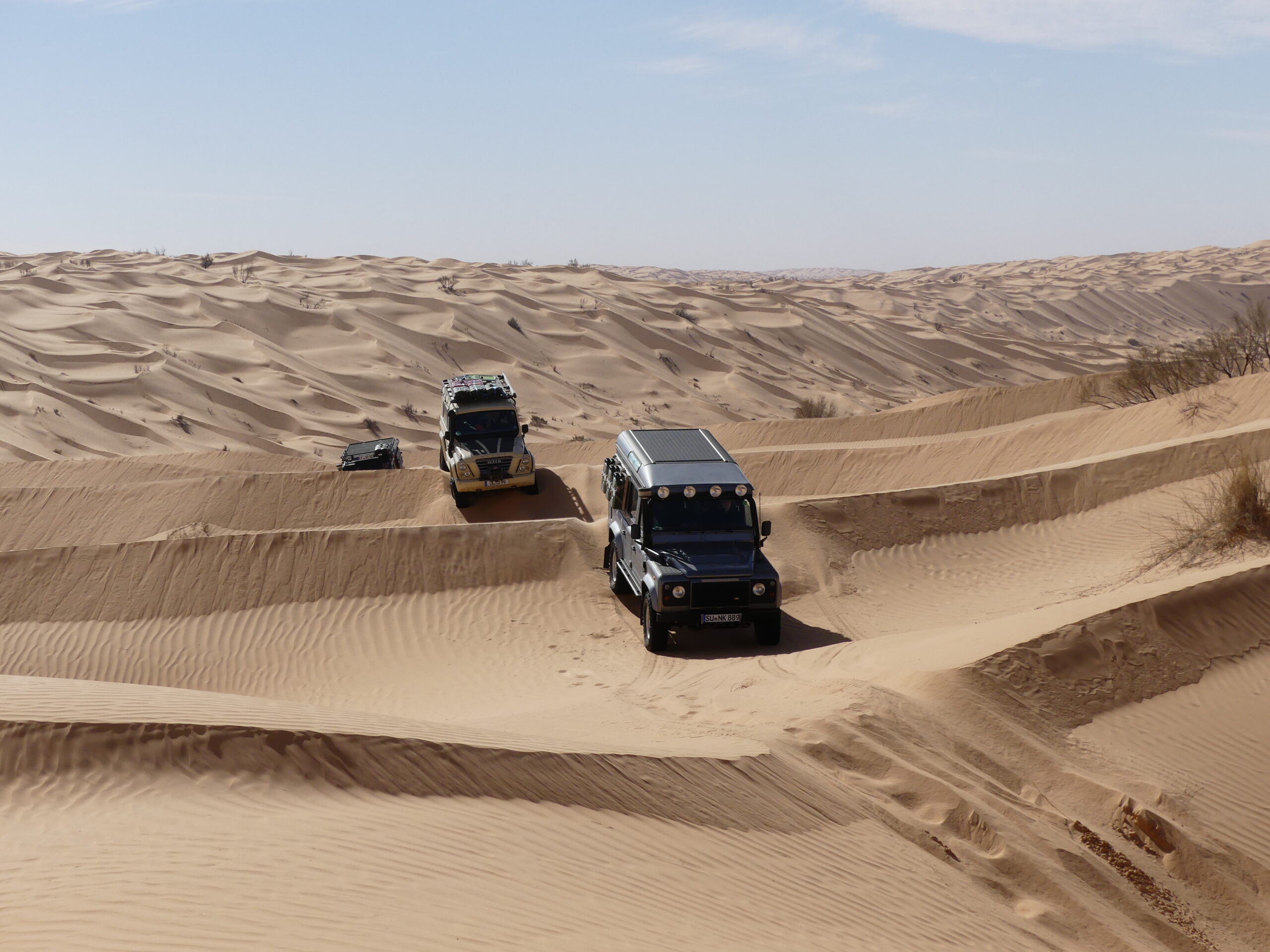
One more practical tip from Andreas: In dune fields you stop, where possible, on the dune crest, with the vehicle pointing slightly downhill. You always drive from crest to crest. That way you can more easily see where the individual group members are and who might be in trouble. When you see the vehicle in front driving to the next dune crest, you wait until you see them on the next crest, then you drive to the free crest in front of you. If the vehicle in front gets stuck, you’re not right behind them, possibly blocking a recovery. You also have no visual contact for this time and don’t know exactly where they are. That way you also reduce the risk of an accident.
So as a rule the last vehicle should confirm all messages. For particularly important information, that is when there’s been an accident or someone’s been hurt, it’s important that everyone confirms the messages. The sender of the message can then say, for example, “Acknowledge” or “Read back. Over.” Everyone replies with “Understood.” Then all the vehicles not involved or needed should close up to the front, name a new lead vehicle if necessary and find a suitable place to wait. Share the new location with everyone involved, and before breaking up the group, quickly agree on the kind of further communication and any next steps.
And above all you should have a lot of fun driving off-road in a group
These tips and tricks are meant to make group off-road driving easier for you, so the drive becomes a pleasure. Because everything you think through well and arrange before setting off won’t become an obstacle on the road. Good preparation matters. Help each other on the road if there are problems and communicate them early in the group. And now, have fun on your next tour with like-minded people, friends or the shared club outing.
What are your experiences with group off-road driving? Write to us.
© Photos: Andreas Woithon and Björn Eldracher