



Artificial intelligence is making its way more and more into our hobby too, and recently we looked at the possibilities of AI here on Matsch&Piste. In what follows we take a look at how trip planning with AI works, especially with Google Gemini, and what other helpful functions Google provides.
In this article we showed you how artificial intelligence and overlanding can be usefully combined. Applications like ChatGPT or Google’s Gemini can help with route planning and suggest worthwhile destinations, give country-specific tips, name entry requirements, suggest the kit you need and much more. All this can speed up and ease the research. But are there limits too? And how do we have to question the AI so that what comes out is really what we hope for?
We reported on OpenAI’s ChatGPT last week.
What is Google Gemini, actually?
Google Gemini is Google’s AI engine, which is also built into the newer smartphones and tablets from Samsung* and others. For the test I used the Samsung Galaxy S25 Ultra* and the TabActive 4 5G.
Just like the ChatGPT already mentioned, you can communicate as if with a human. Here too the basis is a language model trained with a large number of documents. Google Gemini is available as a browser version or, on the road, as an app on the smartphone or a tablet.
The Google AI applications
The Samsung devices tested use Android as their operating system and so offer access to various Google AI apps and functions. These include the Google Gemini voice assistant, with which you can ask questions in a natural way, almost as if you were talking to a real person. “Circle to Search” is also available to you, a versatile image assistant with numerous uses.
Samsung itself offers further AI functions: an interpreter that can translate interactively, online and offline in conversation and even during a phone call, and a few AI functions around social media and photo editing. There’s a separate article on that next week.
Samsung has its own pre-installed voice assistant, Bixby, which primarily controls device functions but can also answer questions. Unlike ChatGPT or Google Gemini, though, the answers are limited to showing web content. No conversation is possible like the one you can have with the other two AI systems.
Trip planning with AI put to the test, various scenarios
We wanted to keep the results as comparable as possible. So at the start I used the same questions as Björn in his test with ChatGPT. When I lacked information or wanted to go deeper, I asked further questions, as in a real conversation. These follow-up questions of course depended on the previous result, which is why they were no longer uniform as things went on.
Entry requirements
This scenario is about a vehicle-based trip overland to the United Kingdom. Besides the entry requirements and conditions, we’re interested in which personal documents and which vehicle documents are needed.
Another scenario revolves around a trip to Morocco, a popular destination for off-road travellers. Here too we’re interested in which entry rules apply and which documents are needed for the border crossing and the trip.
Kit
Next we turned to the kit. For that we assumed we want to take a two-week camping holiday with a 4×4. The trip takes place in Europe, warm climate, and on board are two adults and a dog. The question is: what do we need for it? What do we have to take?
Vehicle preparation
Good vehicle preparation is the be-all and end-all before every trip. In this scenario we wanted to know from the AI what matters in preparing for an off-road holiday in the Tunisian desert. The plan is a 14-day tour with a Land Rover Defender, mainly in the sand and the dunes. So much for the plan.
Navigation
Navigation matters on the road, and already in the tour prep too. We want to test the AI on that as well. For that we came up with two more concrete scenarios.
For one, we want to get an off-road route from the AI. Namely between the places Camprodon and Ribes de Freser. These two places are in the north of Spain. Here we of course want to drive an unpaved track and not on tarmac. And then we’re also interested in getting to Iceland with our own car.
Planning a trip with AI, first filtering out useful information
We first ask about the entry requirements
Question to Google Gemini: “We want to travel by car, so overland, to the United Kingdom. What entry requirements and conditions apply there, and which personal documents and which vehicle documents are needed?”
The answer is detailed and points to the necessary passport, and also to the new electronic travel authorisation (ETA), which has to be applied for in advance. We were a little surprised by the note about a possible proof of financial means for the stay, we’d neither heard of that before nor was it ever asked of us.
This info probably comes from the website of the German Federal Foreign Office, where there’s a corresponding passage, as on the official government website www.gov.uk. We’ve been to Britain very often and were never confronted with it, which is why I assume the general rules were simply reproduced here and not what’s usually the practice.
Of course Google Gemini also names the usual requirements in this context: a valid driving licence, the green insurance card for the vehicle and the “D” sticker, the latter only necessary if the vehicle still carries an old DIN plate, as is the case for registrations before the year 2000.
The AI also gives the note on adjusting the headlights, on the speed limits and toll charges. Taking pets along is covered too.
From our own experience we can say the answer is correct and satisfies me as far as it goes.
Otherwise all the basic information is included. Unlike ChatGPT, though, Google Gemini gives no concrete sources or links you could use to inform yourself further. Only at the end is there a general note to consult the official government pages, where you have to find the relevant info yourself, though.
On with the trip planning with Google Gemini to Morocco
Question to Google Gemini: “We want to take a trip by car to Morocco. What entry requirements and which documents are needed for the border crossing and the trip there?”
The answer lists the required documents and entry requirements clearly, including the note to carry a copy of all important papers. After that come the vehicle-related requirements, a Carnet de Passages isn’t mentioned, which is correct. Then it’s about customs rules and a few traffic rules, like that “give way to the right” applies in roundabouts and night drives should be avoided where possible.
As with ChatGPT, the information from Google Gemini on the customs conditions is sparser. So here too it means asking again. The following answer then goes into the rules in great detail.
With pets I’m missing an important note, which I ask for specially. Google Gemini states what’s needed to bring a pet into Morocco, but not what’s needed to return to Europe, like the titre test.
I follow up: “What do I have to bear in mind on the return from Morocco to Europe regarding a pet?” The answer doesn’t deliver the term titre test, but it does deliver the proof of an effective rabies vaccination, which is the point of the titre test. Google Gemini also gives the necessary deadlines.
A bit of kit on top
Question to Google Gemini: “We want to take a two-week camping holiday with a 4×4. The trip takes place in Europe. In a warm climate. We’re two adults and a dog. What do we need for it, what do we have to take?”
The answer is quite extensive. On a closer look, though, I notice that some answers are kept rather general. So for vehicle preparation Google Gemini gives the usual things like oil check, water check, tyre check and air conditioning. That’s too little for me, especially because I specially used the term “4×4”.
I ask further: “Are there further checks for the 4×4 I should do?” Now the list gets longer and further checks come in: winch, diff locks, four-wheel drive, wheel bearings, dampers and springs. How the checks are done is missing. I follow up: “How do I carry out these checks?” The result is rather weak. So Google Gemini states that to test the four-wheel drive it should be engaged and I should then watch whether the vehicle has more traction.
The further instructions stay largely superficial, often it’s simply recommended to have certain jobs done by a workshop. I stop asking further and would rather read the vehicle check at Matsch&Piste.
Back to the answers. The good thing is that these read like a checklist. Gemini also reminds me, for example, not to forget the recovery gear or the maps. On my request, Google Gemini generates me this list to print and tick off. That’s helpful.
The list is extensive and detailed. Besides the personal kit like headtorches, hygiene and bathroom items, it has everything I actually pack on a holiday like this and includes a few reminders, like booking pitches in advance, checking insurance and so on. That satisfies me as far as it goes. If needed I can get more information out of it with further questions.
Good vehicle preparation matters
I now put the same question to Google Gemini that Björn asked ChatGPT on vehicle preparation: “We’re planning an off-road holiday in the Tunisian desert. On the 14-day tour we’ll be moving mainly in the sand and the dunes with a Land Rover Defender. How should we prepare the vehicle for it?”
This answer too consists again of a long list with many platitudes, which doesn’t bother me further as long as the tips are sensible. The information is grouped by topic, which makes orientation easier. On the topic of tyres there’s a solid note: the air pressure should be droppable a lot, and a repair kit belongs in the luggage. We found the notes on recovery gear especially good: besides sand boards, a kinetic recovery rope is also recommended, including the important note that using a kinetic rope takes experience. We also liked the correct figures on sizing the winch and ropes.
We liked the note on an extra fuel filter and an auxiliary tank, both absolutely sensible for longer tours away from infrastructure. We found the figures on the recovery straps less convincing, though: “either kinetic or static”. For recovery in sand we’d clearly reach for the kinetic strap, static ones belong more to load securing or fixing. The “or” is simply misleading there. This is exactly where the limit of semantic search systems shows: the last logical step, namely taking the experience in such situations into account, is missing. Only when enough good-quality content online explains the use of kinetic ropes in desert sand in enough detail that a clear preference can be derived from it will an AI reliably recognise this difference too.
On heat protection, Google Gemini overshot the mark a bit. Besides the common extra cooling option of an oil cooler, water injection is recommended too. For driving in sand I should merely make sure to master the techniques. Well, I want to know more there and ask for explanations of how that’s done.
The result on the topic of tools is disappointing. The tip: take a “well-stocked tool set”. Aha, who’d have thought. At least the whole thing is balanced out with the note to rather travel in a group. That almost reads as if you could then rely on others in case of doubt.
We stick to Björn’s ChatGPT script and ask “How do I service my vehicle for a 14-day desert tour through Tunisia?”
The again-grouped answer still consists of many general notes. It’s interesting that the AI remembered the vehicle type named before, but only to address it. The technical tips, on the other hand, could just as well apply to a VW Golf, because that has ball joints. A Land Rover Defender rather not. That isn’t really helpful, because the answers stay with the obvious and ignore vehicle-specific particulars. Really useful instead would have been the note to write down the unlock code of the immobiliser…
Let’s look at the navigation and route-finding scenarios too
With trip planning by AI, questions on navigation and route planning can’t be missing either: “Please name me an off-road route between the places Camprodon and Ribes de Freser.” I ask specifically about this route because I know it personally and know there’s a pure track route there, as well as an alternative tarmac route.
Google Gemini immediately starts Google Maps and gives me the tarmac route. Even after the explicit request to replan this route as a pure track, Google sticks to the tarmac version. Only when I state I’m cycling does Google Maps take the track between the two places. OK, I know the situation on the ground, but if that weren’t the case, we wouldn’t ask for a cycle route either, would we?
On we go: “I want to go to Iceland with my own car. Please tell me something about getting there.” The answers sum up all the important things. Here I find nothing missing or wrong. Unlike ChatGPT, Gemini doesn’t ask me whether I want to know more about routes in Iceland. To the question of how I get to Hirtshals, there’s a Google Maps route straight away from my home. Another difference to ChatGPT, which answered here with text on various ways of getting there.
Further Google AI functions for Android
Circle to find
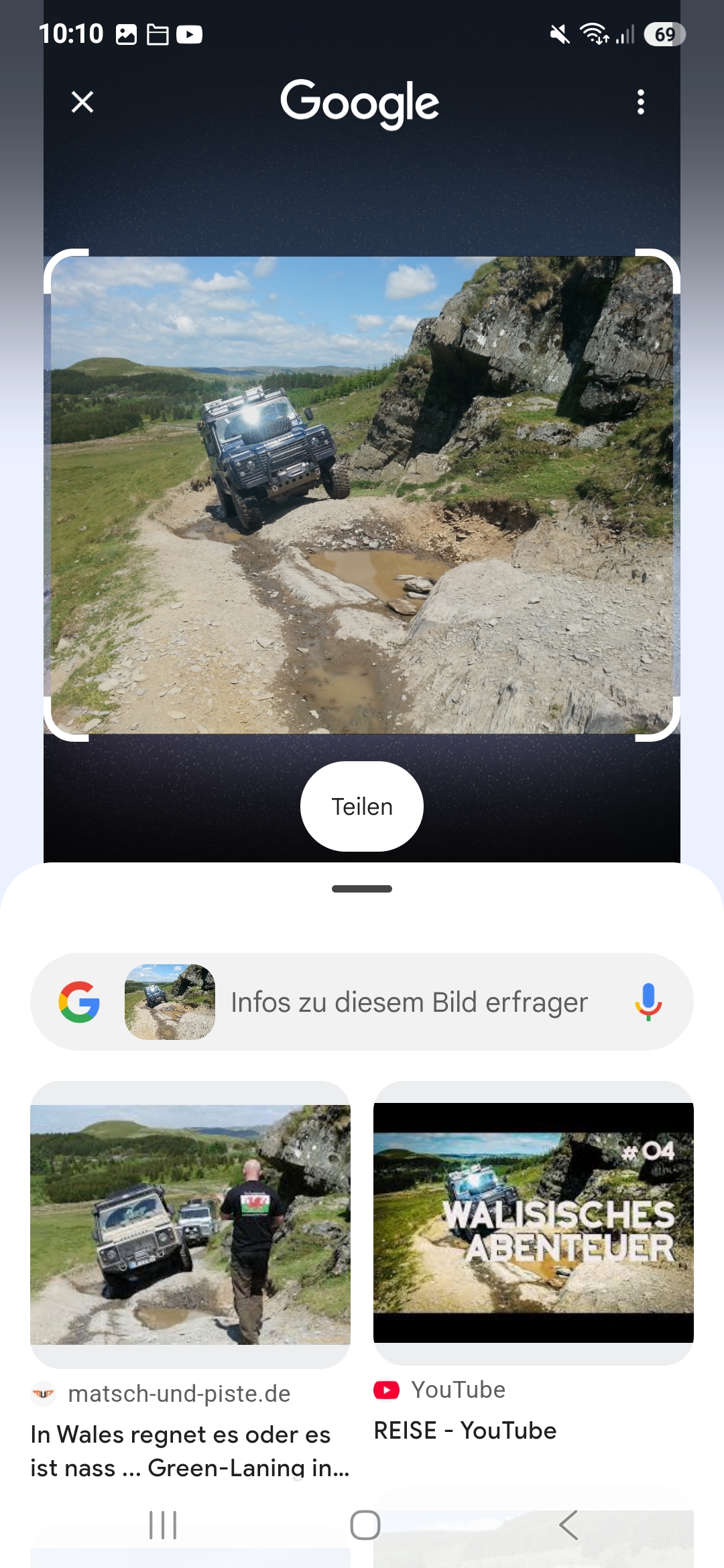
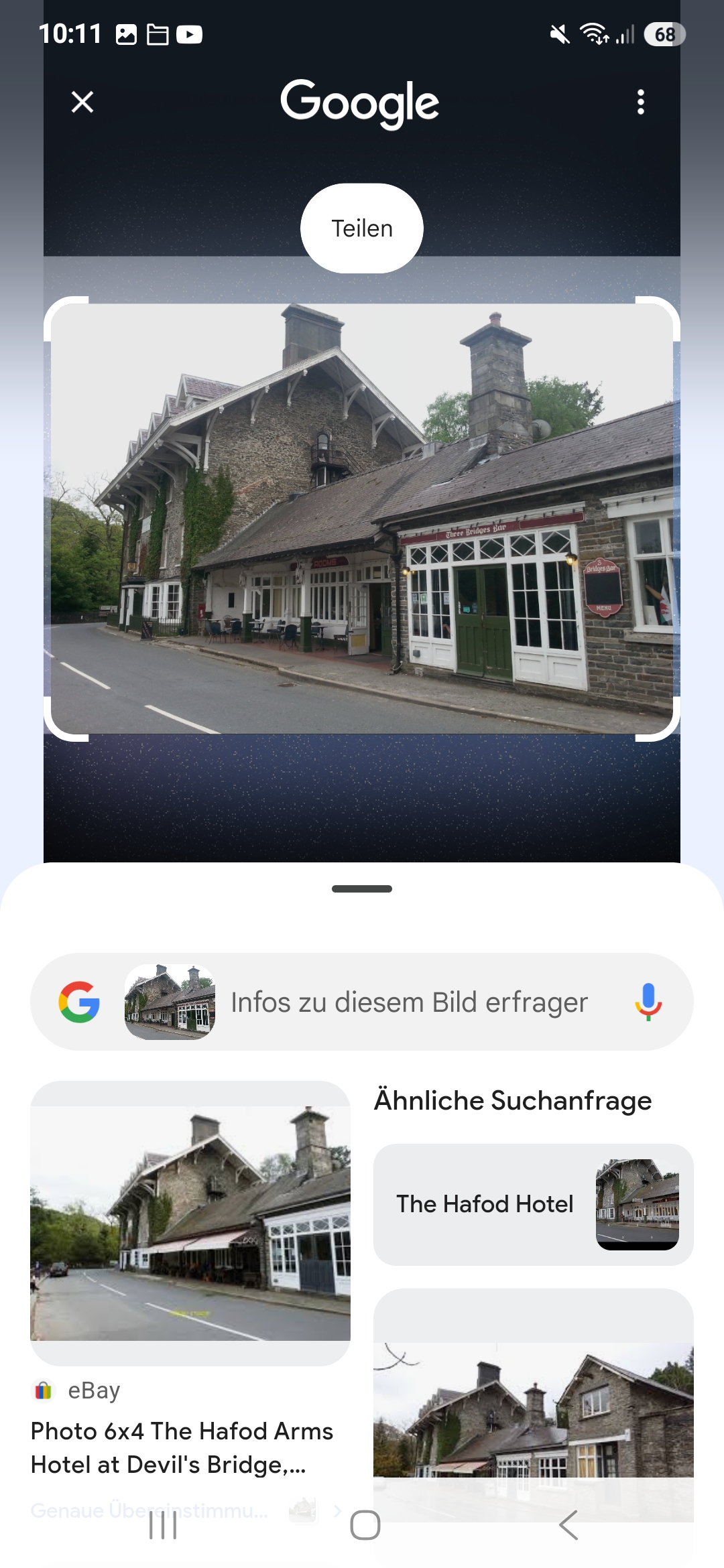
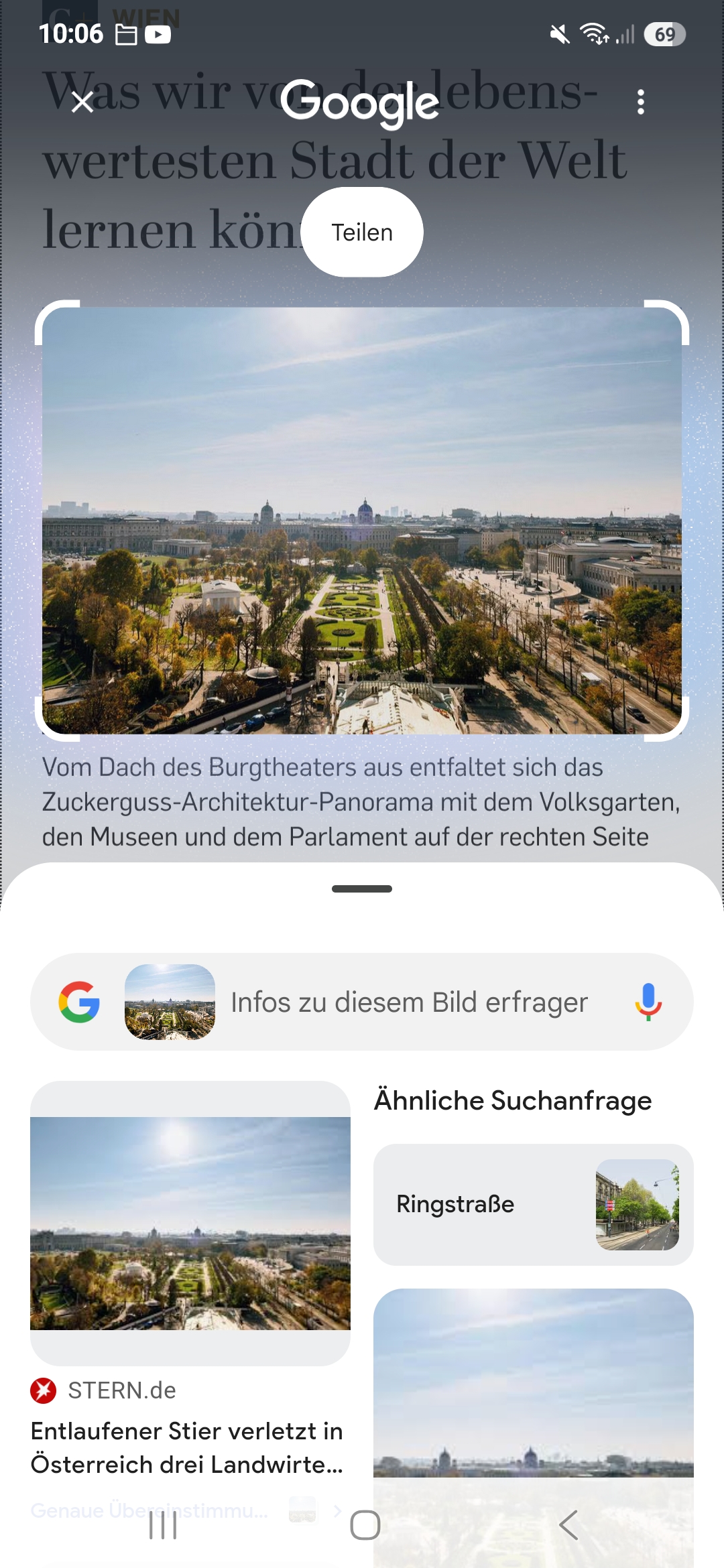
An AI function found only on Android devices is “Circle to find”. This has turned out to be quite handy, and not just when it comes to travel. You have a photo of a building on the smartphone, for example. It doesn’t matter whether it’s a camera shot or an image in a web browser, chat or similar. You press the configured button to start “Circle to find”, circle the object or landscape you’re looking for with your finger, and Google shows you the results. If the image comes from a map, for example, Google Maps offers you a route to it.

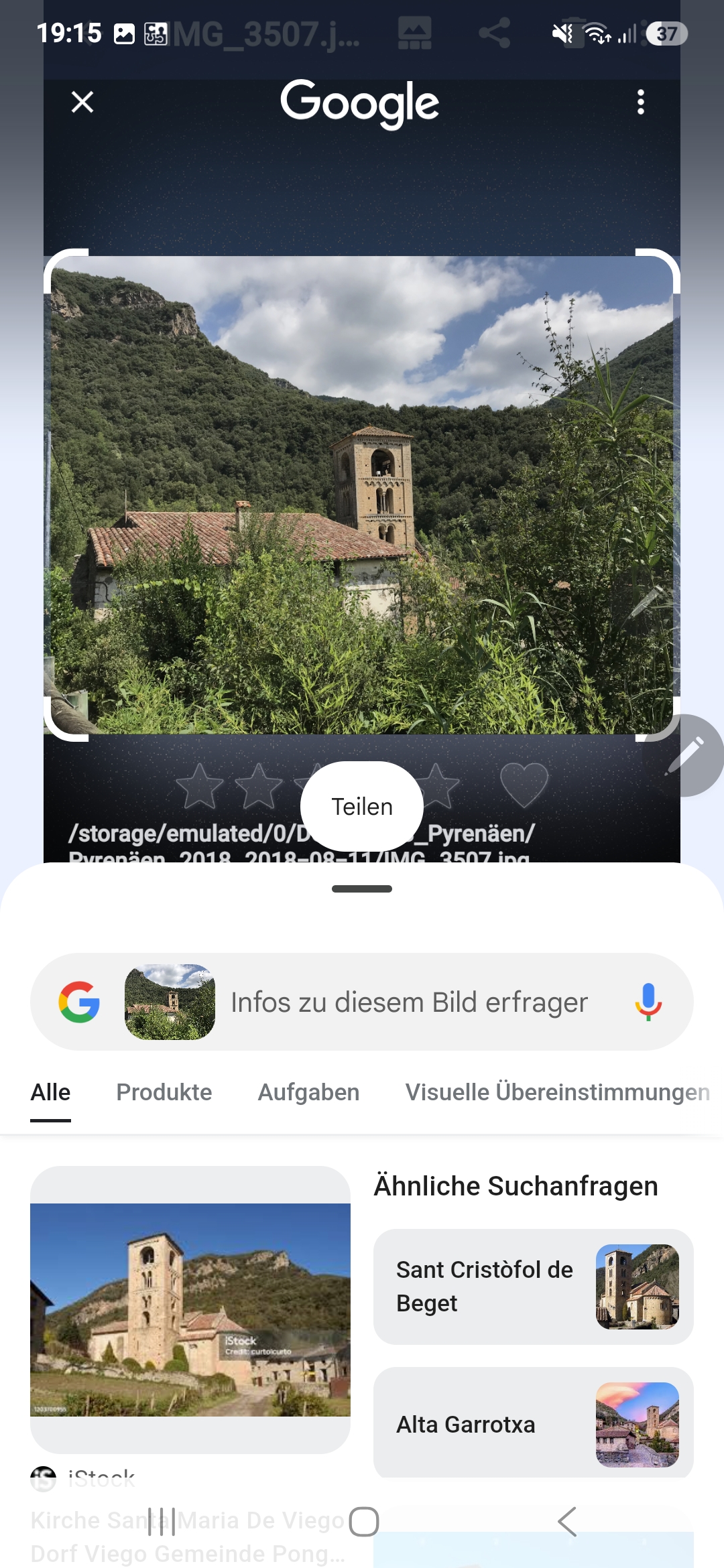
In the tests I did, this worked very well and reliably. It was interesting that Google Search even found our own content. So I had it search for a rather vague image of the Strata Florida in Wales and it found both our travel report and the 4x4PASSION video on it. Another time I had it search for some house in Wales and that was found too.



Verdict: trip planning with AI, Google Gemini
Unlike ChatGPT, Google uses its large range of functions. For routes Google Maps is started, Circle to Search uses the Google image search and so on. Even when I ask ChatGPT to plan a route in Google Maps, I only get a link that then opens Google Maps with the route. Here Google Gemini plays the strength of the usefully integrated functions.
But just like with ChatGPT, you mustn’t expect to get complete or solely correct answers. For my taste there are also all too often answers that are too general. The result can surely be improved by asking further, but then you might as well find and read a few good websites on the question yourself.
One decisive advantage of searching outside the AI remains: the AI’s answers don’t give the sources. But if you know the source, the authors and also the age of the answers, that has a meaning for the credibility and how up to date it is. That lets you even get in touch if needed. The AI’s answers stay anonymous and, at least for me, not quite tangible, harder to place.
The advantage is just as obvious, though: an AI can deliver you answers you maybe hadn’t thought of at all. The search radius is extremely large. So for me the AI has only become a further building block in the planning, but not the only one. As I like to keep control anyway, I’ll keep using campfire chats, maps and tour books alongside the normal internet research to plan our tours and trips.
We’ve looked at this and other aspects in our article on the sensible use of artificial intelligence in overlanding too.
*Affiliate link: If you like this article or something else in the linked shop and buy through this link, we blast through the next mud puddle with a grin. Because with every purchase we get a small commission. Not that we get rich from it, but it’s a little thank-you from you. With it you help us offer our content for free.