

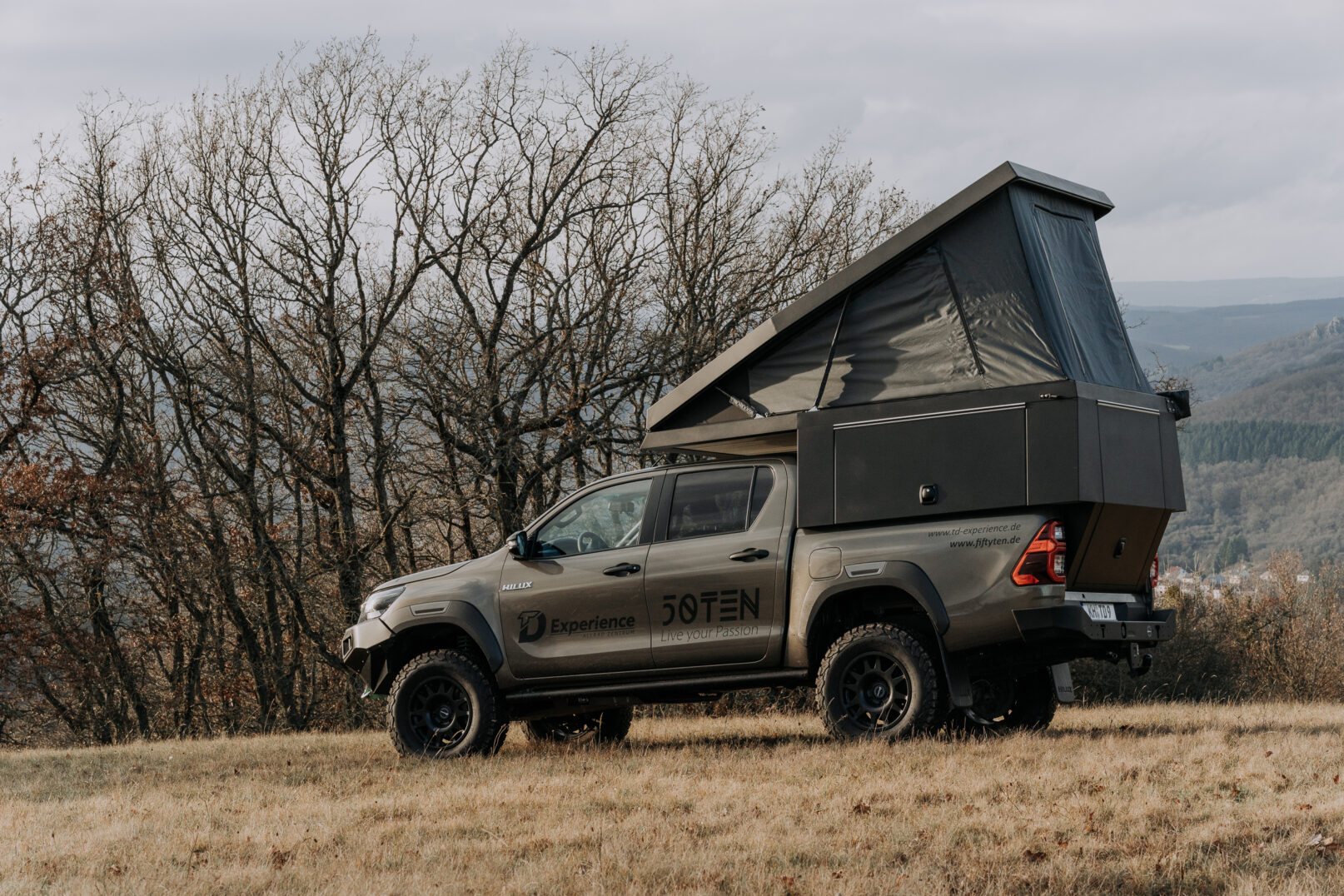

Many of you head out on tour with a pickup. And a pickup really is a practical vehicle, since all sorts of gear fit on the bed and passengers fit inside as well. There is almost no limit to the ways you can convert one. So why not simply take your home along on the bed? In the shape of off-road campers. The idea is nothing new. The sheer number of different campers on the market seems almost endless. Reason enough for us to give you an overview.
The advantages of a demountable camper are obvious. In everyday life the vehicle can be used like a car or used to carry other things. When you set off on a tour, you simply load up your off-road camper and have everything with you. You stay just as mobile at your holiday destination. When you want to make a trip off-road, for example. Then you can take many of the campers off with relatively little effort, and it serves as a base camp. Vehicles with permanently mounted cabins have their advantages too. After all, they are usually mounted on vehicles that are designed from the factory to carry heavy loads.
The base vehicles
Base vehicles for campers can be flatbed vans, trucks, pickups and more. The “chopping” of conventional 4x4s, popular in Australia, is another option. In this article we want to focus mainly on conventional pickups.
Modern or classic commercial-vehicle look? Single or double cab? Diesel or petrol? Manual or automatic? Choosing the right base vehicle is about more than personal preference. It is especially important to get to grips with payload and dimensions. The camper and the base vehicle have to be matched to each other. Because it is no good to you if the driving fun, or even the stability and safety, is lost because the cabin perhaps massively exceeds the dimensions of the base vehicle, or is far too heavy for your pickup and things get dangerous. Many of the pickups currently available in Europe have a payload capacity of around one tonne or more. But what looks like a lot on paper can be used up quickly.
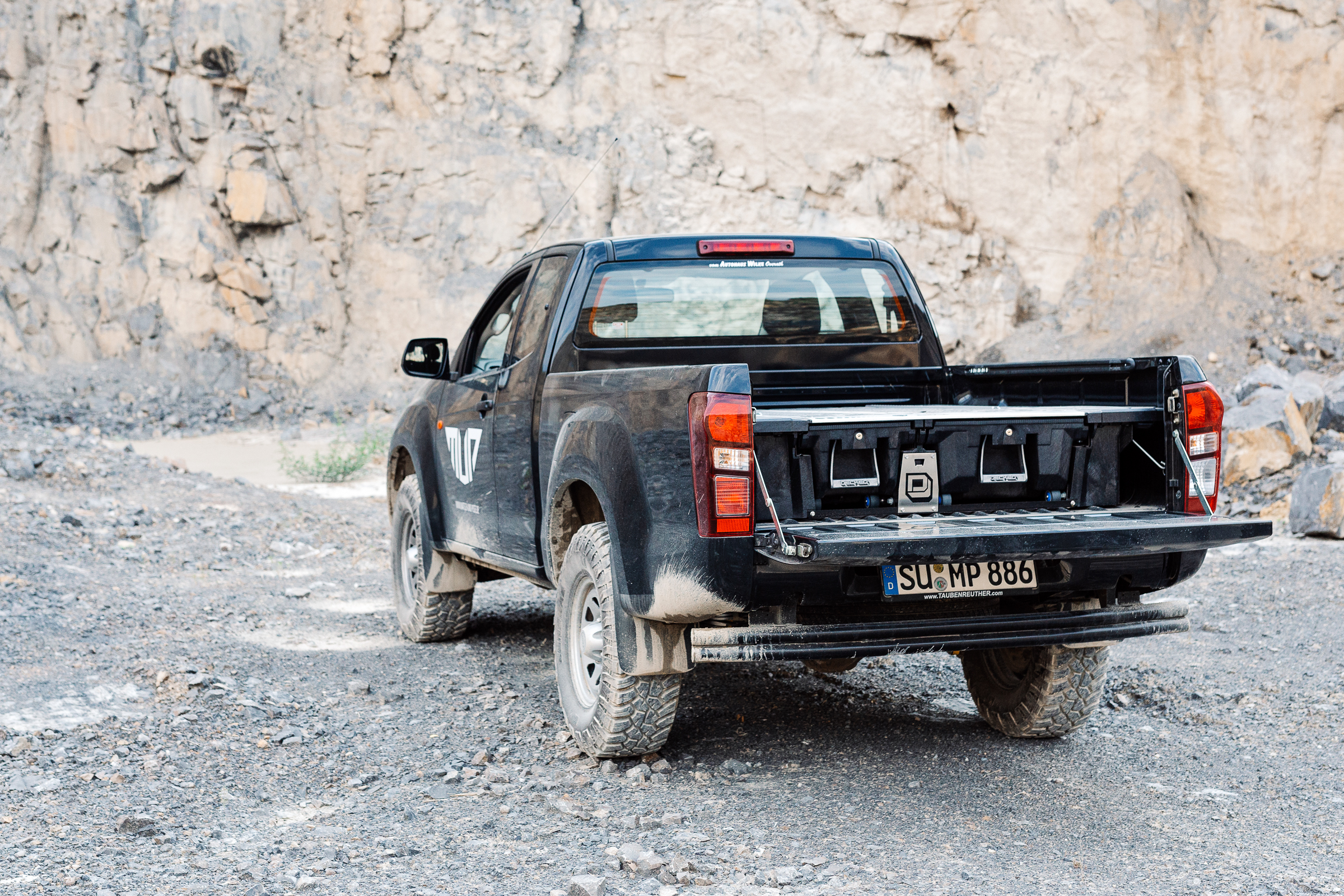
If you want to take the vehicle off-road, the question of dimensions and weight matters even more. The base vehicle must never be overstretched. Reserves are important. Here you should look closely at the suspension in particular. With big, heavy campers, many suspension setups are quickly at their limits or beyond. Take a look at our series on springs and shock absorbers for 4x4s and get individual advice from a specialist on it. Watch out for good ramp angles, the shortest possible overhangs, and make sure the vehicle’s height and width do not get out of hand. Big overhangs are often a problem, especially on double cabs. Why? Well, look at a double cab in side profile. Usually a significant part of the bed sits behind the rear axle, which can create an enormous lever when loaded. Damage becomes more likely and the handling suffers.
Let’s take a tour through the different camper concepts
The first that come to mind, of course, are the popular demountable campers. Campers that are lashed down on the bed of a pickup and, when needed, can be taken off using more or less elaborate jack systems. And there are many more ways to make a pickup ready for travel.
A special form of the demountable camper is the so-called slide-in camper for flatbeds. The name gives it away. Here the bed tub of the base vehicle disappears and is replaced by a flatbed, a flat load area. You have surely seen this on Australian off-roaders. There and in North America this design is widespread. The camper then sits on the flatbed. The whole thing takes a bit more conversion work on the vehicle, but it has its advantages too, such as the possible weight saving from doing away with the bed.
Interesting solutions among the flatbed campers
One example of such a solution is the Trayon demountable campers. These campers from Australia are available in various sizes. The camper consists of a fixed part with a tent structure that folds out on top. The version for single or extra cabs offers room for two to three people and fits onto the flat bed of many common pickups. The larger version for double cabs even has room for up to five people. As well as the fixed double bed, the seating area can be turned into another bed and a shelf into a small bed. The campers are built light from aluminium and tip the scales at around 400 kilograms. The aluminium is slotted, bonded and riveted, but not welded. The aim is for the camper to be sturdy yet still get enough flexibility for off-road use.
Fiftyten has taken a similar route. One of the two Fiftyten off-road campers is inspired by the Australian flatbed campers. The Fiftyten system has three parts: tray, cabin and tent. The so-called tray is a new load area. It replaces the pickup’s bed tub. The cabin and the pop-top roof go on top. The clever bit: when needed, you can still use the new load area as a load bed, with extra side walls and lashing points. Fiftyten also has a Truckbed Camper version in its range. More on that later. By the way, the Fiftyten cabins are also built from aluminium, but the company is currently developing materials from renewable raw materials together with two other firms. You can watch a video of the Matsch&Piste visit to Fiftyten here:
And how a flatbed camper solution can come together as a DIY build, we showed you in this vehicle feature with a DIY camper on a Ford Ranger.
Fixed builds play a special role
Off-road campers are often mounted permanently on pickups. Then the bed tub disappears too, which again saves weight. bimobil, for example, has a swap system in its range for this. The camper is set directly onto the chassis with a galvanised steel subframe. The original load bed is converted into a swap bed and can therefore be used again relatively quickly once the cabin is taken off. An optional crane helps with putting the swap bed on and taking it off. The handy thing is that even a hardtop that may be fitted, roof racks and other bed add-ons can stay in place. When you take the camper off, you can also cover the chassis with a platform of chequer-plate aluminium.
Fixed builds integrated into the vehicle body are popular, where the body of the base vehicle is essentially cut off and the cabin is fitted there. The company Custom Campers, for example, has been making such fixed builds for years. The cabins are tied firmly to the vehicle, and a pass-through into the cab is even created. Widenings and overhangs to the rear are also possible, to enlarge the living space. The builds are made from aluminium. Another example of integrated cabins are the Azalai cabins, which you can watch in this 4x4Passion video:
Campers on truck chassis and special forms
Just as popular are campers that sit on the chassis with or without a subframe and sometimes have a pass-through to the cab. This is a favourite solution on trucks especially.
Another special form, which leans more towards a camping trailer or caravan than a camper, is what is often called a fifth wheel in North America. The fifth wheel is a living semi-trailer. It usually offers enormous space inside. But the off-road ability is heavily restricted. And it takes considerable conversion work on the vehicle. Still, a semi-trailer like that certainly makes a great base camp.
In the following, we give you an overview of various versions of demountable campers for pickups that keep the standard vehicle bed.
Common versions of demountable campers
Like the whole off-road and off-road travel scene, the off-road camper market is enormously varied. There really is something here for every taste and every level of comfort and off-road ambition.
Tent campers
One of the simplest forms are tent campers, some of them inflatable. That can of course be interesting in terms of weight and already offers a fair amount of living space.
Hardtop campers
While in the days of the great Sahara trips many pickup drivers converted their beds into living space simply and well with ordinary hardtops, by now a number of companies are active in this area. Pick-Up-Back is one such company and, with its Hardtop Camper, offers a light, practical travel build for many common pickups. The Hardtop Camper, which has room for two to three people, is set directly onto the original bed. Inside you find a seating area with storage that converts easily into a bed when needed. The maker gives a weight of 150 to 200 kilograms for the empty cabin. On top come 50 to 100 kilograms for the fit-out, depending on the version. The weight advantage over conventional off-road campers is clear here. With a certain sacrifice in comfort, of course. On request, cabins with a pop-top roof and an alcove are available. We presented the Pick-Up-Back range here.
Allrad-Familie also offers interesting hardtop campers. The cabins are modular and so suit tradespeople, travellers, sports enthusiasts and much more. On offer are both finished hardtop cabins and cabins for self-build. The range starts with a simple hardtop and goes all the way to versions with an integrated roof tent.
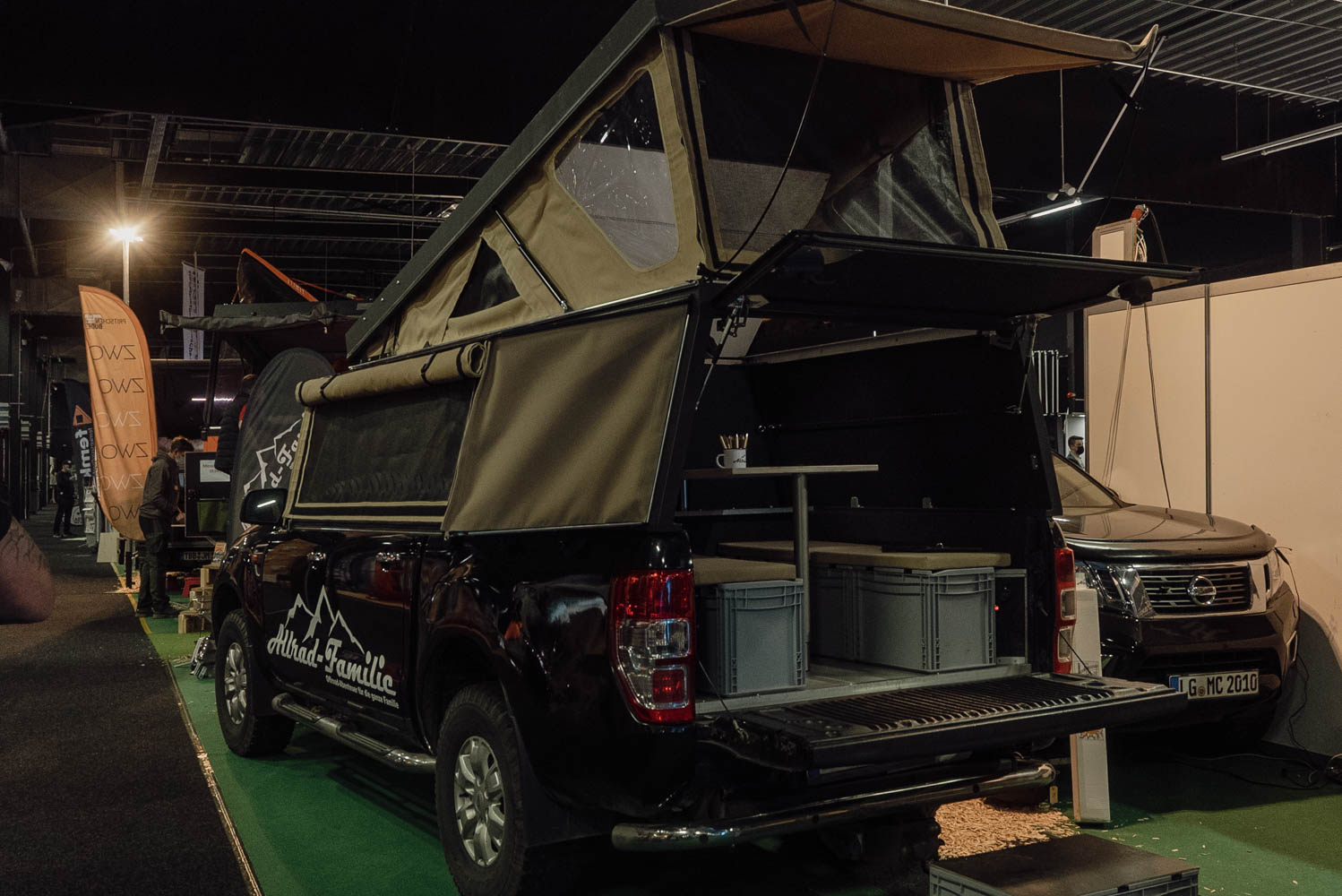
Alu-Cab follows a similar concept with the Canopy Camper, a combination of hardtop and roof tent.
Recently we also presented the DOT ALPACA from Daysontracks. This too is a kind of hardtop cabin with a folding roof. It is especially interesting because the maker gives the weight as just 170 kilograms and many different designs are possible.
Campers with a pop-top roof
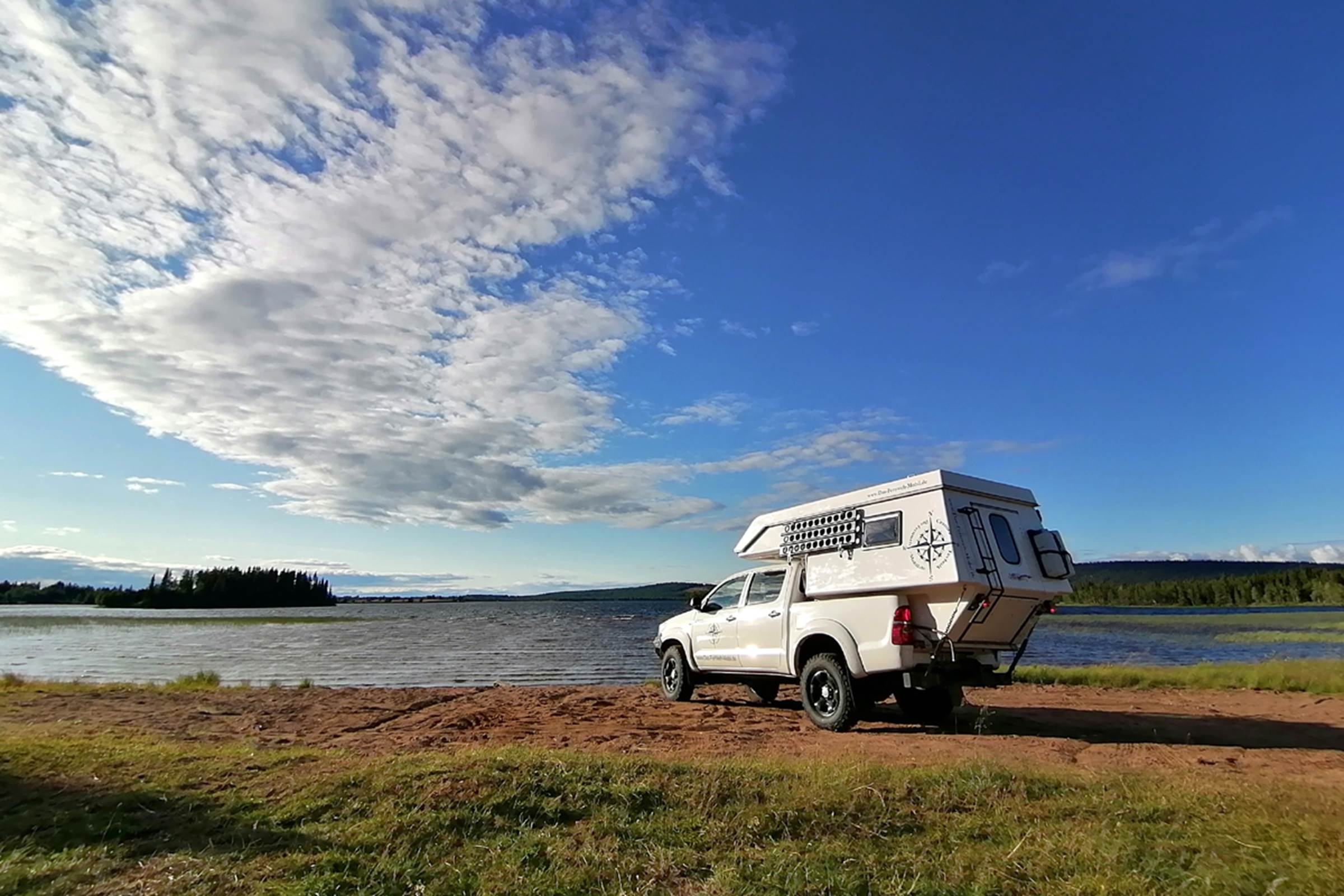
If you want a bit more space, an off-road camper with a pop-top roof might be the one for you. Cramer-Technik developed such a folding-roof camper out of its own travel experience and has been producing Das Fernweh-Mobil for many years. The development paid special attention to building a camper for the whole family that is still comparatively light and off-road capable. The tough off-road camper, made from GRP, can be used with the roof open or closed and can be put on and taken off quickly using a special trolley. It fits almost all common pickups. The folding roof keeps it under a certain height, which can be helpful on ferries or with low-hanging branches and rock overhangs off-road.
Very compact campers with a pop-top roof are available from Pritschenbude. The cabins are modular and fit many common pickups. The dimensions are kept deliberately small so that off-road use is possible. Pritschenbude also offers a modular furniture system for the interior. The “BLAEKBOXS” furniture system attaches to a rail system and can therefore be removed without tools. It fits both the Pritschenbude cabins and other interiors. That is interesting for self-builders.
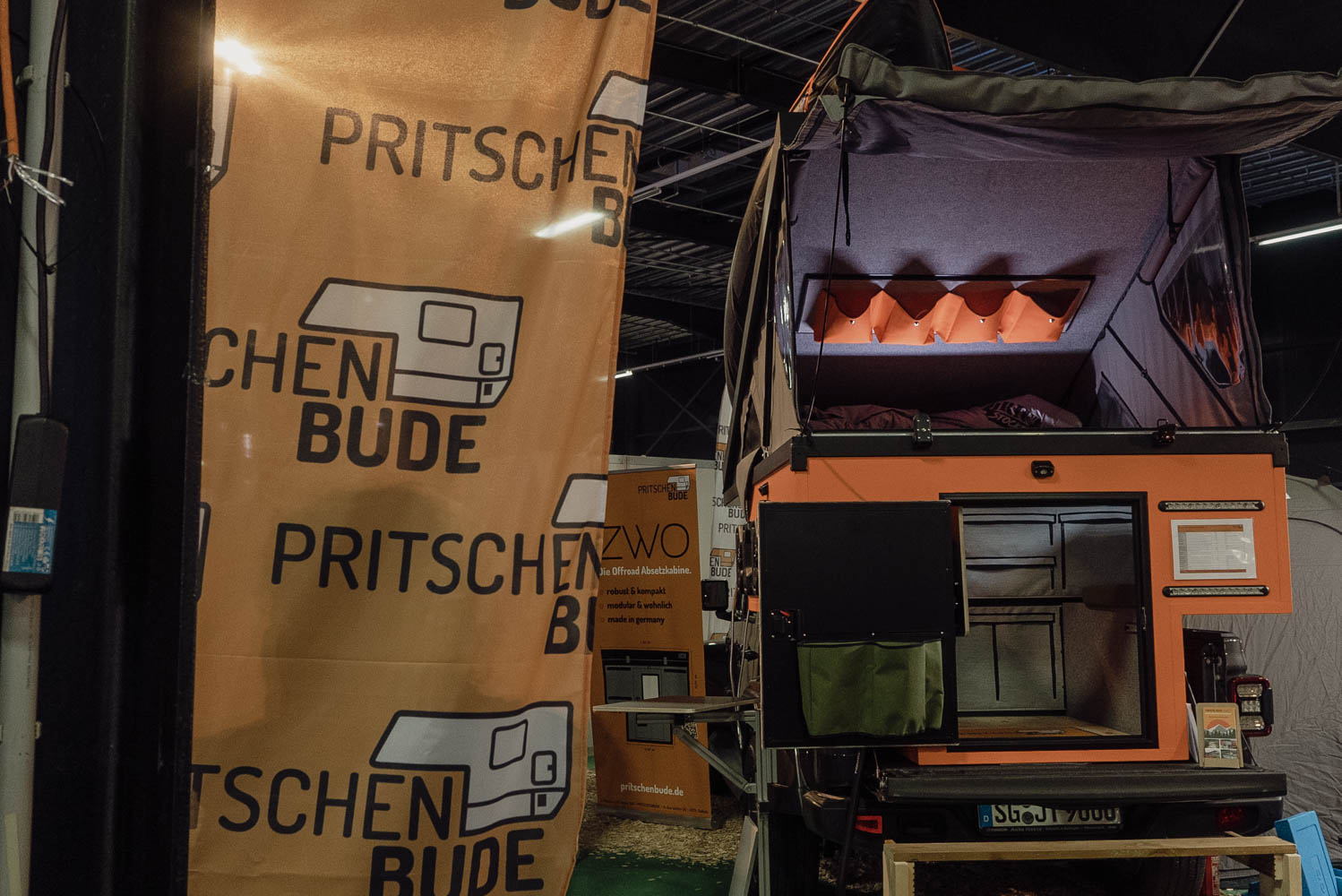
If you want to find out more about Pritschenbude, take a look at this video from 4×4 Passion:
Also interesting here is the Excab off-road camper, called the 2KB. It has a folding roof, and a straight rear end that sits flush, depending on the vehicle, with the pickup’s bed. That avoids spoiling the rear ramp angle unnecessarily and makes for good off-road ability and compact dimensions.
As mentioned, Fiftyten also has such a folding-roof cabin in its range. The Truckbed Camper is the smaller version of the Fiftyten system shown earlier. One key difference is that the original pickup bed tub is kept and the conversion to the flatbed system is not needed. We presented the Truckbed Camper here.
Parallel pop-up roof as a variant
A variant of the folding roof hinged at the front or rear is a parallel pop-up roof. The Four Wheel Campers cabins from the USA have such a pop-up roof. This keeps the dimensions compact when closed, which benefits the off-road ability and the stability, while open it offers plenty of room.
Over-cab campers
Campers with an over-cab bed offer even more space. For families especially this can be an interesting option (with some compromises in off-road ability).
The well-known Tischer over-cab campers, for example, have a large over-cab bed and come in various body sizes. In shape and build the cabins resemble a conventional motorhome, are insulated and winter-capable. If you like it even more comfortable, take a look at the big cabins that come from the North American market. So-called slide-outs add to the living space here. These are living-space extensions that slide out to the rear or the side.
DIY solutions
On top come, as always, plenty of self-builds. A complete self-build of a cabin, for example with sandwich panels, or the conversion of a container, shelter or former ambulance box. Empty cabins can help you realise your very own idea of the perfect off-road camper for you. Some makers also offer their campers as empty shells. Two examples are the Camp Crown empty cabins and the empty cabins from the company Pick-Up-Back mentioned earlier. Do you have a self-built or self-fitted off-road camper that you would like to present in our magazine sometime? Write to us, we would love that.
The matter of load and vehicle insurance
Securing demountable campers naturally matters a great deal. These off-road campers often count as load. So proper load securing is required. You are responsible for it when you are out with such a cabin. Demountable campers are usually secured with straps, chains, wire strops and matching turnbuckles. You will find more on load securing in our article series on it.
Many pickup drivers report that it can sometimes be hard to find insurance for the combination of camper and pickup. Especially whenever the base vehicle is insured as a truck. The insurer then usually sees the camper as load too, so it is of course not included in the base vehicle’s insurance. The key to motorhome insurance is often the entry in the vehicle papers. A wording like “optionally with a removable camper” can be entered there. Then the insurance should work out too. It is best to sort this out before buying and to discuss it with your insurer.
Off-road campers keep bringing new ideas and innovations
Among off-road campers there are many new ideas and innovations. Some time ago, for example, we presented the Flip90 pickup cabin from ICC Offroad. The special thing about these off-road campers is that the cabin tips through 90 degrees, multiplying the space inside.
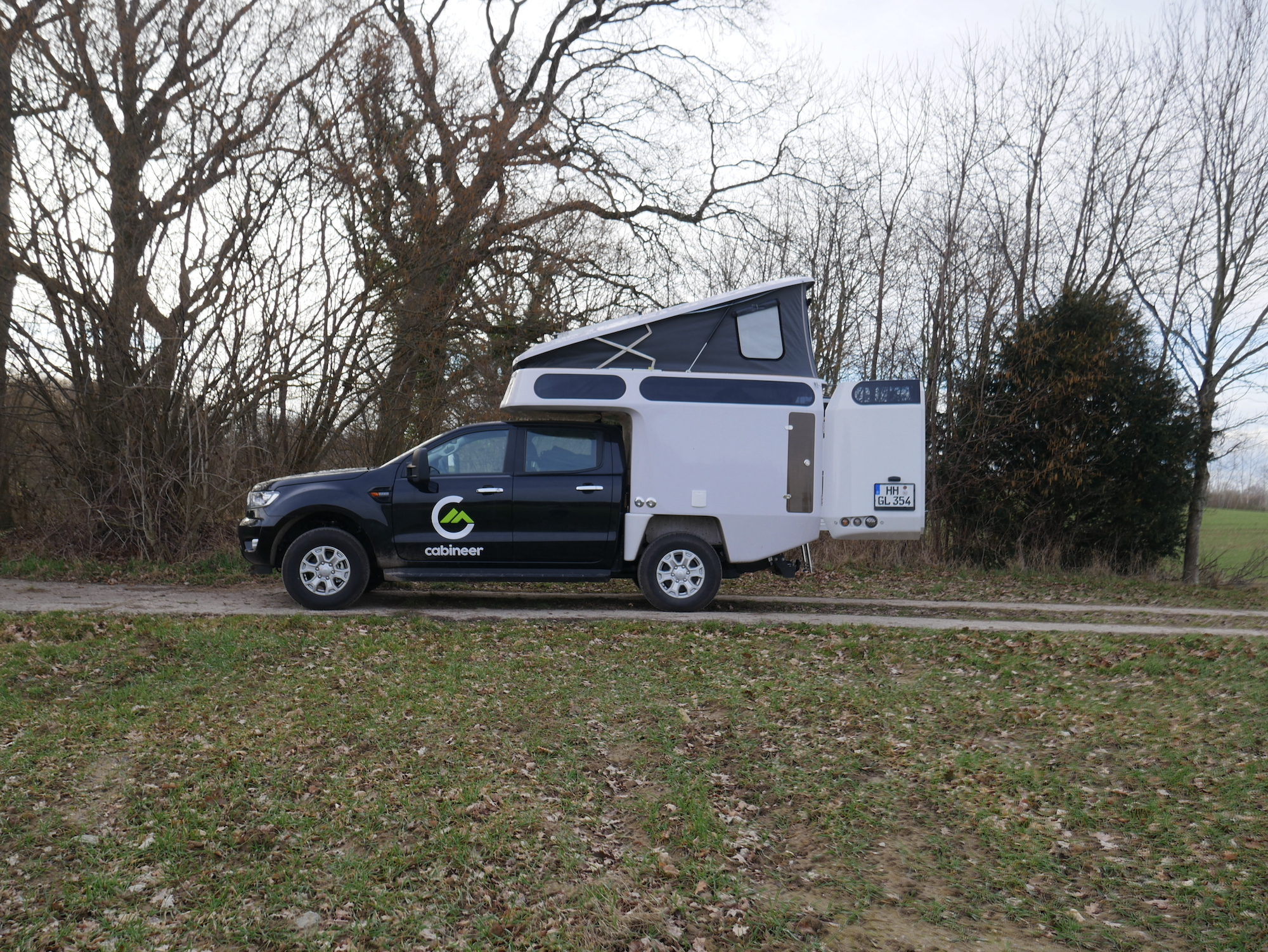
Exciting and forward-looking too is the concept of the Cabineer, a pickup cabin made from renewable raw materials. Cabineer makes a camper from a material of flax, cork and a linseed-oil-based epoxy resin. The material is said to offer excellent strength and insulation while releasing a good 80% less CO2 in production than conventional GRP cabins.
The decision process: what to look out for when buying an off-road camper
Space and sense of room
What matters is that you feel comfortable in your off-road camper. Everyone has a different sense of space and their own need for room. It is worth sitting in the cabin for a while, closing the entry door and letting the space and the sense of room sink in. Storage matters just as much here. If you have hobbies you want to pursue on the road that need equipment carried along, then the cabin should have suitable storage. Sometimes you will see campers where heavy things are also carried on the roof. That raises the centre of gravity, and the sometimes already very high overall height, even further. On tall (over-cab) cabins especially, this is often not a good idea.
Weight
Keep an eye on the vehicle’s gross weight and the maximum permitted payload. On the one hand, once the camper is fitted there still has to be room for fuel, fresh water, waste water, luggage and much more, and on the other you should not permanently max out the vehicle’s gross weight, especially if you take long trips with it and drive off-road. Experience shows that damage on the road is often down to too much load from a high vehicle weight. For good off-road and driving behaviour, payload and luggage should sit favourably for the centre of gravity. For some base vehicles, weight upratings are possible. Just as important as the entry in the papers is that the vehicle, for your particular use, is technically able to carry the increased load without harm. Carrying a high weight a few kilometres over a level road is somewhat different from being out for weeks on the tracks of this world with it.
Dimensions
We mentioned it briefly at the start. Think about compact external dimensions if the off-road ability is not to suffer too much. Be careful on off-road drives. The cabin changes the tipping point, and it is often also wider than the base vehicle up top. So watch out for branches, rock ledges and the like. On tricky sections it is often better for the passenger to get out and guide the driver. The guide has a very responsible job here, and as the driver you have to be able to rely on the guide one hundred percent. You will find tips on guiding properly here in our guide on guiding with hand signals.
Travel area and duration
A lot comes down to the travel area and the length of the trip. If you are in warm climes, a folding roof with tent fabric might be more your thing, while for winter trips a closed cabin is more like it. That often has to do with personal preference. With ventilation, make sure cross-ventilation is possible, so you can get a good through-draught. Speaking of ventilation, good mosquito nets matter, of course.
Do you prefer to be outside or inside? The demands on the layout depend on that. It is simply annoying if you are outside all day and keep having to walk through the whole vehicle just to grab something from the cool box, for example.
If the off-road camper has a folding or pop-up roof, it is a nice thing when the cabin is fully usable with the roof open and closed. In a storm, for example, or when staying overnight at the roadside in town.
On long trips especially, it makes sense to consider how easily your gear can be repaired, including the camper. Special constructions are often harder to repair than standard connections.
Use
Do you want to use the off-road cabin often just at the weekend or for short trips and drive the pickup day to day? Then pay particular attention to the loading and unloading being straightforward and quick. Try it out.
Is towing a trailer possible with the off-road camper mounted? If you tow a trailer with your pickup, it can be worth being able to do so with the cabin mounted. With long overhangs this is often not possible. Please remember that the nose weight reduces the vehicle’s possible payload. More on handling a trailer safely in our article on it.
Room for personalisation
Finally, there should be room for your personalisations and your ideas. Does the maker offer different toilets, which cool boxes are possible, where can you fit add-ons and accessories: these are questions you should ask yourself.
The verdict on off-road campers
The market is enormously varied and has plenty of convincing concepts to offer. We have presented a few examples here.
There is no single recommendation here, because you have to be happy with your choice. Look closely at many different off-road campers before you decide. A test drive with the cabin is of course part of the decision process too. Roger Nies of Wohnkabinen Online raised many important points in our interview with him as well. You can read the interview here.
What experiences have you had with your campers, or why did you choose a particular concept?